 Magic Heidi
 Deine MWST-Abrechnung, schon vorbereitet
Magic Heidi rechnet bei jeder Rechnung und jedem Beleg mit, effektiv oder mit Saldosteuersatz. Am Quartalsende steht die Zahl fürs ESTV-ePortal schon da.
Schluss mit dem MWST-Wochenende
Rechnungen aus dem Mailordner zusammensuchen, Belege nachtippen, Vorsteuer in Excel ausrechnen und hoffen, dass die Zahl im ESTV-Portal stimmt.
Belege suchen
Im Schuhkarton, im Postfach, im HandyExcel-Formeln prüfen
Eine falsche Zelle, eine falsche AbrechnungVorsteuer vergessen
Jeder fehlende Beleg kostet dich GeldMWST-Abrechnung in drei Schritten
Beispiel Q3: CHF 1'992.60 MWST auf dem Umsatz, minus CHF 412.35 Vorsteuer. Zu bezahlen: CHF 1'580.25. Diese Zahl steht bei dir schon da.
Einmal einrichten
MWST-Nummer eintragen, Methode wählen: effektiv oder Saldosteuersatz, MWST additiv oder inklusive. Zwei Minuten, dann nie wieder.
Heidi rechnet mit
Den MWST-Satz wählst du pro Position. Belege liest die KI samt MWST-Satz, die Vorsteuer ist sofort erfasst.
Periode abrechnen
Quartal wählen (beim Saldosteuersatz zählst du zwei Quartale zusammen), vereinbart oder vereinnahmt. Du siehst Umsatz, MWST, Vorsteuer und den Betrag fürs ESTV-ePortal, dazu den Excel-Export.
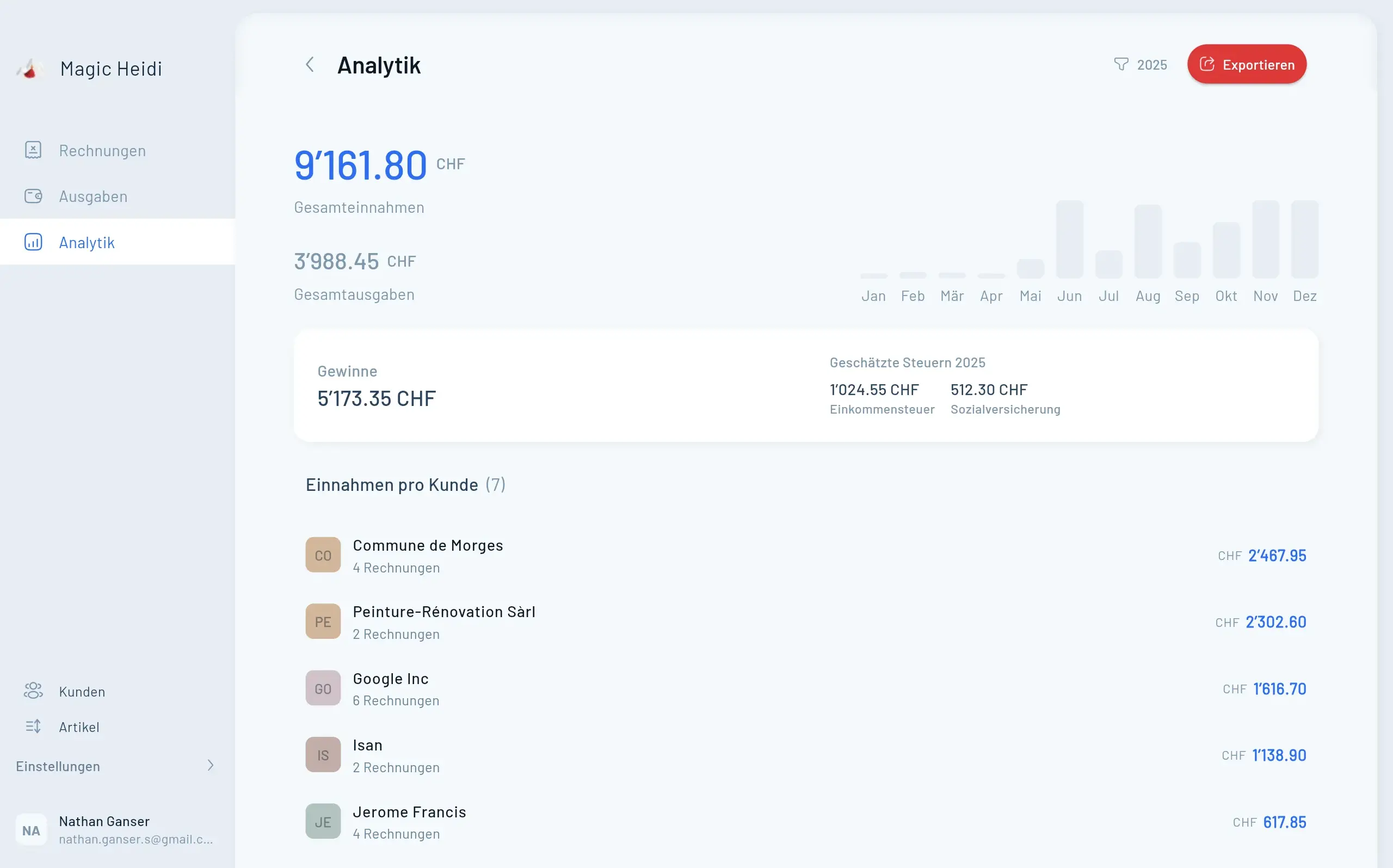
Gebaut für die Schweizer MWST
Keine Buchungssätze, kein Kontenplan. Nur die MWST-Funktionen, die Selbständige wirklich brauchen.
Alle MWST-Sätze
8.1 %, 2.6 % und 3.8 %, auch gemischt auf einer Rechnung.
Saldosteuersatz
Deinen ESTV-Satz hinterlegen, Heidi rechnet die Steuerschuld aus.
Vorsteuer per KI
Beleg fotografieren, die KI erkennt Betrag und MWST-Satz.
Auslandskunden
Rechnungen ohne Schweizer MWST, in CHF, EUR, USD und weiteren Währungen.
Treuhänder-Zugang
Zugang mit einem Klick oder Excel-Export für deinen Treuhänder.
Effektive Methode oder Saldosteuersatz?
Magic Heidi kann beides. Welche Methode für dich günstiger ist, hängt vor allem von deinen Ausgaben ab. Den Saldosteuersatz beantragst du bei der ESTV, alle Regeln erklärt der MWST-Leitfaden.
Effektive Methode
Du zahlst die MWST auf dem Umsatz minus Vorsteuer und rechnest quartalsweise ab. Passt, wenn du viel einkaufst oder investierst. Magic Heidi holt die Vorsteuer aus deinen Belegen.
Saldosteuersatz
Du zahlst Bruttoumsatz × deinen Saldosteuersatz, die Vorsteuer ist pauschal drin, und rechnest halbjährlich ab. Passt bei wenig Ausgaben, z. B. in Beratung oder Design. Magic Heidi rechnet die Steuerschuld automatisch.
MWST-Software im Vergleich
Preise pro Monat im Jahresabo, Stand September 2026 gemäss öffentlichen Preislisten: bexio Advanced, Banana Advanced (CHF 179 pro Jahr). bexio und KLARA exkl. MWST, Banana ohne MWST-Angabe, Magic Heidi inkl. MWST. Mehr im bexio-Vergleich und KLARA-Vergleich.
| Funktion | Magic Heidi | bexio | KLARA | Banana |
|---|---|---|---|---|
| Preis pro Monat | CHF 24.99 | CHF 42 | ab CHF 55 | CHF 15 |
| Effektiv & Saldosteuersatz | ✓ | ✓ | ✓ | ✓ in Advanced |
| Gratis testen | ✓ 3 Rechnungen & 3 Belege, ohne Zeitlimit | ⚠ 30 Tage Test | ⚠ 30 Tage Test | ✓ Gratis bis 70 Buchungen |
| Ohne Buchhaltungswissen | ✓ Einnahmen-Ausgaben-Rechnung | ⚠ Doppelte Buchhaltung | ⚠ Doppelte Buchhaltung | ✗ Kontenplan nötig |
| Gebaut für | ✓ Selbständige & Einzelfirmen | KMU mit Team | KMU, lokale Betriebe | KMU, NGOs, Vereine |
Die MWST, endlich einfach
4.8 von 5 aus über 200 öffentlichen Bewertungen.
“Top, wenn du in der Schweiz bist, ich empfehle dir diese Plattform. Alles ist einfach, und du hast Zugriff auf deine kompletten Statistiken und sogar auf die Zahlen, die du bei der MWST abziehen musst.”
“Das ist die erste Buchhaltungssoftware, die ich als Selbständiger nutze. … Rechnungen, Ausgaben und MWST, alles mit einem Klick exportierbar. Ich bin sehr froh, endlich eine saubere, einfache Plattform zu einem guten Preis gefunden zu haben.”
“Habe bis jetzt immer alles mit Excel und Ablageordnern gemacht und extrem viel Zeit dafür verwendet. Dann bin ich auf Magic Heidi gestossen und muss sagen, dass dies ein Musthave ist, für alle, die selbständig sind.”
“Seit wir Magic Heidi für unser Unternehmen in Genf nutzen, ist die Rechnungsstellung ein Kinderspiel. Die Oberfläche ist klar, intuitiv und perfekt an die Schweizer Anforderungen angepasst (MWST, Währungen, Adressen usw.).”
“Das Programm ist übersichtlich, einfach zu bedienen und macht das Erfassen von Rechnungen und Ausgaben deutlich unkomplizierter. Besonders praktisch finde ich, dass alles sauber strukturiert ist und man schnell den Überblick behält.”
“Als neue Selbstständige hat mir Magic Heidi den Start extrem erleichtert. Die Buchhaltung ist jetzt so viel unkomplizierter und ich verliere keine Zeit mehr mit unnötigem Stress.”
Fragen zur MWST-Abrechnung
Unterstützt Magic Heidi den Saldosteuersatz?
Ja. Du trägst in den Einstellungen den Saldosteuersatz ein, den dir die ESTV bewilligt hat, und Magic Heidi rechnet die geschuldete MWST daraus. Deinen Kunden stellst du weiterhin die normalen 8.1 % in Rechnung. Hast du zwei Saldosteuersätze, geht das mit einem kleinen Workaround.
Reicht Magic Heidi die MWST-Abrechnung direkt bei der ESTV ein?
Nein, die Einreichung machst du selbst im ESTV-ePortal. Magic Heidi zeigt dir für die gewählte Periode Umsatz, MWST, Vorsteuer und den geschuldeten Betrag, du überträgst die Zahlen in wenigen Minuten. So weisst du immer genau, was du einreichst.
Bis wann muss ich die MWST-Abrechnung einreichen?
Innert 60 Tagen nach Ende der Abrechnungsperiode, also nach dem Quartal (effektive Methode) oder dem Halbjahr (Saldosteuersatz). Im selben Zeitraum musst du die MWST auch bezahlen. In Magic Heidi siehst du die Zahlen laufend und musst nicht bis zum Quartalsende warten. Alle Fristen stehen im MWST-Leitfaden.
Kann ich nach vereinbartem oder vereinnahmtem Entgelt abrechnen?
Beides geht. In der MWST-Abrechnung wählst du, ob die MWST nach Rechnungsdatum (vereinbart) oder nach Zahlungseingang (vereinnahmt) zählt. Nimm die Variante, mit der du bei der ESTV angemeldet bist.
Kann ich die Methode später wechseln?
In Magic Heidi ja, du stellst die Methode in den Einstellungen um. Bei der ESTV gelten aber Mindestfristen, bevor du wechseln darfst, und der Wechsel braucht eine Mitteilung an sie. Die aktuellen Regeln erklärt der MWST-Leitfaden.
Wie rechne ich Kunden im Ausland ab?
Dienstleistungen an Firmen im Ausland stellst du meist ohne Schweizer MWST in Rechnung. In Magic Heidi stellst du die Rechnung auf «keine MWST» und ergänzt einen Hinweis wie «Reverse Charge». Den Umsatz meldest du trotzdem in der Abrechnung, unter Ziffer 221 (Leistungen im Ausland). Im Zweifel frag deinen Treuhänder.
Wie kommt die Vorsteuer aus meinen Belegen in die Abrechnung?
Fotografier den Beleg oder lade das PDF hoch. Die KI liest Händler, Datum, Betrag und MWST-Satz und berechnet die Vorsteuer. Sie fliesst direkt in deine MWST-Abrechnung, im Pro-Abo mit unbegrenztem KI-Belegscan (Fair Use).
Ich bin noch nicht MWST-pflichtig. Ist Magic Heidi trotzdem etwas für mich?
Ja, die meisten starten ohne MWST. Unter CHF 100'000 Jahresumsatz bist du von der MWST-Pflicht befreit, und Magic Heidi erstellt Rechnungen ohne MWST. Sobald du die Schwelle erreichst oder dich freiwillig anmeldest, trägst du deine MWST-Nummer ein und alle MWST-Funktionen sind aktiv. Wann du dich anmelden musst, erklärt der MWST-Leitfaden.
Was kostet Magic Heidi?
Du startest gratis mit 3 Rechnungen und 3 Belegen insgesamt, ohne Kreditkarte und mit allen MWST-Funktionen. Danach kostet Pro CHF 24.99 pro Monat im Jahresabo (CHF 299 pro Jahr) oder CHF 39 monatlich, inkl. MWST. Auf jedes bezahlte Abo gibt es 30 Tage Geld-zurück. Alle Details auf der Seite Preise.
Wo werden meine Daten gespeichert?
Deine Rechnungen, Belege und MWST-Daten liegen verschlüsselt auf Servern in Zürich. Einzelne Funktionen wie der KI-Belegscan nutzen spezialisierte Dienste, die Daten teilweise ausserhalb der Schweiz verarbeiten. Mehr dazu auf der Seite Sicherheit. Und du kannst jederzeit alle Daten exportieren, du bist nie eingesperrt.
Die nächste MWST-Abrechnung ohne Wochenende
Gratis starten mit 3 Rechnungen und 3 Belegen, ohne Kreditkarte. MWST-Nummer eintragen, und Heidi rechnet ab heute mit.