Efficient Work for Freelancers: Your Complete Guide to Swiss Freelance Success

Master freelance efficiency in Switzerland with proven time management techniques, Swiss-compliant invoicing tools, and burnout prevention strategies for sustainable productivity.

Swiss freelancer working efficiently

Being a freelancer in Switzerland is a double-edged sword. You get the independence and flexibility, but you're also the CEO, accountant, project manager, and lead creative all at once. Over 25% of Switzerland's workforce now consists of solopreneurs and freelancers—and the ones who thrive aren't necessarily the most talented. They're the most efficient.

Here's the reality: every hour you spend wrestling with invoices, chasing receipts, or figuring out VAT rates is an hour you're not earning money or doing the work you actually love. In Switzerland, where tax regulations are strict and clients expect Swiss precision, efficiency isn't optional—it's your competitive advantage.

The Swiss Freelance Reality Check

Switzerland offers an exceptional environment for freelancers—low unemployment at 3.2%, favorable tax burden at 36.7%, and a growing community aiming to connect 5,000 freelancers by 2026. But Swiss freelancing comes with unique challenges that demand efficiency.

The Swiss Advantage

High trust in quality, multilingual markets, strong work-life balance culture, excellent infrastructure
⚠️

The Compliance Reality

Strict regulations, mandatory VAT registration at CHF 100K, Swiss precision expected in everything
🎯

The Efficiency Imperative

Navigate requirements without getting bogged down in administrative quicksand
Core Principle

Efficiency vs. Effectiveness: Why Both Matter

Effectiveness is doing the right things. Efficiency is doing them the right way. Swiss freelancers need both to thrive without burning out.

Systemize the Routine. Focus on the Remarkable.

The solution to sustainable freelance success in Switzerland.

Swiss-Compliant Tools

Digital Tools That Actually Save Swiss Freelancers Time

The right digital tools don't just make tasks easier—they eliminate entire categories of work. For Swiss freelancers, purpose-built solutions handle your specific requirements automatically.

  • 🧾
    Automatic Swiss QR Invoicing

    Since October 2022, all invoices must contain a QR code. Since November 2025, structured addresses are mandatory. Magic Heidi handles this automatically.

  • 💰
    VAT Compliance Built-In

    The system knows Swiss VAT rates and automatically applies them based on your registration status—no more second-guessing.

  • 📱
    Multi-Device Sync

    Create an invoice on your iPhone while meeting a client in Zurich, then review it on your Mac at your coworking space.

  • 🤖
    AI-Powered Expense Scanning

    Take a photo of a receipt, and AI extracts and categorizes the information. Saves most freelancers 2-3 hours monthly.

Invoices
  • Invoice #3

    Magic Heidi

    CHF 500

    Jan 29

  • Invoice #2

    Webbiger LTD

    CHF 2000

    Jan 24

  • Invoice #1

    John Doe

    CHF 600

    Jan 20

Swiss Invoicing Requirements Mastered

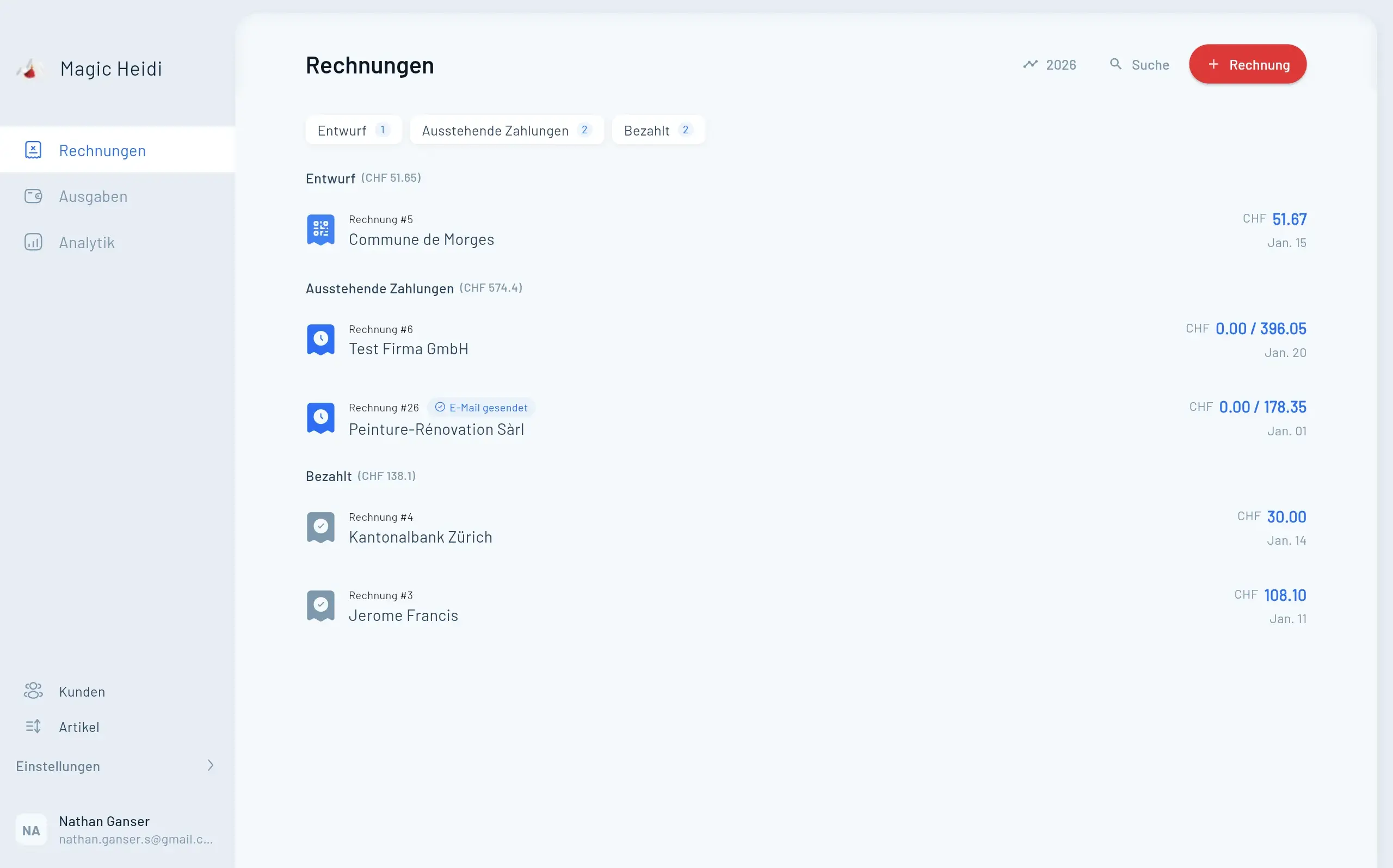
For Swiss freelancers, invoicing isn't just about getting paid—it's a legal compliance requirement with specific rules. Get it right automatically with purpose-built tools.

Magic Heidi Swiss-compliant invoice list

2026 Swiss Invoicing Essentials

VAT registration threshold: If your annual turnover exceeds CHF 100,000 (or CHF 1 to a Swiss customer from global sales of CHF 100,000), you must register with the Federal Tax Administration (AFC).

QR-bill requirements: All invoices must include a Swiss QR code for payment processing. Since November 2025, structured addresses (with proper formatting) are mandatory in the QR code data.

Mandatory invoice information:

  • Your business name and address
  • Client details
  • Invoice date and number
  • Service description
  • Amount and currency
  • VAT rate and amount (if applicable)
  • Swiss QR code with payment information

Professional appearance matters: In Switzerland's trust-based market, a professional invoice signals reliability. Include your logo, use consistent branding, and ensure perfect German/French/Italian translation if working cross-linguistically.

Pro tip: Send invoices immediately after completing work. Swiss clients expect prompt billing, and faster invoicing means faster payment. With Magic Heidi, you can invoice from your phone while still at the client's office.

Managing Swiss VAT & Taxes
Without the Headache

Swiss tax regulations add complexity that freelancers can't ignore. VAT isn't just about collecting it—you need to track it correctly, file quarterly or annual returns, and potentially reclaim VAT on business expenses.

🇨🇭 Swiss-Specific
Automated
📱 Real-Time
Compliant
💰
CHF 100K Threshold

Annual turnover requiring VAT registration with Federal Tax Administration

📊
Automatic Calculation

Magic Heidi calculates and tracks VAT on every invoice and expense automatically

📋
Report Generation

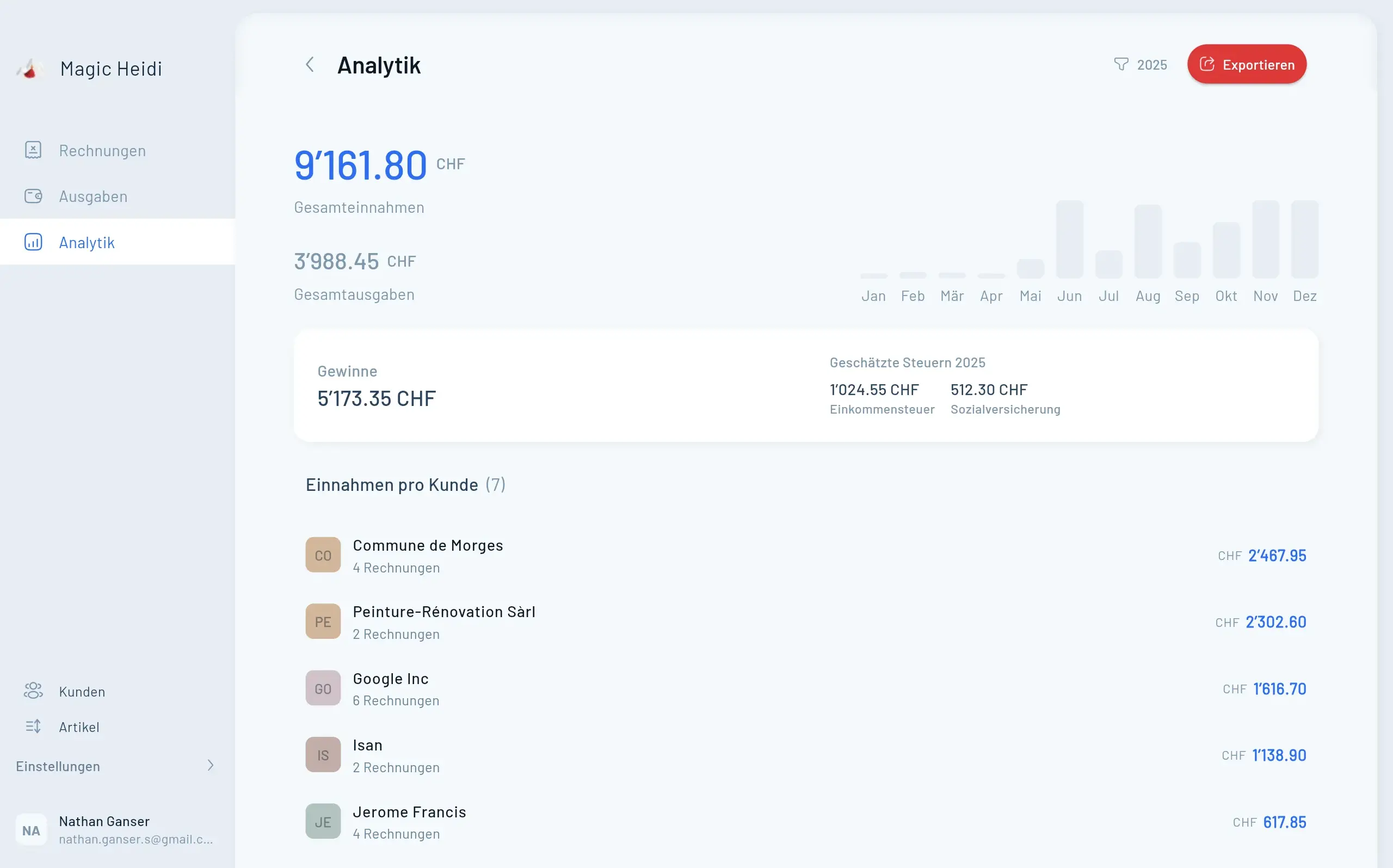
Generate reports for your accountant or tax filing in minutes, not hours

💼
Tax Savings Strategy

Stash away 30-40% of each payment for federal, cantonal, and communal taxes plus AHV/IV

AI-Powered

Simplifying Expense Tracking for Tax Season

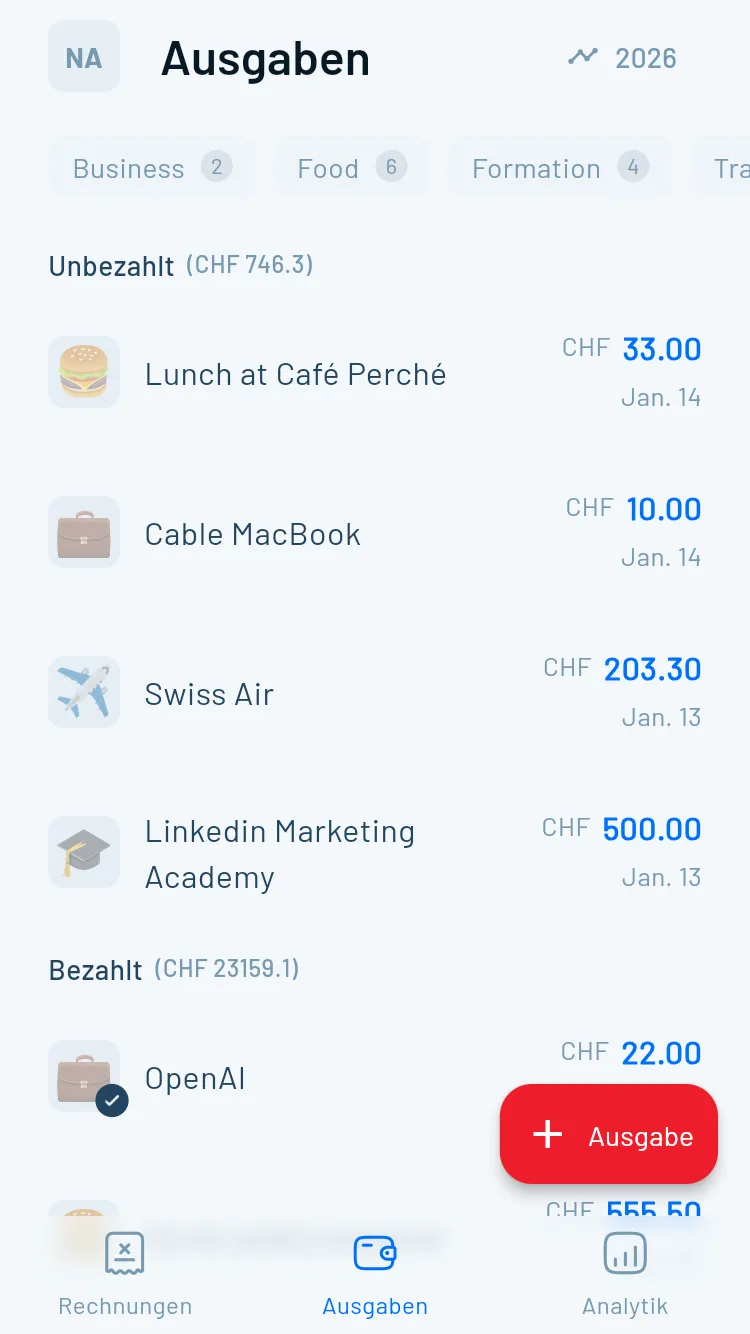
The shoebox full of crumpled receipts kills freelance efficiency. Swiss tax authorities are strict about documentation. Magic Heidi's AI scans receipts and automatically extracts vendor, amount, date, and category—saving 2-3 hours monthly.

Magic Heidi AI expense scanning on mobile

The Smart Expense System

Capture immediately: Don't wait to record expenses. The moment you buy something business-related, photograph it.

Categorize consistently: Use the same expense categories throughout the year (office supplies, marketing, travel, etc.).

Track everything: Even small purchases add up. That CHF 5 coffee during a client meeting? Deductible.

Save receipts digitally: Paper fades, gets lost, or destroyed. Digital copies last forever.

Magic Heidi's expense tracking uses AI to scan receipts and automatically extract relevant information. You snap a photo, and the app identifies the vendor, amount, date, and category. Everything syncs across your iPhone, Mac, or web browser.

This single feature saves freelancers an average of 2-3 hours monthly. Over a year, that's 24-36 hours—nearly a full work week—back in your schedule.

Time Management

Strategies That Actually Work

Time management isn't about doing more—it's about protecting time for high-value work. Freelancers juggle multiple roles simultaneously. Without structure, you end up reactive instead of proactive.

The Pomodoro Technique

Focused Sprints for Deep Work

Developed in the 1980s, the Pomodoro Technique structures work into 25-minute focused periods followed by 5-minute breaks. A 2025 meta-analysis found that time-structured Pomodoro interventions consistently improved focus, reduced mental fatigue, and enhanced sustained task performance.

  • Choose a single task and set timer for 25 minutes
  • Work with complete focus (no email, phone, or distractions)
  • Take a 5-minute break after each session
  • After 4 'Pomodoros,' take a longer 15-30 minute break
  • Best for: Detail-oriented work like design, coding, writing, financial tasks
Focused Work Session
Time Blocking

Strategic Daily Scheduling

Time blocking involves assigning specific time blocks to different task categories. Protect these blocks as you would client meetings. Don't let urgent tasks invade strategic time.

  • 8:00-12:00: Client project work (highest value, highest energy)
  • 12:00-13:00: Lunch and movement break
  • 13:00-14:30: Administrative tasks (invoicing, emails, expenses)
  • 14:30-17:00: Client meetings or secondary project work
  • Best for: Freelancers managing multiple clients needing balanced attention
Strategic Time Planning
Day Theming

Weekly Structure & Focus

Day theming assigns entire days to specific clients or project types, reducing context switching and allowing deep immersion in each client's work.

  • Monday: Client A projects
  • Tuesday: Client B projects
  • Wednesday: Marketing and business development
  • Thursday: Client C projects
  • Friday: Admin, planning, learning
  • Best for: Freelancers with 3-5 ongoing retainer clients
Weekly Planning Structure

Pro Tip: Combine Methods

Use day theming for weekly structure, time blocking for daily planning, and Pomodoro for focused execution during your client work blocks.

Time Management

Which Method for What?

Choose the time management approach that fits your work style and client structure.

MethodBest ForEnergy LevelContext Switching
PomodoroFocused tasks, fighting procrastinationWorks with anyLow (single task focus)
Time BlockingBalanced daily scheduleRequires planningMedium (scheduled switches)
Day ThemingMultiple ongoing clientsHigh consistencyLow (daily focus)
Productivity Hub

Coworking Spaces: Your Community Hub

Working from home offers flexibility, but isolation and distractions can destroy productivity. A Stanford study found that isolated workers have 40% lower dopamine baseline levels. Coworking spaces solve multiple problems at once.

Coworking space environment

The Coworking Advantage

Separation of work and home: Creates psychological boundaries that improve focus and prevent burnout.

Reduced distractions: No household chores calling your name during work hours.

Community and networking: Meet other freelancers, potential clients, and collaborators.

Professional meeting space: Host clients in a professional environment.

Structured routine: Leaving for "work" creates mental commitment and productivity.

Switzerland's coworking boom: The number of coworking spaces increased by 32% between 2019 and 2021, with over 400 spaces available—nearly triple the 50 spaces in 2014.

AI-powered space management: AI chatbots handle routine inquiries, analyze member data for personalized services, and optimize space utilization.

Hyper-local focus: Neighborhood-based coworking emphasizing local connections, partnerships, and community initiatives.

City-by-City Guide

Zurich: Westhive (multiple locations), Citizen Space (near HB), Trust Square (blockchain focus). Typical pricing: CHF 350-500/month for fixed desk.

Basel: RHIZOM (creative community), Birdhaus (startup-focused). Typical pricing: CHF 300-450/month.

Lausanne: Gotham Lausanne. Typical pricing: CHF 350-480/month.

Geneva, Bern, Lucerne, Zug: All have established coworking communities with similar pricing ranges (CHF 300-600/month depending on location and amenities).

Cost-benefit analysis: If coworking costs CHF 400/month but increases your productivity by just 5%, that's easily worth it for most freelancers. The networking opportunities alone often lead to new clients that far exceed the membership fee.

Smart Accounting Through
Collaboration

Even with excellent tools, many Swiss freelancers benefit from professional accounting support—especially when navigating cantonal tax differences and complex deductions. Digital fiduciary services are growing in Switzerland, making accountant collaboration seamless.

Efficient
💰 Cost-Saving
🔗 Collaborative
Compliant
📊
Export Reports

Generate comprehensive financial reports with one click

👥
Easy Sharing

Export your organized data to share with your accountant in one click

📋
Pre-Categorized

Everything categorized automatically, reducing accountant time and fees

🇨🇭
Swiss Compliance

Your accountant receives data in formats they're familiar with

When to Hire an Accountant

Hire an accountant when:

  • You've exceeded CHF 100,000 turnover and need VAT guidance
  • You have complex income streams (multiple countries, different service types)
  • You're not confident understanding cantonal tax regulations
  • Your time is worth more than accounting fees
  • You want to optimize tax deductions

What to DIY:

  • Daily expense tracking (Magic Heidi makes this effortless)
  • Invoice generation and sending
  • Basic financial monitoring
  • Receipt organization

The sweet spot is handling daily financial tasks yourself with efficient tools, then consulting an accountant for strategic tax planning and annual filings.

Learn more about collaborating effectively with your accountant using digital tools.

Mental Health

Avoiding Freelancer Burnout

The Hidden Productivity Killer

Here's the uncomfortable truth: Swiss freelancers can be incredibly efficient and still burn out. In fact, efficiency without boundaries often accelerates burnout.

The burnout epidemic: According to Mental Health UK's 2024 Burnout Report, 91% of workers reported "extreme stress" compared to 46% in 2021. The IPSE study found two in five freelancers report high stress levels.

Warning Signs of Approaching Burnout

Recognize these symptoms early to take corrective action before reaching complete exhaustion.

😴

Chronic Fatigue

Exhaustion that sleep doesn't fix, persistent low energy
😤

Cynicism

Growing cynicism about clients or your work quality
📉

Reduced Productivity

Lower output despite working more hours than before
🤕

Physical Symptoms

Headaches, stomach issues, muscle tension, sleep problems
🚪

Withdrawal

Pulling away from friends, activities, and social connections
🔒

Feeling Trapped

Hopelessness about your business and future prospects
Sustainable Freelancing

The 70-30 Rule

Fill 70% of your schedule with paid freelance work. Leave 30% open for side projects, hobbies, networking, learning, and rest.

This buffer prevents overcommitment and creates space for opportunities. It also ensures you're not running at 100% capacity constantly—which is unsustainable for anyone.

Practical Burnout Prevention Strategies

Set hard work hours: Define start/end times and protect them religiously. Prevents endless working and creates boundaries.

Take real breaks: Daily walks, weekly day off, annual vacation. Allows nervous system recovery and prevents accumulated stress.

Automate admin: Use Magic Heidi for invoicing, expenses, VAT. Reduces cognitive load and frees mental energy.

Financial buffer: Save 3-6 months expenses in emergency fund. Reduces income anxiety and creates safety net.

Delegate or outsource: Hire for tasks below your hourly rate. Frees time for high-value work you're uniquely qualified for.

Regular exercise: 30 minutes daily movement. Regulates stress hormones and improves mental clarity.

Connection: Join Swiss Freelancers network, use coworking spaces. Reduces isolation and builds support system.

Learn to say no: Turn down projects that don't fit. Protects capacity and maintains healthy boundaries.

The Vacation Rule

To thoroughly recharge, disconnect from work completely during vacations. Turn off work email notifications. Set up an auto-responder. Trust that your business will survive a week without you—it will.

Financial Stress Management

Since income volatility is a primary freelance stressor, create predictability where possible:

  • Build a 3-6 month emergency fund
  • Diversify your client base (don't rely on one client for >40% of income)
  • Consider retainer agreements for steady monthly income
  • Track expenses meticulously so you know your true monthly needs
  • Price services to include buffer for slow months

Remember: Sustainable productivity beats sprint-and-crash cycles. Your long-term success depends on staying healthy, creative, and engaged with your work.

Start Working More Efficiently Today

Efficient freelancing in Switzerland isn't about working harder—it's about eliminating friction between you and your best work. The freelancers who thrive automate routine tasks, maintain compliance without stress, protect their energy, and focus on high-value work only they can do.

Your Next Steps

1. Audit your time: Track how you spend one full week. Identify where time leaks are happening.

2. Choose one time management method: Start with time blocking if you're unsure. Implement it for two weeks.

3. Automate your invoicing: Try Magic Heidi free and experience Swiss-compliant invoicing that takes 60 seconds instead of 30 minutes.

4. Set up expense tracking: Stop losing receipts. Start capturing expenses digitally immediately.

5. Implement one burnout prevention strategy: Whether it's the 70-30 rule, setting hard work hours, or joining a coworking space, choose one and commit.

6. Review quarterly: Every three months, assess what's working and what needs adjustment.

Remember: in Switzerland's competitive freelance market, the differentiator isn't just talent—it's how efficiently you can deliver that talent while maintaining the work-life balance that makes freelancing worthwhile.

Efficient work isn't about doing more. It's about doing what matters, doing it well, and having energy left for life outside of work.

FAQ

Frequently Asked Questions

When do I need to register for VAT in Switzerland as a freelancer?

You must register for VAT once your annual turnover exceeds CHF 100,000 (or if you make even CHF 1 to a Swiss customer from CHF 100,000 in global sales). You need to inform the Federal Tax Administration (AFC) when you cross this threshold. Registration is optional if you're below the threshold, but some freelancers choose voluntary registration to reclaim VAT on business expenses.

What information must be included on Swiss invoices?

Swiss invoices must include: your business name and address, client details, invoice date and unique number, detailed service description, amount in CHF, VAT rate and amount (if registered), and a Swiss QR code with payment information. Since November 2025, structured addresses are mandatory in the QR code data.

How can I prevent freelancer burnout while staying productive?

Follow the 70-30 rule: fill only 70% of your capacity with paid work, leaving 30% for rest, learning, and opportunities. Set firm work hours, take real vacations with complete disconnection, build a 3-6 month financial buffer, automate administrative tasks, and maintain social connections through coworking or freelancer networks. Burnout prevention is productivity strategy—exhausted freelancers can't do their best work.

Which time management method is best for freelancers?

It depends on your work style. The Pomodoro Technique (25-minute focused sprints) works best for fighting procrastination on detail-oriented tasks. Time blocking suits freelancers balancing multiple responsibilities who need daily structure. Day theming is ideal for those managing 3-5 retainer clients who benefit from dedicating full days to specific accounts. Many freelancers combine methods: day theming for weekly structure, time blocking for daily planning, and Pomodoro for execution.

Is coworking worth it for Swiss freelancers?

For most freelancers, yes. While coworking costs CHF 300-600 monthly depending on location, it provides separation of work and home, reduces isolation (which causes 40% lower dopamine levels), offers networking opportunities, and provides professional meeting space. If coworking increases your productivity by even 5%, it typically pays for itself. Try a day pass or flex membership before committing to a fixed desk.

How much should I set aside for taxes as a Swiss freelancer?

Save 30-40% of each payment for taxes and social insurance. Swiss freelancers pay federal, cantonal, and communal taxes plus AHV/IV contributions. The exact percentage varies by canton, but consistently setting aside this amount prevents year-end surprises. Work with an accountant to determine your specific tax burden based on your canton and income level.