Absence Management in Switzerland: Tips to Reduce Disruption
(for SMEs & Freelancers)
Practical absence management Switzerland tips for Kurzabsenzen and Langzeitabsenzen: reporting, documentation, Rückkehrgespräch, and freelancer continuity planning—plus what to automate to protect cashflow.

Absences are normal. Chaos is optional.
Whether you run a Swiss micro-SME or work as a freelancer, a single sick day—or a longer absence—can quickly turn into missed deadlines, stressed clients, delayed invoices, and messy admin. The good news: you don’t need an enterprise HR department to manage absences professionally.
This guide shares practical absence management Switzerland tips—aligned with the Swiss way of thinking about Kurzabsenzen (short absences) and Langzeitabsenzen (long absences)—plus a freelancer-focused continuity playbook so your business stays stable even when you’re not available.
Note (important): This article provides general information, not legal advice. For specific cases (illness, accident, pay continuation, obligations), consult your HR/legal advisor and relevant Swiss authorities/insurers. For further reading, see Swiss resources like Suva and the federal SME portal KMU.admin.ch.

What “absence management” means in Switzerland (and why it matters)
In Switzerland, absence management (German: Absenzenmanagement / Fehlzeitenmanagement, French: gestion des absences) usually means a structured way to:
- Detect absences early
- Record them consistently
- Communicate clearly
- Support a safe return to work (e.g., via a Rückkehrgespräch / retour au travail conversation)
- Reduce repeated or long absences by improving processes and workplace conditions
Swiss guidance for SMEs often emphasizes that absence hours have increased over the long run, and that long absences—often linked to mental health or complex medical situations—can be especially costly in time, coordination, and workload distribution. That’s why good absence management isn’t about being strict—it’s about being prepared and fair.
Absence types to plan for (Swiss reality check)
Before you improve a process, define what you’re managing. In practice, most small businesses deal with these categories:
1) Planned absences (easy wins)
Examples:
- Holidays (Ferien)
- Medical appointments
- Training / continuing education
- Parental obligations, planned caregiving
Goal: Schedule early, set handovers, protect deadlines and cashflow.
2) Unplanned short absences (Kurzabsenzen)
Examples:
- 1–3 days sick leave
- Child is sick
- Minor accident
- Sudden family issue
Goal: Make reporting simple, reduce “guesswork,” keep customers informed, and avoid recurring patterns going unnoticed.
3) Long absences (Langzeitabsenzen)
Examples:
- Longer illness, surgery recovery
- Accident-related work incapacity
- Mental health-related absence
- Chronic conditions with intermittent episodes
Goal: Reduce uncertainty with a structured rhythm: documentation, check-ins (appropriately), workload planning, and return-to-work coordination.
4) Illness vs. accident (important in Switzerland)
In Switzerland, illness and accident are often handled differently (insurance, reporting, coordination). Even if you don’t go deep into legal details, your process should at least ask: Is this sickness or accident?—because it changes who needs to be informed and what paperwork may follow.
A simple absence management process
that works (even for tiny teams)
You can implement the following in a team of 2—or 20. The key is consistency.
{ "Step 1": "One reporting channel + a clear deadline", "description": "Define who to inform, how, when (e.g., before 09:00), and the minimum info required—so reporting isn’t vague.", "features": [ "Who must be informed (manager/owner/HR contact)", "How (pick one primary channel)", "When (report-by time)", "What info (today off + update time)" ] }
{ "Step 2": "Short vs. long absence rules (Kurzabsenzen / Langzeitabsenzen)", "description": "Use simple thresholds instead of long policies; escalate structure when absences extend or repeat.", "features": [ { "Day 1–3": "quick updates + project triage" }, { "Day 4+ or patterns": "formalize next steps" }, { "Long absences": "structured check-ins" }, "Plan return-to-work steps early" ] }
{ "Step 3": "Document consistently (without over-collecting data)", "description": "Track operationally relevant facts; avoid storing detailed medical diagnoses in normal business files.", "features": [ "Dates (start/end)", "Type (planned/unplanned; illness/accident)", "Operational impact + handover needs", "Actions taken + next check-in" ] }
{ "Step 4": "Plan coverage like a checklist, not a panic reaction", "description": "Use a repeatable coverage workflow to protect delivery commitments and cashflow.", "features": [ "Identify deadlines at risk this week", "Inform clients/customers proactively", "Pause vs. reassign tasks", "Ensure access + approval paths" ] }
{ "Step 5": "Return-to-work talk (Rückkehrgespräch) that’s supportive", "description": "Aim for reintegration and prevention, not interrogation—especially after longer absences.", "features": [ "Welcome back + what changed", "Capacity/limitations + phased return if needed", "First-week priorities", "Confirm next check-in" ] }
Return-to-work (Rückkehrgespräch): keep it short, human, useful
A 15–25 minute agenda is often enough: welcome back, what changed, current capacity, priorities, risk reduction, and a next check-in—especially after longer absences.

Absence management tips for Swiss micro-SMEs (1–10 employees)
Small teams feel absences more sharply. Use these tactics to reduce fragility.
Create role backups (even if they’re imperfect)
For each key function, define:
- Primary owner
- Backup person
- Where critical info lives (folder path, CRM notes, project tool)
Start with just 3 areas:
- Client communication
- Delivery/operations
- Billing/admin
Build “handover packets” for recurring work
A handover packet can be a single page:
- Current clients + next steps
- Status of invoices/payments
- Open issues + where files are stored
- Common answers/templates
This turns an absence from a crisis into a routine.
Watch patterns—without turning into a police state
Repeated Monday/Friday short absences, frequent last-minute no-shows, or team burnout signs can indicate a deeper problem (workload, conflict, health). A simple monthly review of absence patterns helps you act early.
Make absence management part of your culture
The most effective Swiss SMEs treat absence management as:
- clear expectations + empathy
- structured processes + flexibility
not suspicion.
Freelancer continuity planning: your absence playbook
When you’re self-employed, absence management is business continuity: define minimum operations, build buffers, prepare templates, set up backup help, and automate admin so cashflow doesn’t stop.

Freelancer-specific absence planning (Switzerland): your continuity playbook
If you’re self-employed, you have a different challenge: no one covers for you. That makes absence management less “HR” and more business continuity.
1) Define your “minimum operations” for time off
Answer these before you need them:
- What must still happen weekly? (invoicing, client updates, urgent support)
- What can pause safely for 7–14 days?
- What is truly urgent—and what just feels urgent?
A simple rule: protect cashflow first, then delivery, then optimization.
2) Add buffers to every deadline (quietly)
Instead of promising “Friday,” promise “by end of week” where possible.
Instead of “10 business days,” promise “2 weeks.”
This creates room for real life: illness, family issues, admin overload.
3) Use client communication templates (copy/paste-ready)
Planned vacation email
Subject: Availability update (dates)
Hi [Name], quick heads-up: I’ll be away from [date] to [date] with limited availability.
If you need anything before then, please send it by [date] so I can schedule it.
During my absence, I’ll check messages [frequency]. For urgent issues: [backup contact or instructions].
Thanks! [Signature]
Unplanned sick day message
Subject: Quick update
Hi [Name], I’m unexpectedly unwell today and won’t be able to work as planned.
I’ll update you by [time/day] with a revised timeline. If anything becomes critical meanwhile, please flag it with “URGENT” in the subject line.
Thanks for your understanding, [Signature]
Professional communication prevents the two biggest freelancer risks: client distrust and scope creep caused by uncertainty.
4) Create a lightweight subcontractor backup (even if you rarely use it)
You don’t need a full agency bench. You need:
- 1–2 trusted peers
- a clear rate agreement
- a “handover packet” format
Even a partial backup (e.g., someone who can handle urgent support emails) reduces stress dramatically.
5) Automate admin so cashflow doesn’t stop when you stop
When you’re absent, the business still needs to:
- send invoices
- track payments
- capture expenses/receipts
- issue reminders for late payments
That’s where simple tools matter—not as “nice to have,” but as risk control.
Tools checklist to protect cashflow
Even without a dedicated HR tool, you can get most of the benefit with smart automation and a single source of truth.
- 📅Calendar + visibility
Shared calendar, clear labels (holiday/sick/training), and simple approval/confirmation rules.
- 🗒️Documentation + tracking
One source of truth (sheet/tool), consistent labels, and notes for operational actions taken.
- 🧾Invoicing + payment continuity
Templates, recurring invoices, automated payment reminders, and clean exports for accounting/taxes.
- 📸Expense capture
Mobile receipt scanning, auto-categorization, and bank statement import to reduce manual reconciliation.
- Invoice #3
Magic Heidi
CHF 500
Jan 29
- Invoice #2
Webbiger LTD
CHF 2000
Jan 24
- Invoice #1
John Doe
CHF 600
Jan 20
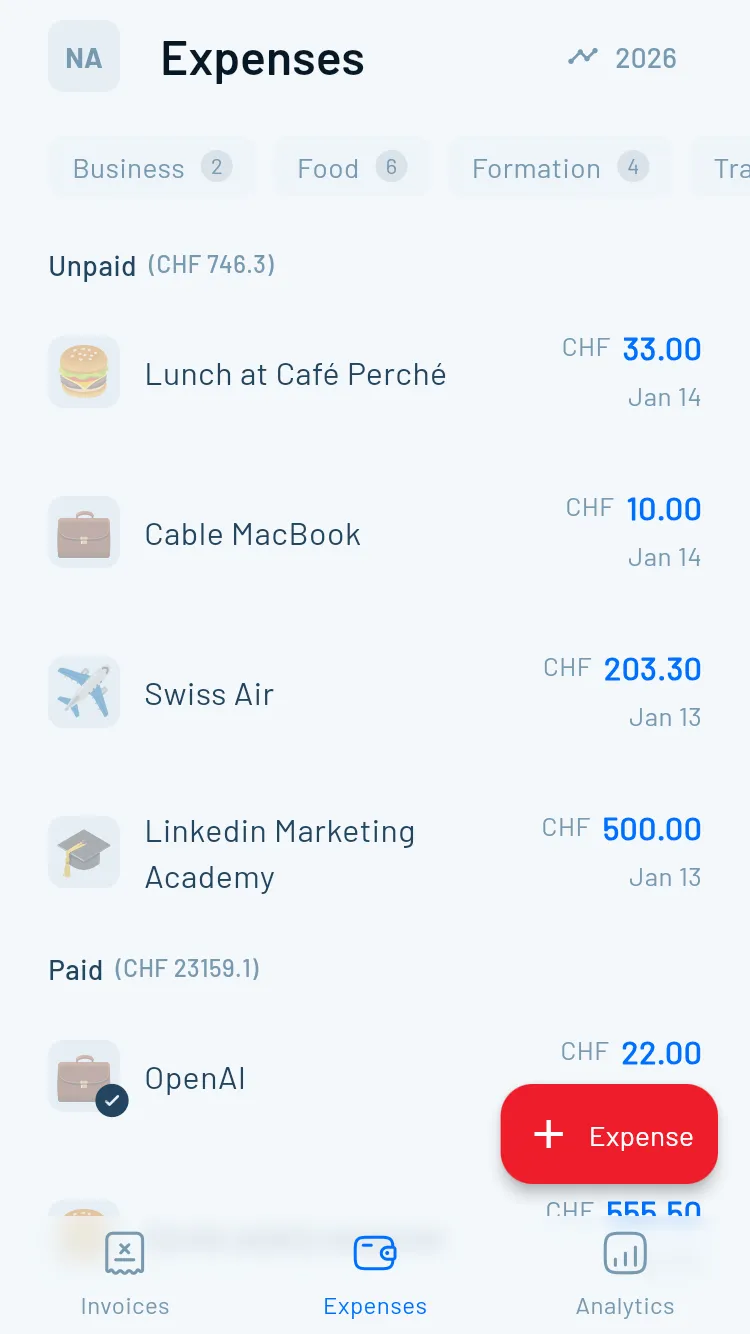
Expense tracking that keeps moving
Mobile receipt capture + categorization helps prevent returning to a backlog of admin after a short or long absence.
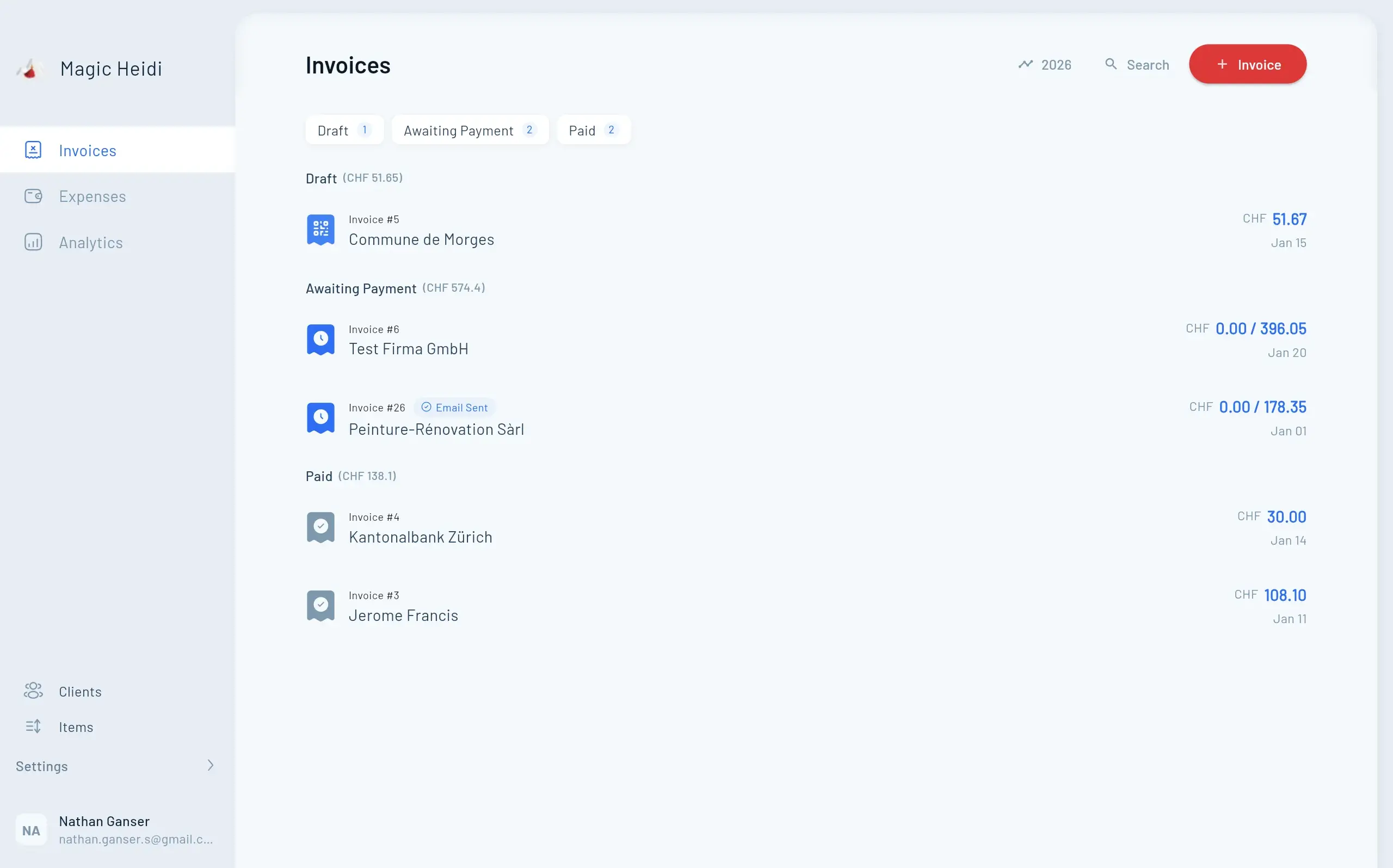
Invoicing that protects cashflow
Templates, recurring invoices, and reminders reduce the risk of a “I was away, so I didn’t bill” dip—especially for freelancers.
FAQs: absence management Switzerland (Kurzabsenzen, Langzeitabsenzen, and freelancers)
What’s the difference between Kurzabsenzen and Langzeitabsenzen?
Kurzabsenzen are short, often unplanned absences (e.g., a few days). Langzeitabsenzen are longer absences that usually require more structured coordination (workload coverage, documentation rhythm, reintegration planning). Swiss resources like Suva commonly use this split because the management approach differs.
What should be covered in a return-to-work discussion (Rückkehrgespräch)?
Focus on reintegration and prevention: priorities for the first days back, current capacity/limitations (if any), changes needed (workload, schedule, tools), and a next check-in date. Keep it respectful and practical; the aim is a stable return.
Can someone work while they have a doctor’s certificate?
This can be nuanced and depends on the situation, insurer, and medical assessment. In practice, treat it carefully: clarify capacity and expectations and seek guidance from appropriate Swiss resources (e.g., Suva) or your HR/legal advisor.
How do holidays interact with longer absences in Switzerland?
Swiss practice includes specific rules around holidays and longer absences (often discussed with reference to the Swiss Code of Obligations, e.g., OR Art. 329b). Because details depend on context and contracts, use official guidance and professional advice for your case.
I’m a freelancer—how far in advance should I announce vacation?
For most client work: 2–4 weeks is a safe baseline. For ongoing retainers or critical operations: 4–8 weeks is better. Your goal is to protect delivery schedules and allow clients to provide input early.
As a freelancer, what should I automate first to protect cashflow during absences?
Prioritize: (1) invoicing templates + recurring invoices, (2) payment reminders, (3) expense capture/receipt scanning, (4) bank statement import. This prevents the common “I was away, so I didn’t bill” cashflow dip.
Do small Swiss teams really need a formal absence policy?
You don’t need something bureaucratic—but you do need clear rules (how to report, who to inform, what happens after several days, where absences are recorded). A one-page policy prevents confusion and perceived unfairness.
Quick checklist: absence management Switzerland tips you can implement this week
- Choose one reporting channel + a “report by” time
- Define thresholds for Kurzabsenzen vs Langzeitabsenzen
- Create a simple coverage checklist for urgent work
- Add a return-to-work conversation template (15 minutes)
- Centralize absence tracking (sheet/tool) with consistent labels
- For freelancers: write 2 email templates (vacation + sick day)
- Automate invoicing and reminders so cashflow doesn’t pause
Keep work moving—even when you’re away
Absence management in Switzerland doesn’t have to be complicated to be effective. The best systems are small, consistent, and humane: clear reporting, predictable coverage, and a supportive return-to-work routine.
And if you’re self-employed, the same principle applies: reduce fragility by planning, communicating early, and automating the admin that keeps income flowing.
CTA: Make your business admin “absence-proof”
If you want fewer interruptions to cashflow when you take time off (or get forced to), use Magic Heidi to streamline invoicing and expenses—so your business stays organized from anywhere.
Try Magic Heidi for free and set up your invoicing + expense workflow in minutes.
Make your admin absence-proof
Streamline invoicing and expenses so cashflow and reporting don’t pause when you’re away.