Banking Guide

Revolut Business for Swiss Freelancers: What You Really Need to Know in 2026

As a Swiss freelancer working with international clients, you need a banking solution that handles multiple currencies without punishing fees. Revolut Business promises exactly that—but can it really serve as your primary business account in Switzerland?

Swiss Business Office

The short answer: It depends on your business model.

Revolut Business excels at international payments and currency exchange. But it has significant limitations for Swiss-only operations—especially the inability to pay Swiss QR-bills, a deal-breaker for many freelancers.

This guide covers everything you need to know about using Revolut Business in Switzerland, including how Magic Heidi solves the Swiss compliance gaps that Revolut can't address.

What Is Revolut Business?

Revolut Business is a digital banking platform designed for companies and freelancers who need modern, borderless banking. Founded in the UK and operating under a Lithuanian banking license, Revolut has grown to serve over 1 million retail customers in Switzerland—approximately one in six Swiss residents aged 20-64.

Important Context

The Swiss Banking Situation

Understanding what makes Revolut different from traditional Swiss banks—and why it matters for your business.

Unlike traditional Swiss banks (UBS, PostFinance, ZKB), Revolut doesn't hold a Swiss banking license. Instead, they partner with PostFinance to provide Swiss IBAN functionality.

What this means in practice:

Your CHF account uses a PostFinance IBAN structure, but it's technically a virtual IBAN. Multiple Revolut Business customers share the same base IBAN, with unique payment references distinguishing individual accounts.

Think of it like apartment buildings: everyone has the same street address (IBAN), but different apartment numbers (payment reference).

This setup works perfectly for most transactions. But it creates complications for certain Swiss banking functions that expect unique IBANs.

Pricing

Revolut Business Pricing in 2026

Revolut eliminated their free Business tier in March 2025. Here's the current pricing structure for Swiss freelancers.

PlanBasicGrowScale
Monthly FeeCHF 10CHF 40CHF 150
Free Local Transfers10 transfers100 transfers1,000 transfers
FX Allowance~CHF 1,250~CHF 20,000~CHF 80,000
FX Fees After~0.6%~0.4-0.6%~0.4%
ATM Withdrawals2% fee2% fee2% fee

Important pricing notes:

  • Incoming transfers in CHF, EUR, and USD are always free
  • Physical cards cost around CHF 6-10 for initial delivery
  • Virtual cards are included at no extra cost
  • FX allowances reset monthly and apply to interbank exchange rates
  • After your FX allowance, you pay small markup fees (still competitive)

For freelancers exchanging CHF 5,000-10,000 monthly, the savings on foreign exchange alone often justify the Basic plan cost.

Major Limitations for Swiss Freelancers
(Be Aware)

Before committing to Revolut Business as your primary account, understand these significant limitations that affect Swiss freelancers.

⚠️

Cannot Pay QR-Bills

The biggest limitation for Swiss operations
🔗

Shared IBAN System

Complications for certain payments
🏦

No Credit Facilities

Traditional banks needed for loans

1. Cannot Pay Swiss QR-Bills (Critical Issue)

This is the biggest problem. Switzerland mandated QR-bills for all invoices in 2020, with full enforcement by 2025. These orange payment slips with QR codes are now the standard for domestic invoices.

Revolut Business cannot process QR-bill payments. When you try to scan a QR-bill or enter the IBAN, you'll receive an error: "Unfortunately we do not support Swiss QR-Bill payments."

For freelancers paying Swiss suppliers, contractors, or subscriptions, this is a deal-breaker. You'll need a traditional Swiss bank account for these payments.

2. No Swiss Payment Systems

Revolut doesn't support:

  • TWINT (Switzerland's dominant mobile payment system)
  • eBill (electronic billing system)
  • Direct debits (LSV/BDD) for automatic payments
  • ESR payment slips (the older orange slips, now replaced by QR-bills)

If your business relies heavily on these Swiss-specific payment methods, Revolut Business cannot be your sole banking solution.

3. The Shared IBAN Challenge

While you receive a unique payment reference, the underlying IBAN is shared among multiple customers. This creates issues for:

  • Salary deposits: Some employers won't pay to accounts requiring payment references
  • Government payments: Certain cantonal offices may not accept Revolut IBANs
  • Business loans: Traditional Swiss banks rarely lend based on Revolut account history
  • Perceived legitimacy: Some conservative clients or accountants prefer traditional Swiss bank IBANs

The good news: Magic Heidi solves the invoicing side of this problem (more on that below).

4. No Credit or Loan Facilities

Revolut Business doesn't offer:

  • Business credit lines
  • Overdraft facilities
  • Equipment financing
  • Working capital loans

Traditional Swiss banks often provide overdrafts of CHF 5,000-25,000 for established business accounts. If you need credit flexibility, you'll need a traditional banking relationship.

5. Account Freeze Risks

Like all banks, Revolut must comply with anti-money laundering regulations. Some users report temporary account freezes when:

  • Large unexpected payments arrive
  • International transfers trigger compliance reviews
  • Business documentation needs updating

While legitimate businesses get resolved quickly, having your account frozen for 3-5 days can disrupt cash flow. Many savvy freelancers maintain a backup Swiss account for this reason.

6. No Interest on CHF Balances

Revolut Business currently pays no interest on Swiss franc deposits. While traditional Swiss banks also offer minimal interest (and sometimes charge negative interest on large balances), it's worth noting if you keep significant reserves.

The Solution

The Perfect Combination: Revolut Business + Magic Heidi

Magic Heidi transforms Revolut Business from a limited international tool into a complete freelancing solution for Switzerland.

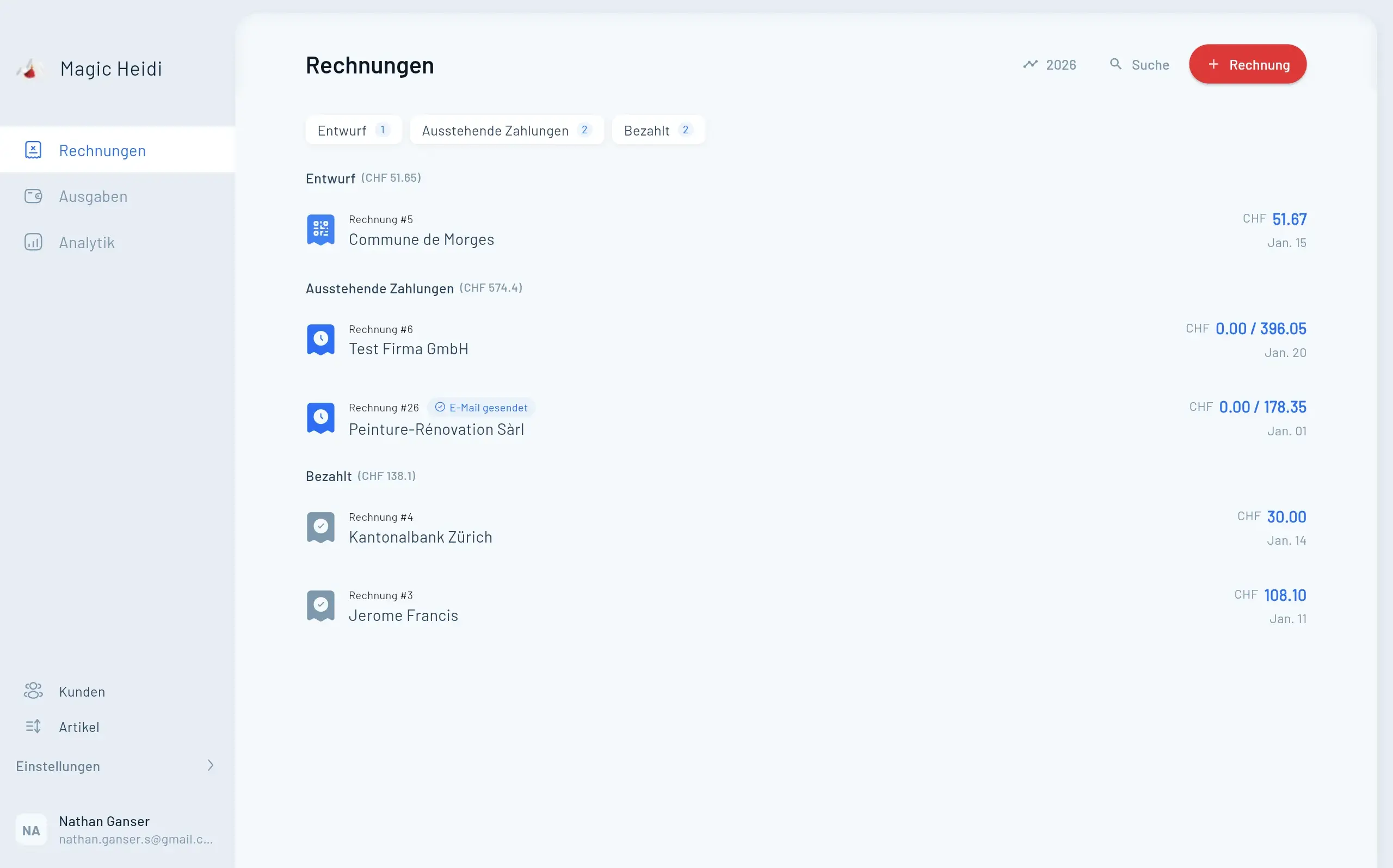
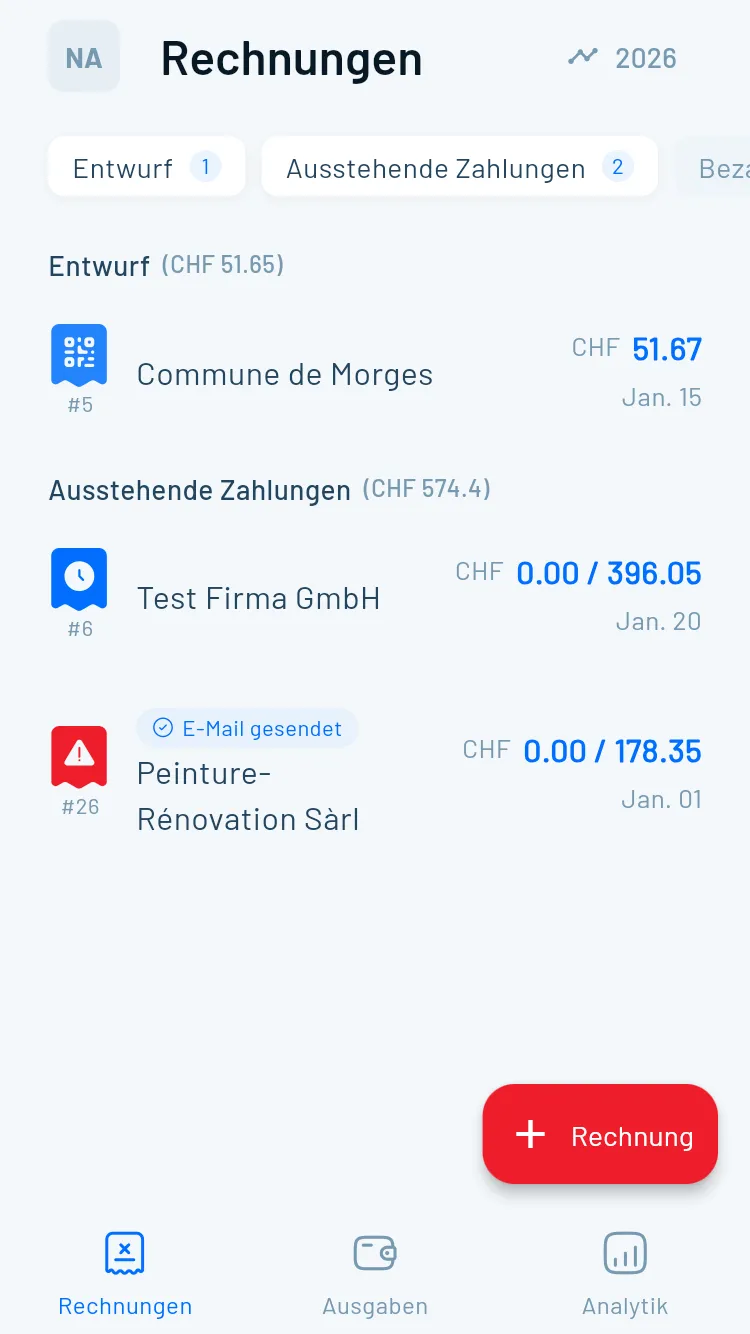
Magic Heidi Invoice Management

Here's the problem: While Revolut gives you a Swiss CHF IBAN, invoicing clients becomes complicated because of the shared IBAN structure and payment reference requirements.

Magic Heidi's solution: Full native support for Revolut Business accounts, including proper handling of the unique payment reference system.

How It Works

Swiss-Compliant Invoicing in 30 Seconds

Step-by-step integration that makes Revolut Business work seamlessly for Swiss freelancing.

  • 🎯
    Enter Business Details

    Set up company info, VAT number, contact details

  • 🏦
    Configure Revolut Banking

    Add PostFinance IBAN and payment reference

  • 🧾
    Generate Compliant Invoices

    Professional Swiss-compliant invoices with QR codes

  • Automatic Accounting

    Track revenue and organize for tax filing

Invoices
  • Invoice #3

    Magic Heidi

    CHF 500

    Jan 29

  • Invoice #2

    Webbiger LTD

    CHF 2000

    Jan 24

  • Invoice #1

    John Doe

    CHF 600

    Jan 20

How It Works: Step-by-Step

1. Enter Your Business Details

Set up your company information in Magic Heidi: business name, address, VAT number (if applicable), and contact details.

2. Configure Your Revolut Banking Details

Enter the banking information from Revolut:

  • PostFinance bank address (as provided by Revolut)
  • Your CHF IBAN
  • Your unique payment reference code

Magic Heidi understands Revolut's structure and configures everything correctly.

3. Generate Swiss-Compliant Invoices

Your invoices display:

  • Header: Your business name and address (professional appearance)
  • Payment section: Revolut's IBAN and your unique payment reference
  • Compliance: All Swiss invoicing requirements met (VAT structure, payment terms, invoice numbering)

Clients see a professional, compliant invoice and pay to your Revolut account using the payment reference Magic Heidi generates.

4. Money Arrives in Your Revolut Account

Payments flow directly to your CHF Revolut Business account. The payment reference ensures Revolut routes the money correctly to you (not to another customer sharing the same base IBAN).

5. Automatic Accounting

Magic Heidi tracks all your invoices and revenue automatically. At year-end, your accounting is already organized for tax filing.

Added Benefit: Zapier Automation

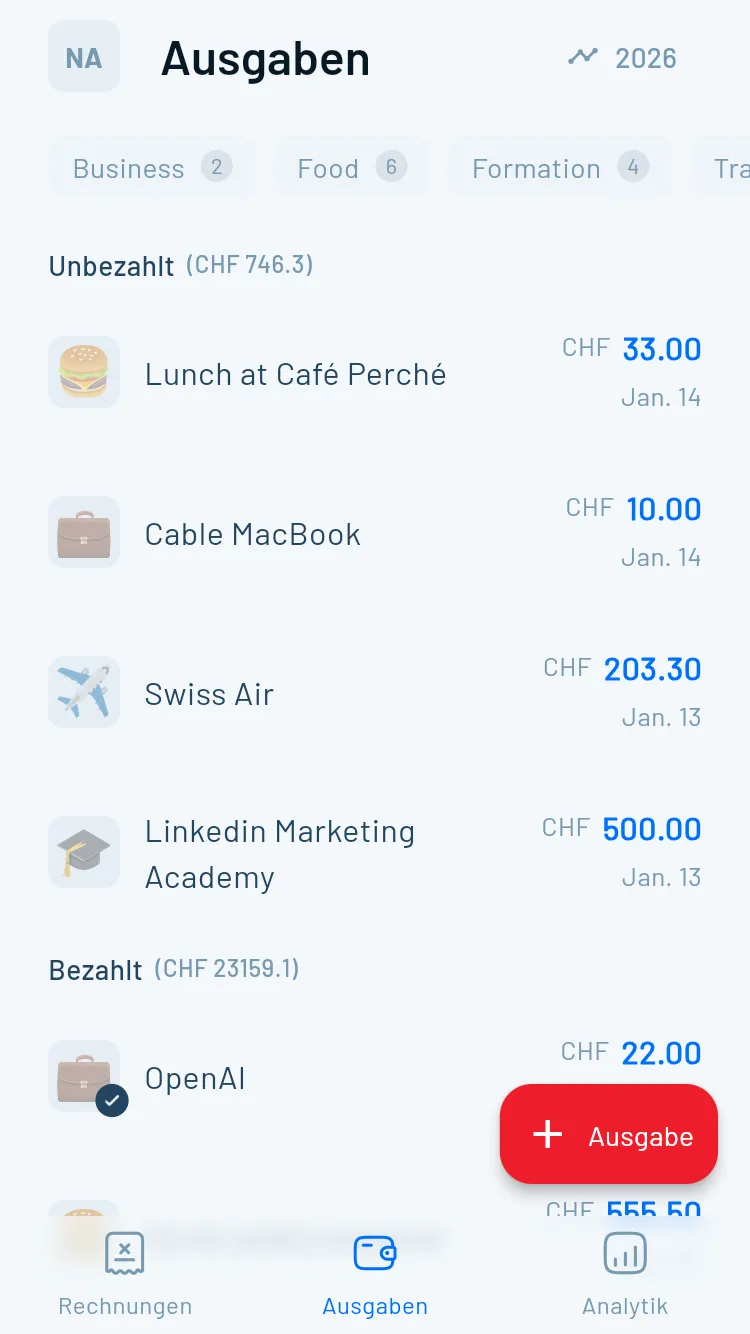
Connect Revolut Business to Magic Heidi through Zapier to automate expense tracking:

  • Every Revolut payment automatically imports to Magic Heidi
  • Expense categorization happens in real-time
  • Receipt matching connects transactions to uploaded receipts
  • Tax-ready reports generate at year-end with zero manual work

Your bookkeeping essentially runs on autopilot.

Getting Started

Practical Setup Guide

Everything you need to know to start using Revolut Business with Magic Heidi in Switzerland.

Step 1

Open Your Revolut Business Account

Visit business.revolut.com and select Switzerland as your country.

  • Proof of business registration (commercial registry extract)
  • Personal identification (passport or ID card)
  • Proof of address (utility bill or bank statement)
  • Business details (legal structure, industry, expected turnover)
  • Verification takes 1-3 business days typically
Business Registration
Step 2

Activate Your Swiss CHF IBAN

Set up your local currency account within the Revolut app.

  • Navigate to 'Accounts' in the app
  • Select 'Add new account currency'
  • Choose CHF (Swiss Franc)
  • Note your unique payment reference for Magic Heidi
Mobile Banking
Step 3

Set Up Magic Heidi Integration

Connect your Revolut Business account to Magic Heidi for Swiss-compliant invoicing.

  • Log into Magic Heidi → Settings → Banking
  • Select 'Add Bank Account' → Choose 'Revolut Business'
  • Enter your CHF IBAN and payment reference
  • Magic Heidi validates and confirms integration
Magic Heidi Integration
Step 4

Create Your First Invoice

Generate a test invoice to ensure everything works correctly.

  • Create new invoice in Magic Heidi
  • Add line items with Swiss VAT rates (if registered)
  • Review payment section with Revolut details
  • Send to client—professional PDF with Swiss requirements
Invoice Creation
Step 5

Connect Zapier for Automation (Optional)

Fully automated bookkeeping with Revolut and Magic Heidi.

  • Create Zapier account (free tier sufficient)
  • Connect Revolut Business as trigger app
  • Connect Magic Heidi as action app
  • Configure: 'New transaction → Create expense'
  • Every payment automatically tracked in Magic Heidi
Expense Automation
Comparison

Revolut Business vs Traditional Swiss Banks

How Revolut stacks up against traditional options for freelancers.

FeatureRevolut BusinessTraditional Swiss Bank
Monthly FeesCHF 10+CHF 5-15+ (higher with transactions)
Foreign ExchangeInterbank rates + low markup1-3% markup typically
Multi-Currency 30+ currencies included Limited, high fees
QR-Bill Payments Not supported Full support
TWINT Integration No Yes
Physical Branches Digital only Branch network
Business Loans Not available Available
Account Opening 1-3 days online1-2 weeks, in-person"
Mobile App Excellent, modernVaries (improving)
International Payments Fast, cheapSlower, expensive

The verdict: Use Revolut Business for international operations, keep a traditional Swiss account for domestic payments and QR-bills.

FAQ

Frequently Asked Questions

Can I use Revolut Business as a sole proprietor in Switzerland?

Only if you're registered in the commercial registry. Unregistered sole proprietors (earning under CHF 100,000) should use Revolut Pro instead, which doesn't require commercial registration.

Is Revolut Business safe and legitimate?

Yes. Revolut holds a Lithuanian banking license and operates across Europe. They're supervised by the European Central Bank and Bank of Lithuania. Your deposits are protected under EU deposit guarantee schemes (up to EUR 100,000). However, they're not a Swiss-licensed bank, which matters for some legal and tax purposes.

Why can't Revolut support QR-bills?

QR-bills require integration with Swiss payment systems (ISO 20022) and specific validation infrastructure. As a non-Swiss bank, Revolut hasn't implemented this functionality. It's technically possible but apparently not a priority for them currently.

Can I accept salary payments to my Revolut Business account?

Not recommended. Most Swiss employers expect unique IBANs without payment references. Some may refuse to pay to Revolut accounts. Use a traditional Swiss bank account for employment income.

What happens if Revolut freezes my account?

Contact support immediately through the app. Have your business documentation ready (invoices, contracts, registration papers). Most freezes resolve within 2-5 business days once you provide requested information. This is why maintaining a backup Swiss account is wise.

Does Magic Heidi support other banking options besides Revolut?

Yes! Magic Heidi supports all Swiss and international bank accounts. You can use UBS, PostFinance, Credit Suisse (now UBS), ZKB, Raiffeisen, Neon, Wise, or any other bank. Revolut Business is just one option that's popular with international freelancers.

How much can I save on foreign exchange with Revolut?

Significant amounts for high-volume international work. Example: Converting CHF 50,000 of EUR income annually might cost CHF 800-1,200 with traditional banks (1.5-2.5% markup). With Revolut Business Grow plan, you'd pay CHF 480 (annual subscription) plus minimal FX fees beyond allowances—often CHF 600-800 total. That's CHF 400-600 saved annually.

Can I upgrade or downgrade Revolut Business plans?

Yes, anytime. Changes take effect at your next billing cycle. Start with Basic, upgrade to Grow if you exceed FX allowances or need more free transfers.

What about Swiss tax deductions for Revolut fees?

Yes, all Revolut Business subscription fees and transaction costs are deductible business expenses. Magic Heidi automatically categorizes these when you import expenses, making year-end tax filing straightforward.

Should I tell clients I use Revolut Business?

Your invoices will show the PostFinance IBAN structure, but clients won't necessarily know it's Revolut. Most clients only care that payments arrive and invoices are compliant. If asked, simply explain you use a digital banking solution with Swiss CHF accounts—no need to overcomplicate.

Final Verdict

Is Revolut Business Right for Your Freelance Business?

Understanding the optimal banking setup for Swiss freelancers in 2026.

Revolut Business is an excellent secondary account for Swiss freelancers with international clients or expenses. The combination of low foreign exchange fees, multi-currency accounts, and modern expense management delivers real value.

But it's not a complete replacement for traditional Swiss banking due to QR-bill limitations, missing TWINT support, and shared IBAN complications.

The optimal setup for most Swiss freelancers:

  1. Revolut Business as your international operations account
  2. Traditional Swiss bank (even a basic account) for domestic payments and QR-bills
  3. Magic Heidi as your central invoicing and accounting platform, integrating both accounts

This combination gives you the best of both worlds: international flexibility with Swiss compliance.

Magic Heidi specifically solves the pain points that make Revolut Business difficult to use alone—especially the shared IBAN invoicing challenge and Swiss tax compliance requirements.

Ready to streamline your freelance finances?

Magic Heidi integrates seamlessly with Revolut Business (and all other banks) to deliver Swiss-compliant invoicing, automated expense tracking, and year-end tax preparation.


Last updated: January 2026 | Pricing accurate as of: January 2026 | Swiss regulations current as of: January 2026