Free Excel Accounting Template for Swiss Freelancers

Starting your freelance journey in Switzerland? Get our free, Milchbüechli-compliant Excel template. Track income, expenses, and VAT—all in one simple spreadsheet. Perfect for freelancers earning under CHF 500,000.

Swiss Freelancer Accounting Dashboard

Starting your freelance journey in Switzerland is exciting—until you realize you need to keep proper accounting records. Even if you're earning CHF 30,000 a year, Swiss tax law requires you to track income and expenses systematically.

The good news? If you're earning under CHF 500,000 annually, you can use simplified bookkeeping (what the Swiss call "Milchbüechli-Rechnung"). And you can do it all in a simple Excel spreadsheet.

This guide includes a free, Swiss-compliant Excel template plus everything you need to know about managing your freelance finances legally and efficiently.

Perfect for: New freelancers, sole proprietors under CHF 500,000 revenue, and anyone not yet ready for full accounting software.

Understanding Swiss Freelancer Requirements

Swiss accounting law is straightforward once you understand these key thresholds. Here's what matters for your freelance business.

💰

CHF 500,000 Rule

Below this revenue? Simple bookkeeping is enough. Above? You need double-entry accounting.
📋

CHF 100,000 VAT Threshold

Cross this threshold and VAT registration becomes mandatory. Stay below? Registration is optional.
📚

10-Year Retention

All business documents must be kept for at least 10 years. Invoices, receipts, bank statements—everything.

The CHF 500,000 Rule

If your annual revenue stays below CHF 500,000, you're allowed to use simplified bookkeeping (einfache Buchhaltung). This means single-entry accounting—essentially tracking what comes in and what goes out.

Once you cross CHF 500,000, you must switch to double-entry bookkeeping. That's when most freelancers hire an accountant or invest in professional accounting software.

The CHF 100,000 VAT Threshold

Hit CHF 100,000 in annual revenue? You must register for VAT (MWST/TVA/IVA). As of January 1, 2024, the standard VAT rate is 8.1%.

Below this threshold, VAT registration is optional. Most small freelancers stay unregistered to keep things simple.

What "Milchbüechli-Rechnung" Actually Means

This charming Swiss-German term literally means "milk notebook accounting"—named after the simple ledgers dairy farmers used to track milk sales.

For modern freelancers, it means:

  • Recording all business income
  • Tracking all business expenses
  • Keeping receipts and invoices
  • Separating business from personal finances
  • Maintaining records for 10 years

No complicated balance sheets required. Just clear records of money in and money out.

Free Template

Download Your Free Swiss Freelancer Template

Everything you need to start tracking your freelance finances today. Milchbüechli-compliant, VAT-ready, and built specifically for Swiss requirements.

Get Started Today

Compatible with Excel 2016+, Google Sheets, and Numbers. No macros, no complexity—just clean, functional accounting.

Step-by-Step Guide

How to Use Your Template

Setting up takes just 15 minutes. Follow this simple guide to start tracking your freelance finances properly.

Excel Template Setup Guide

Setting Up (First 15 Minutes)

  1. Make a copy of the template in your Google Drive or download it to your computer
  2. Save it securely with a clear name: "Freelance_Accounting_2025"
  3. Enable auto-save if using cloud storage
  4. Create monthly backups on a separate drive

Recording Your Income

Each time you invoice a client, add a new row:

Invoice Date: The date you sent the invoice (matters for tax year allocation)

Invoice Number: Use a consistent numbering system (2025-001, 2025-002, etc.)

Client Name: Helps you see which clients bring most revenue

Description: Brief service description ("Website design - ABC Company")

Amount (CHF): The full invoice amount including VAT if you charge it

Payment Date: When you actually received the money (leave blank until paid)

Status: Paid/Unpaid/Overdue

This simple tracking helps you spot late payers and forecast cash flow.

Tracking Your Expenses

Add every business expense immediately—don't wait until month-end:

Date: When you made the purchase

Category: Pick from Swiss-relevant categories (see next section)

Description: Specific enough to remember ("MacBook Pro for client work" not just "computer")

Amount (CHF): Full amount paid including VAT

VAT Amount: Extract this if you're VAT-registered (otherwise leave blank)

Receipt: Note where you filed the physical or digital receipt ("Dropbox/Receipts/2025-03")

Pro tip: Take photos of paper receipts immediately and store them in cloud folders organized by month.

Swiss Tax-Deductible Expense Categories

Understanding what you can deduct saves thousands in taxes. Here are the main categories for Swiss freelancers, explained clearly.

💰 AHV/AVS ~10% deductible
🏦 Pillar 3a up to CHF 36,288
🍽️ Client meals 50% deductible
📱 Phone ~50% deductible
🏠
Home Office

20-30% of rent, electricity, heating, internet if you work from home

💻
Equipment & Software

Computers, desks, chairs, cameras, software subscriptions—fully deductible

📚
Professional Development

Courses, conferences, books, training related to your work

🚗
Transportation

CHF 0.70/km for cars, CHF 0.50/km for bikes, full public transport costs

Home Office Costs

If you work from home, deduct a proportional amount of rent, electricity, heating, and internet. Most cantons accept 20-30% of home costs if you use one room primarily for business.

Example: You pay CHF 2,000 monthly rent. Your office is one of five rooms. Deduct approximately CHF 400/month (CHF 4,800/year).

Professional Services

Accountant fees, legal advice, business insurance, bank fees—all fully deductible.

Marketing and Advertising

Website hosting, business cards, online ads, networking event fees—anything promoting your business.

Pillar 3a Pension Contributions

Freelancers without a second-pillar pension can deduct up to CHF 36,288 in 2025 (20% of net income). This is your biggest potential tax saver.

Tax Season

Preparing for Tax Season with Excel

Come January, your Excel template becomes your tax preparation foundation. Follow this checklist to make tax filing smooth and stress-free.

Tax preparation documents

Year-End Checklist

Eight weeks before deadline:

  • ✓ Close your books for the previous year
  • ✓ Verify all invoices marked as "paid" actually cleared
  • ✓ Reconcile expense totals against bank statements
  • ✓ Calculate total income by category
  • ✓ Sum all deductible expenses by category
  • ✓ Compute net profit (income minus expenses)
  • ✓ Calculate estimated AHV/AVS contributions
  • ✓ Determine Pillar 3a contribution (if applicable)
  • ✓ Generate summary report for accountant

Where Your Numbers Go

Most Swiss cantonal tax forms ask for:

Total Gross Income: Sum of all invoices issued (even if not all paid yet)

Business Expenses: Total of all deductible expenses

Net Profit: The difference—this is what gets taxed

Social Security Paid: Your AHV/AVS contributions

Pension Contributions: Pillar 3a deductions

Your Excel template calculates these automatically in the summary section.

Working with an Accountant

Even with perfect Excel records, many freelancers hire accountants for final tax filing. Your organized spreadsheet makes this:

  • Faster: Accountants charge by the hour—good records save money
  • Cheaper: Less time = lower bills
  • More accurate: Clear data means fewer errors
  • Less stressful: No scrambling to find receipts in March

Expect to pay CHF 500-1,500 for basic tax preparation as a sole proprietor.

Excel vs Software

Excel vs. Accounting Software: The Honest Comparison

Let's address the elephant in the room. Here's when Excel wins, and when it's time to upgrade.

FactorExcelAccounting Software
Monthly CostCHF 0CHF 15-40
Setup Time15 minutes30 minutes
Monthly Time Investment8-12 hours2-3 hours
Error Rate 60%+ have mistakes Automated accuracy
Mobile Access No Full iOS & Android
Bank Integration Manual entry Auto-import
VAT Compliance Manual updates Auto-updated
Best ForFirst 6-12 monthsGrowing freelancers

The Real Cost Calculation

Excel: CHF 0/month + 10 hours/month = CHF 500/month in time (at CHF 50/hour rate)

Accounting Software: CHF 25/month + 2 hours/month = CHF 125/month total

If your hourly rate is CHF 75 or higher, software pays for itself immediately.

Made for Swiss Freelancers

Why Swiss Freelancers Choose Magic Heidi

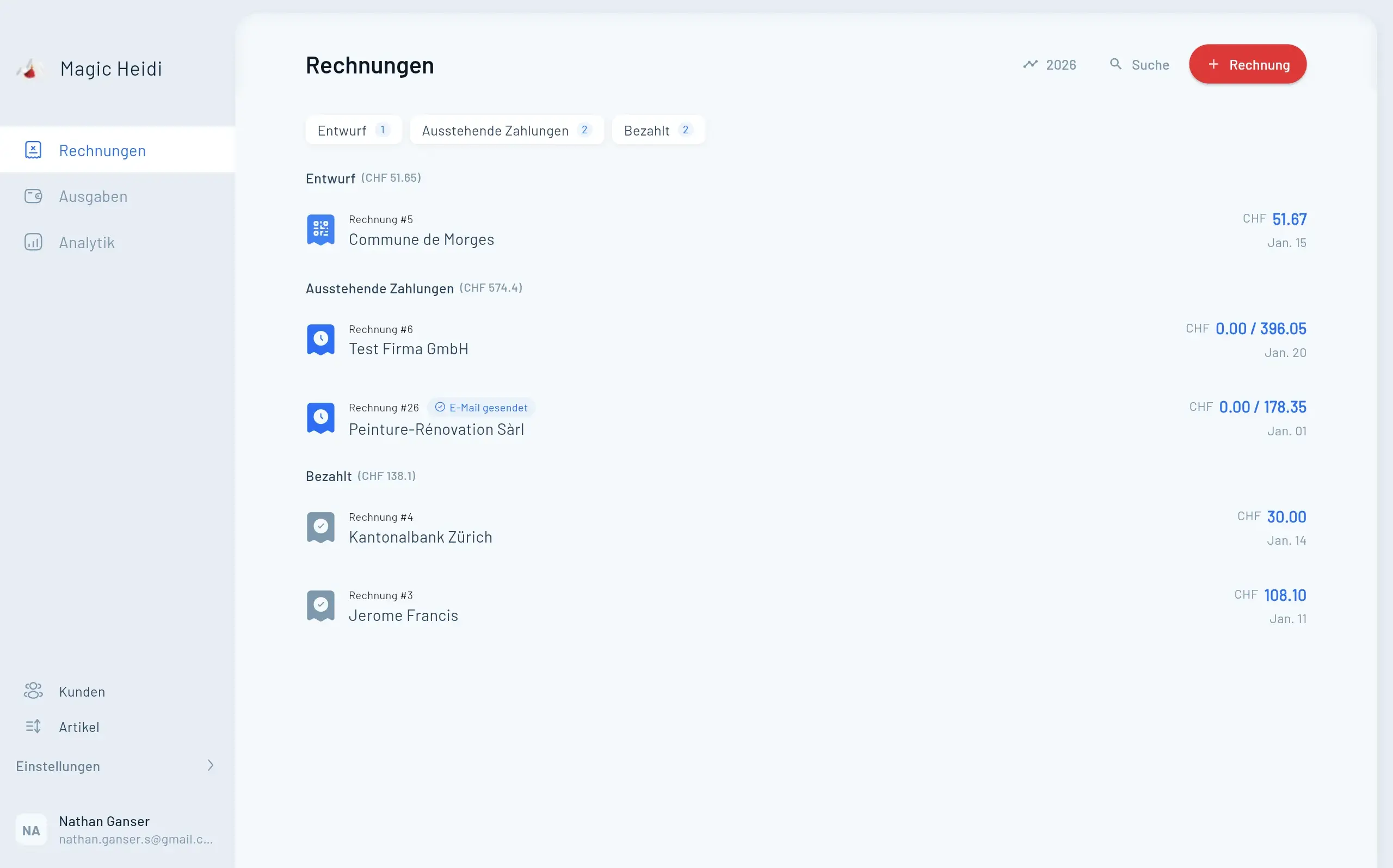
When you're ready to graduate from spreadsheets, Magic Heidi is built specifically for the Swiss market. Save 8+ hours every month.

  • 🧾
    QR Invoice Generator

    Create compliant QR-IBAN invoices in 30 seconds—mandatory Swiss standard

  • 🤖
    AI Expense Scanning

    Snap receipt photos—AI extracts date, amount, VAT, and category automatically

  • 📊
    Swiss VAT Management

    Automatic 8.1%, 3.8%, or 2.6% calculations with canton-specific reports

  • 🌍
    Multi-Currency Support

    Bill international clients in EUR or USD while tracking in CHF

Invoices
  • Invoice #3

    Magic Heidi

    CHF 500

    Jan 29

  • Invoice #2

    Webbiger LTD

    CHF 2000

    Jan 24

  • Invoice #1

    John Doe

    CHF 600

    Jan 20

Pricing That Makes Sense

Start free. Upgrade when ready. Built for Swiss freelancers who value their time.

Free Trial

CHF0/month
14 Days
  • Full access to all features
  • No credit card required
  • Swiss bank integration
  • QR invoice generation
  • AI expense scanning
Start Free Trial

Enterprise

CHFCustom/month
Contact us
  • Everything in Solo
  • Multiple team members
  • Custom integrations
  • Dedicated support
  • Training sessions
Contact Sales
🛡️Try risk-free for 14 days. No credit card required.
FAQ

Frequently Asked Questions

Do I need accounting if I earn under CHF 100,000?

Yes. Swiss tax law requires all self-employed individuals to maintain proper records regardless of income level. Simplified bookkeeping is sufficient, but you can't simply estimate numbers at tax time.

What exactly is Milchbüechli accounting?

It's the Swiss term for simplified, single-entry bookkeeping. Record income when you earn it, expenses when you pay them, and calculate the difference. No balance sheets or complex journal entries required for businesses under CHF 500,000 revenue.

Can I use Excel for VAT accounting?

Technically yes, but it's risky. VAT calculations are complex, and errors can trigger audits. If you're VAT-registered, investing in proper software (like Magic Heidi) significantly reduces compliance risk and saves time on quarterly submissions.

How long must I keep my records?

10 years minimum for all business documents—invoices, receipts, contracts, bank statements, and accounting records. Store both digital and physical copies securely.

When should I hire an accountant?

Consider it when you're approaching CHF 100,000 revenue (VAT registration complexity), if you're terrible with numbers, or if accounting takes more than 15% of your working time. Many freelancers use accountants just for annual tax filing while managing day-to-day books themselves.

Is Excel legally compliant for Swiss taxes?

Yes, if maintained properly. Tax authorities accept any systematic record-keeping method that clearly shows income and expenses. Excel qualifies as long as you keep it organized and maintain supporting documentation.

What happens when I cross CHF 500,000 revenue?

You must switch to double-entry bookkeeping (doppelte Buchhaltung). This means hiring an accountant or using professional accounting software with full accrual accounting. It's also a great milestone—congratulations!

Can I switch from Excel to software mid-year?

Absolutely. Most accounting software lets you import your Excel data. You don't need to wait for January 1st to upgrade.

Start Managing Your Freelance Finances Today

You don't need an accounting degree to run a successful freelance business in Switzerland. Start with our free template or skip straight to smart accounting with Magic Heidi.