VAT Registration in Vaud: Everything Freelancers Need to Know in 2026

Approaching CHF 100,000 in revenue? Already there? VAT registration in Vaud doesn't have to be complicated. This guide walks you through everything: mandatory vs. voluntary registration, current rates, filing methods, and the exact steps to register with Switzerland's Federal Tax Administration.

Swiss Business Office

Understanding VAT Registration in Vaud: The Basics

Value Added Tax (VAT)—known as MWST (German), TVA (French), or IVA (Italian)—is Switzerland's consumption tax on goods and services. In Vaud, as elsewhere in Switzerland, you must register once your annual revenue exceeds CHF 100,000.

Important: This threshold applies to your worldwide revenue, not just Swiss income.

Current VAT Rates for 2024-2026

As of January 2024, Switzerland uses three VAT rates:

  • Standard rate: 8.1% (most goods and services)
  • Reduced rate: 2.6% (food, books, newspapers, medications, menstrual hygiene products)
  • Special accommodation rate: 3.8% (hotel stays, hospitality services)

The planned increase to 8.8% standard rate has been delayed from January 2026 to likely January 2028.

Mandatory Registration Triggers

You must register for VAT if:

  • Your annual turnover exceeds CHF 100,000 (worldwide revenue)
  • You're a foreign company with worldwide turnover above CHF 100,000 AND at least CHF 1 in Swiss sales
  • You operate an e-commerce platform selling goods in Switzerland (new deemed supplier rules from January 2025)

Critical deadline: You must inform the Federal Tax Administration within 30 days of exceeding the threshold. Missing this deadline results in backdated tax liabilities and penalties.

When Voluntary Registration Makes Sense

Below CHF 100,000? You can still register voluntarily—but it comes with a 3-year commitment.

Voluntary registration benefits:

  1. Professional credibility: Shows clients you run a legitimate, established business
  2. Input tax deduction: Reclaim VAT on business expenses (office supplies, equipment, software)
  3. B2B advantage: Many corporate clients prefer working with VAT-registered suppliers
  4. Future-proofing: Simplifies compliance when you cross the threshold

When to avoid voluntary registration:

  • Most clients are private individuals (you'll need to increase prices by 8.1%)
  • Low business expenses mean minimal input tax to reclaim
  • Administrative burden outweighs benefits
  • Revenue will stay well below CHF 100,000

Cash flow consideration: Voluntary registration requires paying VAT to the tax office quarterly, creating a cash flow obligation even if clients haven't paid you yet.

Preparing for Registration: Required Information

Before starting your registration, gather your UID number (business identifier), revenue projections, personal information, and detailed business activity description. Having everything ready streamlines the 4-week approval process.

Business Registration Documents

1. UID Number (Enterprise Identification Number)

Your UID is Switzerland's universal business identifier, formatted as CHE-XXX.XXX.XXX.

For sole proprietors: Commercial registry registration (and thus UID) is optional. However, it's strongly recommended—it demonstrates legitimacy and simplifies administrative processes.

How to get a UID:

  • Register through your cantonal commercial registry
  • Provide business activity description, Vaud address, personal identification
  • The Federal Statistical Office assigns your UID
  • Once VAT-registered, your number becomes CHE-XXX.XXX.XXX MWST (or TVA/IVA)

Important distinction: Your UID is your business identifier. Your VAT number is your UID plus the MWST/TVA/IVA suffix. Use the VAT number on invoices.

2. Revenue Projection

Estimate your first year's turnover as accurately as possible. You can adjust this later if circumstances change.

Include:

  • Current client contracts
  • Expected new business
  • Worldwide revenue, not just Swiss sales

3. Personal Information

  • Full legal name
  • Date of birth
  • Social security number (AVS/AHV number)
  • Business address in Vaud
  • Contact details (phone, email)

4. Business Activity Description

Clearly describe what services or products you provide. This determines:

  • Applicable VAT rates
  • Eligibility for Net Tax Rate Method
  • Industry-specific net tax rates if applicable
Registration Process

Step-by-Step Registration Process

Register online through EasyGov.swiss or the Federal Tax Administration portal. The process takes approximately 4 weeks and is completely free.

Online Registration

Option 1: Online Registration (Recommended)

Fast, secure, and trackable application through official Swiss portals.

  • Visit vat.easygov.swiss and create an account
  • Select 'VAT Registration' and complete the form
  • Enter personal info, UID, estimated turnover, business details
  • Upload supporting documents if requested
  • Submit and save confirmation receipt
Online VAT Registration
Paper Application

Option 2: Paper Application

Traditional mail-in option if you prefer physical documentation.

  • Download Form 105 from estv.admin.ch
  • Complete all sections in black ink
  • Attach required documentation
  • Mail to: Federal Tax Administration, VAT Division, Schwarztorstrasse 50, 3003 Bern
VAT Registration Documents

What Happens Next

Timeline: Registration typically takes approximately 4 weeks from submission.

During review:

  • The FTA assesses your application and supporting documents
  • They may request additional information or clarification
  • They verify your UID number and business registration

Upon approval:

  • You receive your VAT number by mail (CHE-XXX.XXX.XXX MWST/TVA/IVA)
  • Your registration becomes effective, usually from the date you exceeded the threshold
  • You can now charge VAT and reclaim input tax

Cost: Registration is completely free.

VAT Invoicing

After Registration: Your VAT Obligations

Your invoices must include specific elements to be VAT-compliant. Use MWST, TVA, or IVA on invoices—never 'VAT'. File quarterly returns within 60 days and maintain all records for 10 years.

VAT-Compliant Invoice Example

Invoicing Requirements

Your invoices must include specific elements to be VAT-compliant:

Required information:

  • Your business name and address
  • Client name and address
  • Invoice date and unique invoice number
  • Description of goods/services provided
  • Net amount (before VAT)
  • VAT rate applied
  • VAT amount calculated
  • Gross total (net + VAT)
  • Your VAT number: CHE-XXX.XXX.XXX MWST (or TVA/IVA)

Critical: You must use "MWST," "TVA," or "IVA" on your invoices. The term "VAT" is NOT permitted in Switzerland. Many freelancers make this mistake—it can invalidate input tax deductions for your clients.

Filing Deadlines and Payment

Quarterly filing (default):

  • Returns due within 60 days after the end of each quarter
  • Q1 (Jan-Mar): Due May 31
  • Q2 (Apr-Jun): Due August 31
  • Q3 (Jul-Sep): Due November 30
  • Q4 (Oct-Dec): Due February 28/29

Payment deadline: Same as filing deadline

Late payment penalties: 4% annual interest on overdue amounts (as of 2025)

Record Keeping Requirements

Maintain all VAT-related records for 10 years:

  • All invoices issued (sales)
  • All invoices received (purchases)
  • Bank statements
  • Contracts
  • Import/export documentation
  • VAT return submissions and confirmations

The Federal Tax Administration can audit your records within this period. Organized documentation prevents headaches during audits.

Common VAT Mistakes Vaud Freelancers Make

Avoid these costly errors that trigger penalties, backdated liabilities, and compliance headaches. Most are easily preventable with proper systems.

Missing the 30-Day WindowBackdated VAT liabilities and interest charges on unpaid VAT
💳
Applying Wrong RatesCharging 8.1% on books (should be 2.6%) or food products
🚫
Using 'VAT' Instead of TVAInvalidates invoices and prevents client input tax deductions
🌍
Forgetting Worldwide TurnoverCHF 100K threshold includes ALL revenue, not just Swiss income
💰
Not Claiming Input TaxMissing deductions on software, equipment, and business expenses
📅
Missing Filing DeadlinesAutomatic penalties even when you owe no VAT

E-Commerce Platform Rules (Effective January 2025)

New "deemed supplier" concept: Online platforms selling goods to Swiss customers are now considered the supplier for VAT purposes.

Affects:

  • Marketplaces hosting third-party sellers
  • Platform operators facilitating sales
  • E-commerce aggregators

If you sell through platforms: Verify whether the platform is handling VAT or if you're still responsible.

Expanded VAT Exemptions

New exemptions without credit (January 2025):

  • Outpatient and day clinic services
  • Care coordination services
  • Private entity social welfare services
  • Travel agency services (with option to tax)

Annual Filing Option

Eligible SMEs (turnover below CHF 5,005,000) can now file VAT returns annually instead of quarterly, significantly reducing administrative burden.

Rate Adjustments

Approximately 15% of industry net tax rates were adjusted in January 2025 during the regular 7-year review.

Menstrual hygiene products moved from standard rate (8.1%) to reduced rate (2.6%) effective January 2025.

International Clients and Cross-Border Services

Services to non-Swiss clients are generally zero-rated if the place of supply is abroad. Understanding reverse charge mechanisms prevents double taxation.

International Business

Working with Foreign Clients

Services to non-Swiss clients are generally zero-rated if the place of supply is abroad:

  • Don't charge Swiss VAT on invoices
  • Client may need to account for VAT in their country (reverse charge)
  • Still report these sales in your VAT return as zero-rated supplies

Invoice statement for non-EU clients (UK, US, etc.): "Service not taxable in Switzerland according to Article X of the VAT Act"

Reverse Charge Mechanism

When purchasing services from foreign suppliers:

  • You may need to self-assess VAT
  • Report as both output tax (owed) and input tax (deductible)
  • Net effect often zero, but must be properly documented

This complexity is one reason consulting a tax professional pays off for international work.

When to Consult a Professional

Consider hiring a fiduciary (Swiss accounting firm) or tax advisor if:

  • Your VAT situation is complex (multiple rates, international clients)
  • Annual turnover exceeds CHF 500,000
  • You're transitioning from voluntary to mandatory registration
  • You made errors and need to file corrections
  • You're facing a tax audit

Typical costs in Vaud: CHF 1,000-2,500 annually for basic VAT filing support, depending on complexity.

VAT Automation

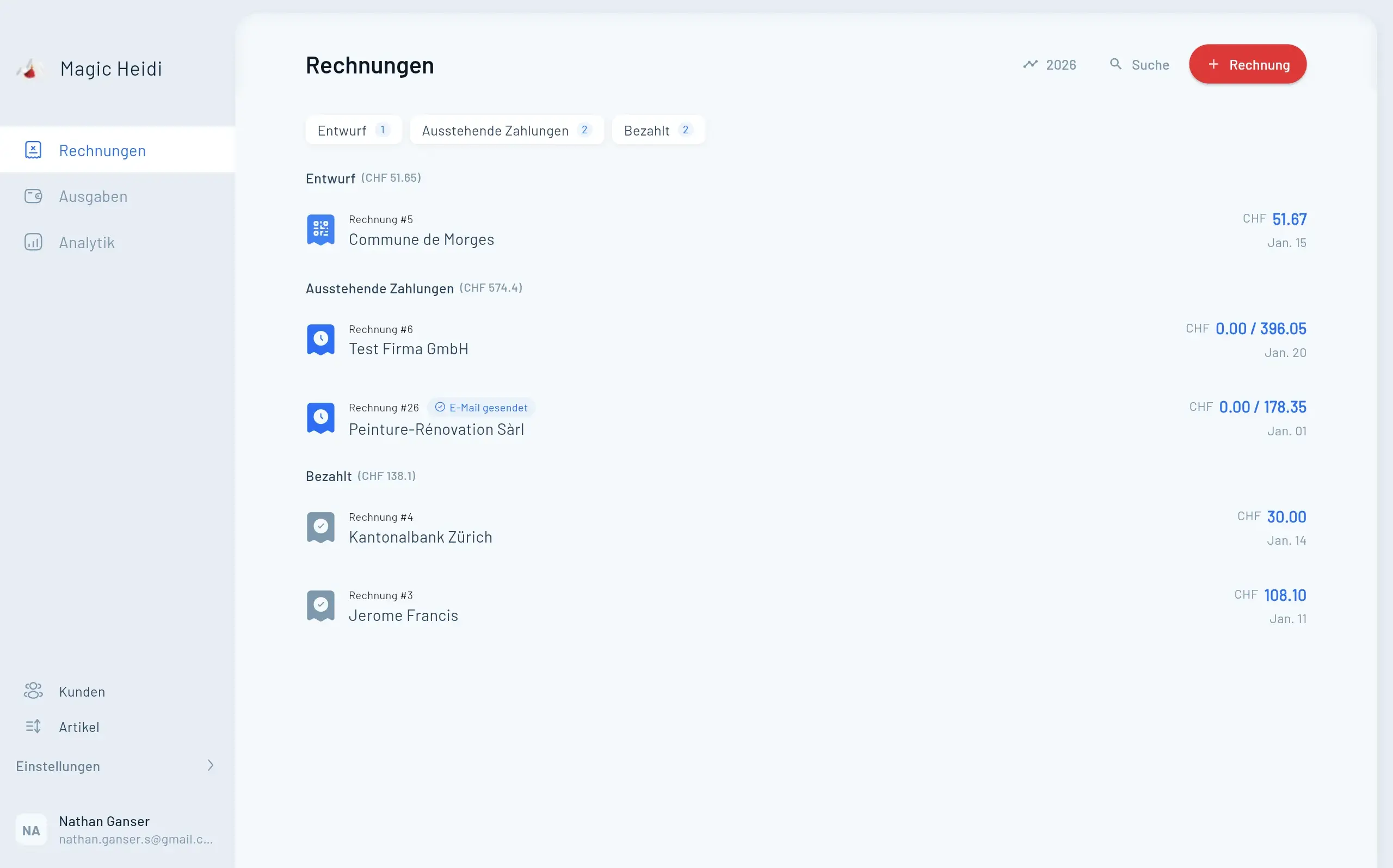
Simplifying VAT Management with Magic Heidi

Modern accounting software eliminates much of the VAT headache. Automatic calculations, deadline reminders, and compliance alerts built for Swiss freelancers.

  • 🧾
    Automatic VAT Calculation

    Correct rates applied to every invoice automatically

  • 📊
    Input Tax Tracking

    Track deductible expenses and maximize VAT recovery

  • 📅
    Quarterly Return Prep

    Pre-filled VAT returns ready for submission

  • 🔔
    Deadline Reminders

    Never miss a filing deadline or payment

Invoices
  • Invoice #3

    Magic Heidi

    CHF 500

    Jan 29

  • Invoice #2

    Webbiger LTD

    CHF 2000

    Jan 24

  • Invoice #1

    John Doe

    CHF 600

    Jan 20

Your VAT Registration Checklist

Ready to register? Follow this sequence:

Before registration:

  • ✓ Calculate projected annual turnover (worldwide)
  • ✓ Decide on voluntary vs. mandatory registration
  • ✓ Choose filing method (Effective, Net Tax Rate, or Annual)
  • ✓ Obtain UID number (recommended for sole proprietors)
  • ✓ Gather personal identification documents
  • ✓ Prepare business activity description

During registration:

  • ✓ Complete online form via EasyGov or FTA portal
  • ✓ Upload required documentation
  • ✓ Submit application
  • ✓ Save confirmation receipt

After approval:

  • ✓ Receive VAT number (allow 4 weeks)
  • ✓ Update invoice templates with VAT number and "TVA"
  • ✓ Set up accounting system for VAT tracking
  • ✓ Configure calendar reminders for quarterly deadlines
  • ✓ Inform clients of new VAT number

Ongoing compliance:

  • ✓ Issue VAT-compliant invoices
  • ✓ Track all expenses with VAT for input tax deduction
  • ✓ Submit quarterly returns within 60 days
  • ✓ Pay VAT owed by deadline
  • ✓ Maintain 10 years of records
  • ✓ Stay informed about rate and regulation changes

Ready to Simplify Your VAT Compliance?

Magic Heidi automates VAT calculations, tracks deductible expenses, and prepares your quarterly returns—giving you more time to focus on your freelance work instead of tax paperwork.


This article provides general information about VAT registration in Vaud and should not be considered legal or tax advice. Tax regulations change regularly. Always verify current requirements with the Federal Tax Administration or consult a qualified tax professional for your specific situation.

Last updated: January 2026