![[object Object]](https://umsousercontent.com/lib_rsaIjJoefXOkuYaf/sdzg7bkox5itjisc.png?w=36)
To understand AbaNinja's position in the Swiss accounting software market, it helps to understand where it came from and how it evolved into what it is today.
Menu
From Abacus to DeepCloud
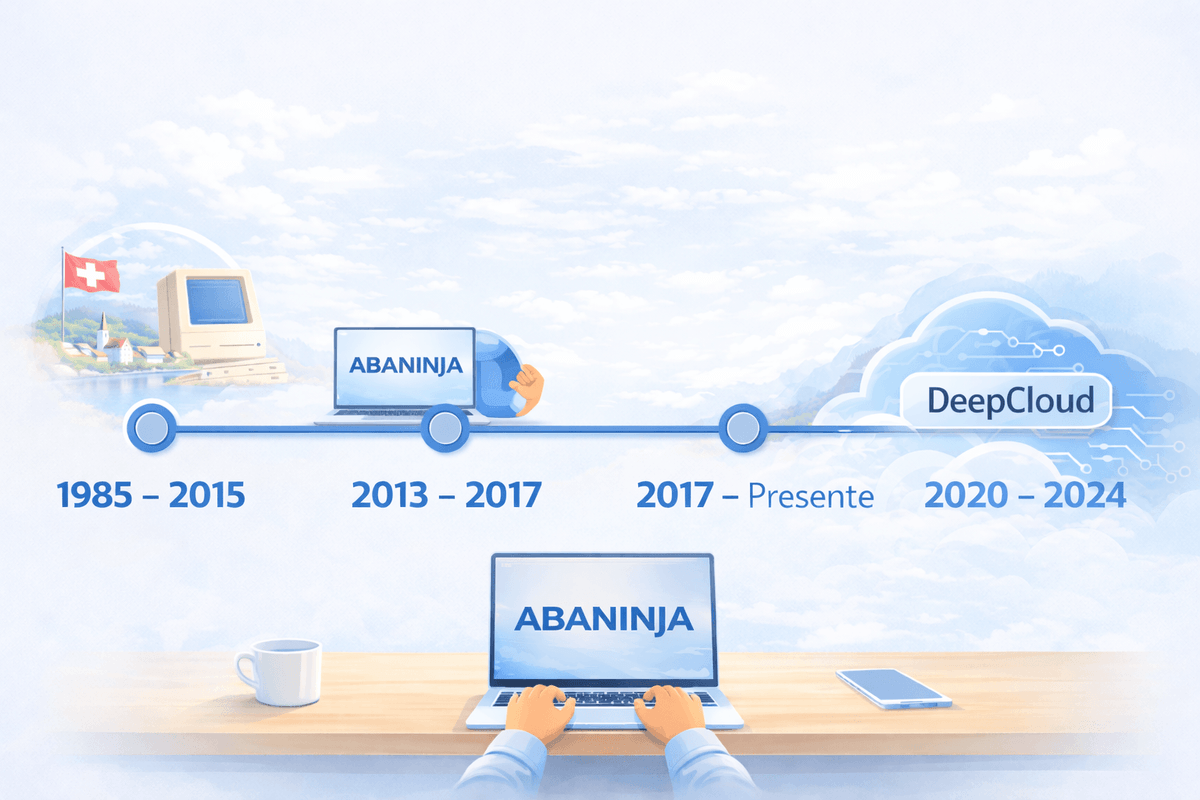
To understand AbaNinja's position in the Swiss accounting software market, it helps to understand where it came from and how it evolved into what it is today.
The story begins with Abacus Research AG, founded in 1985 by three graduates of the University of St. Gallen: Claudio Hintermann, Thomas Köberl, and Eliano Ramelli. Starting from a student apartment, they built what would become the dominant business software provider for Swiss medium and large enterprises. By 2015, Abacus served over 44,000 customers and had established itself as the de facto standard for Swiss fiduciaries and accounting professionals.
Abacus's success was built on a simple but powerful insight: Swiss businesses needed software designed specifically for Swiss regulations. International giants like SAP and Microsoft Dynamics struggled to adapt their global platforms to Swiss particularities—the unique VAT structures, the Swiss Code of Obligations, and the country’s distinct banking communication standards. Abacus hard-coded these Swiss realities into their software from day one, creating a product that simply worked better for local businesses than any imported alternative.
However, this dominance came with a significant limitation. Abacus was built on the “thick client” model: robust, on-premise software installed on local servers. This approach required significant upfront investment and ongoing maintenance, making it impractical for freelancers, startups, and very small businesses.
The early 2010s brought a tectonic shift to the software industry: Software-as-a-Service (SaaS). In Switzerland, this disruption arrived in the form of Bexio, founded in 2013, which offered a browser-based, subscription-only accounting solution requiring no installation and minimal training. Bexio targeted exactly the market segment Abacus had ignored: freelancers, startups, and micro-businesses who couldn’t justify the cost and complexity of enterprise software.
For Abacus, this represented an existential threat—not because freelancers paying CHF 30 per month represented significant revenue, but because of lifecycle risk. If the next generation of Swiss businesses started on non-Abacus platforms, they would grow into medium-sized enterprises that remained outside the Abacus ecosystem. The company’s grip on the fiduciary market would gradually weaken.
AbaNinja was Abacus’s strategic response. Launched in 2016–2017, the product name itself—invoking speed, agility, and precision—signaled a departure from the staid corporate branding of the main Abacus ERP. The software was designed as a “flank protection” product with three primary objectives: provide a free or low-cost entry point into the Abacus ecosystem, ensure seamless data flow with fiduciaries using Abacus, and serve as a testing ground for Abacus’s cloud capabilities.
Unlike the core ERP, which required certified partners for implementation, AbaNinja was designed for “zero-touch” onboarding. A business owner could register online and create their first professional invoice within minutes.
In 2017, AbaNinja became the cornerstone of a broader initiative: Swiss21.org. Rather than a single company, Swiss21 was conceived as an alliance of Swiss software providers offering a “digital starter pack” for the Swiss economy. The proposition was compelling: a suite of integrated business tools—invoicing, accounting, e-commerce, point of sale, CRM, and payroll—offered free or at low cost to digitize Swiss SMEs.
Within this ecosystem, AbaNinja serves as the financial engine. When a customer purchases a product through 21.Shop, the order data flows into AbaNinja. When the 21.POS cash register closes for the day, the totals are automatically journaled. When a contact is updated in 21.CRM, that change propagates to AbaNinja’s address database. This tight integration creates significant switching costs: a user might find a better invoicing tool than AbaNinja or a better shop than 21.Shop, but finding a connected pair that works seamlessly for free is nearly impossible.
As cloud technology matured and artificial intelligence became increasingly central to accounting automation, Abacus recognized the need for a dedicated technology unit. In January 2020, DeepCloud AG was incorporated in the Canton of St. Gallen, headquartered at the same address as Abacus in Wittenbach. DeepCloud was established as an independent subsidiary focused on building “Deep Services”—a new layer of AI-driven infrastructure including DeepO (intelligent document recognition), DeepBox (secure document exchange), and DeepSign (qualified electronic signatures).
Between 2023 and 2024, operational responsibility for AbaNinja was transferred from Abacus Research AG to DeepCloud AG. This wasn’t a sale to an external party, but rather an internal restructuring. The strategic rationale was straightforward: AbaNinja had evolved from a simple invoicing tool into a frontend for DeepCloud’s AI services. Moving the product under the DeepCloud umbrella streamlined the integration of features like AI-powered receipt scanning and digital signatures.
This transition is why you may now encounter references to “DeepNinja” alongside AbaNinja. DeepNinja is essentially the same core software positioned within the DeepCloud ecosystem, primarily targeting fiduciary clients and users requiring tighter integration with DeepBox and DeepSign. For most small businesses, the Swiss21 platform and 21.AbaNinja remain the appropriate entry point.
Today, Swiss21 reports over 80,000 active users, making it one of the most widely adopted business software platforms in Switzerland. The platform continues to evolve, with significant pricing restructuring in 2025 signaling a shift from pure user acquisition toward sustainable monetization.
The Ecosystem Behind AbaNinja
When you sign up for AbaNinja, you're actually joining the Swiss21 ecosystem—a suite of interconnected business applications designed to work together. Understanding this ecosystem helps explain both AbaNinja’s strengths and its limitations.
Swiss21 operates on a “better together” philosophy. Each application handles a specific business function, but all share a common database and pass information seamlessly between modules. Your customer addresses exist in one place and are available everywhere. A sale in your online shop automatically creates an invoice in AbaNinja and updates your inventory. An employee’s time tracking in the mobile app flows directly into payroll processing.
The core applications include 21.AbaNinja for accounting and invoicing, 21.AbaSalary for payroll, 21.Shop for e-commerce, 21.POS for point-of-sale transactions, 21.CRM for contact management, and AbaClik as the mobile companion app. All of these are included in every Swiss21 subscription, even the free Starter tier, though with varying usage limits.
This bundled approach represents Swiss21’s key competitive advantage and its primary limitation. For businesses that need most or all of these functions, the integrated platform offers exceptional value—especially at the free and entry-level tiers. However, for businesses that already have preferred tools for some functions (perhaps a Shopify store or HubSpot CRM), the Swiss21 ecosystem offers less flexibility. You can’t simply use AbaNinja for invoicing while connecting it to external tools with the same seamlessness you’d get within the Swiss21 family.
The ecosystem also creates practical lock-in. Once you’re using multiple Swiss21 applications with data flowing between them, migrating away becomes significantly more complex than switching a single standalone tool. This isn’t necessarily problematic—many users appreciate the integrated experience—but it’s worth understanding before you invest significant time in setting up the platform.
Magic Heidi and AbaNinja both target Swiss freelancers and small businesses, but they approach the market from fundamentally different directions. Understanding these differences can help you choose the right tool for your situation.
AbaNinja emerged from the enterprise software world. It was created by Abacus, a company with decades of experience serving Swiss fiduciaries and medium-sized businesses. This heritage shows in the product: AbaNinja uses proper double-entry bookkeeping, offers deep integration with professional accounting systems, and provides the kind of detailed financial reporting that accountants expect. The interface is functional and data-dense, designed for users who understand (or are willing to learn) basic accounting concepts.
Magic Heidi takes the opposite approach. Built specifically for freelancers who want to focus on their work rather than their bookkeeping, Magic Heidi emphasizes simplicity above all else. The interface is deliberately streamlined, the terminology avoids accounting jargon where possible, and the workflow is designed to minimize the time you spend on administrative tasks. Where AbaNinja offers extensive configuration options, Magic Heidi makes sensible default choices on your behalf.
| Aspect | AbaNinja (Swiss21) | Magic Heidi |
|---|---|---|
| Primary focus 🎯 | Comprehensive business management | Freelancer invoicing and expenses |
| Bundled applications 🧩 | Shop, POS, CRM, Payroll, Mobile app | Invoicing-focused |
| Free tier 🆓 | Yes (limited) | Yes (limited) |
| Paid pricing 💰 | From CHF 21/month | From CHF 9/month |
| Accountant integration 🤝 | Excellent (Abacus ecosystem) | Export-based |
| Learning curve 📚 | Moderate | Minimal |
| Swiss QR-bills 🇨🇭 | Full support | Full support |
| VAT handling 🧮 | All Swiss methods | All Swiss methods |
| AI expense scanning 🤖 | Yes (DeepO) | Yes |
| Multi-currency 🌍 | Yes | Yes |
| Interface language 🌐 | DE, FR, IT, EN | DE, FR, EN |
The most significant difference lies in what each product is trying to be. AbaNinja is one component of the Swiss21 ecosystem, designed to work alongside e-commerce, point-of-sale, CRM, and payroll applications. If you’re running a retail business with a physical store and online shop, or if you have employees, the Swiss21 ecosystem offers genuine value through its integrated approach.
Magic Heidi is purpose-built for the independent professional: consultants, designers, developers, coaches, and similar service providers who primarily need to invoice clients and track expenses. It doesn’t try to be an e-commerce platform or payroll system because most freelancers don’t need those functions. This focused approach allows for a simpler interface and a lower price point.
If your accountant uses Abacus software (and many Swiss fiduciaries do), AbaNinja offers a compelling advantage. Through the AbaWeb integration, your accountant can view your AbaNinja data in real time within their own Abacus environment. There’s no file export, no manual data entry on their end, and no synchronization delays. You handle the day-to-day invoicing and categorization; they handle the year-end closing, VAT reconciliation, and tax optimization. This seamless collaboration can significantly reduce your accounting fees and eliminate data entry errors.
Magic Heidi takes a more universal approach. It exports data in standard formats (CSV, PDF) that any accountant can work with, regardless of what software they use. This flexibility means you’re not locked into the Abacus ecosystem, but you also don’t get the real-time collaboration that AbaNinja offers with Abacus-using fiduciaries.
👉 Choose AbaNinja if:
👉 Choose Magic Heidi if:
What They Mean for Users
In January 2025, Swiss21 implemented significant changes to its pricing structure that affected thousands of existing users. Understanding these changes is important whether you’re an existing user or considering signing up.
The most impactful change was the removal of automatic bank reconciliation from the free Starter tier. Previously, even free users could connect their bank accounts and have transactions automatically imported and matched to invoices. This feature was central to the value proposition of a “free” accounting solution—without it, users must manually download bank statements and upload them, or manually mark invoices as paid. For any business with more than a handful of transactions per month, this manual process becomes impractical.
The free tier also now limits AI document recognition (the feature that automatically extracts information from uploaded receipts and invoices) to just 10 scans per month, and caps support tickets at three total. These limitations, combined with the bank reconciliation restriction, effectively transform the Starter tier from a functional free accounting solution into an extended trial.
Swiss21’s stated rationale centers on sustainability. Hosting secure, compliant financial data and maintaining connections to over 70 Swiss banks involves significant ongoing costs. The company argues that businesses deriving real value from the platform should contribute to these costs. The CHF 21 per month Basic tier, they suggest, represents fair value for the automation and integration provided.
For existing free users, the changes created a difficult choice: upgrade to a paid tier, accept significantly reduced functionality, or migrate to a different platform entirely. The situation was complicated by Swiss21’s “no downgrade” policy—once you upgrade to a paid tier and unlock advanced features, you cannot return to the free tier even if you stop using those features.
The pricing changes also revealed a broader strategic shift. Swiss21 appears to be transitioning from a growth-focused model (maximize free user acquisition) to a yield-focused model (convert existing users to paying customers). This is a common evolution for freemium software companies, but it can feel like a bait-and-switch for users who built their workflows around the original free offering.
If you’re evaluating Swiss21 today, the practical reality is that the Basic tier at CHF 21 per month represents the minimum viable option for most businesses. The free Starter tier may be useful for testing the interface or for businesses with extremely low transaction volumes, but it’s no longer a sustainable long-term solution for active businesses.
For many Swiss businesses, where their financial data is stored matters as much as how the software functions. Switzerland’s strong privacy traditions and its position outside the European Union create unique considerations for business software.
AbaNinja and the Swiss21 platform store all data in DeepCloud’s data centers located in Wittenbach, Switzerland. These facilities hold ISO 27001 certification, the international standard for information security management. Data never leaves Swiss borders, and Swiss data protection law (the Federal Act on Data Protection, or FADP) governs how it’s handled.
This Swiss data residency provides meaningful protection that goes beyond marketing claims. Unlike data stored with US cloud providers, Swiss-hosted data is not subject to the US Cloud Act, which allows American authorities to compel disclosure of data stored by US companies regardless of where the servers are physically located. For businesses handling sensitive client information—lawyers, healthcare providers, financial advisors—this distinction can be legally significant.
The DeepCloud infrastructure also supports the qualified electronic signature capabilities offered through DeepSign. Swiss law recognizes qualified electronic signatures as legally equivalent to handwritten signatures, but this recognition depends on the signature being created and stored according to specific technical and legal requirements. The integrated Swiss infrastructure ensures these requirements are met.
That said, cloud-based software always involves trusting a third party with your business data. AbaNinja’s terms of service grant Abacus certain rights to view and modify content if there’s suspicion of illegal activity, though they state no obligation to proactively monitor content. Users retain ownership of their data and can export it or delete their accounts at any time.
For businesses subject to regulatory requirements around data handling—financial services, healthcare, legal services—it’s worth reviewing the complete terms of service and data processing agreements before committing. Swiss21 makes these documents available on their website, and they’re written in plain language rather than impenetrable legalese.