Complete Guide 2026

The Complete Swiss Freelancer's Guide to Expense Tracking & Financial Optimization

Managing expenses effectively isn't just about saving receipts—it's about protecting thousands of francs that could either go to tax authorities or stay in your business. Master the art of tracking, deducting, and optimizing every franc.

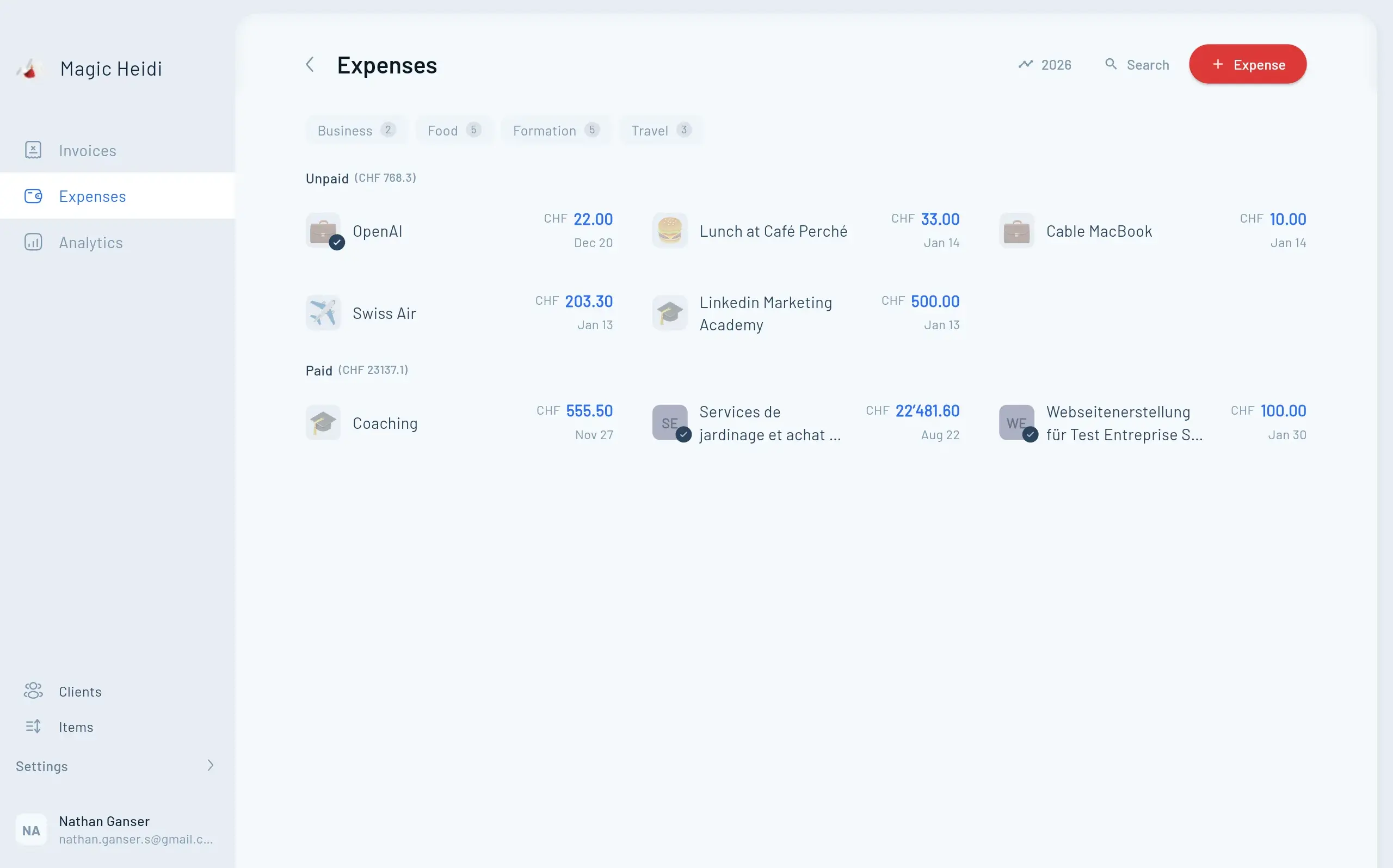
Magic Heidi Expense Tracking Dashboard

Here's the reality: 36% of freelancers are unaware of all available tax deductions, and over 50% don't track expenses accurately. That gap between what you could deduct and what you actually deduct? It averages CHF 8,000–10,000 annually for established freelancers.

This guide shows you exactly which expenses to track, how to optimize your financial health, and which tools make the process effortless—all with Swiss-specific rules, thresholds, and deadlines.

Swiss Tax Reality

Why Expense Tracking Matters More in Switzerland

Switzerland's tax system is uniquely complex. You're not just dealing with one tax authority—you're managing obligations at three levels simultaneously.

Add social contributions (AHV/IV/EO at up to 10% of net income), and suddenly every deductible expense represents significant savings across multiple tax calculations.

The Swiss advantage: If your annual turnover stays under CHF 500,000, you can use simplified bookkeeping instead of full double-entry accounting. But "simplified" doesn't mean careless—you still need organized records of income, expenses, and assets.

What Poor Expense Tracking Actually Costs

Let's put numbers to the problem:

Scenario: Freelance consultant earning CHF 120,000 annually in Zurich

  • Combined effective tax rate: ~25% (federal + cantonal + municipal)
  • Missed deductions: CHF 12,000 (home office, meals, travel, courses)
  • Extra tax paid: CHF 3,000
  • Over 10 years: CHF 30,000 left on the table

That's not accounting for lost compound growth if you'd reinvested those savings.

Hidden Deductions

The 7 Expense Categories
Swiss Freelancers Always Forget

Most freelancers track obvious expenses like software subscriptions and equipment. But these often-overlooked categories can add up to thousands:

Home Office Deductions

If you work from home, you can deduct a proportional share of your housing costs. Two methods: Flat rate (CHF 30 per m² in some cantons) or pro-rata calculation (percentage of rent, utilities, internet).

  • 20m² office in 100m² apartment = CHF 400/month rent deduction
  • Plus proportional utilities, internet, building insurance
  • Annual deduction potential: CHF 5,280+
  • Critical rule: Space must be exclusively for business

Business Meals (50% Deductible)

Meeting a client for coffee? Taking a prospect to lunch? You can deduct 50% of meal costs when there's a clear business purpose.

  • Client meetings and pitch presentations
  • Networking events and conferences
  • Business lunches with documented purpose
  • Best practice: Note client name on each receipt

Professional Development

Every course, conference, trade journal, or business-focused subscription that improves your professional skills is fully deductible.

  • Online courses (Udemy, Coursera, LinkedIn Learning)
  • Industry conference tickets and memberships
  • Professional association fees
  • Average missed annually: CHF 1,500–2,500

Travel & Transportation

Business travel is fully deductible with systematic tracking. Public transport, mileage, parking—it all counts.

  • Public transport tickets (GA travelcards qualify!)
  • Mileage at cantonal rates (typically CHF 0.70/km)
  • Taxis, parking fees for business purposes
  • Bike-share and e-scooter rentals to client meetings

Insurance Premiums

Business-specific insurance is deductible (though regular health insurance remains personal).

  • Professional liability coverage
  • Cyber-risk insurance for digital businesses
  • Legal expense insurance for business matters
  • Equipment and business interruption insurance

Phone & Internet

The business portion of your phone and internet bills is deductible. Track business vs. personal usage or use flat-rate percentages.

  • CHF 100/month phone + CHF 60/month internet
  • 70% business use = CHF 1,344 annual deduction
  • Separate business line = 100% deductible
  • Most freelancers claim 60-80% business use

Pillar 3a Contributions

Not business expenses per se, but deductible from taxable income up to 20% of net earnings (capped at CHF 35,280 for self-employed in 2024).

  • CHF 100,000 net income = max contribution eligible
  • Potential tax savings: CHF 7,000–10,000 depending on canton
  • Reduces both income tax and social contributions
  • Must be paid before December 31 each year
Smart Tools

Track Expenses with AI-Powered Automation

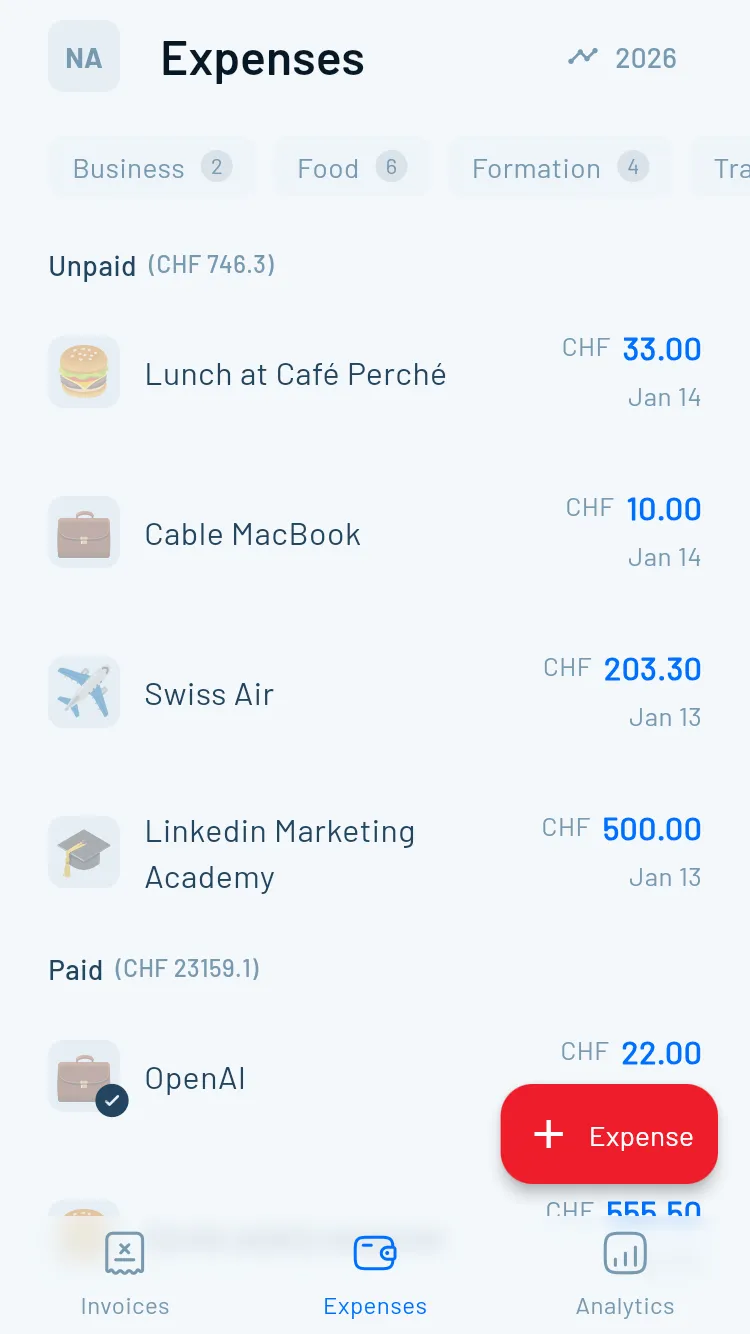
Paper receipts are the enemy of freelancers. Lost. Faded. Forgotten. Snap a photo—Magic Heidi's AI extracts the date, amount, VAT, category, and vendor automatically. No more manual data entry. No more shoeboxes of receipts.

Magic Heidi AI Expense Scanning on Mobile

Choosing Your Expense Tracking Method

You have three realistic options. Each has tradeoffs:

Spreadsheets (Manual)

Best for: First-year freelancers with minimal transactions

Pros:

  • Free
  • Complete control
  • Simple to start

Cons:

  • Time-consuming (3-5 hours monthly)
  • High error rate (30% more mistakes than automated systems)
  • No automatic categorization
  • Manual VAT calculations
  • No receipt storage

Verdict: Works until you hit CHF 60,000–80,000 revenue or VAT registration.

Swiss Expense Management Software

Best for: Growing freelancers and VAT-registered businesses

Pros:

  • Automated expense categorization (AI-powered)
  • Receipt scanning and storage
  • Swiss VAT rate integration (7.7%, 3.7%, 2.5%)
  • Multi-language support (DE/FR/IT/EN)
  • QR-bill compatibility
  • Direct bank statement import
  • 60% less administrative time vs. manual tracking

Cons:

  • Monthly cost (CHF 10–40 typically)
  • Learning curve initially

Top Swiss options:

  • Magic Heidi: All-in-one (invoicing + expenses + VAT + accounting)
  • bexio: Comprehensive but pricier
  • SmallInvoice: Good for basic needs
  • Abacus: Enterprise-focused

Verdict: Essential once revenue exceeds CHF 80,000 or you register for VAT.

Software Comparison

Magic Heidi vs. Traditional Accounting Tools

Purpose-built for Swiss freelancers who want to spend less time on administration and more time on billable work.

FeatureMagic HeidibexioSpreadsheetsTraditional Accountant
Monthly CostCHF 24.99CHF 45+FreeCHF 200+
AI Expense Scanning Included No No Manual
Setup Time5 minutes30+ minutes1-2 hoursMultiple meetings
Swiss VAT Automation 7.7%, 3.7%, 2.5% Yes Manual Yes
QR-Bill Generation Automatic Yes No Varies
Mobile Receipt Capture iOS & Android Limited No Email only
Time Saved vs. Manual60% less admin40% lessBaseline80% less (but costly)
Financial Optimization

Beyond Just Tracking: Strategic Financial Management

Tracking expenses is step one. Optimization means using that data to make better business decisions.

Debt-to-Income Ratio

Understanding Your Financial Health

Your debt-to-income (DTI) ratio shows financial health and affects loan eligibility. Calculate it monthly to stay ahead.

  • Formula: (Total Monthly Debt Payments / Gross Monthly Income) × 100
  • Under 36% = Excellent (easy loan approval)
  • 36–50% = Acceptable (moderate risk)
  • Over 50% = High risk (loan denials likely)
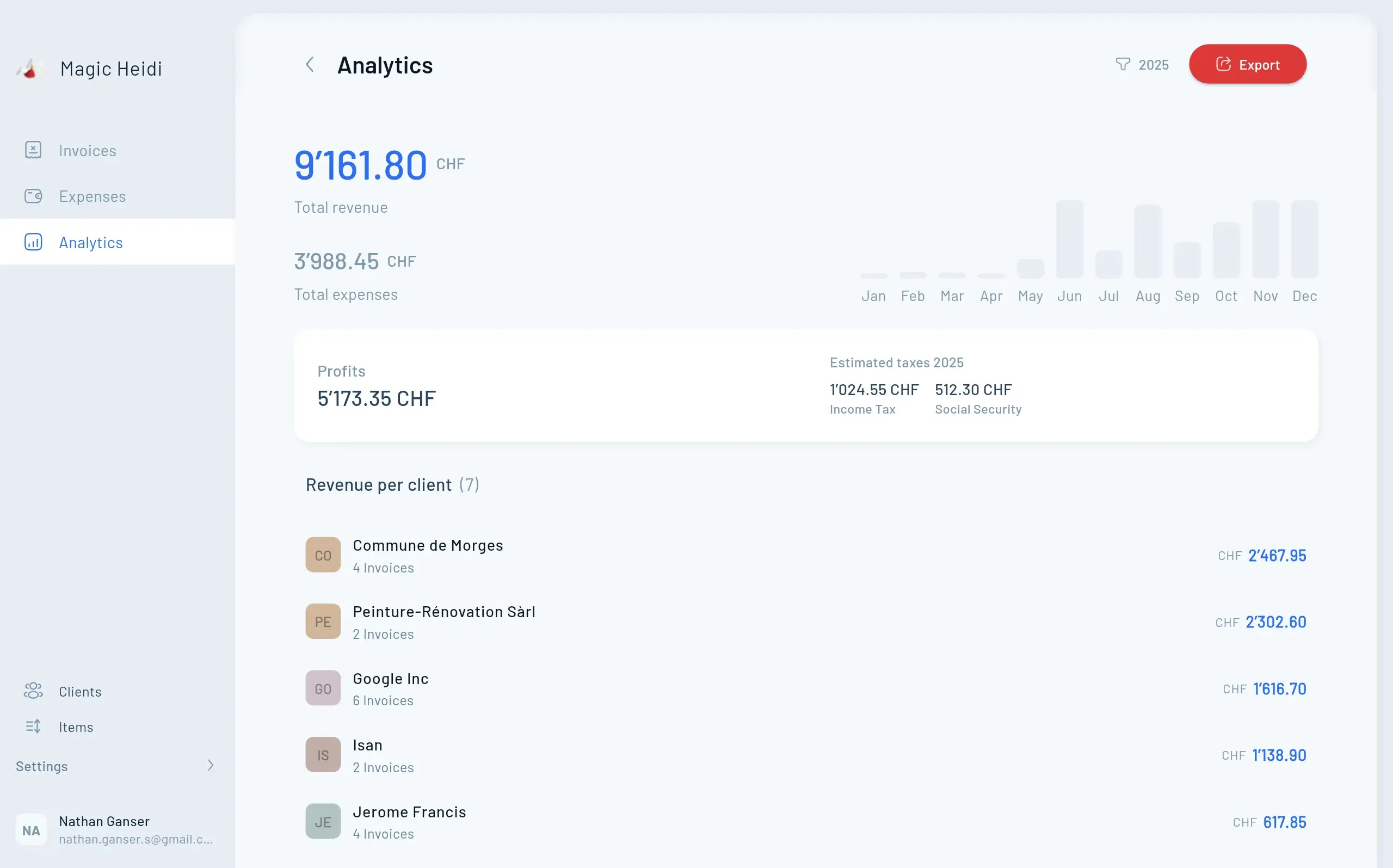
Magic Heidi Financial Analytics Dashboard

Example DTI Calculation:

  • Gross monthly income: CHF 10,000
  • Business loan payment: CHF 800
  • Equipment lease: CHF 300
  • Credit line interest: CHF 150
  • Total debt: CHF 1,250
  • DTI: 12.5% (Excellent)

Optimization strategy: If your DTI exceeds 40%, prioritize paying down high-interest debt before taking new financing.

Return on Assets (ROA): Measuring Efficiency

ROA shows how effectively your business assets generate profit.

Calculation:

ROA = (Net Income / Total Assets) × 100

Example:

  • Annual net profit: CHF 75,000
  • Total assets: CHF 30,000 (equipment, receivables, cash)
  • ROA: 250%

Benchmarks:

  • Under 5%: Assets aren't pulling their weight
  • 5–20%: Solid performance
  • Over 20%: Excellent asset efficiency

For freelancers, high ROA is typical (you're not asset-heavy like manufacturers). The key is trending—if ROA drops, investigate whether you're accumulating unproductive assets or if profitability is declining.

The Profit Margin Sweet Spot

After all expenses (including your AHV contributions), aim for:

  • Service-based freelancers: 40–60% net margin
  • Product-based businesses: 20–40% net margin

If margins are too low:

  1. Audit expenses monthly—identify 3 categories to reduce
  2. Raise prices (15% increase = significant margin improvement)
  3. Eliminate low-margin clients/projects
  4. Automate repetitive tasks

Common Expense Tracking Mistakes (And How to Avoid Them)

Mistake #1: Mixing Personal and Business Accounts

Problem: Makes expense categorization nearly impossible, raises audit flags

Solution: Open a dedicated business bank account. Costs CHF 5–15/month but saves hours of reconciliation and provides clear audit trails.

Mistake #2: Forgetting Small Purchases

Problem: CHF 15 here, CHF 30 there—adds up to CHF 2,000+ annually

Solution: Snap photos of receipts immediately (most apps have mobile scanning). Make it a daily 2-minute habit.

Mistake #3: Not Tracking Mileage Contemporaneously

Problem: Tax authorities reject retroactive mileage logs

Solution: Use automatic mileage tracking apps, or log trips same-day with purpose and odometer readings.

Mistake #4: Over-Claiming Home Office

Problem: Claiming 50% of a 2-bedroom apartment as office space invites audits

Solution: Be conservative. One dedicated room in a 4-room apartment = 25% maximum. Document exclusivity.

Mistake #5: Missing Digital Subscriptions

Problem: Annual renewals auto-charge and get overlooked

Solution: Quarterly review of credit card statements for recurring charges. Categorize all software, tools, and services.

FAQ

Frequently Asked Questions

How long must I keep receipts in Switzerland?

10 years from the end of the relevant tax period. Digital storage is legally acceptable and recommended for easier organization and backup.

Can I deduct 100% of business meals?

No. In Switzerland, business meals are typically 50% deductible. Keep receipts with client names and business purpose noted to support your deductions.

What's the home office deduction if I don't have a dedicated room?

Without a dedicated, exclusive workspace, home office deductions become difficult to justify. A corner of your bedroom won't qualify. Consider coworking space costs as fully deductible alternative.

When do I need to register for VAT?

Within 30 days of exceeding CHF 100,000 annual turnover. You can voluntarily register below this threshold if you have significant input VAT to reclaim.

How do I calculate my net income for AHV contributions?

Gross revenue minus all deductible business expenses (including depreciation). This net figure is what AHV/IV/EO contributions (up to 10%) are calculated on.

Can I deduct my regular health insurance?

No. Basic health insurance (LAMal/KVG) is a personal deduction on your tax return, not a business expense. Supplemental business-specific insurance (liability, cyber, legal) is deductible.

What happens if I miss the March 31 tax deadline?

File for an extension before the deadline via eTax or TaxMe. Most cantons grant automatic extensions. Filing late without extension triggers fines (CHF 100+) and interest charges.

Start Optimizing Your Freelance Finances Today

Expense tracking isn't about obsessing over every franc—it's about creating systems that work automatically, ensuring you never leave money on the table, and giving you crystal-clear visibility into your business health.

Keep Exploring

Dive deeper into specific aspects of freelance financial management:

Guide to Swiss Expense Tracking Software for Freelancers | 2026 Guide Finding the Right Tool for Recurring Expenses and Beyond — Compare features, pricing, and Swiss-specific capabilities of top expense platforms.

Expenses You Should Not Forget Track Every Deductible — Detailed breakdown of commonly missed expense categories with CHF examples and cantonal variations.

How to Deduct Travel Expenses Save on Business Trips — Complete guide to mileage rates, public transport deductions, and documentation requirements for Swiss tax authorities.

Simplifying Expense Tracking Easy Methods to Stay Organized — Practical systems for receipt management, categorization, and monthly reconciliation that take 15 minutes.

Unlocking Financial Success with ROA Boost Your Returns — Advanced strategies for measuring and improving your return on assets, with freelancer-specific benchmarks.

Maximizing Swiss Freelancer Profits Increase Your Earnings — Comprehensive profit optimization covering pricing, client selection, service packaging, and margin improvement.

Optimizing Your Debt Ratio Keep Finances Healthy — Detailed debt-to-income ratio guidance for freelancers, including loan eligibility thresholds and debt reduction strategies.