

Complete 2026 Guide

How to Become a Freelancer in Switzerland

Everything you need to know about AHV registration, permits, the CHF 100K threshold, taxes, and compliance. Start your independent career today.

Swiss Freelancer

Thinking about becoming a freelancer in Switzerland? You're not alone. With over 52,000 new companies registered in 2024 and roughly 25% of the Swiss workforce now freelancing, independent work has never been more popular.

But here's the reality: Switzerland isn't the easiest place to start freelancing. The bureaucracy is complex, the requirements seem endless, and one wrong move can lead to expensive compliance issues.

The good news? Once you understand the system, it becomes surprisingly straightforward. This guide walks you through everything—from validating your business idea to submitting your first invoice, managing taxes, and staying compliant year after year.

Should You Become a Freelancer? Ask Yourself First

Before diving into paperwork, answer these fundamental questions to determine if you're truly ready for freelance life in Switzerland.

💰

Financial Readiness

3-6 months of savings, ability to handle irregular income, and understanding of AHV contributions (5.371-10% of income)
🎯

Professional Readiness

Clients lined up, marketing skills, and comfort with uncertainty and self-promotion
📋

Legal Eligibility

EU/EFTA nationals can start immediately. Non-EU/EFTA need Permit C or be spouse of Permit C holder

The Counter-Intuitive Swiss Requirement: Start Working Before Registering

Here's what surprises most new freelancers: Swiss authorities expect you to already be conducting business before you complete your official registration.

When you apply to your canton's compensation office (Ausgleichskasse) for AHV registration, you'll need documentary evidence:

  • Invoice copies showing real client work
  • Signed agreements or contracts
  • Business offers you've sent
  • Branded letterhead or marketing materials
  • Proof of business insurance or office lease

Practical recommendation: Start canvassing clients, complete a few assignments, and create legitimate invoices before knocking on official doors. This "proof of activity" requirement is exactly why many freelancers work in a gray area initially—they need to work to prove they're working.

Just be aware: income earned during this pre-registration phase is still taxable and subject to AHV contributions once you're officially registered.

Step-by-Step Process

How to Register as a Freelancer in Switzerland

Follow these five essential steps to establish your freelance business legally and stay compliant with Swiss regulations.

Swiss Freelancer Registration Process
Registration Steps

Five Steps to
Official Freelancer Status

Complete these steps in order to establish your legal freelance business in Switzerland.

Step 1 - Validate Your Business Idea

Get your first 2-3 clients and complete actual work. This serves dual purposes: proves market demand and provides documentation for registration.

  • Complete real client work before registering
  • Create professional invoices for documentation
  • Keep records of all communications and contracts
  • Build portfolio of completed projects

Step 2 - Register with AHV/AVS

Your canton's compensation office must recognize your status as self-employed. Processing takes 4-8 weeks.

  • Complete affiliation form from cantonal Ausgleichskasse
  • Submit invoice copies and client agreements
  • Provide business letterhead and marketing materials
  • Contribution rates: 5.371% to 10% of annual income

Step 3 - Commercial Register (If Over CHF 100K)

Mandatory when annual turnover exceeds CHF 100,000. Optional below but recommended for credibility.

  • CHF 120 registration fee (CHF 500-1,000 with advisor)
  • Business name must include your surname
  • Provides legal protection for commercial name
  • Annual fees vary by canton (CHF 80-150)

Step 4 - VAT Registration (Only if Over CHF 100K)

VAT registration becomes mandatory once taxable turnover exceeds CHF 100,000 annually.

  • Voluntary registration possible below threshold
  • Collect VAT from Swiss clients and remit quarterly
  • Exports may be VAT-exempt
  • Detailed record-keeping required

Step 5 - Set Up Accounting System

Establish robust systems from day one. Requirements depend on your turnover level.

  • Below CHF 500K: simplified 'milk book' system suffices
  • Above CHF 500K: full accounting required
  • Keep all documents for 10 years minimum
  • Consider Swiss-specific accounting software

Over 326,000 active sole proprietorships operate in Switzerland—making it the most popular legal form for freelancers.

Why sole proprietorship (Einzelfirma) works for most freelancers:

  • Simplest structure with minimal setup requirements
  • No minimum capital injection required
  • Fast implementation
  • Direct control over all business decisions
  • Straightforward tax treatment

The critical downside: Unlimited personal liability. Your personal assets are at risk if business debts or legal issues arise. Consider liability insurance to mitigate this risk.

When to consider alternatives:

  • If your business carries significant liability risk (construction, healthcare)
  • When you want to bring in partners
  • If you're seeking external investment
  • Once annual turnover approaches CHF 500,000-1,000,000

At that point, forming a GmbH (limited liability company) or AG may make sense—but that's beyond freelancing.

Tax Obligations

Understanding Your Swiss Tax Obligations

Switzerland's federal structure means you'll pay taxes at three levels: federal, cantonal, and municipal. Combined effective rate averages 36.7%.

Swiss Tax Structure

Filing deadlines: Tax return deadlines vary by canton but generally fall around March 31st of the following year. Extensions are usually available upon request.

Estimated payments: Some cantons require quarterly estimated tax payments. Budget accordingly to avoid year-end cash flow crunches.

Pension planning reality check: For a full AHV pension, you need 44 years of contributions from age 21 to retirement (age 65). Each missing contribution year reduces your pension by 2.3%.

  • Minimum monthly pension (with complete records but low income): CHF 1,260
  • Maximum monthly pension (requiring CHF 90,720+ average annual income): CHF 2,520

As a freelancer without mandatory 2nd pillar contributions, plan additional retirement savings aggressively.

Common Challenges

Overcoming Freelancer Challenges

Five major challenges every Swiss freelancer faces—and practical solutions to overcome them.

Challenge 1

Clients Who Don't Pay

Freelancers face unique vulnerability when clients delay payment or refuse to pay entirely.

  • Always use written contracts (verbal agreements are risky)
  • Request 30-50% upfront for new clients
  • Set clear payment terms (15-30 days standard)
  • Include late payment fees in contracts (5% plus interest)
  • Use invoicing software with automated reminders
  • Consider invoice financing for cash flow gaps
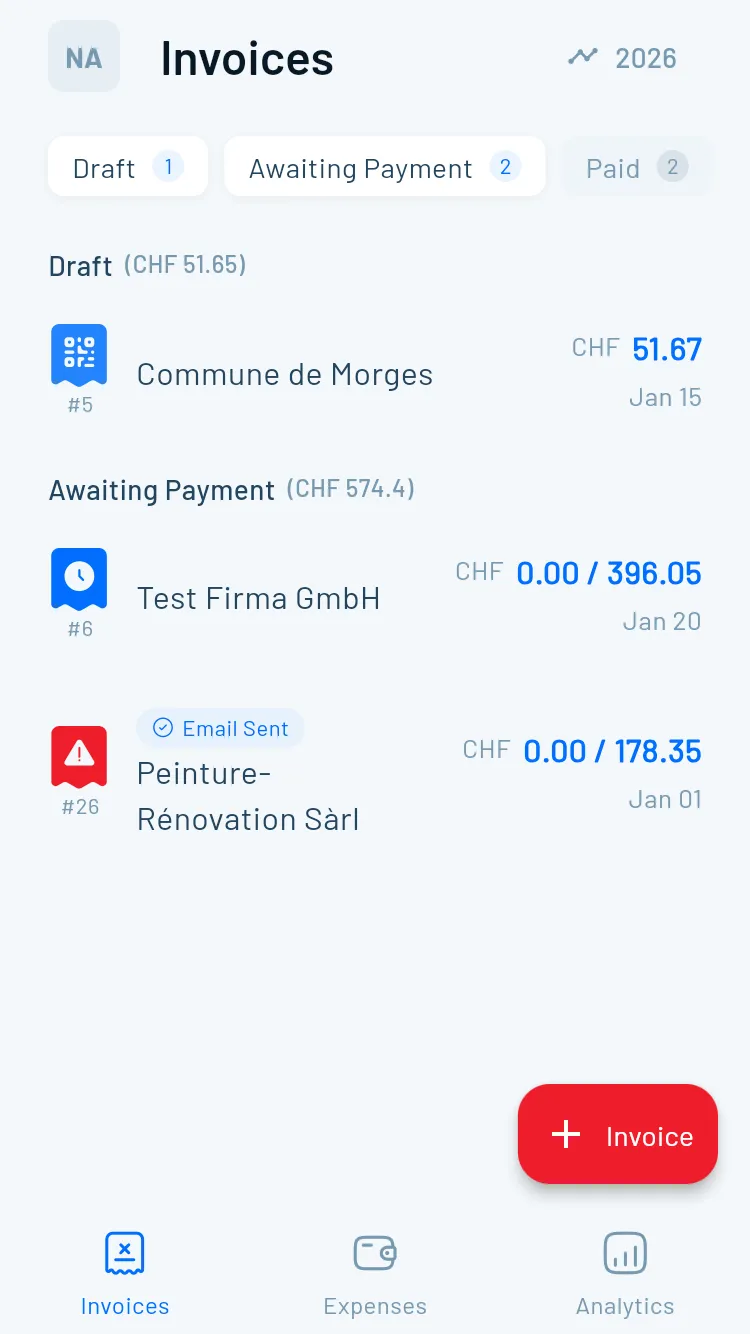
Magic Heidi Invoice Management
Challenge 2

Irregular Income

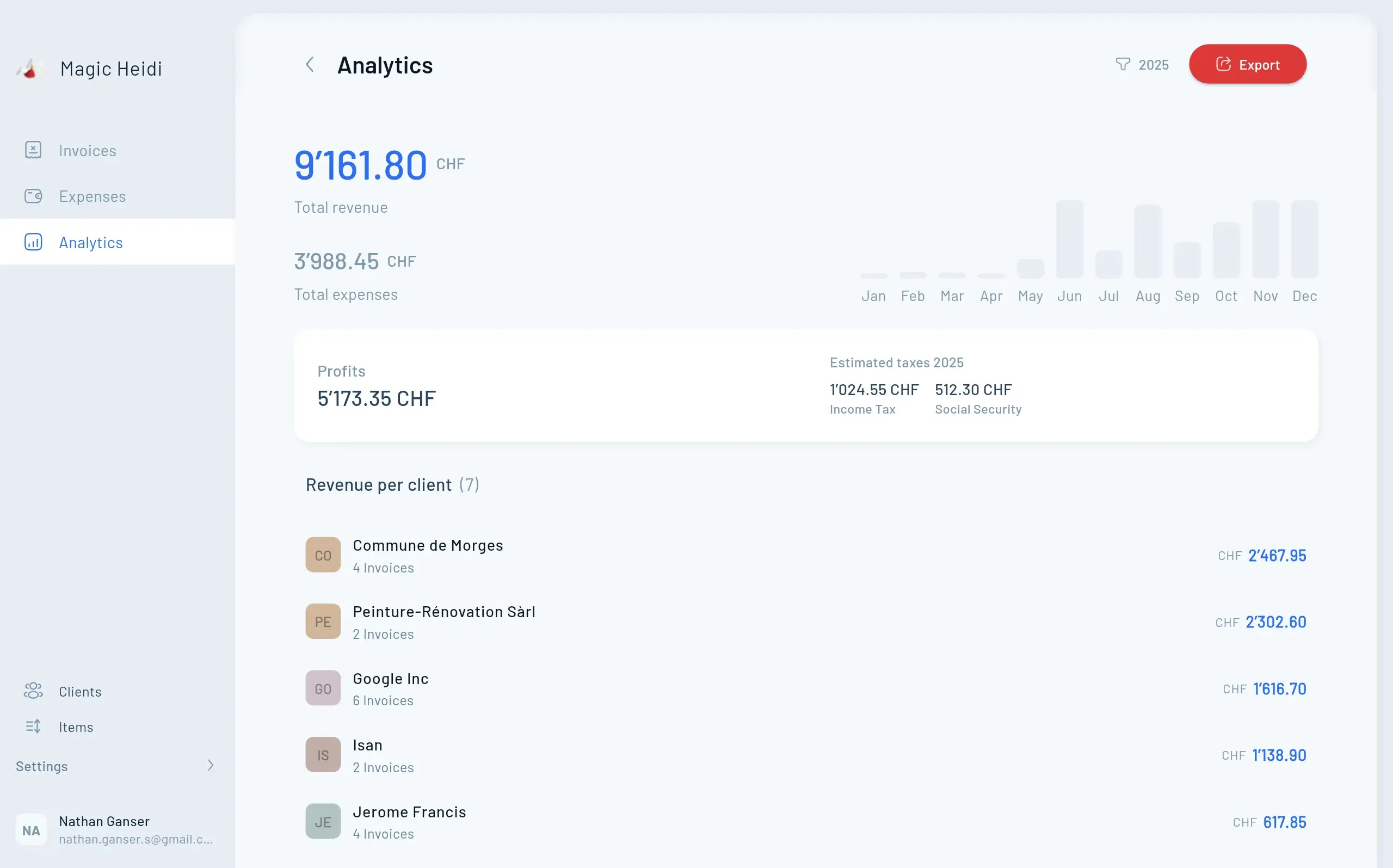
Some months deliver strong revenue, others almost nothing. Financial planning becomes critical.

  • Maintain 6 months of expenses as emergency fund
  • Use separate business and personal accounts
  • Pay yourself consistent 'salary' rather than spending windfalls
  • Create rolling 12-month revenue projections
  • Diversify client base to avoid dependency
  • Consider retainer agreements for steady monthly income
Magic Heidi Analytics Dashboard
Challenge 3

Underpricing Your Services

Many new freelancers charge too little, undervaluing their work and expertise.

  • Research industry rates for your canton and specialty
  • Calculate true hourly rate including all expenses and taxes
  • Account for non-billable time (admin, marketing, development)
  • Start competitive, then increase as you build reputation
  • Price based on value delivered, not just time spent
  • Review rates every 6-12 months
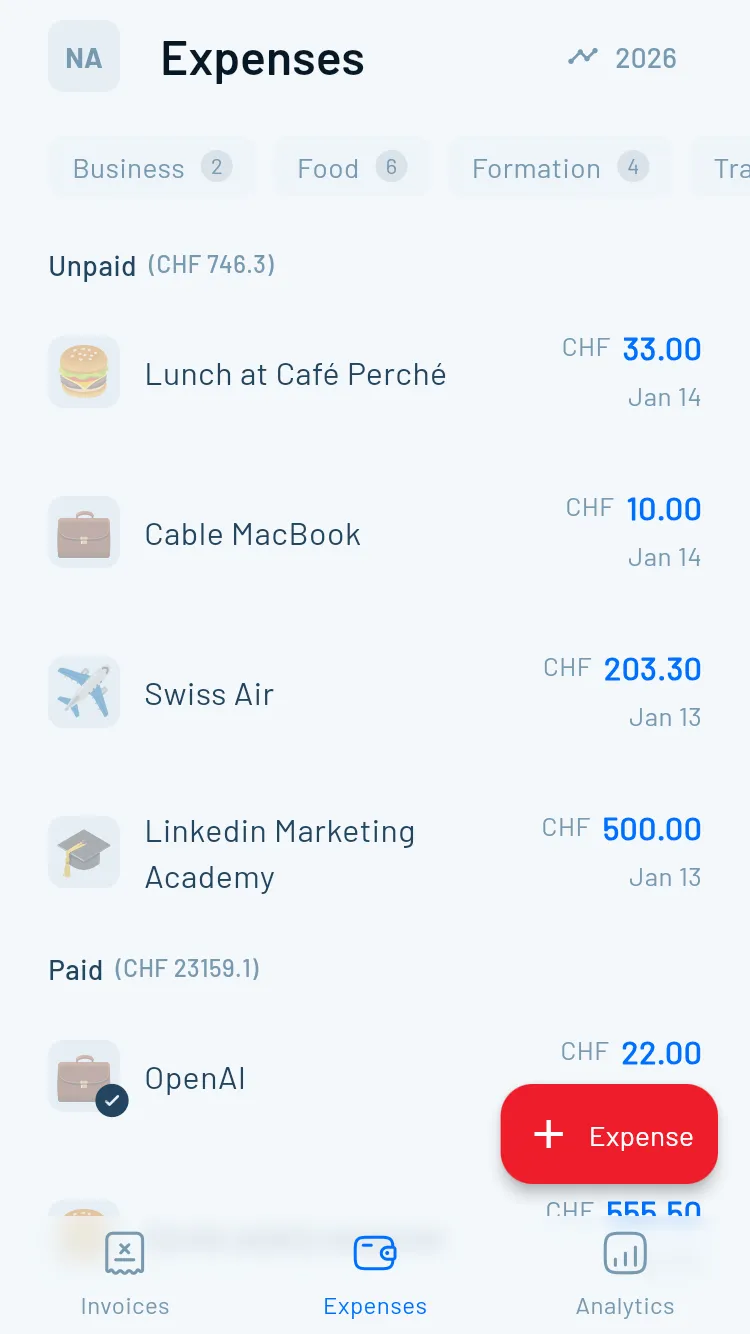
Magic Heidi Expense Tracking

Challenge 4: Risk of Employee Reclassification

If your working relationship is poorly structured, authorities may reclassify you as an employee rather than an independent contractor.

Red flags that trigger reclassification:

  • Working exclusively for one client
  • Client controls your working hours and methods
  • Using client's equipment and workspace
  • Receiving benefits typical of employment
  • No independent business infrastructure

Consequences:

  • Back payment of employer social security contributions
  • Tax penalties
  • Legal complications

Protection strategies:

  • Maintain multiple clients simultaneously
  • Use your own equipment and tools
  • Invoice in your business name with proper VAT (if applicable)
  • Work from your own office/workspace
  • Set your own schedule and methods
  • Demonstrate financial risk (your own investments, collection risk)

Challenge 5: Managing Complex Tax and VAT Regulations

Swiss tax and VAT laws can be confusing, especially for newcomers.

Solutions:

  • Hire an accountant for your first year, at minimum
  • Use accounting software designed for Swiss regulations
  • Attend free seminars offered by cantonal commerce offices
  • Join freelancer associations for peer support
  • Set aside 30-40% of revenue for taxes and contributions
  • Track every expense meticulously (potential deduction)

Magic Heidi automates Swiss VAT calculations, tracks deductible expenses, categorizes income, and imports bank statements—reducing your compliance burden significantly.

Essential Tools and
Resources for Swiss Freelancers

Official government platforms, accounting software, and networking communities to support your freelance journey.

📱 Magic Heidi
🔗 LinkedIn Groups
👥 Meetup.com
🤝 Strategic Volunteering
🏛️
EasyGov.swiss

Electronic platform for administrative tasks, company registration, and official communications

📚
SECO SME Portal

Comprehensive guides from State Secretariat for Economic Affairs

🇨🇭
Ch.ch

Official Swiss government portal with multilingual information

💼
Coworking.ch

Networking events for freelancers across Switzerland

FAQ

Frequently Asked Questions

Can I freelance while keeping my full-time job?

Yes, but manage commitments carefully. Ensure your employment contract doesn't prohibit outside work or create conflicts of interest. You'll still need to register with AHV once self-employment income exceeds CHF 2,300 annually, and you'll pay contributions on both employed and self-employed income.

Do I need a business bank account?

Not legally mandatory, but highly recommended. It simplifies accounting, separates personal and business finances, and appears more professional to clients. Some banks offer special SME accounts with lower fees.

Can I work from home as a freelancer?

Yes. However, if you claim home office deductions, you may need to notify your building management or landlord. Some residential leases restrict commercial activity. Dedicated workspace strengthens your case as truly self-employed.

What if my annual income is below CHF 2,300?

You may not need to register with AHV if income stays below this threshold. However, contributions help build your pension entitlement, so voluntary registration might still make sense.

How do I price my services?

Calculate: (desired annual income + business expenses + taxes + contributions) ÷ billable hours per year. Remember that only 60-70% of your time will be billable when accounting for administration, marketing, and professional development. Research industry rates in your canton and adjust based on your experience level.

What if I have clients outside Switzerland?

International clients add complexity. Services provided to foreign clients may be VAT-exempt. Currency exchange management becomes important—consider using specialized fintech services like Wise or PayPal for international payments. Keep detailed records of all cross-border transactions.

How often do I need to file taxes?

Annual tax returns are standard, with deadlines varying by canton (typically March 31st). Some cantons require quarterly estimated payments. VAT filings are quarterly or semi-annual depending on your turnover. Set reminders well in advance.

What happens if I exceed the CHF 100,000 threshold mid-year?

Register for VAT and Commercial Register as soon as you realize you'll cross the threshold. It's your responsibility to monitor turnover and register proactively. Retroactive registration can trigger penalties.

What's the biggest mistake new freelancers make?

Underestimating administrative time and costs. Budget both time and money for invoicing, accounting, tax preparation, client communication, and professional development. These 'non-billable' hours significantly impact your effective hourly rate.

Should I hire an accountant?

For your first year, strongly recommended—especially if you're unfamiliar with Swiss tax law. Even experienced freelancers benefit from annual accountant consultations to optimize deductions and ensure compliance. Factor CHF 1,000-3,000 annually into your budget.

Take Control of Your Freelance Journey

Switzerland offers tremendous opportunities for freelancers: high rates, strong currency, excellent work-life balance, and a thriving economy with 52,978 new companies registered in 2024 alone.

Ready to Simplify Your Freelance Finances?

Magic Heidi handles invoicing, expense tracking, VAT compliance, and accounting—so you can focus on what you do best. Try it free and see why thousands of Swiss freelancers trust Magic Heidi to manage their business finances.

The keys to success:

  • Start with clients before paperwork
  • Understand the three critical thresholds (CHF 2,300, 100,000, 500,000)
  • Register properly with AHV and Commercial Register when required
  • Set up robust accounting systems from day one
  • Build financial reserves for irregular income
  • Price your services appropriately
  • Maintain clear boundaries with clients to avoid reclassification

Your independence starts now. 🚀