Business Structure Guide

Choosing Your Swiss Business Structure: A Complete Guide

Over 326,000 Swiss professionals operate as sole proprietors—but is this structure right for you? Your choice between sole proprietorship, GmbH, or AG shapes everything from personal liability to tax obligations and growth potential.

Swiss Business Office

This guide helps you understand each option, identify critical decision points, and plan your structure as your business evolves.

Why Your Business Structure Decision Matters

Your business structure determines:

  • Personal liability exposure: Whether your private assets protect your business debts
  • Tax burden: From progressive income tax to corporate taxation and double taxation
  • Capital requirements: From zero to CHF 20,000 or more
  • Administrative complexity: Simple accounting versus comprehensive reporting
  • Growth flexibility: Your ability to bring on partners or raise capital

With approximately 25% of Switzerland's workforce now freelancing, understanding these structures isn't optional—it's essential for protecting yourself and maximizing opportunities.

Structure Options

The Three Main Swiss Business Structures

Each structure offers different advantages, requirements, and protections. Here's what you need to know.

Sole Proprietorship

Einzelfirma / Entreprise Individuelle

Best for: Freelancers and consultants starting out, testing business ideas, or maintaining flexibility.

  • No minimum capital required
  • Registration optional below CHF 100,000 annual turnover
  • Simplified accounting permitted under CHF 500,000 turnover
  • Business name must include your surname
  • Setup possible within weeks once AHV registration complete
  • The catch: You're personally liable for all business debts with your entire private assets

Paperwork and Documents
Limited Liability Company

GmbH / Sàrl

Best for: Established freelancers scaling up, those with significant liability exposure, or partnerships.

  • Minimum CHF 20,000 share capital (fully paid at incorporation)
  • Limited liability—creditors cannot access personal assets
  • At least one director must reside in Switzerland
  • Comprehensive accounting required (balance sheet, income statement)
  • Can issue shares to partners or investors
  • The tradeoff: Higher setup costs, more administrative burden, and double taxation
Swiss Security and Protection
Stock Corporation

AG / Société Anonyme

Best for: Larger businesses seeking significant capital or planning eventual sale.

  • CHF 100,000 minimum capital (CHF 50,000 paid at incorporation)
  • Most complex compliance requirements
  • Suitable for businesses targeting substantial growth
  • Preferred structure for investors and venture capital
  • Typically only worthwhile when turnover significantly exceeds CHF 500,000
Business Analytics
Comparison

Structure Comparison at a Glance

Compare key factors across all three Swiss business structures to make an informed decision.

FactorSole ProprietorshipGmbHAG
Minimum CapitalCHF 0CHF 20,000CHF 100,000
LiabilityUnlimited personal Limited to company Limited to company
Setup Time2-4 weeks4-8 weeks6-12 weeks
Setup Cost~CHF 500CHF 2,000-5,000CHF 5,000-10,000
AccountingSimplified (under CHF 500k)Double-entry requiredComprehensive required
TaxationPersonal income taxCorporate + dividend taxCorporate + dividend tax
Tax Rate RangeProgressive (canton-dependent)11.85%-21.6% corporate11.85%-21.6% corporate
Partners/Investors Not possible Share issuance possible Share issuance standard
Administrative BurdenLowMediumHigh

Understanding Tax Implications

Sole Proprietorship Taxation

As a sole proprietor, you and your business are one tax entity:

  • All business income taxed as personal income
  • Progressive tax rates apply (varies by canton and municipality)
  • Business expenses deduct from taxable income
  • No double taxation—profits taxed once

Example: If you earn CHF 120,000 from freelancing in Zurich, this combines with any other personal income and gets taxed at your marginal rate—potentially 20-30% or higher depending on total income and deductions.

GmbH/AG Taxation

Limited companies face multi-level taxation:

Corporate level:

  • 8.5% federal corporate income tax
  • 3-13% cantonal/municipal tax
  • Combined effective rate: 11.85% (Zug) to 21.6% (Basel)

Shareholder level:

  • Dividends taxed as personal income
  • Salaries taxed as employment income
  • Social security contributions apply

The advantage: You control timing of personal income. Pay yourself a modest salary plus dividends, potentially reducing overall tax burden compared to high-earning sole proprietors.

The cost: Double taxation reduces profit available for personal use.

Registration Process

Getting Started: Registration Requirements

The registration process varies significantly between sole proprietorships and limited companies. Here's what you need to know for each structure.

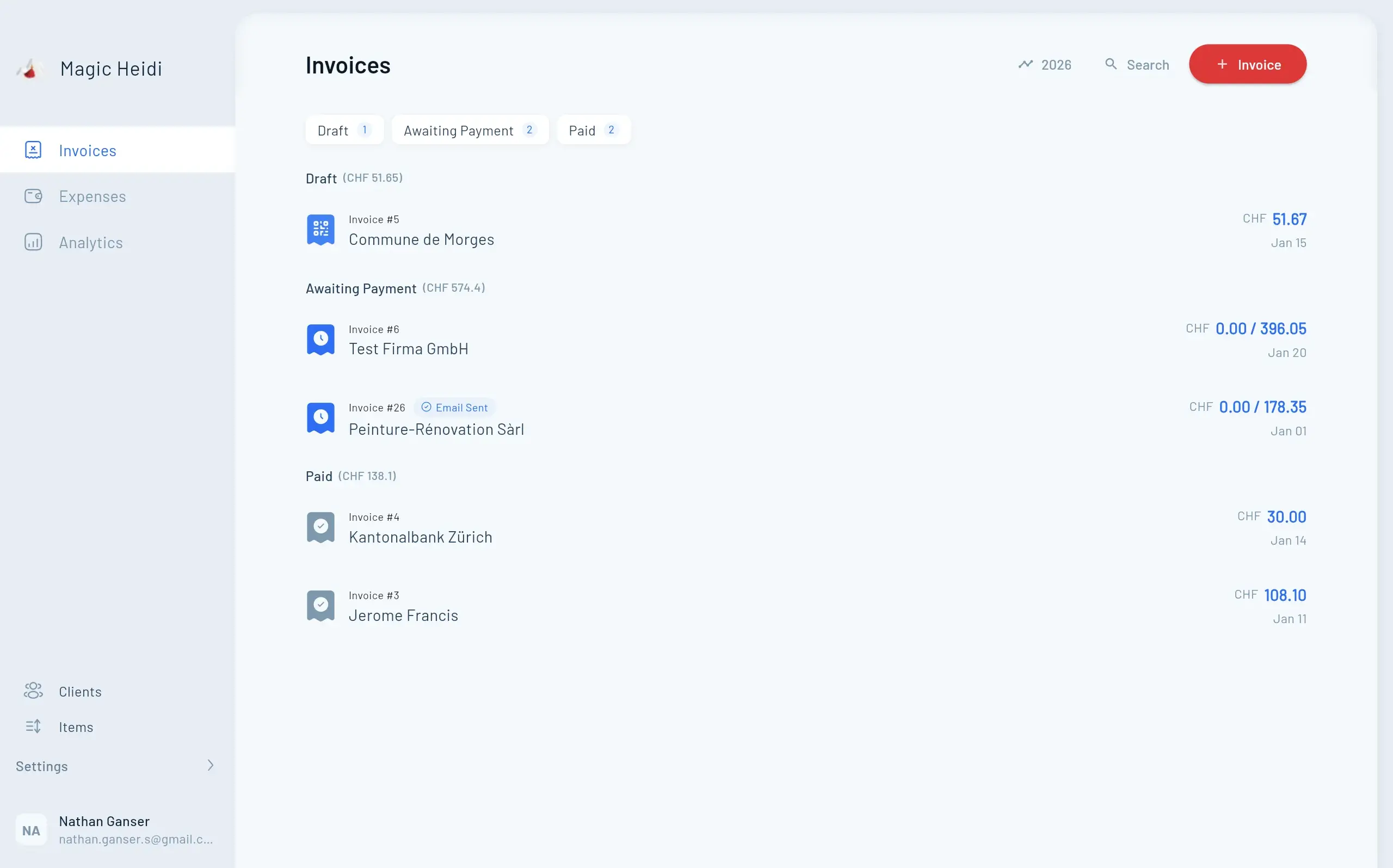
Magic Heidi Invoice Management

For Sole Proprietors

Essential steps:

  1. AHV registration (social security)
    • Apply to your canton's compensation office
    • Demonstrate legitimate self-employment (multiple clients)
    • Receive self-employment decision (2-4 weeks)
  2. Commercial register (if over CHF 100,000)
    • Submit registration at your canton's register office
    • Cost: CHF 150-600 depending on canton
    • Requires proof of AHV registration
  3. VAT registration (if over CHF 100,000)
    • Register with Federal Tax Administration
    • Choose accounting method (effective or flat rate)
    • Begin collecting VAT on invoices

Timeline: 2-4 weeks if documents ready.

Documents needed:

  • Valid ID or residence permit
  • Proof of address
  • Business concept description
  • Client contracts (demonstrate multiple clients)
  • Professional qualifications (if regulated profession)

For GmbH Establishment

Essential steps:

  1. Articles of association
    • Draft founding documents (notary or lawyer recommended)
    • Define share structure and management
  2. Capital deposit
    • Open bank account and deposit CHF 20,000
    • Bank confirms capital in blocked account
  3. Notarization
    • All founders sign before notary public
    • Notary authenticates articles of association
  4. Commercial register
    • Submit application with all documents
    • Pay registration fee (CHF 600-1,200)
  5. Tax and VAT registration
    • Register for corporate tax
    • Register for VAT if applicable
    • Setup payroll if taking salary

Timeline: 4-8 weeks from start to operational business.

Total costs: CHF 22,000-25,000 including capital, fees, and professional services.

Work Permits and International Considerations

EU/EFTA Citizens

Self-employment access is relatively straightforward:

  • Apply for B Permit (5-year validity)
  • Demonstrate financial viability (business plan, contracts, CHF 30,000+ annual income potential)
  • Must work for at least 3 different clients to prove genuine self-employment
  • Permit usually approved within 2-3 months

Third-Country Nationals

Self-employment permits are extremely rare:

  • Quota restrictions apply (very limited)
  • Preference given to high-value businesses creating Swiss jobs
  • Alternative: Establish GmbH or AG (more favorable permit consideration)
  • Requires demonstrating significant economic benefit to Switzerland

Practical tip: If you're from outside EU/EFTA and want to freelance in Switzerland, establishing a limited company significantly improves permit prospects.

Managing Multiple Businesses or Dual Activity

Swiss law permits holding multiple jobs simultaneously—employed and self-employed.

Key Considerations for Dual Activity

Tax obligations:

  • All income sources must be declared on tax return
  • Employment and self-employment reported in separate sections
  • Failure to declare all income risks retroactive taxes, penalties, and interest

Social insurance:

  • AHV/IV/EO contributions calculated separately per income source
  • Pension fund (BVG) contributions from employment
  • Self-employed must make full AHV contributions
  • Unemployment insurance typically only from employment

Employer relationship:

  • Must not compete directly with your employer
  • Self-employment should not compromise job performance or cause exhaustion
  • Obtain written employer approval (especially if in same field)
  • Some employment contracts prohibit side businesses

Managing Multiple Businesses

You can operate multiple sole proprietorships or combine structures:

Examples:

  • Consulting sole proprietorship + separate product business GmbH
  • Two unrelated freelance activities under separate sole proprietorships
  • GmbH for main business + side projects as sole proprietor

Why separate:

  • Liability isolation (protect profitable business from risky venture)
  • Tax optimization (different structures may suit different activities)
  • Clearer accounting and business evaluation
  • Easier eventual sale of one business

Administrative reality: Each business requires separate registration, accounting, and tax filing. Tools like Magic Heidi help manage multi-business accounting from one platform.

Common Mistakes to Avoid

Avoid these common mistakes that cost Swiss freelancers thousands in unnecessary taxes, penalties, and lost opportunities.

⚠️

Single Client Risk

Working exclusively for one client jeopardizes self-employment status. AHV may reclassify you as employee. Maintain at least 3 active clients.
🕐

Delaying Structure Transition

Staying sole proprietor too long exposes personal assets. One lawsuit could threaten personal wealth. Plan GmbH transition early.
📋

Inadequate Bookkeeping

Poor records cost money in missed deductions and trigger tax scrutiny. Use accounting software from day one.
🏛️

Ignoring Cantonal Differences

Tax rates range from 11.85% to 21.6%. Some cantons streamline processes; others take months. Research your canton.
💰

Overlooking Social Security

Budget 10-15% of income for AHV. No automatic unemployment insurance. Private protection needed.
FAQ

Frequently Asked Questions

Do I need CHF 20,000 to start a business in Switzerland?

No. Sole proprietorship requires no minimum capital. Only GmbH (CHF 20,000) and AG (CHF 100,000) have capital requirements. Most freelancers start as sole proprietors.

Can I work as a freelancer with just one client?

Legally yes, but risky. AHV may reclassify you as an employee of that client, triggering social security contribution obligations for the client. Maintain at least 3 clients to demonstrate genuine self-employment.

What happens if I earn under CHF 100,000 as a sole proprietor?

Commercial register and VAT registration are optional. You still must register with AHV, pay social security contributions, and declare income on tax returns. Simplified accounting is permitted.

How long does business registration take?

Sole proprietorship: 2-4 weeks after AHV approval. GmbH: 4-8 weeks including notarization and capital deposit. AG: 6-12 weeks due to higher complexity.

Can I switch from sole proprietorship to GmbH later?

Yes. You dissolve the sole proprietorship and transfer assets/liabilities to a newly formed GmbH. Process takes 3-6 months. Best done at year-end with proper accounting records.

Do freelancers qualify for unemployment benefits?

Generally no. Both sole proprietors and GmbH owners are considered responsible for their own employment. Consider private income protection insurance as alternative safety net.

How do tax rates compare between structures?

Sole proprietors pay progressive personal income tax (potentially 20-35%+ depending on income and canton). GmbH pays corporate tax (11.85-21.6%) plus personal tax on dividends—but you control timing. High earners often save with GmbH despite double taxation.

What if my business involves physical risk or property?

Consider GmbH regardless of revenue. Activities with inherent liability (events, construction, manufacturing, retail) benefit from limited liability protection. One accident or property damage claim could devastate personal finances without it.

Can I have a sole proprietorship and GmbH simultaneously?

Yes. Many entrepreneurs maintain side projects as sole proprietorships while operating main business as GmbH. Requires separate accounting and tax filing for each.

Are there special requirements for regulated professions?

Yes. Doctors, lawyers, architects, and other regulated professions need specific qualifications, registrations, and sometimes professional liability insurance regardless of business structure. Check with your professional association.

Next Steps

Your Next Steps

Whether you're just starting out or ready to transition to a GmbH, Magic Heidi provides the accounting infrastructure you need to stay compliant and focus on growing your business.

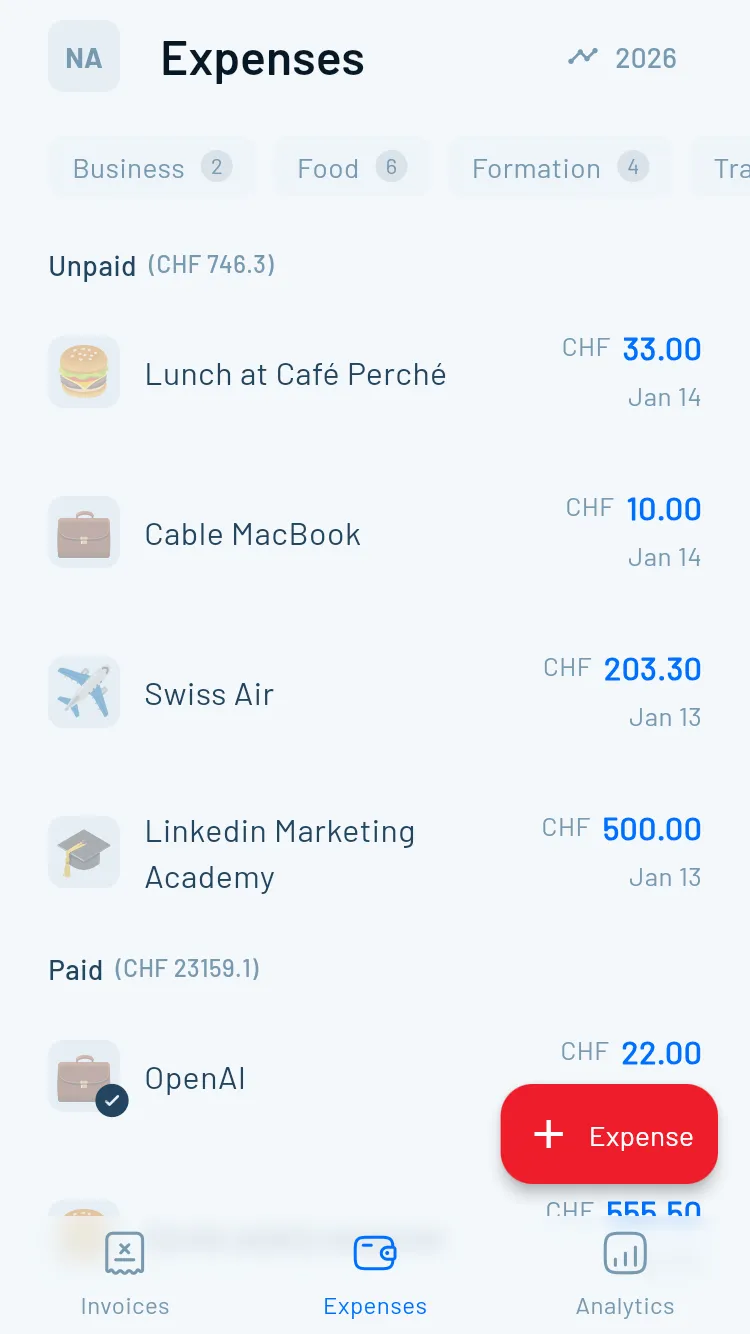
Magic Heidi Mobile Expense Tracking

If you're starting out:

  1. Register with AHV as self-employed
  2. Setup simple accounting system (Magic Heidi automates this)
  3. Secure 2-3 initial clients
  4. Create compliant invoices from day one

If you're approaching CHF 100,000 revenue:

  1. Decide: stay sole proprietor or transition to GmbH
  2. Register with commercial register if staying sole proprietor
  3. Setup VAT accounting (Magic Heidi calculates automatically)
  4. Begin planning GmbH transition if appropriate

If you're ready for GmbH:

  1. Consult with fiduciary or lawyer on structure
  2. Prepare articles of association
  3. Arrange CHF 20,000 capital
  4. Schedule notary appointment
  5. Setup comprehensive accounting system

Whatever structure you choose, Magic Heidi grows with you. Our Swiss-made accounting platform handles invoicing, expenses, VAT, and bank integration—whether you're a new sole proprietor or an established GmbH managing multiple businesses.

Start Your Business Journey with Confidence

Join thousands of Swiss freelancers who trust Magic Heidi to keep their finances organized, compliant, and stress-free.

This guide provides general information about Swiss business structures. Tax laws and requirements vary by canton and individual circumstances. Consult with qualified tax advisors and legal professionals for personalized advice.