Complete 2026 Guide

Insurance and Social Security for Swiss Freelancers

What you must know, what nobody tells you, and the critical deadlines that cost money if you miss them.

Swiss Freelancer Insurance Guide

Becoming a freelancer in Switzerland means taking control of your career—and your insurance coverage. Unlike employees who have everything handled by their employer, you're now responsible for registering, choosing, and paying for your own health insurance, social security, and pension contributions.

The Swiss system is comprehensive but complex. Miss a deadline, and you'll face penalties. Choose the wrong coverage, and you'll pay thousands more than necessary. Forget to register for AHV, and you could owe years of back payments with interest.

This guide covers everything you need to know: mandatory deadlines, optional coverage that might save you, real costs to budget for, and the critical mistakes that catch most new freelancers off guard.

What's Mandatory vs. Optional
(And Why It Matters)

Let's start with what you legally must have versus what's highly recommended but technically optional.

🏥

Health Insurance (KVG/LAMal)

Mandatory. 3 months to register or face automatic enrollment and interest charges.
👴

AHV/AVS Old Age Insurance

Mandatory when income exceeds CHF 2,300. Register immediately to avoid back payments.
🚫

No Unemployment Benefits

Freelancers don't pay into unemployment insurance and aren't eligible for benefits if business fails.
🩹

Accident Insurance

Optional but critical. You lose employer coverage when going freelance—add it to health insurance.
🤒

Daily Sickness Benefits

30-day window to switch from employer policy without health check. Miss it, pay more or get denied.
🛡️

Professional Liability

Mandatory for some professions. 60-70% of large companies require at least €250,000 coverage.
Critical Timeline

Your First 90 Days: Deadlines That Cost Money

Miss these dates and you'll pay penalties, interest, or lose coverage options permanently.

Days 1-30

Register for Health Insurance

You have 3 months legally, but don't wait. Compare providers immediately—premiums vary by hundreds per month.

  • All basic insurance covers identical benefits by law
  • Choose CHF 2,500 deductible if healthy (saves CHF 1,200-2,400/year)
  • Miss deadline = canton assigns you to a provider + retroactive billing + interest
  • Use Comparis or Priminfo to find cheapest provider in your canton

Swiss Health Insurance Registration
Days 1-30

Switch Daily Sickness Benefits

Exactly 30 days from last day of work to convert employer's group policy to individual—without health check.

  • After 30 days, insurers require health assessment
  • Pre-existing conditions may be denied or cost significantly more
  • Mark this deadline before you quit your job
  • This replaces income if you can't work due to illness
Daily Sickness Benefits Switch
Month 1-3

Register with Cantonal Compensation Office

Register for AHV as soon as you start freelancing. Earlier = better. Tax administration registration = back payments + interest.

  • Bring: 13-digit social security number (on health insurance card)
  • Bring: Copies of invoices, contracts, offers to clients
  • Bring: Proof of business activity (business lease, liability insurance, business plan)
  • Catch-22: They want proof of clients, but you might not have any yet—bring whatever you have
AHV Registration
Real Costs

What You'll Actually Pay: Budget Planning Numbers

Stop guessing. Here are the real numbers you need to budget for.

Insurance/Contribution TypeAnnual Cost RangeTax Deductible?Mandatory?
Health Insurance (KVG)CHF 2,400-6,600Partially✓ Yes
AHV/IV/EO (CHF 50k income)CHF 4,825✓ Fully✓ Yes
AHV/IV/EO (CHF 80k income)CHF 7,720✓ Fully✓ Yes
AHV/IV/EO (CHF 100k income)CHF 9,650✓ Fully✓ Yes
Pillar 3a (max contribution)CHF 7,258-36,288✓ FullyOptional
Professional Liability (€250k)CHF 300-800UsuallySome fields
Professional Liability (€1M)CHF 800-2,000UsuallySome fields

Health Insurance: Real Premium Examples

Monthly premiums vary dramatically by canton and age. Examples for adults with a CHF 2,500 deductible:

  • Basel-Stadt: CHF 300-400/month
  • Geneva: CHF 400-550/month
  • Appenzell Innerrhoden: CHF 200-280/month

Choose the highest deductible (CHF 2,500) if you're healthy. You'll save CHF 100-200 per month compared to the CHF 300 deductible—that's CHF 1,200-2,400 per year.

After meeting your deductible, you pay 10% co-insurance on covered costs, capped at CHF 700 per year for adults (CHF 350 for children).

AHV/IV/EO Contribution Details

Self-employed people pay 9.65% of net income:

  • AHV (old age insurance): 7.8%
  • IV (disability insurance): 1.4%
  • EO (income compensation): 0.45%

For incomes below CHF 56,900, a sliding scale applies, ranging from 5.196% to 9.155%.

You'll receive invoices quarterly. These contributions are fully tax-deductible and directly determine your future pension.

Pillar 3a Tax Advantages

In 2025:

  • Employees with a pension fund: up to CHF 7,258
  • Self-employed without a pension fund: up to CHF 36,288 (20% of net income)

The full amount is tax-deductible. In a high-tax canton, saving CHF 36,288 in pillar 3a could reduce your tax bill by CHF 10,000-15,000.

New for 2026: You can make retroactive payments to cover contribution gaps from 2025 onward, going back up to 10 years.

The Hard Truth

What About Unemployment Benefits?

The answer most freelancers don't want to hear.

As a freelancer in Switzerland, you generally cannot collect unemployment benefits if your business fails or you lose clients.

Why? Self-employed people don't contribute to unemployment insurance (ALV/AC) and therefore aren't covered.

The exception: If you return to employee status after freelancing, you might qualify based on contributions made before going freelance—but only if you contributed for at least 12 months during the 2 years before registering as unemployed.

What This Means for You

Build an emergency fund. Most financial advisors recommend 6-12 months of living expenses. As a freelancer, consider the higher end or beyond.

Some freelancers deliberately maintain part-time employment (at least CHF 500/month average) to keep contributing to unemployment insurance. Work 3-4 days freelancing + 1 day employed = maintain safety net.

Complementary Insurance: Worth It or Waste?

Over 80% of Swiss residents carry complementary insurance in addition to mandatory KVG coverage. Should you?

Makes sense if you use alternative medicine regularly
Osteopathy visit: CHF 120-150. Good coverage pays 70-90%
Skip if young, healthy, rarely use healthcare
⚠️ Get it while healthy—can't qualify with chronic conditions
🏨
Private Hospital Rooms

Private or semi-private rooms during hospital stays

🌿
Alternative Medicine

Homeopathy, osteopathy, traditional Chinese medicine covered

🦷
Dental Coverage

Dental work coverage (not included in basic KVG)

✈️
Better Abroad Coverage

Enhanced coverage when traveling internationally

FAQ

Common Questions (And Honest Answers)

Can I register for health insurance in a cheaper canton?

No. You must register in your canton of residence. Premiums are based on where you live.

What if my income varies a lot month to month?

AHV contributions are based on annual net income reported on your tax return. You'll receive provisional quarterly invoices, then a final adjustment after taxes are filed. Pillar 3a contributions can be made any time during the year.

Do I need professional liability insurance if my work is low-risk?

Even low-risk work can result in claims. A missed deadline, error in deliverables, or miscommunication can cost clients money. Larger companies often require proof of coverage before signing contracts.

Can I deduct all insurance costs from my taxes?

AHV/IV/EO contributions: fully deductible. Pillar 2 and 3a: fully deductible. KVG health insurance: partially deductible (varies by canton). Complementary insurance: generally not deductible. Accident and daily sickness benefit: typically deductible if they provide income protection.

What happens if I can't afford all these insurance costs?

Health insurance and AHV are non-negotiable. If cash flow is tight, choose the highest health insurance deductible to minimize premiums. For AHV, contact your compensation office about payment plans. Consider scaling back complementary insurance or delaying pillar 3a until business is established.

Do I still pay AHV if I'm also employed part-time?

Yes, but your employer will deduct their portion from salary. You'll pay self-employed AHV contributions only on freelance income. Total contributions can't exceed the maximum ceiling based on combined income.

Action Plan

Your Action Plan: What to Do Now

Stop overwhelming yourself. Follow this timeline.

This Month

Get the Mandatory Basics in Place

These three actions protect you from penalties and coverage gaps.

  • Compare health insurance providers using Comparis or Priminfo
  • Register for health insurance (3-month deadline from establishing residence)
  • Gather documentation for AHV: social security number, invoices, contracts, business proof
Mandatory Insurance Basics
Within 3 Months

Complete Registration and Add Critical Coverage

Register with authorities and close the most dangerous coverage gaps.

  • Register with cantonal compensation office for AHV/IV/EO
  • Add accident insurance to health insurance policy
  • Research professional liability insurance requirements for your field
Complete Registration
Within 6 Months

Build Long-Term Financial Security

Start retirement savings and income protection.

  • Open pillar 3a account—even small contributions add up
  • Evaluate daily sickness benefits insurance (critical with dependents/high fixed costs)
  • Review complementary insurance options while you're healthy and qualify easily
Long-Term Financial Security
Annually

Optimize and Review

Make sure you're getting best value and maximizing tax benefits.

  • Compare health insurance rates each fall (October-November switching period)
  • Review AHV contribution invoices against actual income
  • Maximize pillar 3a contributions before year-end for tax deduction
Annual Review

Streamline Your Freelance Finances

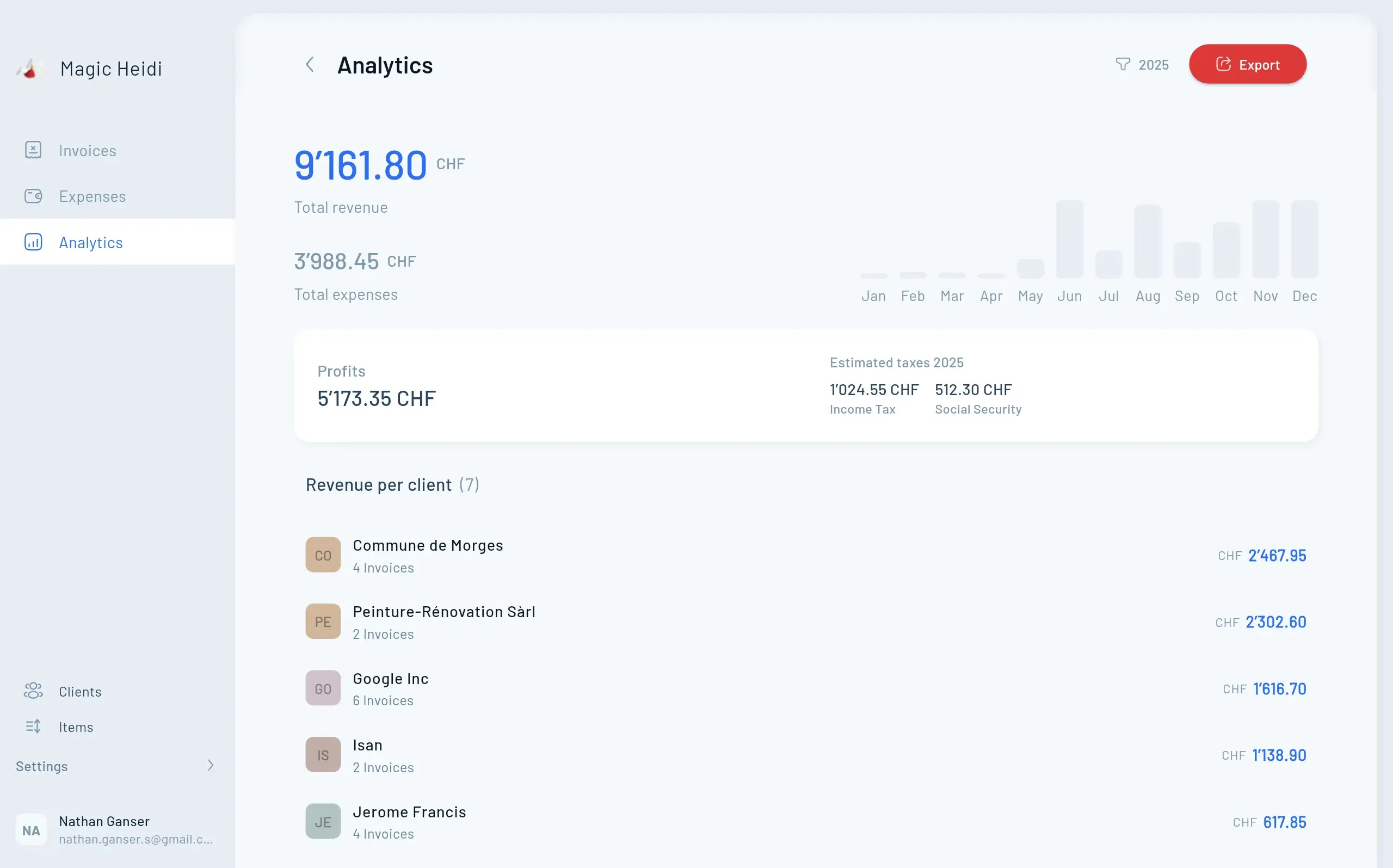
Swiss insurance is complex, but your invoicing and accounting don't have to be. Magic Heidi helps thousands of Swiss freelancers manage finances—so you can focus on work that pays.


This guide is updated for 2025. Swiss insurance and social security regulations change periodically. Always verify current requirements with official sources like ch.ch or your cantonal authorities.