Time Tracking for Swiss Freelancers: Complete Guide to Working Hours & Compliance
Master time tracking, hourly rates, and Swiss working hours regulations. Boost earnings by 25% with proper tracking.
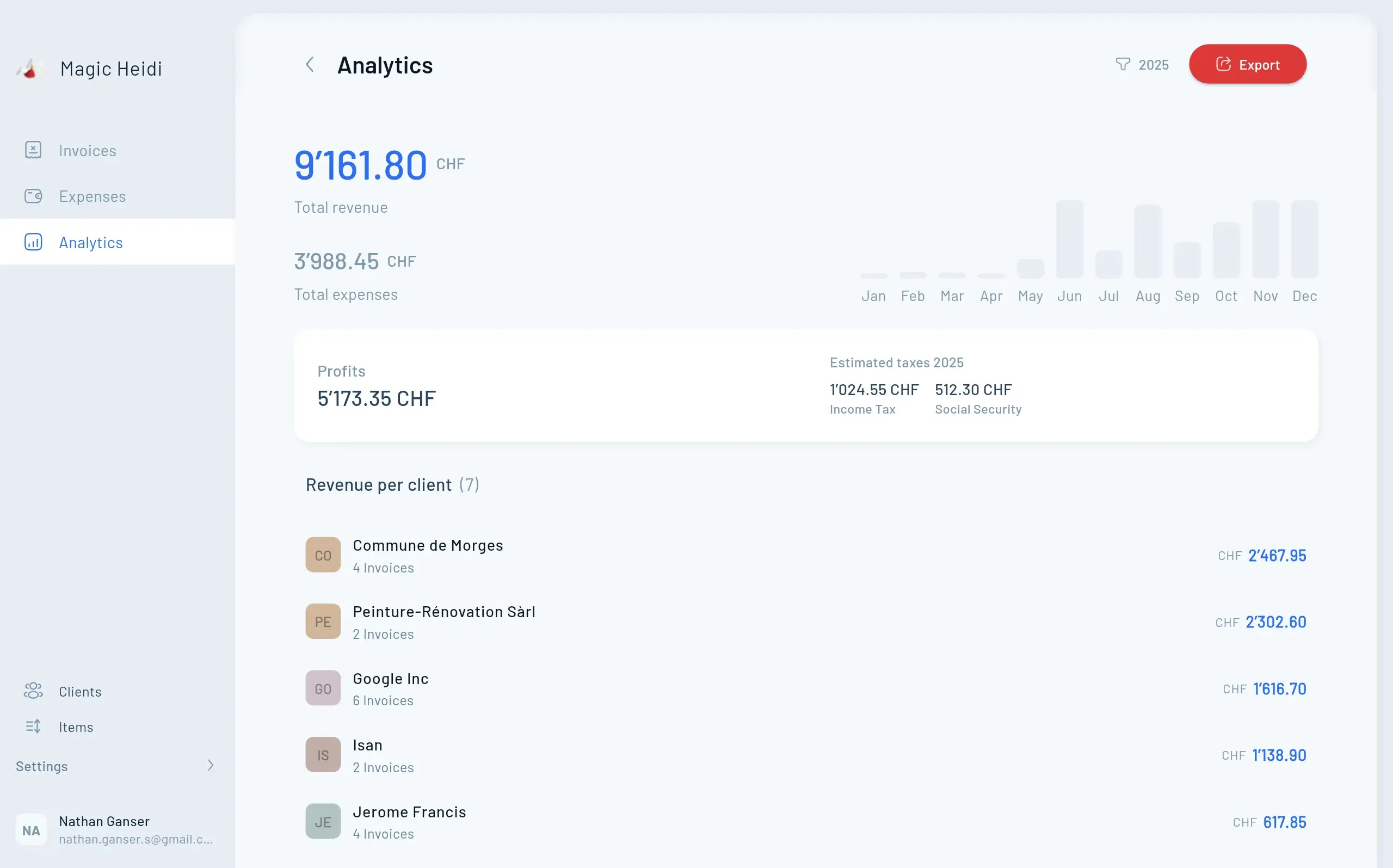
Imagine losing CHF 25,000 per year without realizing it. That's the reality for most Swiss freelancers who don't track their time properly.
The culprit? Those "quick 5-minute emails," forgotten phone calls, and context switches between clients that drain 15-30% of your billable hours. When you're earning an average of CHF 100,000 annually, that's serious money left on the table.
Here's the good news: Swiss freelancers who implement proper time tracking don't just reclaim lost revenue—they also stay compliant with Swiss tax requirements, reduce client disputes, and actually work fewer hours while earning more.
This comprehensive guide covers everything you need to know about working hours and time tracking as a Swiss freelancer, from legal requirements to practical tools, hourly rate calculations, and the Swiss-specific features that make all the difference.
Why Time Tracking Matters More Than You Think
Let's be honest: time tracking feels like administrative busywork. You became a freelancer for creative freedom, not to watch the clock like an employee.
But here's what proper time tracking actually does for your Swiss freelance business:
Recaptures lost revenue. Most freelancers think they're billing 40 hours per week when they're actually working 50-55. Those unbilled hours include client communications, project management, and the constant "quick questions" that add up. When you track everything, you'll discover you're either undercharging by thousands of francs or need to adjust your rates.
Provides legal protection. Swiss tax authorities can audit you at any time and request documentation from any of the past 10 years. Detailed time records prove your business expenses, justify your deductions, and demonstrate professional conduct if a client disputes an invoice.
Reveals your true hourly rate. Think you're earning CHF 100 per hour? Factor in proposals, invoicing, client meetings, skill development, and marketing—suddenly your real rate might be CHF 60. Time tracking shows exactly where your time goes and which activities actually generate income.
Prevents burnout. Swiss work culture values productivity, but also work-life balance. When you see you're consistently working 60-hour weeks, the data becomes a wake-up call to raise rates, drop unprofitable clients, or hire help.
Enables accurate pricing. Want to move from hourly to project-based pricing? Historical time data tells you exactly how long similar projects take, so you can price profitably without guessing.
The average Swiss freelancer makes CHF 48 per hour. With proper time tracking, you can identify inefficiencies, eliminate low-value work, and potentially increase your effective rate by 20-30% without working more hours.
The Hidden Cost of Poor Time Tracking
Most Swiss freelancers lose CHF 25,000-72,000 annually through poor time tracking. Those unbilled emails, calls, and context switches add up fast.
Lost Revenue
15-30% of billable hours vanish into "quick tasks" and forgotten workLegal Exposure
No documentation for tax audits or client disputesHidden Burnout
Working 60 hours, billing 40—without realizing itUnderstanding Swiss Working Hours Regulations for Freelancers
Here's where it gets interesting: Swiss working time laws (Arbeitszeitgesetz) primarily apply to employees, not self-employed freelancers. You're not legally bound by the 45-hour weekly maximum that applies to office workers.
However, following these guidelines is still smart for several reasons:
Swiss labor law sets a maximum of 45 hours per week for office staff, technicians, and retail employees in large companies. Other workers have a 50-hour weekly limit. These aren't arbitrary numbers—they're based on decades of research into sustainable productivity and health.
Working beyond these limits regularly, even as a freelancer, leads to:
- Decreased quality of work
- Higher error rates
- Burnout and health issues
- Damaged client relationships
- Reduced long-term earning potential
Overtime considerations: If you regularly exceed 45-50 hours weekly, you're likely either underpricing your services or taking on too much work. Employees get a 25% overtime premium—shouldn't you factor similar premiums into your extended hours?
Break requirements: Swiss law mandates breaks because they improve productivity. Working more than 5.5 hours? Take a 15-minute break. More than 7 hours? Take 30 minutes. More than 9 hours? Take a full hour. These aren't just good for employees—they're good for anyone who wants to maintain focus and quality.
When regulations DO apply: If you're working as a "dependent contractor" (essentially an employee in all but name), Swiss authorities may reclassify your relationship. Proper time tracking helps prove your independence by showing you control your own schedule and work for multiple clients.
The bottom line: While Swiss freelancers have flexibility, tracking your hours ensures you're not exploiting yourself worse than any employer would be allowed to.
The Hidden Cost of Poor Time Tracking
Without tracking, small tasks disappear into the void. You feel busy all day but can only bill for 4-5 hours of "real work." Meanwhile, you've actually worked 9-10 hours.
5-Minute Tasks
Client emails asking for "quick" status updates actually take 12 minutes after context switching.
- Switch to email client
- Remember project context
- Write thoughtful response
- Return to original work
Quick Fixes
"Can you just tweak this one thing?" becomes 35 minutes once you open the file and remember where you left off.
- Find the project files
- Review previous work
- Make the adjustment
- Test and verify
Brief Calls
"Let's hop on a quick call" turns into 45 minutes with pre-call prep and post-call notes.
- Prepare meeting context
- Join call (tech issues?)
- Discuss and align
- Document action items
The Real Numbers
A Swiss freelancer charging CHF 100 per hour, working 8 billable hours per day, 5 days per week, should earn CHF 4,000 weekly or about CHF 16,000 monthly (assuming 4 weeks).
But with poor time tracking:
- 2 hours daily lost to untracked admin work = -CHF 4,000 monthly
- Another hour to untracked client communications = -CHF 2,000 monthly
- Total monthly loss: CHF 6,000
- Annual loss: CHF 72,000
Even if you capture just half of those lost hours through better tracking, that's an extra CHF 36,000 per year—enough for a nice vacation, a tax-advantaged Pillar 3a contribution, or simply fewer working hours with the same income.
Time Tracking Methods: From Spreadsheets to Swiss-Optimized Software
You have three main approaches to time tracking. Let's compare them honestly.
Choose Your Time Tracking Approach
Each method has its place. Choose based on your complexity, discipline, and Swiss compliance needs.
| Feature | Magic Heidi | Timer Apps | Spreadsheets |
|---|---|---|---|
| Swiss QR Invoices | ✓ Automatic | ✗ Need separate tool | ✗ Manual creation |
| VAT Handling | ✓ Canton-specific | ✗ Not included | ✗ Manual calculation |
| Setup Time | 5 minutes | 15 minutes | 30+ minutes |
| Learning Curve | Easy | Medium | None |
| Cost | CHF 30/month | CHF 10-20/month | Free |
| Swiss Compliance | ✓ Built-in | ⚠ Partial | ✗ Manual |
| 10-Year Archive | ✓ Automatic | ✗ Self-managed | ✗ Self-managed |
| Data Location | ✓ Switzerland | ✗ US/EU | ✓ Local |
Manual Methods: Pen, Paper & Spreadsheets
The classic approach: Write down what you worked on and for how long, either in a notebook or an Excel spreadsheet.
Pros:
- Free
- Complete control
- No learning curve
- Works offline
- No data privacy concerns
Cons:
- Easy to forget entries
- No automatic calculations
- Difficult to generate client reports
- Time-consuming to maintain
- Prone to human error
- Not suitable for Swiss invoicing requirements (no automatic QR code generation)
Best for: Freelancers with very few clients (1-2) doing simple, predictable work who can remember to log everything.
Timer-Based Tools: Toggl, Clockify, Harvest
The middle ground: Apps where you manually start and stop a timer for each task, then generate reports.
Examples:
- Clockify: Free for basic features, unlimited tracking
- Toggl Track: Free for 1 user, paid plans from ~CHF 10/month
- Harvest: Free for 1 person and 2 projects, Pro at CHF 10.80/month
Pros:
- Accurate to the minute
- Easy to categorize time by client/project
- Automatic reports and invoicing
- Reasonable pricing
- Mobile apps available
Cons:
- Requires discipline to start/stop timer
- Interruptions cause tracking gaps
- Doesn't capture "forgotten" tasks
- Not Swiss-specific (no QR invoices, VAT handling)
- Often need separate invoicing software
- Data stored outside Switzerland
Best for: Freelancers comfortable with timer discipline who primarily work at a computer and don't need Swiss-specific invoicing features.
Swiss Time Tracking Done Right
Most time tracking tools were built for global markets. Magic Heidi was built specifically for Swiss freelancers.
- 🇨🇭Swiss QR Invoices
Automatically generated on every invoice
- 📊VAT Management
Canton-specific handling built-in
- 🔒10-Year Archive
Swiss-compliant storage included
- 🌍Multilingual
DE, FR, IT, EN interfaces
- Invoice #3
Magic Heidi
CHF 500
Jan 29
- Invoice #2
Webbiger LTD
CHF 2000
Jan 24
- Invoice #1
John Doe
CHF 600
Jan 20
How to Set Your Swiss Freelancer Hourly Rate
Before you track time, you need to know what it's worth. Here's the honest math.
The baseline formula:
Hourly Rate = (Desired Annual Income + Business Expenses) / Billable Hours
Let's break it down with Swiss numbers.
Step 1: Calculate Your Required Annual Income
What do you need to live comfortably in Switzerland, save for retirement (Pillar 3a), and cover health insurance?
Example:
- Living expenses: CHF 50,000
- Health insurance: CHF 6,000
- Pillar 3a (tax-advantaged savings): CHF 7,056
- Emergency fund contribution: CHF 5,000
- Desired profit/discretionary: CHF 20,000
- Total target: CHF 88,056
Step 2: Add Business Expenses
As a freelancer, you pay costs that employees don't:
- Software/tools: CHF 2,000
- Professional insurance: CHF 1,500
- Marketing/website: CHF 1,500
- Coworking/office: CHF 3,000
- Training/conferences: CHF 2,000
- Accountant: CHF 1,500
- Total expenses: CHF 11,500
Combined need: CHF 99,556 (let's round to CHF 100,000)
Step 3: Calculate Realistic Billable Hours
This is where most freelancers go wrong. They think: 52 weeks × 40 hours = 2,080 hours of billable work!
Reality check:
- 52 weeks in a year
- Minus 4 weeks vacation = 48 weeks
- Minus 10 public holidays = ~46.5 weeks
- Minus 2 weeks sick/personal = 44.5 weeks
So far: 44.5 weeks × 40 hours = 1,780 hours
But wait—not all working time is billable:
- Client acquisition (proposals, meetings): 15% of time
- Administration (invoicing, bookkeeping): 10%
- Professional development: 5%
- Non-billable overhead: 30%
Realistic billable hours: 1,780 × 0.70 = 1,246 hours per year
Step 4: Calculate Your Minimum Rate
CHF 100,000 ÷ 1,246 hours = CHF 80 per hour
This is your break-even rate. To actually profit and account for risk, multiply by 1.2-1.5:
Target rate: CHF 96-120 per hour
The Swiss Market Reality
According to Swiss salary data, the average freelancer makes CHF 100,000 annually or about CHF 48 per hour. But that "average" includes:
- New freelancers still building their practice
- Part-time freelancers
- Lower-skill service providers
In reality, established Swiss freelancers in professional services (consulting, IT, design, marketing, etc.) typically charge:
- Junior level: CHF 80-100/hour
- Mid-level: CHF 100-150/hour
- Senior/specialized: CHF 150-250/hour
- Executive consulting: CHF 250-400+/hour
The 1.5-2.5x rule: Your freelance rate should be 1.5 to 2.5 times what you'd earn as an employee on an hourly basis. If you'd make CHF 90,000 as an employee (roughly CHF 43/hour), your freelance rate should be CHF 65-110/hour minimum.
Why? Because you now pay your own:
- Social security contributions
- Health insurance
- Vacation time
- Sick leave
- Pension contributions
- Business expenses
- Income volatility risk
Time tracking proves what you're actually earning. If you're supposedly charging CHF 100/hour but tracking shows your real rate (including unbilled admin) is CHF 60/hour, you need to either raise rates or streamline operations.
Track Time Effectively: Seven Rules
Theory is nice. Here's what actually works for Swiss freelancers.
Track Everything
That 5-minute email? Track it. The client call? Track it. Researching solutions? Track it. You can decide later what to bill, but you can't retroactively remember forgotten work.
- Client emails and communications
- Phone calls and video meetings
- Research and problem-solving
- Proposal writing and admin
Categorize Properly
Separate billable vs. non-billable time to reveal your true capacity.
- Billable: Direct client work
- Non-billable: Proposals, onboarding
- Business development: Marketing
- Administration: Invoicing, bookkeeping
Review Weekly
Every Friday at 4 PM, review your week. This 15-minute habit saves hours at month-end.
- Verify all entries are accurate
- Add any forgotten tasks
- Identify time-wasting patterns
- Analyze project profitability
Use Project and Client Tags
Organize tracked time by:
- Client name
- Project/matter
- Task type (strategy, execution, revision, meeting)
- Billing status (billable, non-billable, already invoiced)
This lets you generate clean reports like: "Client A: Project X: 23.5 hours in March, CHF 2,350"
Set Automatic Reminders
Most tracking tools (including Magic Heidi) can remind you to log time if you haven't tracked anything for a while. Set reminders for:
- End of each workday: "Did you log all your time?"
- Friday afternoon: "Review your week and fill any gaps"
- Last day of month: "Finalize your time entries for invoicing"
Maintain Your 10-Year Archive
Swiss law requires keeping business records for 10 years. This includes:
- Time logs
- Invoices (sent and received)
- Receipts and expenses
- Bank statements
- VAT documentation
- Contracts
Tax authorities can audit any of those years at any time. Cloud-based tools like Magic Heidi automatically archive everything in a Swiss-compliant format, but if you're using manual methods, establish a clear filing system (digital and/or physical) from day one.
Use Productivity Techniques
Time tracking reveals where your hours go. Optimize them with proven techniques:
Pomodoro Technique: Work in 25-minute focused blocks with 5-minute breaks. Track each pomodoro. This naturally prevents burnout and improves concentration.
Time Blocking: Schedule specific blocks for client work, admin, and business development. Track time within each block to ensure you're sticking to your plan.
The "No-Reply Morning": Block the first 2-3 hours of each day for deep client work—no email, no Slack, no calls. Track this uninterrupted time and watch your productivity soar.
Batching: Group similar tasks (all calls on Tuesday afternoon, all invoicing Friday morning). Tracking will show you save 20-30% of time by reducing context switching.
Swiss Tax & Compliance: How Time Tracking Protects You
Switzerland's tax system is famously complex—federal taxes, cantonal taxes, communal taxes, VAT, social security contributions. Time tracking helps with all of it.
Swiss authorities can audit any previous year
Required once you exceed CHF 100,000 annually
Time logs justify your business expenses
VAT-registered freelancers file every quarter
The 10-Year Record Requirement
Swiss tax authorities can audit you at any time and request documentation from any of the previous 10 years. You must keep:
- All invoices (sent and received)
- All receipts and expense documentation
- Bank statements
- VAT records
- Social security payment proof
- Business contracts
- Time logs and work records
Fail to produce these documents? You can face:
- Denied deductions
- Tax adjustments and back-taxes
- Penalties and interest
- In serious cases, accusations of tax fraud
Time tracking isn't just about billing—it's your first line of defense in an audit.
VAT Registration and Time Tracking
Once your annual revenue exceeds CHF 100,000, you must register for VAT. From that point, every invoice must include:
- Correct VAT rate (7.7% standard, 2.5% reduced, or exempt)
- Your VAT number
- Breakdown of net amount, VAT, and gross
Your tracked time becomes the basis for those invoices. If you generate an invoice for 30 hours of work without time records to support it, you're vulnerable to disputes—both from clients and tax authorities.
Magic Heidi automates Swiss VAT handling by:
- Tracking which clients are Swiss vs. international (different VAT treatment)
- Applying correct canton-specific VAT rates
- Generating VAT-compliant invoices with Swiss QR codes
- Producing ready-to-file quarterly VAT reports
Deductions Require Proof
Want to deduct your home office, software subscriptions, professional development, or business travel? You need proof:
- Receipts (what you bought)
- Business justification (why it's work-related)
- Time logs (showing you actually used it for business)
Example: You claim 20% of your apartment as a home office deduction. Tax authorities ask: "Prove you work from home." Your time logs show 90% of work hours logged from your home office location. Deduction approved.
Without time logs? Your deduction might be reduced or rejected.
From Time Tracking to Swiss QR Invoices
Tracked your time. Now what? You need to convert those hours into payment—the Swiss way.
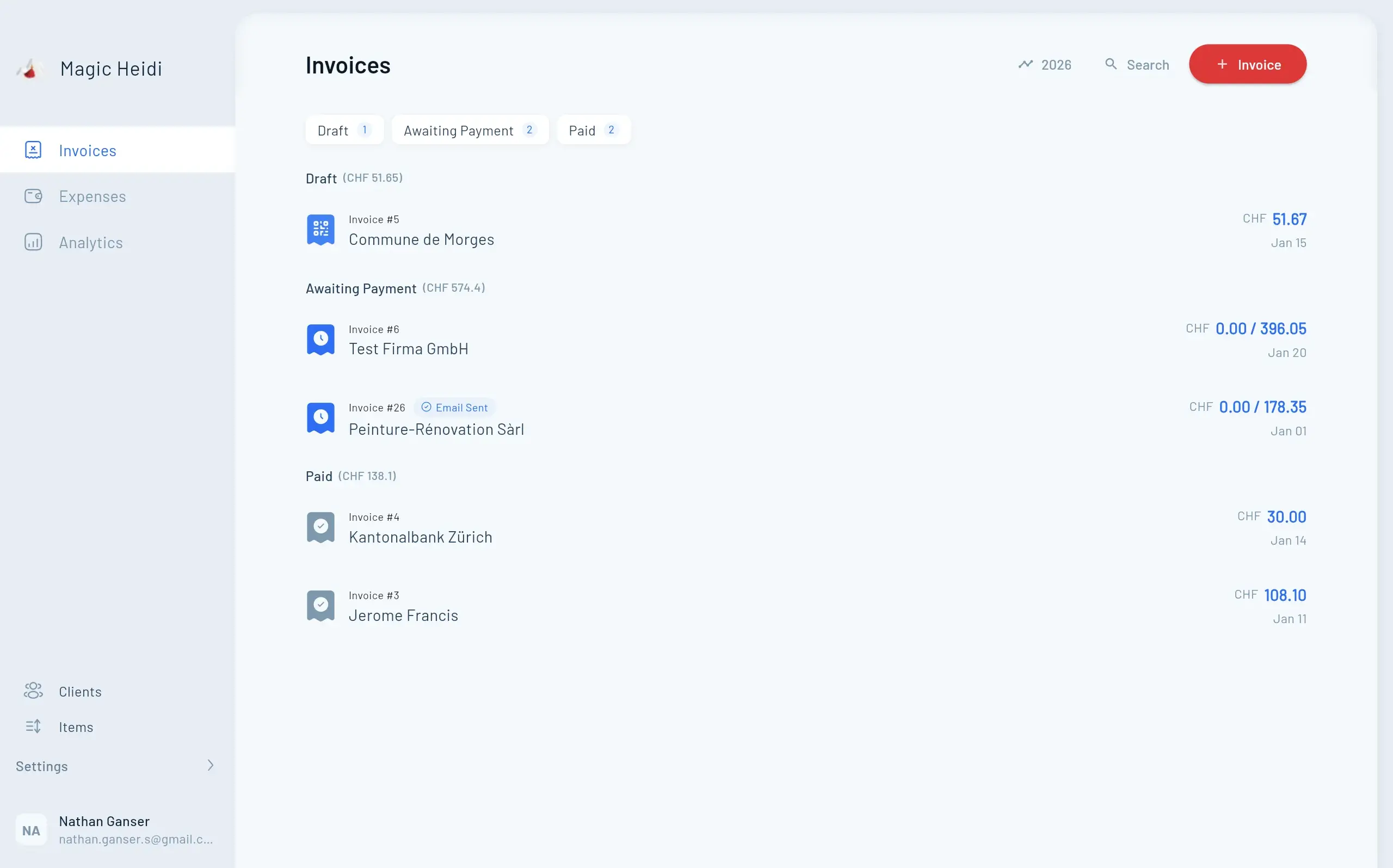
Swiss Invoice Requirements
Every Swiss invoice must include:
- Your business name and address
- Client name and address
- Unique invoice number
- Invoice date
- Payment terms (typically 30 days)
- Detailed description of work
- QR-code for easy payment (mandatory since 2020)
- VAT breakdown (if registered)
- Your bank details (now encoded in QR code)
Creating Invoices from Time Entries
Best practice:
- At month-end, filter your time entries by client and date range
- Review entries for accuracy
- Group similar tasks together (e.g., "Strategy consultation: 4.5 hours")
- Calculate total hours and amount
- Generate professional invoice with Swiss QR code
- Send to client
- Mark time entries as "invoiced" so you don't double-bill
Manual method: Export time entries to Excel, create invoice in Word with QR code generator. Tedious and error-prone.
Magic Heidi method: Select time entries → click "Create Invoice" → automatically generates VAT-compliant invoice with QR code → send directly to client. Done in 2 minutes.
Handling Time-Based Disputes
Clients sometimes question invoices. "This seems like a lot of hours for that task."
With detailed time tracking, you can provide:
- Breakdown of specific tasks and durations
- Comparison to estimate or previous similar work
- Context (e.g., "3 revision rounds requested")
- Proof of work delivered
Most disputes evaporate when you show professional time logs. Clients aren't challenging your honesty—they simply want transparency.
Pro tip: For larger projects, send weekly or biweekly time summaries so clients aren't surprised by the final invoice.
Magic Heidi: Built for Switzerland, Not Adapted
Magic Heidi combines time tracking with Swiss-compliant invoicing, expense management, VAT handling, and 10-year archives—all in one platform built for Switzerland.
- 🧾QR-Code Invoices
Automatic Swiss banking standard compliance
- 📊Time → Invoice
Convert tracked hours in seconds
- 🤖AI Expense Scanning
Scan receipts, extract data automatically
- 🏦Bank Integration
Import statements from Swiss banks
- Invoice #3
Magic Heidi
CHF 500
Jan 29
- Invoice #2
Webbiger LTD
CHF 2000
Jan 24
- Invoice #1
John Doe
CHF 600
Jan 20
Magic Heidi: Swiss Time Tracking Done Right
Let's be direct: plenty of time tracking tools exist. Why would Swiss freelancers choose Magic Heidi?
Built for Switzerland, Not Adapted for It
Most tools are built for the US or global markets, then add basic multi-currency support and call it "international." Magic Heidi was built from the ground up for Swiss freelancers, with features including:
Swiss QR-code invoices: Automatically generated on every invoice, meeting Swiss banking standards for easy client payments.
Canton-specific VAT handling: Different cantons have nuances. Magic Heidi knows them.
Multilingual interface: German, French, Italian, English—work in your language.
Swiss bank integration: Import bank statements from Swiss financial institutions directly.
10-year compliant archives: Automatic storage meeting Swiss legal requirements.
Swiss data storage: Your data stays in Switzerland, not US or EU servers.
Complete Business Management, Not Just Time Tracking
Most freelancers end up using 3-5 different tools:
- One for time tracking (Toggl)
- Another for invoicing (Stripe/PayPal)
- Another for expenses (Expensify)
- Another for accounting (Wave)
- Spreadsheets for everything else
Magic Heidi combines:
- Time tracking across all devices
- Invoicing with Swiss QR codes and VAT
- Expense management with AI-powered receipt scanning
- Bank statement imports for reconciliation
- VAT reporting ready for tax filing
- Client management and project organization
One platform. One subscription. One login. All your freelance business management.
AI-Powered but Not Overcomplicated
Magic Heidi uses AI where it actually helps:
- Scan receipts with your phone, AI extracts vendor, date, amount, category
- Import bank statements, AI suggests expense categorization
- Generate invoice, AI pre-fills client details from previous work
But it doesn't force AI where simple manual entry works better. Time tracking stays straightforward—you log hours, categorize them, done.
Simple Pricing. No Surprises.
One plan. All features. Cancel anytime.
Free Trial
- Full time tracking
- Swiss QR invoices
- Expense scanning
- All features unlocked
- No credit card required
Professional
- Unlimited time tracking
- Unlimited invoices
- Unlimited expenses
- AI expense scanning
- Swiss QR-code invoices
- Canton-specific VAT
- Bank statement import
- 10-year Swiss archive
- Priority support
Common Questions About Time Tracking for Swiss Freelancers
Do Swiss labor laws apply to freelancers?
Mostly no—Swiss working time regulations (Arbeitszeitgesetz) primarily apply to employees, not self-employed freelancers. You're not legally bound by the 45-hour weekly maximum. However, following those guidelines protects your health and productivity. And if you're a "dependent contractor" (working for essentially one client like an employee), authorities may reclassify your relationship.
What's the best free time tracking tool for Swiss freelancers?
Clockify offers unlimited time tracking for free, which works for basic tracking. However, it lacks Swiss-specific features like QR invoicing, VAT handling, and local compliance tools. If you need truly Swiss-optimized tracking with invoicing, Magic Heidi's free 14-day trial gives you full access to test whether the integrated approach saves you time and hassle.
How do I calculate my hourly rate in Switzerland?
Use this formula: (Target Annual Income + Business Expenses) ÷ Realistic Billable Hours. For example: (CHF 100,000 + CHF 10,000) ÷ 1,246 billable hours = CHF 88/hour minimum. Then multiply by 1.2-1.5 for profit margin and risk: CHF 106-132/hour. The average Swiss freelancer rate is CHF 48/hour, but professional service providers typically charge CHF 80-250/hour depending on experience.
Do I need to track time if I charge fixed project prices?
Yes! Even with fixed pricing, time tracking tells you whether projects are profitable, how long similar projects actually take (for future estimates), where time is lost to scope creep, and which types of projects to pursue or avoid. Many freelancers think they're making good money on fixed projects until time tracking reveals they're earning well below their hourly target.
How long must I keep time records in Switzerland?
Swiss law requires keeping business records for 10 years. This includes time logs, invoices, receipts, contracts, and bank statements. Tax authorities can audit any of those years at any time. Cloud-based tools like Magic Heidi automatically archive everything in a Swiss-compliant format for the full decade.
Can time tracking really improve my productivity?
Absolutely. Time tracking creates awareness. Once you see you're spending 8 hours per week on email, 5 hours on unproductive meetings, and 10 hours searching for lost documents, you'll naturally start optimizing. Studies show time tracking alone can improve productivity by 15-25% simply through increased awareness and elimination of time-wasting activities.
What's the difference between billable and non-billable hours?
Billable hours are time you can legitimately invoice to a client (direct work, project meetings, requested revisions). Non-billable hours are time you can't invoice but still must do (proposals, invoicing, bookkeeping, professional development, marketing). Most Swiss freelancers find 60-70% of their working hours are billable. The other 30-40% is necessary overhead that must be covered by your hourly rate.
How does Magic Heidi compare to Toggl, Harvest, or Clockify?
Toggl, Harvest, and Clockify are excellent time tracking tools built for global markets with strong features and reasonable pricing. However, they're not Swiss-specific—you'll need separate tools for Swiss QR invoicing, VAT handling, and compliant archiving. Magic Heidi was built specifically for Swiss freelancers and includes time tracking PLUS Swiss QR invoicing, VAT management, expense tracking, bank imports, and 10-year archives in one platform with data stored in Switzerland.
Take Control of Your Time—and Your Income
Swiss freelancers who implement proper time tracking reclaim 15-30% of lost billable hours. That's CHF 15,000-30,000 per year for someone earning CHF 100,000. Try Magic Heidi free for 14 days—no credit card required.
Take Control of Your Time—and Your Income
Here's what we know:
Swiss freelancers who implement proper time tracking reclaim an average of 15-30% of lost billable hours—that's CHF 15,000-30,000 per year for someone earning CHF 100,000.
They also reduce tax compliance stress, eliminate client disputes over invoices, gain clear insight into project profitability, and stop working 60-hour weeks while earning 40-hour incomes.
The question isn't whether you should track time. It's whether you want to keep losing thousands of francs annually, or take 5 minutes per day to track your work and capture the value you're already creating.
Start today:
- Choose your method: Excel template for simple situations, timer-based tool for basic tracking, or all-in-one Swiss solution for complete business management.
- Set up your categories: Billable vs. non-billable, client names, project codes, task types.
- Track everything for one week: You'll be shocked at where your time actually goes.
- Calculate your real hourly rate: Divide your weekly income by all tracked hours, including admin and non-billable work.
- Make adjustments: Raise your rates, eliminate low-value activities, or get better tools to reduce admin overhead.
Ready to try the Swiss-optimized approach?
Magic Heidi offers everything Swiss freelancers need—time tracking, QR invoicing, expense management, VAT handling, and 10-year compliant archives—all in one platform built specifically for Switzerland.
Try Magic Heidi free for 14 days. No credit card required. Track your time, generate professional invoices with Swiss QR codes, scan expenses with AI, and see if the integrated approach saves you hours of admin work every month.
Your time is literally money. Start tracking it like it matters—because it does.