Customer Directory & Segmentation: Better Client Management
Stop hunting through scattered spreadsheets and sticky notes. Master customer organization with simple, proven strategies built for Swiss freelancers.

The Hidden Cost of
Poor Contact Management
Managing customer contacts shouldn't feel like a daily treasure hunt. Yet most Swiss freelancers waste valuable time searching for client details, tracking payments, and remembering language preferences.
30+ minutes daily
Wasted searching for client informationRevenue losses
Missing follow-ups with high-value clientsScattered data
Information across spreadsheets and notesWhy Customer Organization Matters for Your Business
Before diving into tactics, consider what poor contact management actually costs you:
Time losses: Searching for customer details, re-entering information, chasing down email addresses before sending invoices.
Revenue impact: Missing follow-ups with high-value clients, forgetting about customers who haven't ordered recently, unclear picture of who actually pays your bills.
Relationship damage: Sending German invoices to French-speaking customers, mixing up project details between clients, appearing unprofessional due to disorganization.
Swiss freelancers juggle unique challenges—multiple languages, canton-specific requirements, and diverse client types. Your customer directory should work for you, not against you.
Understanding Your
Customer Directory
Your customer directory is more than a contact list. It's your business intelligence system.
Basic Information
Names, addresses, contact details, language preferences. These are table stakes for any business.
- Complete contact details
- Language preferences (DE/FR/IT/EN)
- Canton and location data
- Communication preferences
Revenue Tracking
Which customers generate the most income? Who paid quickly? This data shapes your business strategy.
- Total revenue per customer
- Payment behavior patterns
- Invoice history tracking
- High-value client identification
Context and History
Project notes, special requirements, communication preferences. These details transform transactions into partnerships.
- Project documentation
- Special requirements
- Decision-maker notes
- Uploaded contracts and files
What Makes a Good Customer Directory
A functional directory needs three qualities:
Accessibility: Find any customer's information in under 10 seconds. No searching through multiple systems or old files.
Completeness: All relevant details in one location. Upload contracts, track communication, note payment preferences.
Actionability: Your directory should answer questions like "Who are my top 10 customers?" and "Which clients haven't ordered in 6 months?"
Magic Heidi centralizes this information in one place, with Swiss-specific features like automatic city name completion from zip codes and data storage exclusively on Swiss servers in Zürich.
Setting Up Your Customer Information
Start with consistent data entry. Every customer should have complete contact details, billing preferences, and project context in one centralized location.
Smart Use of Customer Notes
The notes field is your CRM-in-miniature. Track important details that save time and prevent awkward situations.
Organizing Customer Files
Upload relevant documents directly to customer profiles:
- Signed contracts and agreements
- Project briefs and specifications
- Payment confirmations
- Correspondence requiring follow-up
This eliminates the "where did I save that?" problem. Everything related to a customer lives in one place.
Customer Segmentation Strategies That Work
Segmentation means grouping customers by shared characteristics. This helps you make smarter decisions about where to focus your energy.
Segment by What Matters
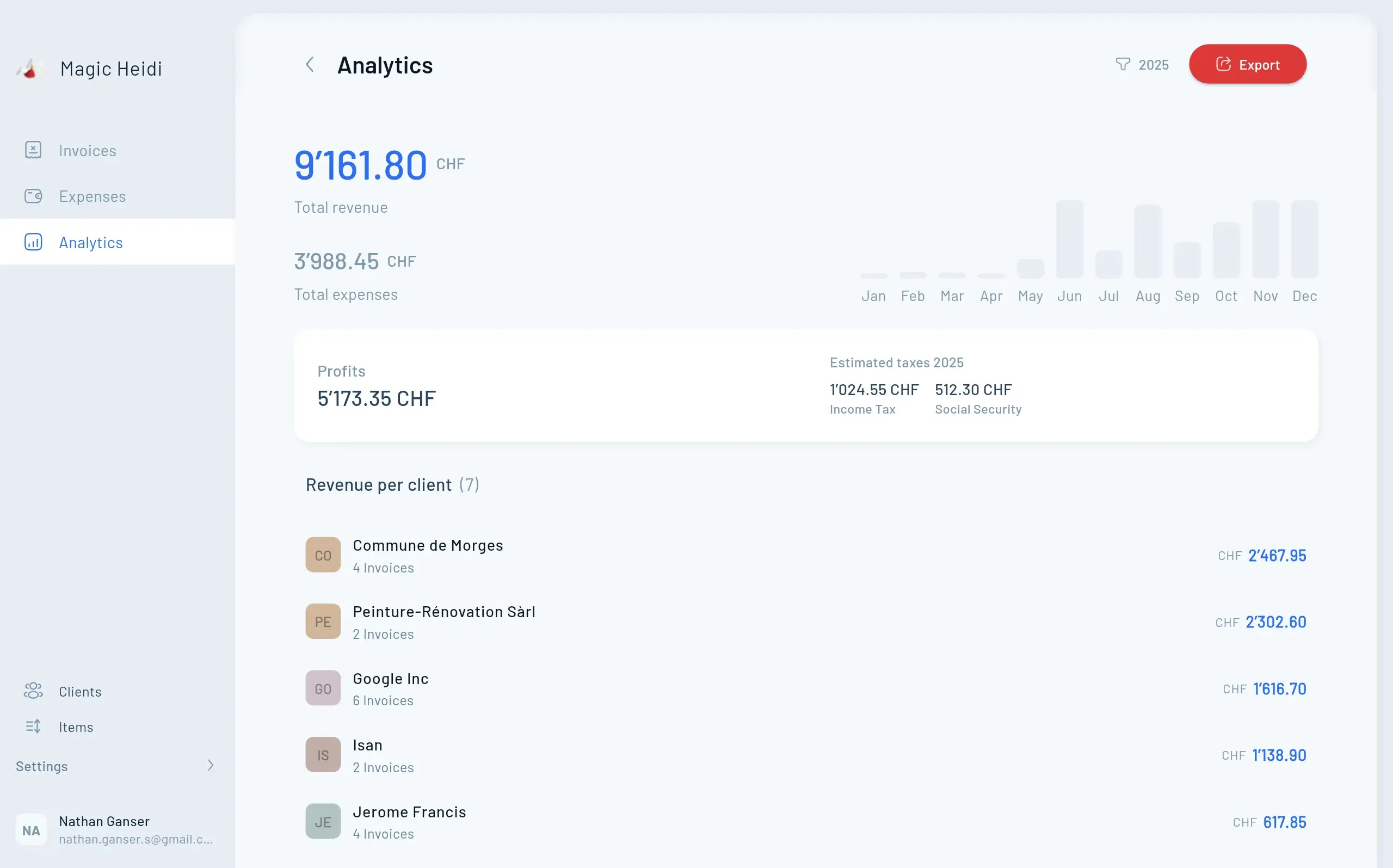
Magic Heidi shows revenue per customer, making segmentation simple. Sort by total billing to instantly see who matters most to your bottom line.
- 💎High-Value Clients
Top 20% generating 80% of revenue
- 📊Mid-Tier Customers
Consistent revenue generators
- 🏭Industry Type
Corporate, individual, or public sector
- 🌍Geographic Location
Canton, language region, travel distance
- ⚡Payment Behavior
Quick, standard, or slow payers
- 🎯Engagement Status
Active, recent, dormant, or lost
- Invoice #3
Magic Heidi
CHF 500
Jan 29
- Invoice #2
Webbiger LTD
CHF 2000
Jan 24
- Invoice #1
John Doe
CHF 600
Jan 20
Segment by Revenue Value
Your top 20% of customers likely generate 80% of your revenue. Identify them.
High-value clients: These customers deserve priority attention. Check in quarterly even without active projects. Remember their preferences. Respond faster.
Mid-tier customers: Consistent revenue generators. Maintain good relationships, but don't over-invest time relative to what they pay.
Small or one-time customers: Service professionally, but recognize when pursuing them costs more than they return.
Segment by Industry or Service Type
Different customer types need different approaches.
Corporate clients: May require purchase orders, have longer payment cycles, need formal documentation.
Individual consumers: Often pay faster, communicate informally, may need more explanation of technical details.
Government/public sector: Expect specific invoice formats, have strict payment schedules, require thorough documentation.
Segment by Geographic Location
For Swiss freelancers, location matters more than in most countries.
By canton: Different cantons may have specific requirements. Track which customers need canton-specific invoice details.
By language region: Note each customer's preferred language. Send German invoices to Zürich, French to Geneva, Italian to Ticino.
By travel distance: If you provide on-site services, knowing which customers require travel helps with scheduling and pricing.
Swiss-Specific
Considerations
Switzerland's unique multilingual and cantonal landscape requires special attention to customer management details.
DE/FR/IT/EN invoice options
Region-specific formats
City names from zip codes
Servers in Zürich only
Segment by Payment Behavior
Cash flow management starts with knowing who pays reliably.
Quick payers: These customers pay within days. They're gold. Prioritize their requests and acknowledge their reliability.
Standard payers: Pay within terms (30 days). The majority of customers fall here.
Slow payers: Consistently pay late or require reminders. Adjust your terms—shorten payment deadlines, consider deposits, or decide if they're worth the hassle.
Tag customers in your notes: "Quick payer—excellent," "Requires reminder," "Always pays eventually but slow." This informs your follow-up strategy.
Segment by Engagement Status
Not all customers are currently active.
Active customers: Currently have projects or regular orders. Your primary focus.
Recent customers: Completed work within the past year. Prime for re-engagement.
Dormant customers: No contact in over a year. Decide if they're worth a check-in email or if you should archive them.
Lost customers: Explicitly moved to competitors or no longer need your services. Learn from these situations.
Practical Implementation in Magic Heidi
Magic Heidi doesn't require complex tagging systems or expensive CRM add-ons. Use what's built in smartly with consistent naming conventions and strategic data entry.
Using the Two-Line Name Field
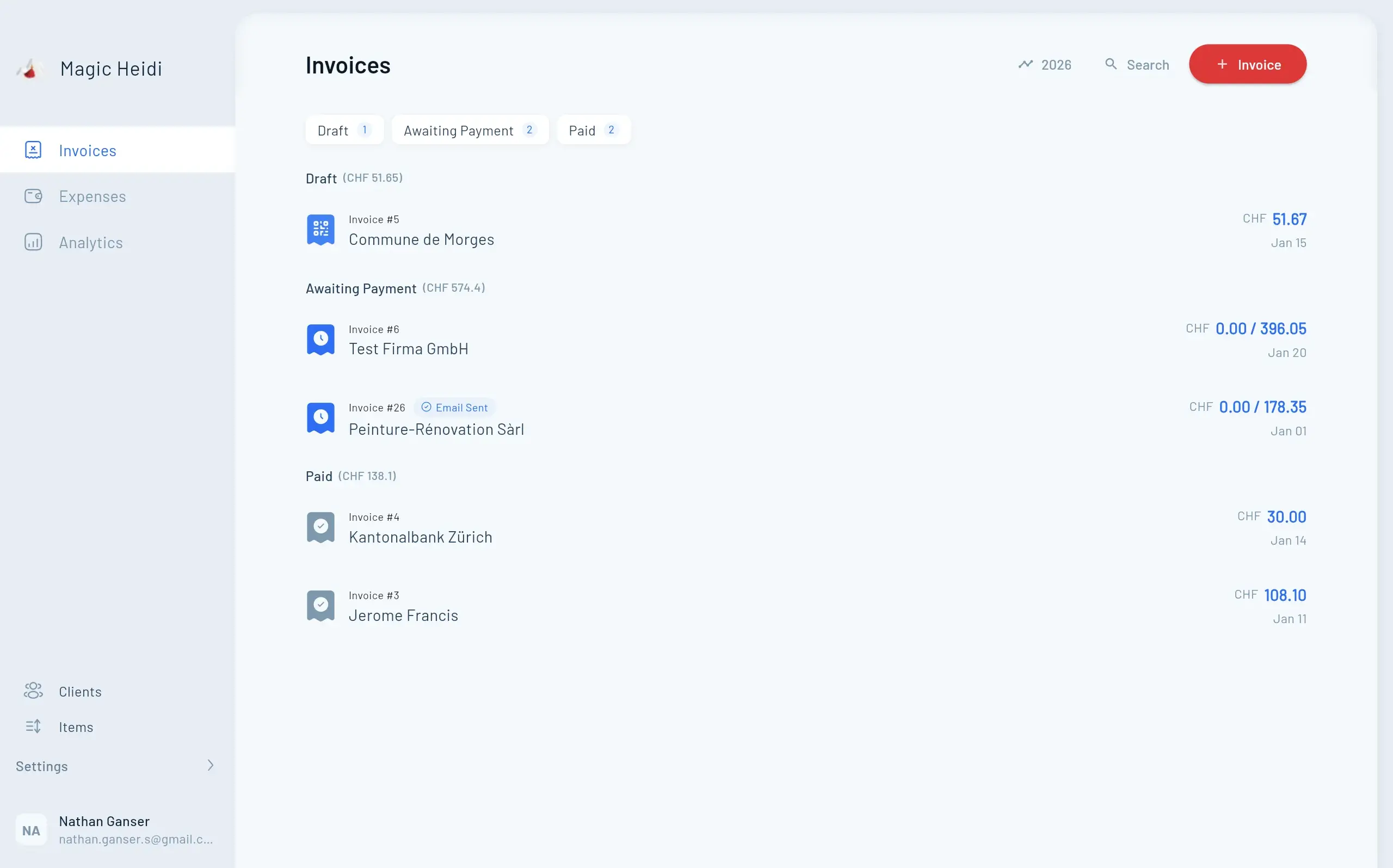
The customer name field supports two lines. Use this strategically for instant visual segmentation.
Creating Naming Conventions
Develop consistent naming patterns for easy searching:
- Start business names with the business name: "Bäckerei Müller" not "Müller's Bakery"
- Include canton codes for geographic sorting: "ZH" for Zürich, "GE" for Geneva
- Add emoji indicators if helpful: ⭐ for VIP customers, 💰 for high-value
Consistency makes searching faster. You'll find "Bäckerei name" easier than remembering if you wrote "Bakery" or "Boulangerie."
Leveraging Revenue Data
Click on any customer to see total revenue and related invoices. Use this to:
Identify growth opportunities: A customer who paid 15,000 CHF last year but only 3,000 this year might need attention. Are they using a competitor? Did their needs change?
Make strategic decisions: Should you offer that discount? Check if they're a 10,000 CHF/year customer or a 500 CHF/year customer.
Prioritize customer service: When multiple customers need attention, revenue data helps you decide who gets the callback first.
Regular Review Schedule
Set quarterly reviews to maintain your directory:
Q1: Clean up outdated information, note which customers you want to re-engage before summer slowdown.
Q2: Review revenue by customer, identify top performers for relationship strengthening.
Q3: Update language preferences and contact details, prepare for year-end push.
Q4: Segment customers for year-end communications, plan who to prioritize in new year.
Maintaining Your Directory
Long-Term
Initial setup is easy. Consistent maintenance is where most freelancers fail.
Update Immediately
When a customer mentions changes, update your directory right away. Don't trust your memory.
- After every project completion
- After payment issues occur
- After important conversations
- When contact details change
Archive Inactive Customers
Keep your active directory focused on customers who matter to your current business.
- No project in 2+ years
- Using another provider
- Gone out of business
- One-time with no future potential
Respect Data Protection
Swiss data protection laws require careful handling of customer information.
- Collect only necessary data
- Use strong passwords
- Delete upon customer request
- Comply with Swiss privacy standards
Mistakes to Avoid
Learn from these common customer directory mistakes and save yourself future headaches.
Inconsistent Data Entry
Pick a format and stick to it. Sometimes 'AG,' sometimes 'Inc.' creates chaos.
Neglecting Notes
'I'll remember' is a lie. Document important details immediately.
Over-Complicating
You're a freelancer, not a Fortune 500. Three or four segments are enough.
Not Using Data
What's the point of tracking if you never review? Check numbers monthly.
Mixing Contacts
Create clear separation. Customer directory isn't your personal address book.
Advanced Tips for Swiss Freelancers
Managing Multilingual Customers
Switzerland's four language regions require attention to detail:
- Note preferred language in customer record
- Send invoices in their language whenever possible
- Keep templates ready in German, French, and Italian
- Don't assume—always confirm language preference for new customers
Canton-Specific Considerations
Some cantons have unique requirements or business cultures:
- Note if customers need specific invoice formats
- Track regional holidays for timing project deliveries
- Understand payment culture varies by region
- Consider including canton in customer naming for easy filtering
Integrating with Other Swiss Tools
Magic Heidi handles invoicing alongside customer management, eliminating the need for separate systems. This integration means:
- Every invoice automatically links to the customer
- Revenue tracking happens automatically
- No duplicate data entry between systems
- Single source of truth for customer information
Making Customer Data Work for Your Business
A customer directory isn't just about organization—it's about intelligence.
Revenue concentration: Do three customers represent 60% of your income? That's a risk. Consider diversifying.
Service opportunities: Which good customers haven't bought in six months? A friendly check-in might generate work.
Pricing decisions: Track which customer types pay your full rates versus which always negotiate. This informs future pricing strategy.
Capacity planning: Understanding seasonal patterns across your customer base helps you plan marketing, vacations, and cash reserves.
Take Action on Your Customer Directory
Your customer directory should be a business asset, not an afterthought. Start organizing today and save hours monthly.
Start Today
- Review your current customer list
- Add notes to your top 10 customers with key details
- Upload any contracts or important documents
- Identify which customers generate the most revenue
- Create a simple segmentation system that makes sense for your business
Good customer organization isn't complicated. It's consistent. Spend 10 minutes weekly maintaining your directory, and you'll save hours monthly hunting for information.
Magic Heidi makes this easier by centralizing everything—customers, invoices, revenue tracking—in one Swiss-based platform. No complicated CRM setup. No per-user pricing headaches. Just simple, effective customer management designed for freelancers like you.
Ready to organize your customer contacts? Try Magic Heidi free for 30 days and see how much time you save with proper customer directory management. Your future self will thank you.