 Magic Heidi
 Moving to Switzerland as a Freelancer: The Complete 2026 Guide for EU Citizens
Can you really move to Switzerland, keep your EU clients, and pay less tax? If you're an EU freelancer earning €60,000 or more, the answer is often yes—but the devil is in the details.

Quick Answer: EU/EFTA freelancers can move to Switzerland and continue working remotely for foreign clients. You'll need a residence permit (relatively straightforward for EU citizens), must pay Swiss taxes and social insurance, and should earn at least CHF 30,000-40,000 annually to demonstrate financial viability.
Why Switzerland Attracts EU Freelancers (And Why It Might Not Work for Everyone)
The tax appeal is real—but so are the costs. Here's what the numbers actually show.
€15,000-20,000
Potential annual tax savings for €100k earners vs. Germany/France
62.7% Higher
Switzerland's cost of living compared to Germany
€80,000+
Recommended minimum income to make the move financially viable
22-25%
Effective tax rate in low-tax cantons like Zug (vs. 35-45% in EU)
The Tax Appeal: Real Numbers
Switzerland's tax advantage is significant for higher earners:
Typical effective tax rates for €100,000 income:
- Germany: 35-40% (income tax + solidarity surcharge)
- France: 40-45% (progressive income tax)
- Austria: 38-42% (progressive income tax)
- Italy (standard regime): 38-43% (IRPEF + regional taxes)
- Switzerland (Zug canton): 22-25% (federal + cantonal combined)
That's potentially €15,000-20,000 more in your pocket annually. Switzerland's federal income tax maxes out at 11.5%, with cantonal taxes varying from as low as 11% (Schwyz, Zug) to 30%+ (Geneva, Basel).
But here's the catch: Switzerland's cost of living is 62.7% higher than Germany's. Rent alone is 113.3% more expensive.
When Switzerland Makes Financial Sense
You'll likely benefit if:
- You earn €80,000+ annually
- You currently pay 40%+ in income tax
- You value quality of life (safety, infrastructure, nature)
- You can work 100% remotely
- You're comfortable with high upfront costs (deposits, health insurance)
You might NOT benefit if:
- You earn under €60,000 and use favorable home-country schemes (Italy's 15% flat tax, France's auto-entrepreneur)
- You need to be close to family (frequent travel costs add up)
- You require specialized services in your native language
- You're supporting dependents on a modest income
Can You Legally Work as a Freelancer in Switzerland? (Yes, Here's How)
EU/EFTA citizens have special rights that make freelancing in Switzerland surprisingly straightforward—even with just one client.

EU/EFTA Rights: Your Golden Ticket
Unlike non-EU citizens who need Swiss employer sponsorship, you have the right to move and work as self-employed under EU-Swiss bilateral agreements.
What you'll get:
- B permit (EU/EFTA): Valid 5 years, renewable
- No quota restrictions: Unlike non-EU work permits
- Family included: Spouse and children can join you
- Path to permanent residency: After 5-10 years of continuous legal residence
The "One Client" Question: What You Need to Know
Can you be self-employed with just one client? Yes, but with conditions.
Switzerland scrutinizes "Scheinselbständigkeit" (pseudo self-employment)—arrangements that look like employment but are structured as freelancing. They're concerned about:
- Employers avoiding payroll taxes
- Workers missing employment protections
To prove genuine self-employment:
✅ Use your own equipment and tools
✅ Set your own working hours
✅ Work from your own location
✅ Invoice for deliverables, not hourly work
✅ Have autonomy over how you complete projects
✅ Carry your own business risk
✅ Can theoretically subcontract work
Lower scrutiny if:
- Your client is foreign (outside Switzerland)
- You have at least 2-3 clients, even if one is 80% of income
- You can show a business plan to diversify
Higher scrutiny if:
- Your sole client is a Swiss company
- You work on-site at their office regularly
- They control your schedule and methods
Practical tip: Many solo freelancers with one main client still get approved, especially when that client is in their home country. Document your autonomy and have a plan to diversify over time.
How to Move to Switzerland
as a Freelancer
From preparation to first tax return—here's your complete timeline.
Before You Move (2-3 months)
Financial preparation is critical. Save CHF 15,000-25,000 for deposits, insurance, and setup costs.
- Line up clients and contracts (proof of income for permit)
- Research your target canton (tax rates, language, industry presence)
- Find temporary accommodation for first 3 months
- Gather documents (passport, birth certificate, proof of income, business plan)
Week 1-2 (Arrival & Registration)
Register with residents' services within 14 days and start your permit process.
- Visit commune's Einwohnerkontrolle (residents' registration office)
- Apply for B permit (processing 4-12 weeks)
- Open bank account with residence confirmation
- Start apartment hunting with proper documentation
Month 1-3 (Business Setup)
Register as self-employed and set up all mandatory Swiss systems.
- Register for AHV/IV/EO (social security) - 10.6% on net income
- Get mandatory health insurance (within 3 months)
- Register for VAT if turnover exceeds CHF 100,000
- Set up proper bookkeeping system (Swiss compliance required)
First Year (Ongoing Requirements)
Stay compliant and optimize your tax situation throughout your first year.
- File quarterly VAT returns (if registered)
- Pay provisional social security contributions
- Submit annual tax return (March-April following year)
- Consider Pillar 3a contributions (up to CHF 36,288 tax-deductible)
Real Numbers: Will You Actually Save Money?
Let's compare take-home income at different earning levels, factoring in Switzerland's high costs.
Scenario 1: €60,000 Annual Income
Germany (Berlin):
- Gross: €60,000
- Income tax + contributions: ~€18,500 (30.8%)
- Health insurance: ~€5,400
- Net take-home: €36,100
- Monthly living costs: ~€1,500
- Annual surplus: €18,100
Switzerland (Zug - low tax):
- Gross: CHF 64,500 (€60,000)
- Income tax: ~CHF 7,200 (11.2%)
- AHV/IV/EO: ~CHF 4,900 (7.6% on lower incomes)
- Health insurance: CHF 3,810
- Net take-home: CHF 48,590 (€45,200)
- Monthly living costs: ~CHF 5,000 (€4,650)
- Annual surplus: CHF -11,410 (€10,600 deficit)
Verdict: At €60,000, you'd actually have less money in Switzerland despite lower taxes. The 62.7% higher living costs erase your tax savings.
Scenario 2: €100,000 Annual Income
Germany (Munich):
- Gross: €100,000
- Income tax + contributions: ~€36,000 (36%)
- Health insurance: ~€5,400
- Net take-home: €58,600
- Monthly living costs: ~€2,000
- Annual surplus: €34,600
Switzerland (Zug):
- Gross: CHF 107,500 (€100,000)
- Income tax: ~CHF 18,800 (17.5%)
- AHV/IV/EO: ~CHF 11,400 (10.6%)
- Health insurance: CHF 3,810
- Net take-home: CHF 73,490 (€68,300)
- Monthly living costs: ~CHF 6,000 (€5,580)
- Annual surplus: CHF 1,490 (€6,720)
Verdict: You'd save roughly €5,000-8,000 annually (depending on lifestyle), plus gain Swiss quality of life.
Scenario 3: €150,000 Annual Income
France (Paris):
- Gross: €150,000
- Income tax + social charges: ~€62,000 (41.3%)
- Health insurance: included
- Net take-home: €88,000
- Monthly living costs: ~€2,500
- Annual surplus: €58,000
Switzerland (Zurich - mid tax):
- Gross: CHF 161,250 (€150,000)
- Income tax: ~CHF 38,700 (24%)
- AHV/IV/EO: ~CHF 17,100 (10.6%)
- Health insurance: CHF 5,400
- Net take-home: CHF 100,050 (€93,000)
- Monthly living costs: ~CHF 7,000 (€6,510)
- Annual surplus: CHF 16,050 (€14,900)
Verdict: You'd be significantly better off—roughly €15,000+ more annually, even in expensive Zurich.
Key Insight: The €80,000 Threshold
Below €80,000: Marginal benefit or even loss when factoring living costs
€80,000-€120,000: Moderate savings (€5,000-€12,000 annually)
Above €120,000: Substantial savings (€15,000-€30,000+ annually)
What to Actually Expect:
Monthly Expenses
Here's a realistic budget for a single freelancer in Zurich (with comparisons to Germany).
Monthly Budget Breakdown (Zurich)
Total monthly expenses: CHF 3,913 (€3,638) excluding taxes and savings.
- Rent (1-bed, city): CHF 2,000 (€1,860) — 113% more than Germany
- Health insurance: CHF 393 (€365) — mandatory, no employer contribution
- Groceries: CHF 600 (€560) — 60% more than Germany
- Transport/utilities/misc: CHF 920 (€855)
What Costs More vs. Germany
Switzerland's premium pricing affects daily life significantly.
- Groceries: +62% (cheese and meat especially expensive)
- Restaurants: +75% (expect CHF 25-35 for basic lunch)
- Rent: +113% (cities; rural areas more affordable)
- Childcare: +50-80% (if applicable)
What Makes It Worth It
The quality-of-life upgrade that justifies the premium.
- Safety: Extremely low crime rates
- Infrastructure: Trains run on time, everything works
- Nature: Alps, lakes, hiking on weekends
- Healthcare: World-class quality (if expensive)
Choosing Your Canton: Tax vs. Lifestyle
Where you settle dramatically affects your tax bill—but lifestyle matters too.
Schwyz
22.59% total tax — lowest rates, rural German-speaking, beautiful lakeside
Zug
22.67% total tax — crypto/finance hub, expensive housing, international
Zurich
32-35% total tax — largest city, best opportunities, excellent networking
Geneva
43.33% total tax — highest rates, cosmopolitan French-speaking, international
Ticino
28-32% total tax — Italian-speaking, Mediterranean climate, perfect for Italians
Nidwalden
24.30% total tax — small, quiet German-speaking, mountain setting
Matching Your Home Country
From Italy → Ticino (Italian-speaking, familiar culture)
From France → Geneva, Vaud (French-speaking)
From Germany → Zurich, Zug, Basel (German-speaking)
From Austria → Eastern cantons (German-speaking, mountain culture)
Practical tip: Many expats choose low-tax cantons (Zug, Schwyz) and accept the cultural/language adjustment. You'll manage in English in most business contexts.
Taxes Deep Dive: What You'll Actually Pay
Switzerland has three tax levels—federal, cantonal, and municipal. Understanding all three is crucial for accurate planning.

How Swiss Taxes Work
Switzerland has three tax levels:
1. Federal income tax: 0-11.5% (progressive, everyone pays same)
2. Cantonal tax: 5-25% (varies dramatically by canton)
3. Municipal tax: 2-8% (within canton, varies by commune)
Total effective rate: 15-45% depending on location and income.
Self-Employed Deductions
You can deduct:
- Business expenses (equipment, software, training)
- Home office (portion of rent/utilities if dedicated space)
- Professional insurance
- Health insurance premiums (even mandatory basic insurance!)
- Pillar 3a retirement contributions
- Professional development
- Marketing and advertising
You cannot deduct:
- Private living expenses
- Commuting (unless to client sites)
- General clothing (unless specific professional attire)
Avoiding Double Taxation
Switzerland has tax treaties with all EU countries. Once you're a Swiss tax resident (living there >183 days/year):
✅ You pay tax only in Switzerland on your freelance income
✅ Your home country won't tax you (with rare exceptions)
✅ Submit proof of Swiss tax residency to home country if requested
Exception: If you maintain a "permanent establishment" in your home country (office, regular presence), that country may claim taxation rights. For remote freelancers working from Swiss home, this rarely applies.
Common Pitfalls
to Avoid
Learn from others' mistakes—here are the top five traps that catch new arrivals.
Underestimating Startup Costs
Budget at least CHF 20,000 (€18,600) for first 3 months.
- Apartment deposit: CHF 4,000-7,000
- First month rent: CHF 2,000-3,000
- Health insurance deposit: CHF 800
- Furnishing and buffer: CHF 8,000+
Choosing Canton Based Only on Tax
Zug has lowest taxes but highest rents—calculate total cost (tax + rent + lifestyle).
- Highest rents can offset tax savings
- Limited housing availability
- Smaller networking opportunities
- Consider language and lifestyle fit
Forgetting Currency Risk
Income in EUR/USD but expenses in CHF? Exchange rate fluctuations can wipe out tax savings.
- Bill in CHF when possible
- Use multi-currency accounts
- Budget with conservative exchange rates
- Build currency buffer
Neglecting Integration
Some cantons require language courses and integration for permanent residency.
- Start learning German/French/Italian immediately
- English gets you started, not settled
- Language opens doors to networking
- Community participation matters
Not Planning for Retirement
Self-employed have no mandatory employer pension (Pillar 2).
- Contribute to Pillar 3a (tax-deductible, up to CHF 36,288)
- Consider voluntary Pillar 2 buy-in
- Build private savings
- 2026 update: First 13th AHV payment in December
Your Top Questions Answered
Can I move with my family?
Yes. EU/EFTA citizens can bring spouse and children under 21 (or dependent older children). Each family member gets own residence permit. Budget impact: Family of 4 needs CHF 10,000-15,000/month minimum.
What if I want to hire employees later?
You can hire as self-employed or form a company (GmbH). Swiss employment law is protective—budget for social security contributions (~14% employer portion), mandatory accident insurance, potentially pension fund enrollment, and proper employment contracts.
Do I need to close my business in my home country?
Not necessarily, but practically yes. If you're Swiss tax resident and manage the business from Switzerland, Swiss authorities may consider it Swiss-based. Consult tax advisor for cross-border structures.
Can I keep my home country health insurance?
No. Swiss health insurance is mandatory within 3 months. EU health cards (EHIC) only cover temporary visits, not residence.
What about schooling for kids?
Public schools are free and excellent. Language of instruction matches canton (German/French/Italian). International schools available but expensive (CHF 20,000-40,000/year).
How hard is the language barrier?
Business: English widely spoken in professional contexts. Daily life: Local language essential for integration. Administration: Often requires local language, especially outside cities. Advice: Learn enough to handle daily tasks (A2-B1 level) within first year.
Will I qualify for Swiss pension eventually?
Yes. After contributing to AHV/IV for years, you earn pension rights. Full Swiss pension requires 44 years of contributions. Partial contributions are credited proportionally. Coordination with home country pension via EU agreements.
Is Moving to Switzerland Right for You?
Use this framework to make an informed decision based on your specific situation.
✅ Good Fit If You
Earn €80,000+, currently pay 35%+ tax, work 100% remotely, value safety and nature, comfortable with high costs, willing to learn local language
⚠️ Reconsider If You
Earn under €60,000, benefit from special home-country schemes, need frequent family visits, require specialized care in native language
💡 Best Case Scenario
High-earning (€120,000+) remote freelancer with international clients, comfortable with German/French, values quality of life over family proximity
Next Steps: Your Action Plan
If You're Seriously Considering:
1. Run the numbers (this month):
- Calculate your true take-home in Switzerland vs. current
- Factor in 62.7% higher living costs
- Add startup costs (CHF 20,000+)
- Run scenarios for 3 cantons
2. Visit Switzerland (next 3 months):
- Spend 1-2 weeks in target canton
- View apartments and prices
- Meet other expat freelancers
- Test daily life costs
- Assess lifestyle fit
3. Prepare financially (6 months before):
- Save CHF 20,000-25,000 minimum
- Secure client contracts for first year
- Research health insurance options
- Prepare business plan for permit
4. Make the move (when ready):
- Find temporary accommodation (Airbnb, sublet)
- Register within 14 days of arrival
- Start B permit process immediately
- Open bank account and register for insurance
- Begin setting up business admin
How Magic Heidi Helps Swiss Freelancers
Once you're settled, managing invoicing, expenses, and VAT compliance becomes crucial. Magic Heidi is Swiss accounting software built specifically for freelancers.
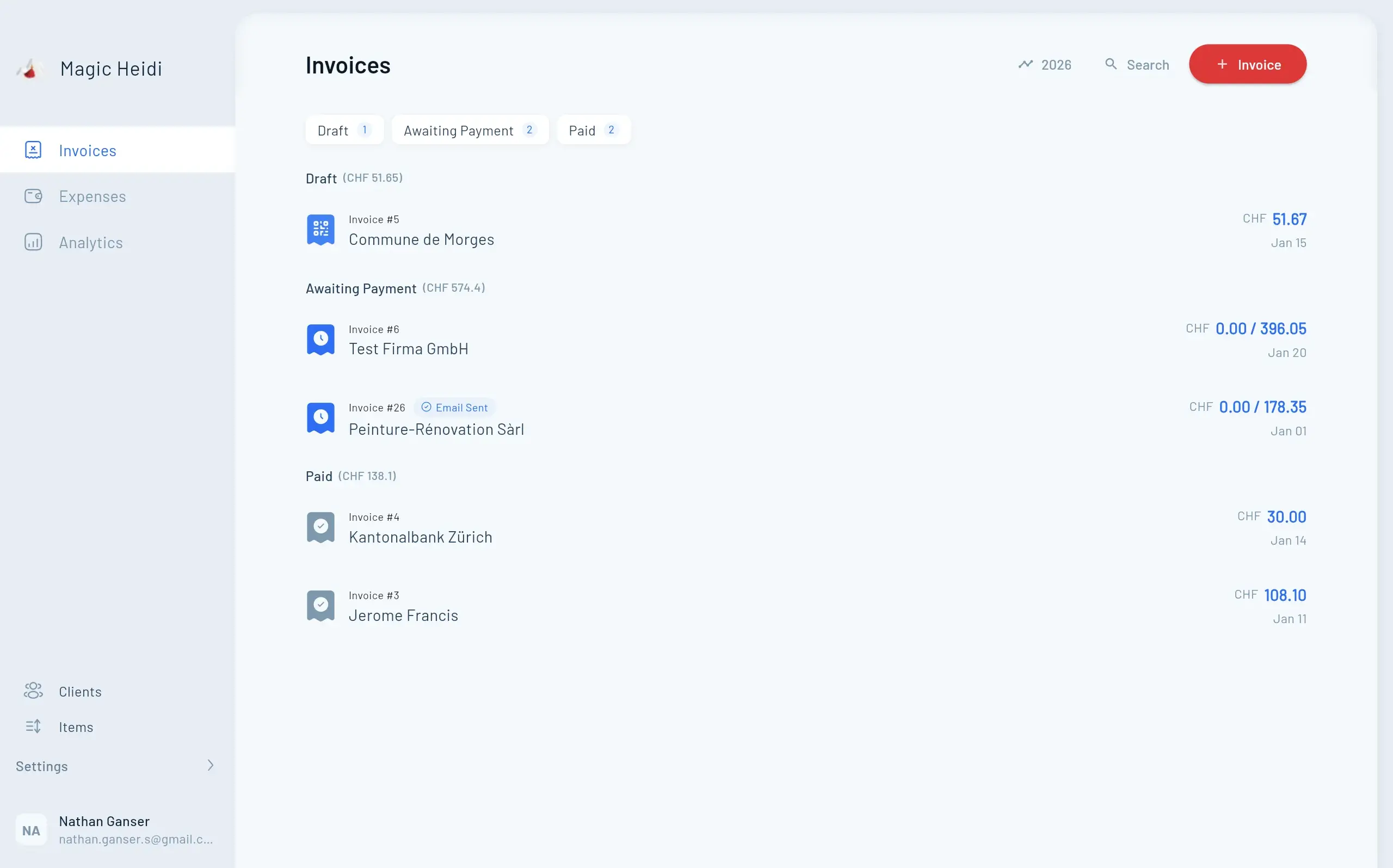
Built for
Swiss Freelancers
Everything you need to stay compliant and save time on admin.
Swiss-Compliant Invoicing
Create professional invoices with QR-bill integration that meet Swiss standards.
- Swiss QR-bill generation
- Multi-language support (DE/FR/IT/EN)
- Professional templates
- Automatic numbering
Multi-Currency Support
Work with international clients while tracking everything in CHF, EUR, and USD.
- Automatic exchange rates
- Multi-currency invoicing
- Currency conversion tracking
- Expense management in any currency
VAT Management
Handle Swiss VAT compliance when you cross CHF 100,000 threshold.
- Automatic VAT calculations (8.1% standard rate)
- Quarterly VAT return preparation
- Reverse charge mechanism
- VAT reclaim tracking
Bank Integration
Import statements from Swiss banks and automate reconciliation.
- PostFinance integration
- UBS and Credit Suisse support
- Automatic transaction categorization
- Real-time financial dashboard
Ready to Simplify Your Swiss Accounting?
Try Magic Heidi free and see how much time you save on admin—time better spent on client work or exploring your new Alpine home.

Final Thoughts: The Switzerland Question
Moving to Switzerland as an EU freelancer is completely legal and potentially lucrative—if your numbers work.
For high earners frustrated by 40%+ tax rates, Switzerland offers a genuine opportunity to keep significantly more of what you earn while living in one of the world's safest, most beautiful countries.
For moderate earners or those benefiting from home-country schemes, the financial case is weaker. The quality-of-life upgrade may justify it anyway—that's a personal call.
The key: Run your specific numbers before deciding. Generic advice doesn't apply to everyone. Calculate your take-home, subtract realistic living costs, and see if the surplus justifies the upheaval.
Thousands of EU freelancers have made this move successfully. With proper planning, realistic expectations, and good record-keeping (hello, Magic Heidi), you can join them.
Ready to explore your Swiss future? Start with the numbers, visit your target canton, and make an informed decision. Your Alpine office awaits—if it makes financial sense.