
Free template

Quote template Switzerland: copy the example or download

A complete quote in English that you can copy right now, then the same template as free Word, Excel and PDF files in English. No signup, no email address. In German a quote is called an Offerte.

A Swiss quote example in English, ready to copy

In German-speaking Switzerland a quote is an Offerte (in French offre or devis, in Italian offerta). It is more than a price list: legally it is an offer under the Swiss Code of Obligations (CO Art. 3 ff.). If your client accepts it before the deadline, you have a contract at that price.

Here is a filled-in quote from a UX consultant in Zurich to a company in Bern. Copy it into Word, Pages or Google Docs, replace the details and save it as a PDF:

Mia Bernasconi
Seestrasse 22, 8002 Zürich
mia@bernasconi.ch  |  +41 79 123 45 67
UID: CHE-123.456.789 MWST

──────────────────────────────────────────────────────────────
QUOTE No. 2026-012
Date:          8 September 2026
Valid until:   8 October 2026 (30 days)

To: Müller Consulting GmbH, Hauptstrasse 10, 3000 Bern
Re: Quote for UX concept and build of the customer portal

──────────────────────────────────────────────────────────────
Item Description                     Qty   Unit     Unit price    Total
──────────────────────────────────────────────────────────────
1    Concept and consulting          8     hrs      CHF 140.00    CHF 1'120.00
2    Build as per brief              1     flat     CHF 2'500.00  CHF 2'500.00
3    Stock photos (licence)          10    pcs      CHF 35.00     CHF 350.00
──────────────────────────────────────────────────────────────
                                    Subtotal excl. VAT           CHF 3'970.00
                                    VAT 8.1%                     CHF 321.57
                                    Total CHF incl. VAT          CHF 4'291.57

Not included:   copywriting, hosting, changes after sign-off
                (billed by the hour, CHF 140.00/hr)
Payment terms:  50% advance when the order is placed,
                50% within 30 days of sign-off
Delivery:       within 4 weeks of the order

Accepting this quote creates a binding contract for the
services described at the price stated.

Quote accepted on: ____________   Signature: ____________

Not VAT-registered? Delete the UID line and the VAT line, and add: "No VAT charged: not registered for VAT (Art. 10 VAT Act)." The total is then the subtotal.

Swiss details that people from abroad often miss: amounts in CHF with an apostrophe as the thousands separator (CHF 4'291.57), the UID number with the suffix "MWST" if you charge VAT, a concrete "valid until" date and a line for the client's acceptance.
Download

Word, Excel and PDF in English

The files follow the same layout as the example above, with English labels (Quote, Valid until, VAT). No macros, no signup.

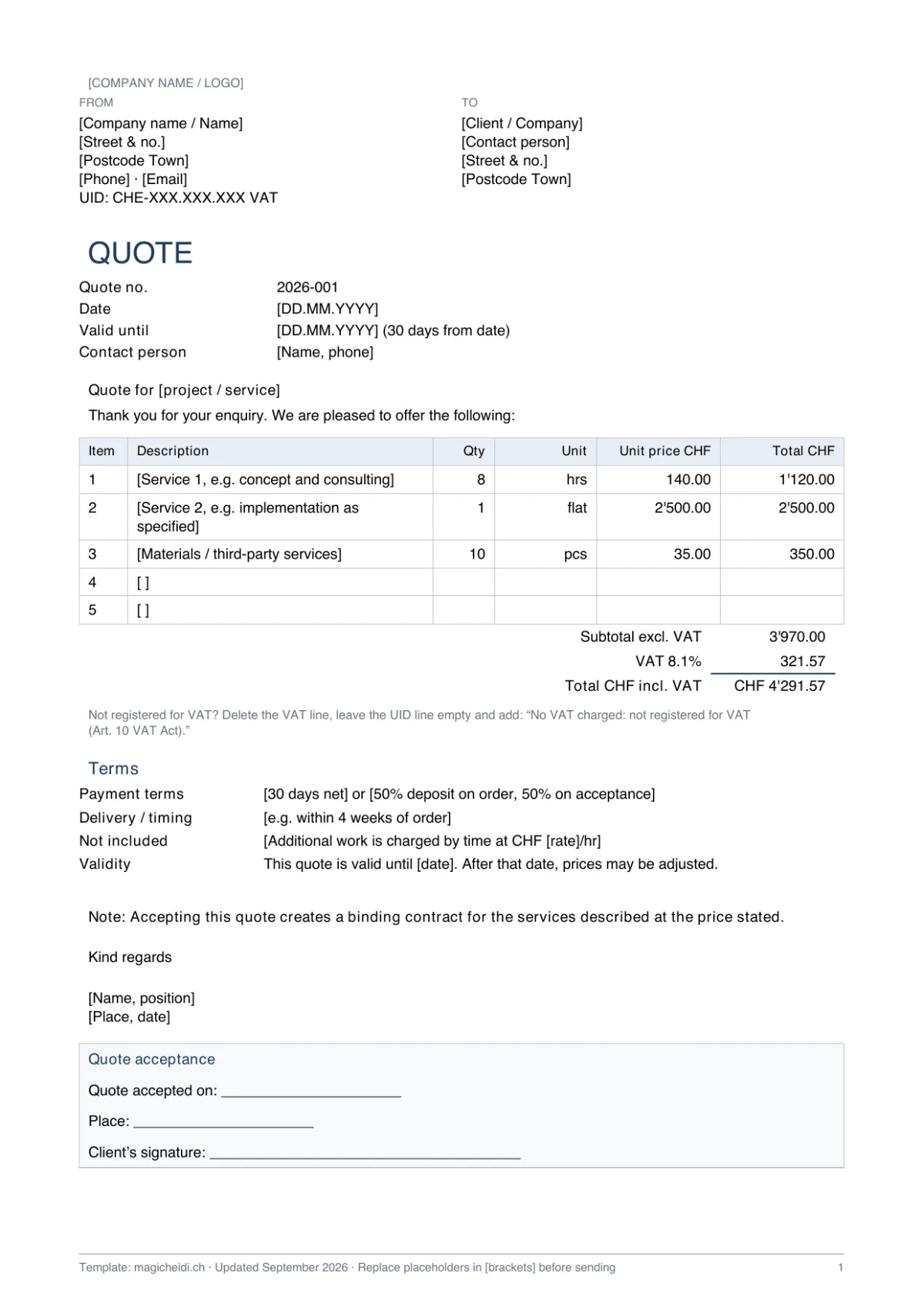
Preview: the Swiss quote template

Swiss quote template in English: A4 page with sender and client, quote number, valid-until date, line items, subtotal, VAT 8.1%, total in CHF and an acceptance block

All three files have the same A4 layout. Placeholders sit in square brackets, for example Company name / Name or Client / Company. Replace them, save as PDF, send.

Which file suits you?

  • Word (.docx): the most flexible. Add your logo, adjust the wording, export as PDF.
  • Excel (.xlsx): calculates each line (qty × unit price), the subtotal, VAT and total. You pick the VAT rate from a dropdown (0%, 2.6%, 3.8% or 8.1%). Three sheets: Instructions, Quote (blank) and Example (a filled example that calculates). Opens in Numbers and Google Sheets too.
  • PDF: to print and fill in by hand, or as a model while you write.

Client in Zurich or Bern? The same template exists in German (Offerte): Word, Excel, PDF. In Geneva or Lausanne, use the French version (devis): Word, Excel, PDF.

If you only need a rough figure that doesn't bind you, a cost estimate is the right document. Once the quote is accepted and the work is done, the invoice template (in English) takes over.

Binding under CO Art. 3

A quote is an offer. If the client accepts within the deadline, your price applies.

State a deadline

30 days is common. Without a deadline it's unclear how long you stay bound.

10 details

From the sender with UID to the signature field. The template has them all.

VAT from CHF 100'000

Only show VAT if you're registered: 8.1%, 2.6% or 3.8%.

Quote becomes invoice

In Magic Heidi an accepted quote becomes a QR-bill with one click.

What goes on a quote in Switzerland?

Swiss law doesn't prescribe a form for quotes. For your quote to work as a binding offer and turn into an invoice later without questions, it should contain these ten details. The template has all of them.

1. Sender

Your name or business name, address, phone or email. If you're VAT-registered: UID number with the suffix MWST (CHE-123.456.789 MWST).

2. Recipient

Your client's company, contact person and address. Often forgotten on PDF quotes because the address is only in the email.

3. Quote number

Unique and sequential, for example 2026-001. The order confirmation and invoice refer back to it.

4. Date and valid until

The quote date and a specific expiry date. 30 days is common, 14 if material prices move a lot.

5. Line items

Description, quantity, unit, unit price and total per line. Just as important: what is not included.

6. Subtotal, VAT, total

Amount excl. VAT, VAT rate and VAT amount, total in CHF incl. VAT. Without VAT registration the VAT line goes.

7. Payment terms

30 days net, an advance when the order is placed, or instalments by milestone. What you write here applies to the invoice later.

8. Delivery or timing

When you deliver, for example "within 4 weeks of the order", and what you need from the client for that: content, access, approvals.

9. Acceptance field

"Quote accepted on / place / signature". Or a note that confirmation by email is enough.

10. Note on the contract

A sentence like "Accepting this quote creates a binding contract." Optionally with a reference to your terms and conditions.

VAT on your quote: only if you're registered

You have to register for VAT once your annual turnover in Switzerland and abroad from services not exempt from VAT reaches CHF 100'000 (Art. 10 para. 2 VAT Act). From then on, your quote shows the same as your invoice later: UID with the suffix MWST, net amount, VAT rate (8.1% standard, 2.6% reduced, 3.8% accommodation; Art. 25 VAT Act), VAT amount and total incl. VAT. That way nobody argues later whether the price was meant "including" or "excluding" VAT.

Below the threshold, leave out the VAT line and the UID and add: "No VAT charged: not registered for VAT." In the Excel template you set the rate to 0%. When voluntary registration pays off is covered in the VAT guide for freelancers.

How long is a quote binding?

The Code of Obligations calls a quote an "offer" and covers it from Art. 3 CO. The core rule: if you make an offer with a deadline for acceptance, you're bound until that deadline expires (CO Art. 3). Without a deadline, a written offer binds you until you could expect a reply under normal circumstances (CO Art. 5). How long that is depends on the case, and that vagueness is exactly what you want to avoid.

If the client accepts only after the deadline, that counts as a new offer from their side: you're no longer bound and can quote new terms or decline. Reply clearly, though: simply starting work is easily read as acceptance at the old price. If you don't want to be bound at all, you have to say so explicitly, for example "without obligation" or "non-binding" (CO Art. 7). Then you have, in effect, a cost estimate rather than a quote.

How long to make it valid:

  • 30 days: the standard for services and most projects.
  • 14 days: when material or purchase prices fluctuate, for example in the trades.
  • 60 days with a price-increase clause: when the client takes long to decide but you want protection against price changes.

Why this matters: a CHF 18'500 quote for a bathroom renovation goes out with no validity date. Six months and one rise in material prices later, the client accepts and insists on the old price. One line saying "valid until" would have avoided the argument.

Quote, cost estimate or order confirmation?

The terms get mixed up in daily use, but they mean documents with different levels of commitment. The table shows when you need which.

The difference

Quote vs. cost estimate vs. order confirmation

Four documents, four roles from first contact to payment.

DocumentHow bindingWhen to use it
Quote (Offerte)Binding offer (CO Art. 3 ff.). If the client accepts within the deadline, the stated price applies.When scope and price are clear and you want a firm order. Template: this page.
Cost estimate (Kostenvoranschlag)An estimate with a reservation. Moderate deviations are normal; larger extra costs must be announced in advance.When the effort is still unclear, for example repairs. Template and details on the cost estimate page.
Order confirmation (Auftragsbestätigung)Confirms an order already placed. Not required, but proof of what was agreed.After a verbal yes, or when details changed between quote and start.
Invoice (Rechnung)Claims the amount owed once the work is done.After completion or partial sign-off. Template: Swiss invoice template.

For contracts for work (trades, construction, repairs) there's a second distinction. If you agreed a fixed price in advance, you must complete the work for that sum even if it took you more effort (CO Art. 373). If you only gave an approximate estimate and it is exceeded disproportionately, the client can withdraw from the contract (CO Art. 375). So always state explicitly whether your price is fixed, billed by time spent, or an estimate.

For the estimate there's a separate cost estimate template with a non-binding clause, for the invoice the Swiss invoice template.

How to write a quote, step by step

This is how you fill in the template. The result is the example at the top of this page.

  1. Clarify the request. Ten minutes on the phone about scope, timing and budget save you two rounds of quotes.
  2. Fill in the header. Sender with UID, recipient with contact person, quote number, date and valid until.
  3. Describe the line items concretely. "Build a website" is too vague. "Website with 5 subpages, responsive, CMS set-up, content migration" is something the client can accept and you can bill. Also state what's not included.
  4. Set the prices. Flat fee or hourly rate, with quantity, unit and unit price per line. The Excel template calculates subtotal, VAT and total.
  5. Record the terms. Payment terms, delivery time, a rule for extra work and, if needed, a price-increase clause.
  6. Prepare the acceptance. A signature field or a note that confirmation by email is enough, plus the sentence that acceptance creates a contract. An email is enough for the contract. But for provisional setting aside of an objection (Rechtsöffnung), the law requires an acknowledgement of debt confirmed by signature (Art. 82 DEBA). If it ever comes to debt collection, a quote signed by the client helps you more than a plain email.
  7. Send as PDF and follow up. Check page breaks, totals and the address first and use a clear file name, for example Quote-2026-014-ClientName.pdf. After 7 to 10 days, send a friendly follow-up. Many quotes don't fail on price but because nobody followed up.

Common mistakes:

  • No validity date: you stay bound without knowing for how long.
  • Vague scope: "various work" can be neither accepted nor billed.
  • "Incl." or "excl." VAT unclear: on CHF 4'000 that's a CHF 324 difference.
  • Extra work not covered: without a clause, extras are quickly treated as included.
  • No quote number: the invoice and order confirmation can't be matched to it.

Hourly rate or flat fee?

  • Flat fee: the client knows exactly what they'll pay. If you underestimate the effort, the loss is yours. Protection: define the scope precisely and bill everything else as extra work by time spent.
  • Hourly rate: you're paid for every hour, the client doesn't know the final amount. Protection for them: an estimate such as "40 to 50 hours" and a cost ceiling.
  • Mix: a flat fee for the defined core, an hourly rate for options and change requests. The best fit for most freelancers.

Four clauses the template has room for: extra work ("Services outside this quote are billed by time spent at CHF X/hr"), price increases for projects over several months, sign-off ("deemed accepted if no written notice of defects is received within 14 days") and payment terms with an advance for larger amounts. Not sure what to charge? The hourly rate calculator helps.

From quote to invoice

The quote is the first link in a chain: quote, acceptance, possibly an order confirmation, deposit invoice, final invoice. From about CHF 2'000 it's worth asking for a 30 to 50% advance when the order is placed, announced in the quote. The final invoice takes over the line items, prices and payment terms from the quote, deducts the advance and lists extra work separately.

What a correct final invoice looks like is in the guide how to write an invoice in Switzerland; you create the QR payment part with the QR-bill generator.

Template or software?

A rule of thumb based on how many quotes you send and how often a quote turns into an invoice.

Decision helper

Template vs. software

Pick what matches your quote volume.

SituationRecommendation
1–3 quotes a yearCopy the example or use Word, Excel or PDF
Several quotes a monthSoftware: numbering, validity and VAT run automatically
Every quote becomes an invoiceSoftware: one click instead of retyping
Clients in English, German, French or ItalianSoftware with a language choice per quote instead of four templates
Tracking open / accepted / declinedSoftware clearly ahead
When the template isn't enough

Magic Heidi: a quote in under a minute, the invoice in one click

Type the client name, service and price. Validity, sequential quote number and VAT are preset. Once accepted, the quote becomes a QR-bill with one click.

A quote in under a minute

Line items, VAT rate, validity and number are ready. Logo and letterhead come from your settings.

Sent by email, with a signature field

The quote goes out as a PDF with a cover message in your client's language: English, German, French or Italian. The last page has a date and signature field for acceptance.

Accepted? One click to a QR-bill

Line items, VAT, client details and payment terms carry over. The bank matching marks the invoice as paid.

What the template can't do: track the status, turn the accepted quote into a QR-bill without retyping, or switch the language per client. The quote software in Magic Heidi does that, on iPhone, Android, Mac, Windows and in the browser. Free for up to 3 invoices, then CHF 24.90 a month on the annual plan (CHF 299 a year) or CHF 39 billed monthly, VAT included. Details on the pricing page.

FAQ

Questions about the Swiss quote template

What is an Offerte?

Offerte is the Swiss German word for a quote: a written offer with scope, price and a deadline. Legally it is an offer under CO Art. 3 ff. If your client accepts it in time, a contract is formed at the stated price. In French-speaking Switzerland the same document is an offre or devis, in Ticino an offerta.

Are the downloadable files in English?

Yes. The Word, Excel and PDF files have English labels, and the example on this page is in English too. For a German-speaking client, the same template is also available in German (Offerte). Magic Heidi creates the quote PDF in English, German, French or Italian.

How long is a quote binding in Switzerland?

As long as you state: if it says "valid until 8 October 2026", you're bound until then (CO Art. 3). Without a deadline you stay bound until you could expect a reply under normal circumstances (CO Art. 5). How long that is depends on the case, so always set a concrete date. 30 days is standard.

What's the difference between a quote and a cost estimate?

A quote is a binding offer: if the client accepts, the stated price applies. A cost estimate is an estimate with a reservation, where moderate deviations are normal. If it's exceeded disproportionately, the client can withdraw from the contract (CO Art. 375). Use a quote when scope and price are clear, an estimate when the effort is still uncertain.

Do I have to show VAT on the quote?

Only if you're registered for VAT, which is required from CHF 100'000 annual turnover from services not exempt from VAT (Art. 10 VAT Act). Then the quote shows your UID with the suffix MWST, the net amount, the VAT rate (8.1%, 2.6% or 3.8%), the VAT amount and the total incl. VAT. Below that, write the quote without VAT and note that no VAT is charged.

Can I withdraw or change a quote?

As long as the client hasn't accepted, you can send a new, replacing quote and expressly withdraw the old one. Once accepted, the contract is concluded; changes need the client's agreement, in practice through an addendum both sides confirm.

What if the client accepts after the deadline?

Late acceptance counts as a new offer from the client. You're no longer bound by the old price and can quote again or decline. Reply clearly and in writing: if you simply start the work, that can be read as acceptance at the old price.

Does a quote need a signature?

No. A clear acceptance by the client, including by email, is enough to conclude the contract. A field "Quote accepted on / signature" is still useful because it documents the acceptance. The template has one; in Magic Heidi it's on the last page of every quote.

Does the Word or PDF template calculate?

No, only the Excel template does. It has formulas for every line (qty × unit price), subtotal, VAT and total. In Word and PDF you enter the amounts yourself. In Excel, don't overwrite the grey result cells with manual values.

Can I add more than ten lines?

The Excel template has ten item rows. If you need more, insert rows and extend the formulas and the sum range, otherwise the new rows are missing from the subtotal; then check the print area. In Word you just add table rows.

Swiss quote template: copy, download, send

A good quote needs ten details, a clear description of the work, a deadline and a sentence on acceptance. The English example above covers that, and the Word, Excel and PDF files give you the same layout in English, with or without VAT. For a non-binding figure there's the cost estimate template, for billing the invoice template. All free templates for the self-employed in Switzerland are on one page.

Everything on this page is based on the Swiss Code of Obligations (conclusion of contracts, CO Art. 1 ff.), the VAT Act and ESTV guidance (as of November 2026). Current VAT rates and thresholds are on estv.admin.ch. For legally tricky cases, a short check by a lawyer or a fiduciary is worth it.

Written by Nathan Ganser, co-founder of Magic Heidi. Last updated 12 November 2026.

Get started

Download the template, or write quotes in Magic Heidi

The Word, Excel and PDF files are free. Magic Heidi is free for up to 3 invoices, then CHF 24.90 a month on the annual plan.