VAT Return 2026

Swiss VAT Return Online: Filing Your VAT Statement Step by Step (2026)

Since January 1, 2025 you must file your VAT return online in the FTA ePortal. This guide shows how to settle your VAT – choose the method, fill in the form fields, meet the deadlines – and get the return done in 15 minutes.

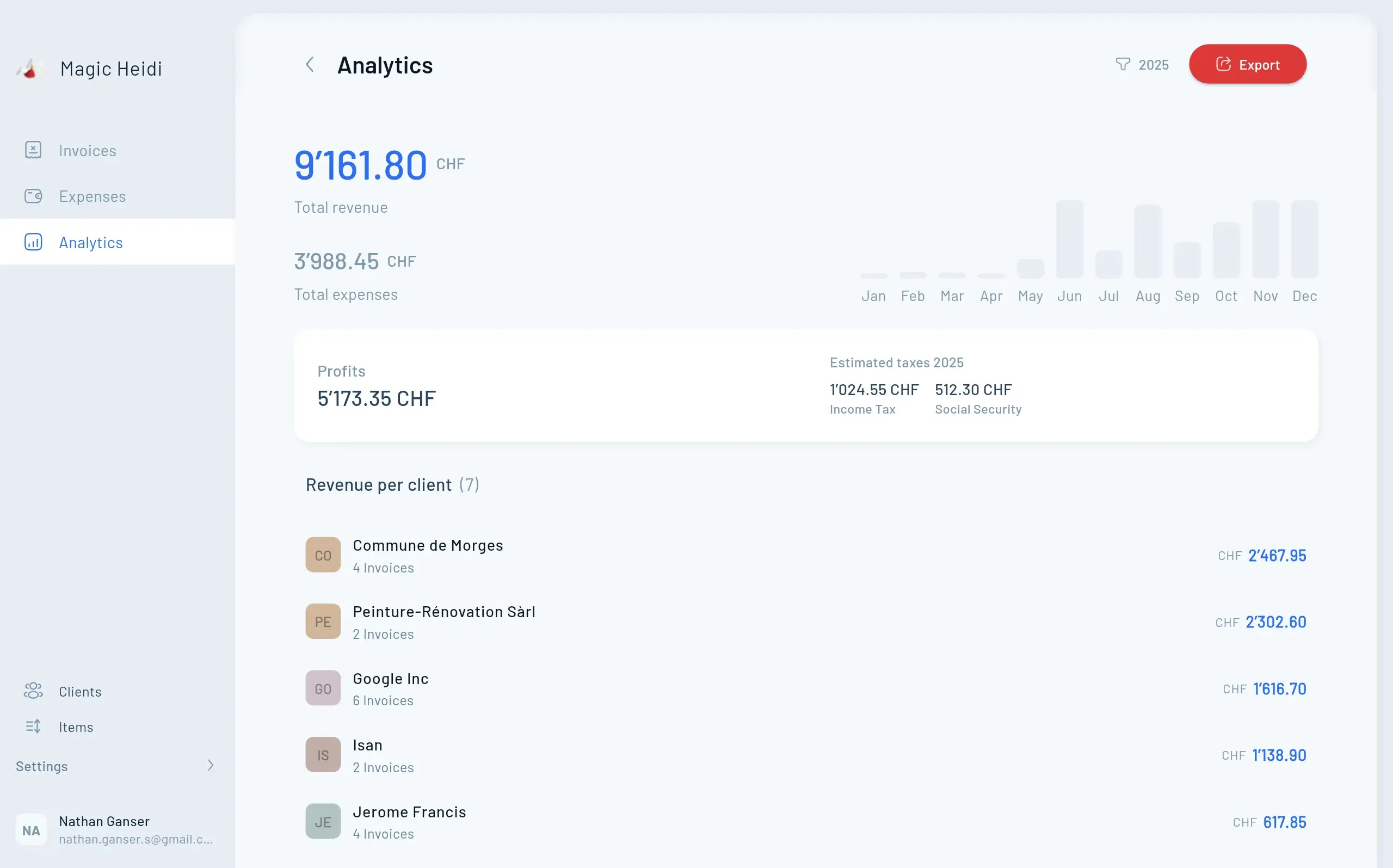
Magic Heidi Analytics Dashboard

But here's the good news: online filing doesn't have to be complicated. With the right knowledge and tools, you can master Swiss VAT compliance, maximize your deductions, and get back to billable work faster.

This guide covers everything you need to know about filing your online VAT statement in 2026—from current rates and registration thresholds to step-by-step ePortal instructions and common mistakes that trigger audits. For the whole system explained end to end — rates, the CHF 100,000 threshold, registration and input tax — start with the Swiss VAT overview.

VAT Fundamentals

What Swiss Freelancers Need to Know About VAT in 2026

Value-added tax (VAT, or MWST/TVA/IVA in Switzerland's official languages) affects how you invoice clients, track expenses, and manage cash flow. Understanding the basics prevents costly errors.

Important: You may see references to a 7.7% rate in older content—this is outdated. The current standard rate is 8.1%, effective since January 1, 2024.

Looking ahead: In June 2026, the Swiss parliament approved an increase of the standard rate from 8.1% to 8.5% from January 2028 to fund the 13th AHV pension payment; a popular vote is scheduled for November 2026.

Registration Threshold for Freelancers

You must register for VAT if your worldwide annual turnover from taxable supplies exceeds CHF 100,000.

Here's what many freelancers miss: this threshold is calculated on a rolling 12-month basis, not just by calendar year. Once you cross CHF 100,000 in any consecutive 12-month period, you have 30 days to register.

Businesses below the threshold can register voluntarily. Why would you? To reclaim input VAT on business expenses—potentially worth thousands in annual savings.

When to Register

Registration timeline matters:

  • Within 30 days of exceeding the threshold or starting taxable activity
  • Application processing takes approximately 4 weeks
  • Your VAT number follows the format: CHE XXX.XXX.XXX
  • You receive a UID (Enterprise Identification Number) alongside your VAT number

Delayed registration means you may owe backdated VAT on invoices already issued. Don't wait.

2025 Mandate

The 2025 Online Filing Mandate: What Changed

January 1, 2025 marked the end of paper-based VAT returns in Switzerland. All VAT-registered businesses must now submit returns electronically through the ePortal.

Swiss Business Office

Critical decision: If you're starting fresh in 2026, skip VAT-declaration Easy. With its May 2026 shutdown approaching, beginning with VAT-declaration Pro saves you a future migration headache.

AGOV Login: The Future of Swiss Government Access

Switzerland is transitioning from CH-Login to AGOV (Swiss Government Account) for all federal services.

Timeline:

  • AGOV registration available now
  • Mandatory from October 31, 2026
  • CH-Login discontinued end of 2027

Set up your AGOV account early to avoid last-minute access issues during tax season.

Practical filing notes: You don't upload individual invoices—the portal only wants the period totals, split by VAT rate. You still have to keep the individual invoices for ten years in case the ESTV asks.

At the plausibility check, don't just click through: the portal flags unusual values in red or yellow. The most common warnings are input VAT exceeding output VAT, sharp deviation from the previous quarter, and missing required fields.

If you spot an error after submission, file a corrective return online. Within the original deadline, it's free. For small differences (under CHF 100), it's often simpler to correct in the next period's return.

Filling in the VAT Return: The Key Form Fields Explained

The online form in the ePortal follows the same logic as the old paper form. As a freelancer you usually only need a handful of fields (numbered "Ziffern"):

  • Field 200 – turnover: the total of your agreed or collected consideration for the period, including exempt supplies. Deductions such as services abroad (exports are VAT-exempt) go in fields 220 to 280.
  • Fields 302 / 312 / 342 – tax: split of taxable turnover by rate 8.1% (302), 2.6% (312) and 3.8% (342). As a service provider, your turnover almost always lands entirely in field 302; the portal calculates the tax due automatically.
  • Fields 400 / 405 – input tax (effective method only): 400 for input tax on materials and services, 405 for input tax on investments and other operating costs (laptop, office furniture).
  • Field 500 / 510 – result: the amount payable (500) or your credit (510). Check, submit – the QR invoice for payment is provided directly in the portal.

Under the net tax rate method you essentially fill in only two things: field 200 (total turnover including VAT) and field 322 or 332 (turnover multiplied by your approved net tax rate). Input tax drops out entirely – the flat rate covers it. On your invoices you still show the normal rates, i.e. 8.1% for most services.

Worked example (effective method): Marco, a fictional IT consultant from Zug, has CHF 30,000 turnover in the quarter, all at the standard rate – VAT due: CHF 2,430. In the same quarter he bought a laptop and software subscriptions, CHF 180 of input tax in total. He enters 30,000 in fields 200 and 302, 180 in the input tax fields, and owes CHF 2,250. The whole return takes under 20 minutes because his accounting software shows him all three figures ready-made. That's where it's decided whether the VAT return is painful or relaxed: not in the ePortal, but in your accounting software throughout the year.

AI-Powered

Expense Tracking That Does Itself

Paper receipts are the enemy of freelancers. Lost. Faded. Forgotten. Snap a photo — Magic Heidi's AI extracts the date, amount, VAT, category, and vendor automatically. No more manual data entry. No more shoeboxes of receipts.

Magic Heidi Expensing on Mobile

Settling VAT: Effective Method vs. Net Tax Rate

How you settle your VAT – and how often – depends on the method you chose at VAT registration:

Effective methodNet tax rate method
PrincipleVAT on turnover minus input tax on expensesIndustry flat rate on gross turnover
FilingQuarterly (4× per year)Semi-annually (2× per year)
Deadline60 days after quarter end60 days after half-year end
Input tax deductionYes, with receiptsNo – built into the flat rate

Conditions, industry rates and detailed worked examples are in the net tax rate method guide – here, just the deadlines and the rule of thumb.

Quarterly Filing (Standard Under the Effective Method)

Most freelancers file quarterly:

  • Q1: January-March (due by end of May)
  • Q2: April-June (due by end of August)
  • Q3: July-September (due by end of November)
  • Q4: October-December (due by end of February)

Best for: Freelancers with steady revenue between CHF 100,000-5,000,000 annually.

Semi-Annual Filing (Net Tax Rate Method)

If you file under the net tax rate method, you only submit twice a year:

  • H1: January-June (due August 31)
  • H2: July-December (due February 28 of the following year)

Under the net tax rate method, you apply an industry flat rate (between 0.1% and 6.5%) to your revenue, with no input VAT deduction. Simpler, but rarely cheaper.

A worked example: Marco, a fictional IT consultant in Lugano, earns CHF 130,000 in annual revenue with around CHF 5,000 of input VAT from his laptop, software, and coworking. Under the effective method, he'd owe roughly CHF 5,500 in VAT (8.1% of 130,000 minus 5,000 of input VAT, simplified). Under the net tax rate of 6.1% for IT services, he'd owe CHF 7,930. For Marco, the effective method is clearly better. For a copywriter with almost no material costs, the math flips the other way.

Practical tip: Run your last twelve months through both methods before deciding. Switching is possible later, but only after three years for the effective method and after one year for the net tax rate method.

Monthly Filing

Monthly returns suit businesses regularly in VAT credit positions—meaning you typically pay more input VAT than you collect from customers.

Best for: Freelancers with high equipment or material costs, or those wanting faster refunds.

Annual Filing (New for 2025)

Starting January 1, 2025, SMEs can apply for annual VAT reporting if:

  • Annual taxable turnover stays below CHF 5,005,000
  • You have a clean compliance history
  • You apply by the end of February of the year in question via the ePortal

Best for: Smaller freelancers who want to minimize administrative burden and have predictable, lower-volume businesses.

Annual filers must still pay provisional amounts quarterly, reconciling once yearly.

Maximize Deductions

Maximizing Your VAT Deductions

Input tax deduction is your biggest opportunity to reduce VAT liability legally.

Fully Deductible

What Qualifies for Full Deduction

These business expenses qualify for 100% VAT deduction:

  • Office equipment and furniture
  • Software and digital tools (including Magic Heidi)
  • Professional services (accounting, legal, web design)
  • Marketing and advertising
  • Training and professional development
  • Business insurance
  • Workspace rent (if exclusively for business)
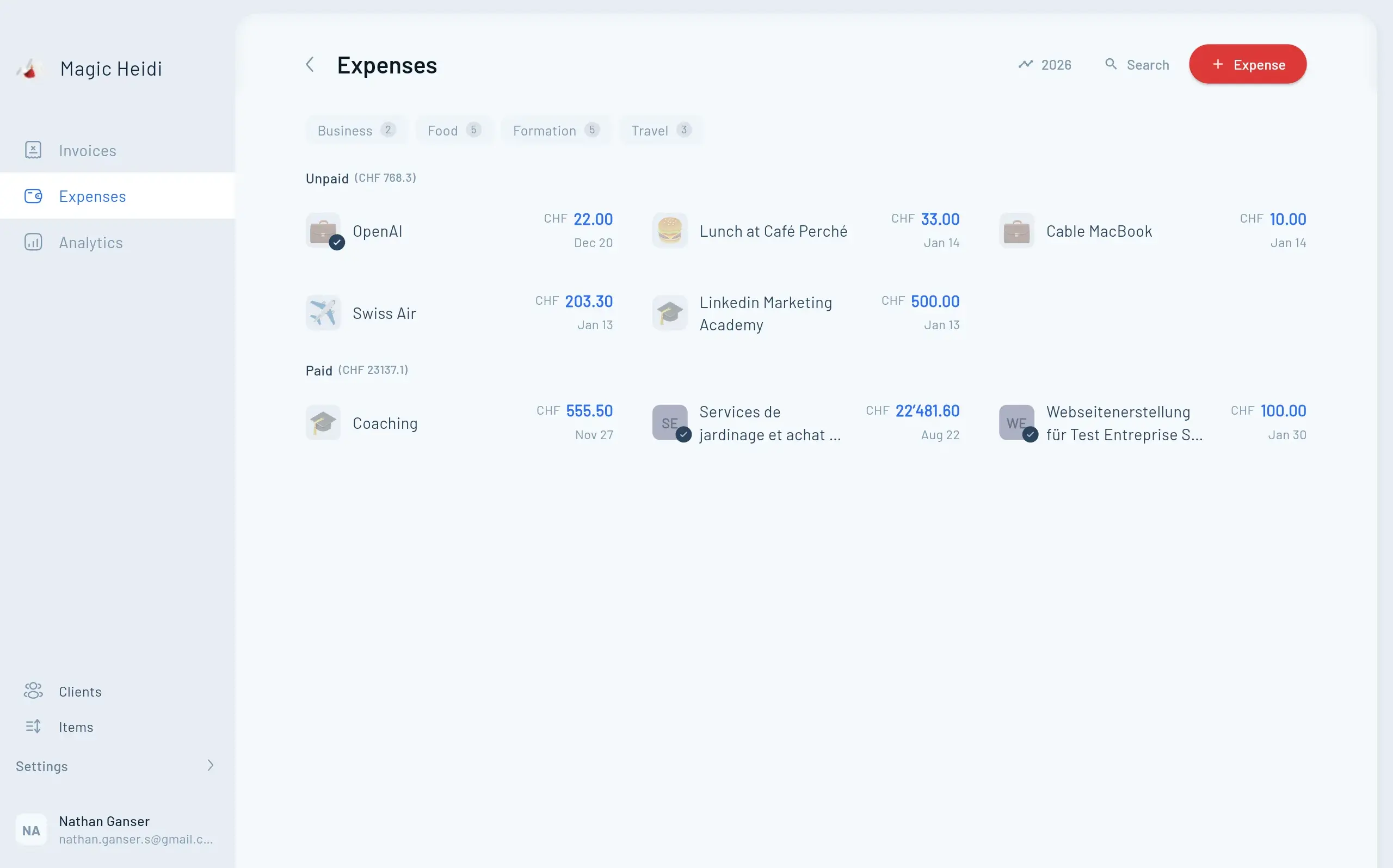
Magic Heidi Expense List
Partially Deductible

Mixed-Use Items & Documentation

These require careful calculation and proper documentation:

  • Meals during business travel (generally 50%)
  • Mobile phone bills (business portion only)
  • Vehicle costs (if used privately too)
  • Home office (proportional to business use)
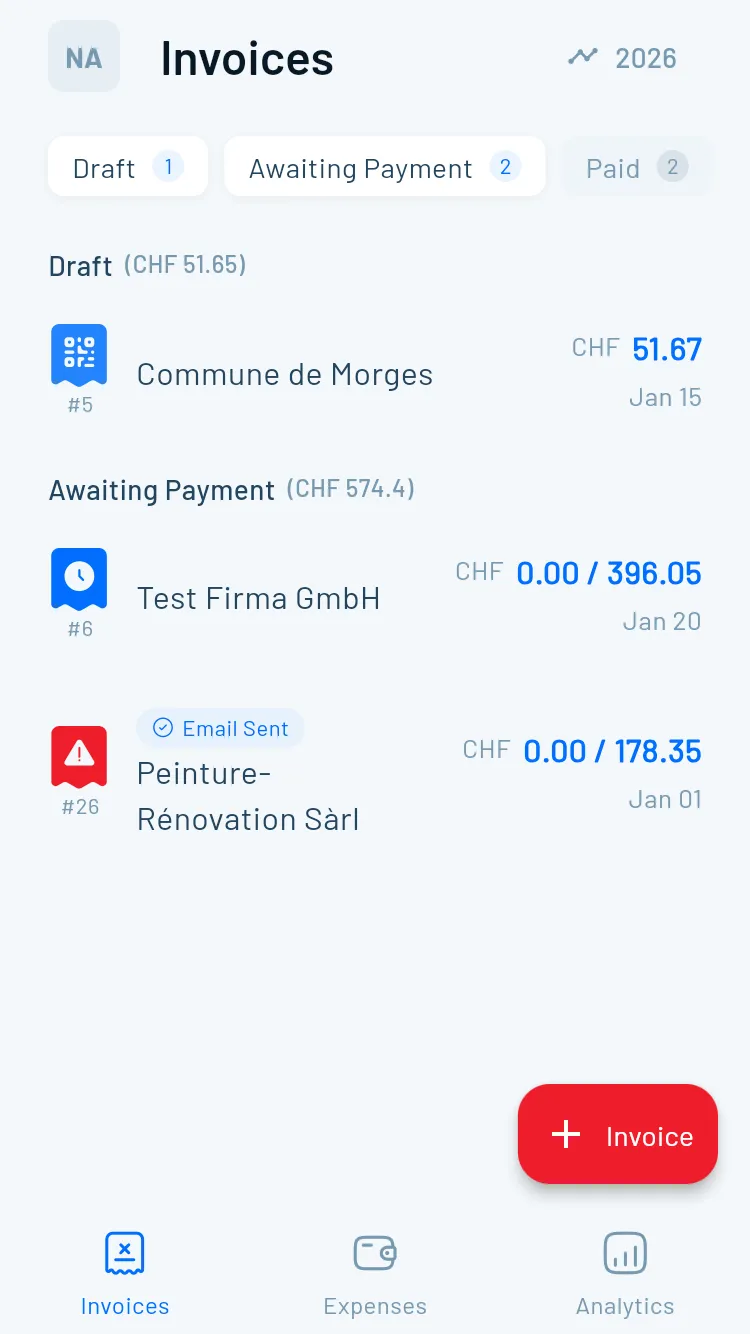
Magic Heidi Mobile Invoicing

Required Documentation

For VAT deduction claims, you need:

Compliant VAT invoices showing:

  • Supplier's VAT number
  • Invoice date and number
  • Clear description of goods/services
  • Amounts with VAT breakdown
  • Your business name and address

Additional requirements:

  • Receipts for smaller purchases
  • Bank statements proving payment
  • Business purpose documentation for mixed-use items

Mixed-use example: Léa, a fictional photographer in Lausanne, uses her iPhone 60% for work and 40% personally. So she can only deduct 60% of the input VAT on the iPhone purchase. At her first audit after three years, she had to repay CHF 800 plus late interest because she'd deducted 100%. An honest estimate when entering each expense prevents this.

Time-saver: Magic Heidi's receipt scanner automatically identifies deductible VAT and flags missing documentation, ensuring you never leave money on the table.

Common VAT Mistakes That Cost Freelancers Thousands

Learn from others' errors. These mistakes appear in nearly every VAT audit.

Late Registration

Waiting until after exceeding CHF 100,000 creates backdated VAT liability on all invoices.
💳

Wrong VAT Rates

Applying incorrect rates leads to overcharged clients and administrative nightmares.
📄

Non-Compliant Invoices

Missing required elements delays payments and prevents client deductions.
🛒

Claiming Personal Expenses

Audits catch these deductions. You'll repay improperly claimed VAT plus interest.
📅

Missing Deadlines

Interest charges (4% in 2026) apply immediately. Repeated late filing triggers audits.
🌍

International Service Rules

Misunderstanding B2B vs B2C rules creates cross-border tax complications.

VAT on International Services: Cross-Border Rules

Freelancers with international clients face additional complexity.

B2B Services (Business Clients)

Services to EU/EEA business clients:

  • No Swiss VAT charged
  • Reverse charge applies (client accounts for VAT in their country)
  • You must verify client's VAT number
  • Report as zero-rated export service

Services to non-EU business clients:

  • Generally no Swiss VAT
  • Follow the same reverse charge principle
  • Maintain documentation proving client's business status

B2C Services (Private Consumers)

Services to Swiss private clients:

  • Always charge Swiss VAT (8.1% standard rate)
  • No exceptions

Services to foreign private clients:

  • Complex place-of-supply rules apply
  • Generally taxable where the customer is located
  • May require foreign VAT registration depending on service type and volume
  • Consult a tax advisor for significant foreign B2C business

Documentation Requirements

For international transactions, keep:

  • Client's VAT number verification (use EU VIES system)
  • Contracts clearly stating service nature
  • Communication proving client's location
  • Bank statements showing international payments

Extension Requests

Need more time? Request an extension via the ePortal before the deadline.

Standard extensions:

  • Granted relatively easily for first-time requests
  • Usually two to three months (30-90 days)
  • Typically granted without a detailed justification
  • Still must pay estimated VAT due to avoid interest

Practical tip: The request takes a few clicks in the ePortal—what matters is submitting it before the original deadline expires. Don't rely on it every quarter, but as a backup option it's perfectly legitimate.

When to request:

  • Missing documentation from suppliers
  • Illness or emergency
  • Complex transactions requiring professional advice
  • System issues (rare but document thoroughly)

Penalties and Interest

Late filing and payment consequences:

Interest on late payment:

  • 4% per year (2026 rate, down from 4.5% in 2025)
  • Calculated daily from deadline
  • Applied automatically, no exceptions

Fines:

  • Repeated late filing: Up to CHF 5,000
  • Serious non-compliance: Up to CHF 800,000 in extreme cases
  • Intentional fraud: Criminal prosecution possible

Good news: The FTA is generally reasonable with first-time issues if you communicate proactively and demonstrate good faith.

Magic Heidi

How Magic Heidi Transforms VAT Management

Manual VAT tracking consumes hours every quarter. Here's how Magic Heidi gives you those hours back.

  • 📸
    AI-Powered Receipt Scanning

    Extract supplier, date, amount, and VAT automatically. Save 8-12 hours per quarter.

  • Real-Time VAT Calculation

    See your VAT liability update live as you create invoices and log expenses.

  • 🧾
    Swiss-Compliant Invoicing

    Generate professional invoices with automatic QR codes and all required legal elements.

  • 📊
    One-Click ePortal Export

    Export period data in ePortal-compatible format with pre-calculated figures.

Invoices
  • Invoice #3

    Magic Heidi

    CHF 500

    Jan 29

  • Invoice #2

    Webbiger LTD

    CHF 2000

    Jan 24

  • Invoice #1

    John Doe

    CHF 600

    Jan 20

Professional Invoicing

Swiss-Compliant Invoices in 30 Seconds

Generate professional invoices featuring automatic VAT calculation at correct rates, embedded QR codes for the Swiss payment system, all required legal elements, and multi-language support (German, French, Italian, English).

Magic Heidi Mobile Invoicing

Multi-Currency Handling

Invoice international clients in EUR, USD, or other currencies while Magic Heidi:

  • Converts to CHF using official rates
  • Applies correct VAT treatment for international services
  • Maintains audit trail with exchange rates used
  • Generates reports in multiple currencies

Mobile-First Design

Run your business from anywhere:

  • Scan receipts at the coffee shop
  • Invoice clients from the train
  • Check VAT status on your phone
  • Sync seamlessly across all devices
FAQ

Frequently Asked Questions about Filing VAT

Can I still file the VAT return on paper?

No. Since January 1, 2025, electronic filing via the FTA ePortal is mandatory. The transition period has ended and the old paper VAT forms are no longer sent out.

What do I need to file VAT online?

Three things: an AGOV login, your business (UID) linked in the ePortal, and your figures for the period – turnover, tax per rate and, under the effective method, input tax. Set up access as soon as you receive your VAT number, not shortly before the deadline.

How long does filing the VAT return online take?

If your books are up to date, about 15 to 20 minutes. It's not the ePortal that takes time but gathering the figures. With accounting software that keeps VAT totals automatically, even that shrinks to a few minutes.

Where do I find the VAT forms?

The old paper VAT forms no longer exist. Today you complete the return form directly in the FTA ePortal – with the same field numbers as before (200, 302, 400, etc.). You no longer need templates to print or mail.

Do I need to register for VAT if I earn less than CHF 100,000?

Registration is optional below the threshold, but consider it if you have significant deductible expenses. Voluntary registration lets you reclaim input VAT on equipment, software, and services—potentially thousands in savings.

What happens if I exceed the threshold mid-year?

You must register within 30 days of crossing CHF 100,000 in any rolling 12-month period. Your VAT liability begins from the date you exceed the threshold, not from registration completion.

Can I file monthly instead of quarterly?

Yes, request monthly filing via the ePortal if you're regularly in VAT credit (paying more input VAT than collecting from customers). This accelerates refunds.

How long do I need to keep VAT records?

Ten years. Switzerland requires comprehensive record retention including invoices, receipts, contracts, and correspondence. Digital storage (like Magic Heidi provides) satisfies this requirement.

What if I make a mistake on a submitted return?

File a corrective statement through VAT-declaration Pro. The system allows amendments to previous periods. Within the original deadline, the correction is free. For small differences (under CHF 100), it's often simpler to adjust in the next period's return. Act quickly—voluntary corrections face lighter consequences than audit discoveries.

Do I charge VAT to foreign clients?

It depends. B2B services to foreign businesses typically use reverse charge (no Swiss VAT). B2C services to private foreign consumers have complex place-of-supply rules. Document everything carefully.

Can I switch from quarterly to annual filing?

Yes, if your turnover stays below CHF 5,005,000 and you have good compliance history. The application for the annual option introduced in 2025 must be submitted by the end of February of the year in question via the ePortal.

What's the penalty for not registering when required?

The FTA assesses backdated VAT on all taxable supplies from when you should have registered, plus interest and potential fines. In serious cases, penalties can reach CHF 5,000 or more.

File With Confidence in 2026

Swiss VAT compliance evolved significantly in 2025. Paper filing is gone. Online submission through the ePortal is mandatory. But you don't need to navigate this alone. Try Magic Heidi free and experience how AI-powered automation transforms hours of tedious data entry into minutes of smart, strategic work.