 Magic Heidi
 Swiss VAT Registration 2026: How to Register, Step by Step
When you must register for VAT (CHF 100,000), how online registration with the Federal Tax Administration works, which documents you need and how you get your VAT number – the national guide for sole proprietors, freelancers and SMEs.

You must register for VAT as soon as your business generates more than CHF 100,000 in annual worldwide turnover from taxable supplies. Registration is done online with the Federal Tax Administration (FTA, in German ESTV) – within 30 days of the liability arising. You need your UID (or receive it in the same step), choose your filing method during registration and receive your VAT number in the format CHE-XXX.XXX.XXX MWST with the confirmation. Below the threshold you are exempt, but you can register voluntarily.
This page is the national guide to Swiss VAT registration. VAT is a federal tax: you always register with the FTA – whether your business sits in Zurich, Geneva, Lugano or Chur. The rules, the threshold, the form and the VAT number are identical across Switzerland; only the cantonal preliminary steps (compensation office, commercial register) differ – you'll find the overview by canton further down.
What comes afterwards in day-to-day practice – applying the right rates, deducting input tax, filing each period – is covered in Swiss VAT for freelancers. For the full picture of the Swiss system with all rates, methods and deadlines, start with the Swiss VAT overview 2026; what's behind the number is explained in the UID number guide.
Mandatory above CHF 100,000
Annual worldwide turnover from taxable supplies is what counts. Legal form is irrelevant: sole proprietorships, GmbHs and AGs share the same threshold. Non-profit associations: CHF 250,000.
Deadline: 30 days
Registration must happen within 30 days of the liability arising – i.e. from the moment it becomes foreseeable that you'll exceed the threshold, not when the bank statement says so.
Online with the FTA
VAT registration runs digitally through the federal ePortal with an AGOV login. No paper form, no fee – registration itself is free.
UID + MWST = VAT number
You don't apply for a separate number. Once entered in the VAT register, your UID with the suffix MWST is automatically your VAT number.
Voluntary below the threshold
Below CHF 100,000 you can waive the exemption. Worth it with high expenses or B2B clients – and it binds you for at least one tax period.
Choose your method right away
During registration you decide how to file: effective method (quarterly, with input tax deduction) or net tax rate method (semi-annual, flat rate).
When Do You Need to Register for VAT?
The CHF 100,000 turnover threshold and the cases where VAT registration becomes mandatory
CHF 100,000+ Turnover
Annual worldwide turnover from taxable supplies exceeds CHF 100,000
Foreign B2C Sales
Foreign companies supplying B2C services in Switzerland must register
Import Activities
Importing low-value consignments totalling more than CHF 100,000 per year
Non-Profit Organizations
Non-profit associations and charitable institutions from CHF 250,000 turnover
The CHF 100,000 Rule Explained
The threshold is simple: if your annual turnover from taxable supplies exceeds CHF 100,000, you must register for VAT within 30 days of the liability arising.
A detail many miss: since 2018 the threshold applies worldwide. Your total turnover counts, not just the part with Swiss customers. Services to clients abroad count towards the threshold too – even if you invoice them without Swiss VAT because they're taxable abroad. Foreign companies also calculate with their worldwide turnover.
An example: a designer starts as a sole proprietor and earns CHF 85,000 in her first year. In year two she wins two larger clients and reaches CHF 120,000. Liability doesn't begin when the FTA writes to her – it begins the moment it becomes foreseeable that she'll exceed the threshold within twelve months. The 30 days run from there.
Practical tip: check your turnover monthly, not just at year-end. If you document the date you crossed the threshold and prepare the registration, you won't have to correct invoices retroactively.
Sole Proprietorship and VAT: Liable or Exempt?
Legal form doesn't matter. A sole proprietorship is subject to exactly the same rules as a GmbH or AG: only turnover from taxable supplies is decisive.
When a sole proprietorship is exempt from VAT:
- As long as your turnover from taxable supplies stays below CHF 100,000 per year, you are exempt from liability. You don't have to register, may not show VAT on your invoices and can't reclaim input tax.
- The exemption applies automatically – nothing to apply for, nothing to report.
- Non-profit sports and cultural associations and charitable institutions only become liable from CHF 250,000.
- Certain supplies are exempt from tax regardless of turnover – healthcare, education, culture or insurance, for instance. If you provide only such supplies, you won't become VAT-liable even with CHF 300,000 in turnover.
A common mistake: salary from employment doesn't count towards the threshold. If you're self-employed alongside a job, only the self-employed turnover counts.
Don't forget acquisition tax: even without registration, you owe acquisition tax if you buy more than CHF 10,000 per year in services from foreign suppliers (typically software subscriptions, freelancers abroad). Details in the acquisition tax guide.
When Voluntary Registration Makes Sense
Even below the threshold you can waive the exemption and register voluntarily. The reason:
Input tax deduction: once registered, you reclaim the VAT on business expenses – office supplies, equipment, software subscriptions, services. With substantial expenses, this often outweighs the administrative effort.
Example: a consultant with CHF 80,000 in annual turnover but CHF 20,000 in business expenses could reclaim around CHF 1,620 in VAT (at the 8.1% rate). Over the years, that adds up.
The catch: waiving the exemption generally binds you for at least one tax period. And from then on you must charge VAT to every customer – with a mostly private clientele, that makes your offer 8.1% more expensive. For VAT-registered business clients, however, VAT is a pass-through item.
Which VAT rate applies to you? Most service providers and freelancers work with the standard rate of 8.1%; there's also 2.6% (food, books, medication) and 3.8% (accommodation). All rates and special cases are in the Swiss VAT rates overview; for concrete amounts, use the VAT calculator.
VAT Registration in 5 Steps
From checking your turnover to receiving your VAT number – how registration with the FTA works
Step 1: Check your liability
Review worldwide turnover of the last twelve months and your forecast. Note the date on which the CHF 100,000 threshold is reached or foreseeably exceeded – the 30 days run from there.
Step 2: Prepare your documents
UID (if you have one), commercial register extract (GmbH/AG or registered sole proprietorship), AHV insurance number, turnover forecast, bank details and a precise description of your activity.
Step 3: Register online with the FTA
In the federal ePortal with your AGOV login, complete the 'VAT registration' service: company details, start of liability, activity, expected turnover.
Step 4: Choose your filing method
Effective method (quarterly, with input tax deduction) or net tax rate method (semi-annual, flat rate). The net tax rate must be actively requested.
Step 5: Receive your VAT number
The FTA confirms the entry – usually within 3–4 weeks. From now on the VAT number goes on every invoice, and VAT is charged from the start of liability.
Registering for VAT: The 5 Steps in Detail
Step 1: Check liability and timing
Pull at least these figures from your books: worldwide turnover (regardless of whether the client sits in Switzerland or abroad), the share of taxable supplies in Switzerland and any special cases such as import or acquisition tax. As soon as the trend points to exceeding the threshold, document the date – the form will later ask for it as the start of liability, and it determines from when your invoices must include VAT.
Step 2: Prepare your documents
For registration you need: your UID (business identification number, if you already have one), the commercial register extract (GmbH, AG or registered sole proprietorship), your AHV insurance number, a turnover forecast and your bank details. As a sole proprietor you're usually already recognised as self-employed by the compensation office – that recognition is the preliminary step that varies by canton (see the cantonal overview).
Step 3: Register online with the FTA
Registration is fully digital via the federal ePortal; there's no paper form anymore. You sign in with your AGOV login and complete the VAT registration. Three points to check carefully before submitting:
- Company details: name, address and legal form must match the official records (commercial register, compensation office).
- Start of liability: don't simply enter the registration date if the obligation arose earlier.
- Activity description: "consulting" is too vague. "Web development and technical project consulting for business clients" helps the FTA classify you – and assign a net tax rate.
Registration is available in German, French or Italian and costs nothing.
Step 4: Choose your filing method
During registration you decide how you'll file in future. Under the effective method you declare the VAT collected each quarter and deduct the input tax you paid. Under the net tax rate method you apply an FTA-set industry rate to your turnover every six months – no input tax deduction, but far less work. Rule of thumb: low expenses → net tax rate, high investments → effective method. Run both variants on your last twelve months; conditions, industry rates and worked examples are in the net tax rate method guide.
Step 5: Receive your VAT number and update your invoices
The FTA reviews the application and confirms the entry in the VAT register – usually within 3–4 weeks; respond quickly to any queries. With the confirmation you have your VAT number. From the start of liability it belongs on every invoice, together with the rate applied and the VAT amount. Store the number and rates once in your invoice template or invoicing software – and set up access for filing your VAT return in the ePortal right away so the first deadline doesn't become a scramble.
Getting Your VAT Number: How You Receive It
The most common question on this topic has a surprisingly simple answer: you don't apply for the VAT number separately – you get it through registration. There's no separate "apply for VAT number" form and no additional fee.
The number is your existing UID with the suffix MWST (TVA/IVA depending on the region): CHE-XXX.XXX.XXX MWST. If you're already in the commercial register or registered with a compensation office, you already have the UID – registration merely adds the VAT status. If you don't have a UID yet, you receive it in the same step.
Everything about the format, the CHE number and the invoice requirement – and how to look up a number in the federal UID register – is explained in the Swiss UID number guide.
Foreign Companies: Registration with a Fiscal Representative
Foreign companies without a Swiss domicile must appoint a fiscal representative resident in Switzerland for VAT registration. The representative handles the VAT obligations – returns, payments, refunds and audits. Cost: around CHF 1,500–3,000 per year, depending on transaction volume and complexity. Direct registration without a representative is planned for the coming years. Here too: worldwide turnover determines liability, not just what's earned in Switzerland.
After Registration: Use the Input Tax Deduction
Why VAT registration pays off financially
Input Tax Deduction: Where VAT Registration Pays Off
When you buy goods or services for your business, you pay VAT to your suppliers. As a registered business you deduct this "input tax" from the VAT collected from your customers (under the effective method).
Example calculation:
- You invoiced clients CHF 50,000 (plus CHF 4,050 VAT at 8.1%)
- You paid CHF 15,000 for business expenses (plus CHF 1,215 VAT)
- You owe the FTA: CHF 4,050 − CHF 1,215 = CHF 2,835
Without VAT registration you'd simply lose the CHF 1,215 paid on expenses. Requirement: a receipt showing VAT for every expense – easiest captured as you go with AI receipt scanning.
What Comes After Registration
With registration the routine begins: VAT on every invoice, collecting receipts, and one return per period in the ePortal. Under the effective method you file quarterly, under the net tax rate method semi-annually – return and payment are each due 60 days after the end of the period. How to actually submit the return (AGOV login, form fields, deadlines) is shown step by step in the online VAT statement guide.
Your checklist for the first 30 days after registration:
- Update invoices: store the VAT number and applicable rates in your template.
- Adjust your bookkeeping: set up VAT accounts, receipt filing and a filing calendar.
- Set up ePortal access: activate the AGOV login and the permission for "VAT return" – not on deadline day.
- Set VAT aside: the VAT you collect is never your money. A separate account avoids nasty surprises at the first payment.
Common VAT Registration Mistakes
and How to Avoid Them
Learn from others' errors and start your VAT liability clean from day one
Waiting Too Long
Register within 30 days of the liability arising – otherwise the FTA claims VAT retroactively, including default interestMiscalculating the Threshold
Count all taxable worldwide turnover, not just Swiss clients or paid invoices – partial payments countWrong Start of Liability
The registration date isn't automatically the start of the obligation – from the actual date, your invoices must include VATWrong VAT Rate
Applying 8.1% to food taxed at 2.6% creates correction work – store the rates correctly oncePoor Receipt Filing
Input tax can only be deducted with a receipt. Keep all invoices and receipts for ten years – audits can go back five yearsForgetting Foreign Turnover
Services to clients abroad count towards the threshold too – and foreign software subscriptions trigger acquisition tax from CHF 10,000VAT Registration by Canton: The Cantonal Preliminary Steps
VAT registration itself always goes through the FTA and is identical nationwide. What differs by canton are the preliminary steps – the compensation office that recognises you as self-employed, and the commercial register office – as well as the industries that dominate locally and bring their own VAT questions. For these eight cantons we've broken it down in detail:
| Canton | Cantonal offices | What's special locally | Guide |
|---|---|---|---|
| Zurich | SVA Zürich, Commercial Register Office of the Canton of Zurich | Mandates for banks and insurers (exempt supplies) change the VAT calculation | VAT Registration Zurich |
| Geneva | OCAS, Registre du commerce | Invoices to UN organizations and missions, clients in France | VAT Registration Geneva |
| Bern | Compensation Office of the Canton of Bern, Commercial Register Office Bern | Federal administration contracts, bilingualism, accommodation in the Oberland (3.8%) | VAT Registration Bern |
| Ticino | IAS Bellinzona, Registro di commercio | Swiss VAT vs. Italian IVA, acquisition tax with Italian suppliers, import tax | VAT Registration Ticino |
| Vaud | CCVD, Registre du commerce | Voluntary registration for EPFL start-ups, primary producer rule in winegrowing | VAT Registration Vaud |
| Aargau | SVA Aargau, Commercial Register Office Aarau | Construction and assembly services across cantonal and national borders (Fricktal) | VAT Registration Aargau |
| St. Gallen | SVA St.Gallen, Commercial Register Office St. Gallen | Liechtenstein counts as domestic, exports to the Rhine Valley and Vorarlberg | VAT Registration St. Gallen |
| Lucerne | WAS Luzern, Commercial Register Office Lucerne | Accommodation at 3.8%, guides and package deals on Lake Lucerne | VAT Registration Lucerne |
Your canton missing? The FTA procedure is the same – follow the five steps above and only clarify the preliminary step (compensation office, commercial register) with your cantonal office.
How Magic Heidi Simplifies VAT After Registration
Managing VAT manually means: every invoice at the right rate, every receipt captured for input tax, every deadline in your head. Magic Heidi was built for Swiss sole proprietors and freelancers and handles this in the background.
- 🧾Store Your VAT Number Once
Save the number and rates once – every QR invoice shows the VAT correctly, automatically
- 📸AI Receipt Scanning
Photograph the receipt, done: amount, date and VAT share are captured automatically for the input tax deduction
- 🧮Both Filing Methods
Effective or net tax rate – Magic Heidi keeps the right totals per quarter or half-year
- 📊Return Figures at the Push of a Button
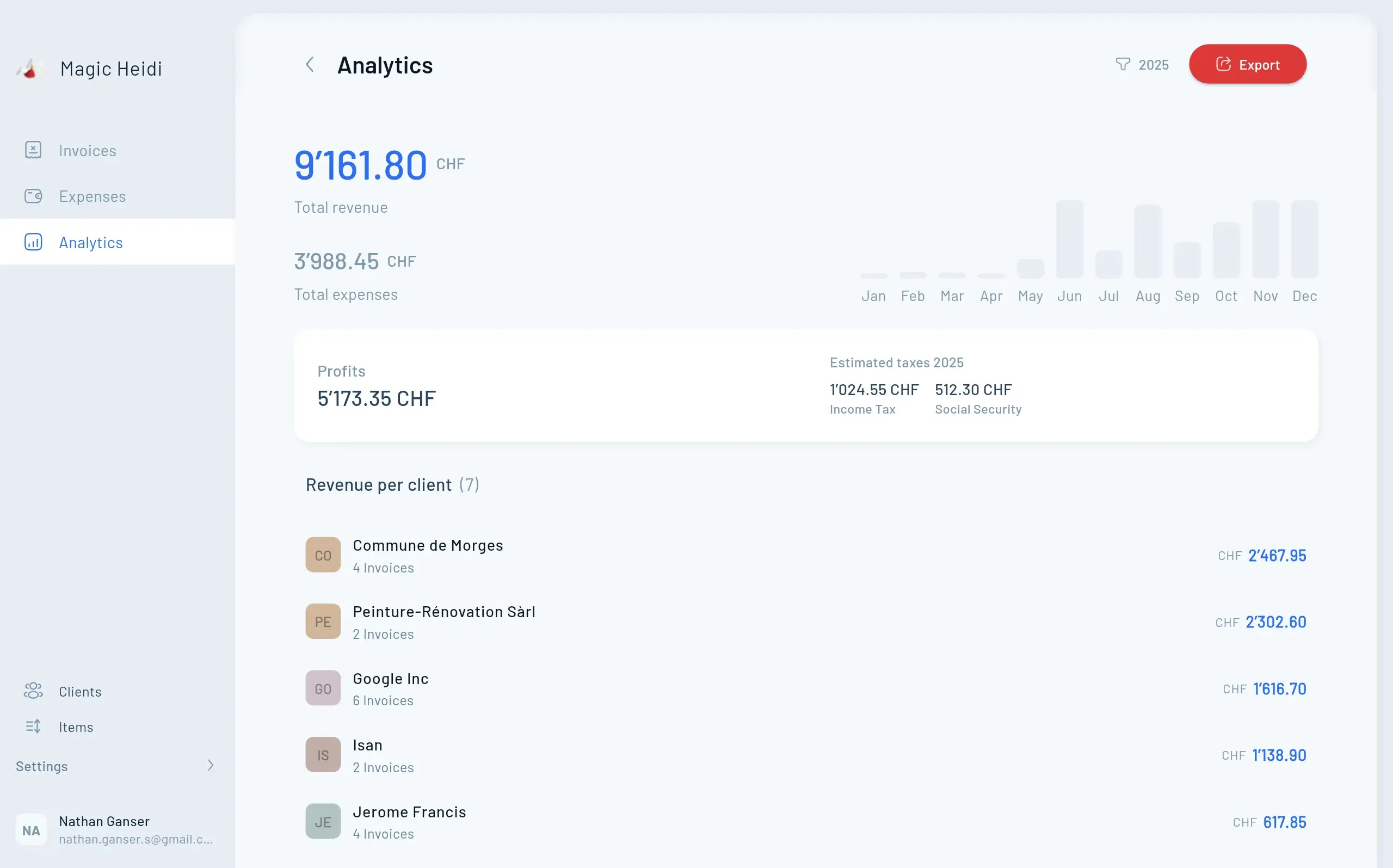
Turnover, tax and input tax per period calculated and ready – you just transfer the figures into the ePortal
- Invoice #3
Magic Heidi
CHF 500
Jan 29
- Invoice #2
Webbiger LTD
CHF 2000
Jan 24
- Invoice #1
John Doe
CHF 600
Jan 20
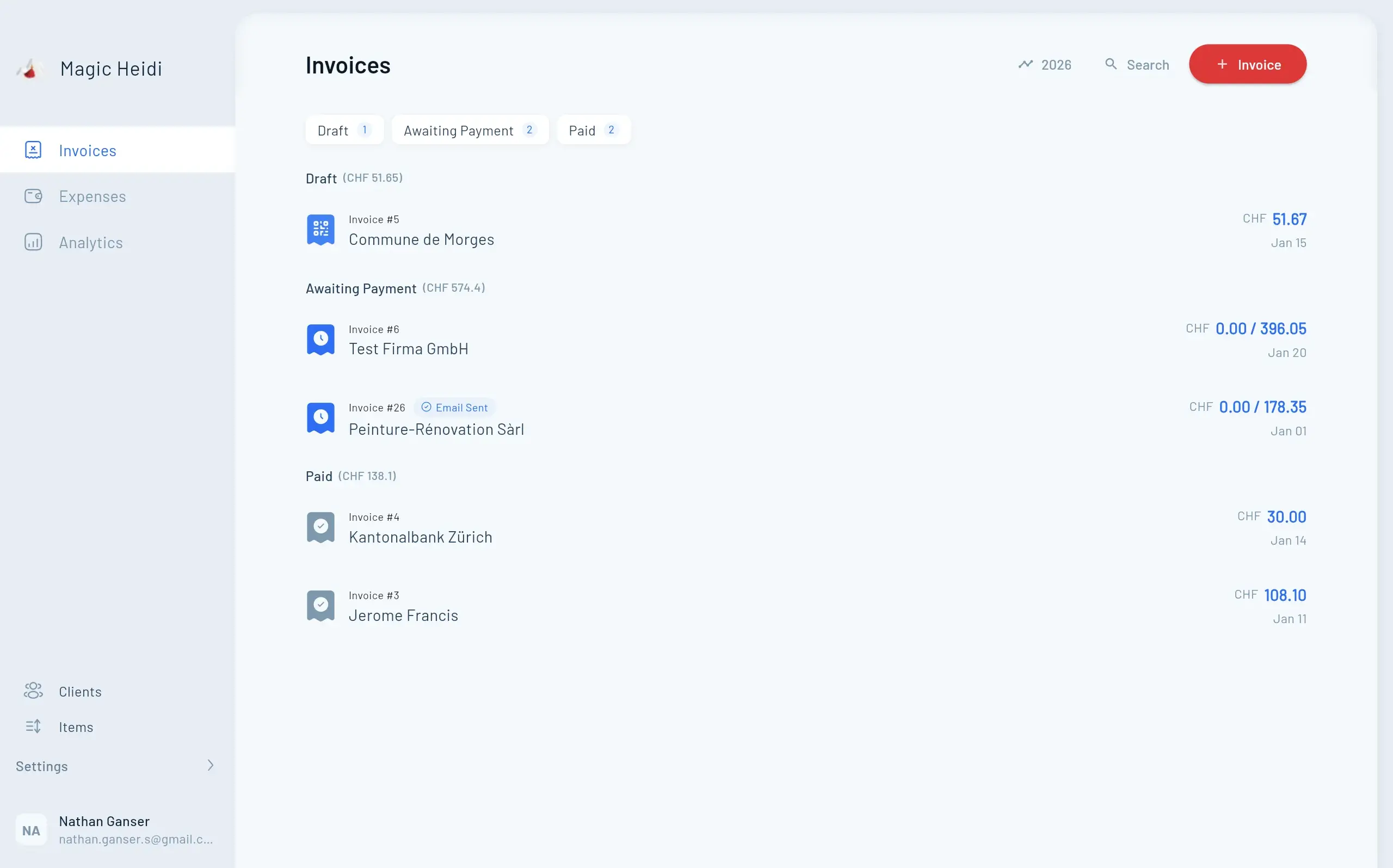
Built specifically for Swiss freelancers and SMEs, Magic Heidi understands Swiss VAT so you don't have to. Focus on your business while the software handles invoices, receipts and VAT totals in the background.
Explore the VAT features for freelancers or learn more about AI-powered receipt scanning. Try it free: 3 invoices and 3 expenses at no cost, no credit card required.
Frequently Asked Questions about VAT Registration
When do I have to register for VAT?
As soon as your business generates more than CHF 100,000 in annual worldwide turnover from taxable supplies. Liability arises the moment it becomes foreseeable that you'll exceed the threshold within twelve months – from then you have 30 days to register. For non-profit associations the threshold is CHF 250,000.
How do I register for VAT?
Online with the Federal Tax Administration (FTA) via the federal ePortal: sign in with your AGOV login, complete the VAT registration (company details, start of liability, activity, turnover forecast), choose your filing method and submit. There's no paper form anymore, and registration is free.
Which documents do I need for VAT registration?
Your UID (if you have one), the commercial register extract for a GmbH, AG or registered sole proprietorship, your AHV insurance number, a turnover forecast and your bank details. Plus a precise description of your activity – it helps the FTA classify you and assign a net tax rate.
How long does VAT registration take?
Completing the form in the ePortal takes around 30 minutes if your documents are ready. Processing by the FTA usually takes 3–4 weeks. Important: liability starts on the date you crossed the threshold, not on confirmation – from then on your invoices must include VAT.
What does a Swiss VAT number look like – and how do I apply for it?
A Swiss VAT number has the format CHE-XXX.XXX.XXX MWST (TVA in French-speaking Switzerland, IVA in Ticino). It's your UID with the suffix MWST. You don't apply for it separately: it's assigned automatically with the confirmation of your VAT registration. To check whether a company is VAT-registered, use the public federal UID register – see the UID number guide.
Is the VAT number the same as the UID number?
Almost. The UID (business identification number, format CHE-XXX.XXX.XXX) is issued to every Swiss business, even without VAT liability. The VAT number is the same number with the suffix MWST – it only exists if VAT registration is active. Details are in the Swiss UID number guide.
Does turnover with foreign clients count towards the CHF 100,000 threshold?
Yes. Worldwide turnover from taxable supplies is decisive – even if you invoice a service abroad without Swiss VAT because it's taxable there. What doesn't count: salary from employment and tax-exempt supplies such as healthcare or education.
Which filing method should I choose when registering?
Effective, if you have high expenses or investments with a lot of input tax (quarterly filing, input tax deduction). Net tax rate, if you mainly sell your working time and buy little (semi-annual filing, flat rate, no input tax deduction). The net tax rate must be requested. Switching later is possible but binds you for a minimum period – details in the net tax rate method guide.
What happens if I miss the 30-day deadline or don't register at all?
The FTA claims VAT retroactively from the date you became liable – including default interest and possible fines. Since you can hardly charge VAT to your customers after the fact, you effectively pay it out of your own pocket. So register too early rather than too late.
How much does VAT registration cost?
Registration with the FTA is free. Foreign companies without a Swiss domicile, however, need a fiscal representative (around CHF 1,500–3,000 per year). The ongoing effort afterwards – receipts, returns – stays small with accounting software.
Do I have to charge VAT as a sole proprietor below CHF 100,000 turnover?
No. Below the threshold you're exempt from VAT, issue invoices without VAT and may not show a VAT number either. You can waive the exemption voluntarily, though – sensible with high expenses or if your clients are VAT-registered themselves.
Can I deregister if my turnover drops below CHF 100,000?
Yes – if your turnover is below the threshold and isn't expected to reach it in the following year either, you can apply for deletion from the VAT register. This doesn't happen automatically, and you may have to correct earlier input tax deductions on certain assets. The VAT deregistration guide shows how.
Do I charge VAT to foreign clients?
Mostly not: for services to business clients abroad, the place-of-recipient principle generally applies – the invoice goes out without Swiss VAT. B2C services to foreign consumers are assessed differently depending on the type of service.
How long must I keep VAT records?
Ten years for all tax-relevant documents – invoices, receipts and VAT returns. Digital storage is sufficient.
Registered for VAT? Now Make Filing a Routine
VAT registration is done in half an hour. What matters afterwards is a clean setup: VAT number on every invoice, receipts captured digitally, return figures at the push of a button. Magic Heidi does exactly that – try it free, no credit card required.