 Magic Heidi
 VAT in Switzerland 2026: Rates, Filing & Obligations Explained
Everything about Swiss VAT (MWST/TVA) in one place: current rates, the CHF 100'000 threshold, registration, reporting methods, online filing via ePortal, and all 2026 deadlines.
VAT (called MWST in German, TVA in French) is Switzerland's main consumption tax: businesses charge it on their sales and pass it on to the Federal Tax Administration (FTA). In 2026 there are three rates — 8.1% standard, 2.6% reduced, and 3.8% special rate for accommodation — and the obligation to register starts at CHF 100'000 annual turnover.
This guide covers Swiss VAT from A to Z: when you must register, which reporting method suits you, how to file your VAT return online via ePortal, and which deadlines apply in 2026. Written from experience — we went through the whole process ourselves as freelancers.
Key takeaways
- Swiss VAT rates in 2026: 8.1% (standard), 2.6% (reduced, e.g. food), 3.8% (accommodation) — unchanged since 01.01.2024.
- VAT registration becomes mandatory once your business exceeds CHF 100'000 turnover per year — registration must happen within 30 days.
- There are two reporting methods: effective (quarterly, with input tax deduction) and the net tax rate method (semi-annual, flat rate, less admin).
- VAT returns are filed electronically via the FTA's ePortal — deadline: 60 days after the end of the reporting period.
- Registered businesses can reclaim the VAT paid on business expenses as input tax.
What is Swiss VAT?
Value added tax is a general federal consumption tax on goods and services consumed in Switzerland. It is ultimately paid by consumers — but collected and remitted by businesses, which add it to their invoices. The legal basis is the Swiss VAT Act (MWSTG).
For you as a business owner or freelancer, this means: once you are VAT-registered, you charge VAT to your clients, deduct the VAT you paid on your own expenses (input tax), and transfer the difference to the FTA. You are effectively a collection agent for the federal government — the business doesn't earn anything on VAT itself.
VAT is the largest source of federal revenue. By international standards, Swiss rates are low: Germany charges 19%, France 20%, Austria 20% — Switzerland only 8.1%.
The Current Swiss VAT Rates
Three rates apply since 01.01.2024 — still valid unchanged in 2026.
8.1% Standard Rate
The default for most goods and services — including freelance work like consulting, IT, or design
2.6% Reduced Rate
Food, non-alcoholic drinks, books, newspapers, medication
3.8% Special Rate
Accommodation services: hotel stays including breakfast
Swiss VAT Rates 2026 in Detail
| Rate | 2026 | Applies to |
|---|---|---|
| Standard rate | 8.1% | Most goods and services (consulting, trades, IT, retail …) |
| Reduced rate | 2.6% | Food, non-alcoholic beverages, books, newspapers, medication, seeds |
| Special rate (accommodation) | 3.8% | Overnight stays including breakfast (hotels and similar) |
These rates have applied since 01.01.2024 (increase to fund the AHV pension system) and are unchanged in 2026. Certain services are fully exempt from VAT — for example healthcare, education, insurance, and residential rent. If you only provide exempt services, you owe no VAT but also cannot deduct input tax.
You'll find a detailed overview with special cases under Swiss VAT rates in detail. And to quickly convert an amount gross/net: the free Swiss VAT calculator handles all three rates in both directions.
Who Has to Register? The CHF 100'000 Threshold
The rule is simple: your business becomes liable for VAT once it generates more than CHF 100'000 of taxable turnover per year worldwide. This applies equally to sole proprietorships, GmbHs, and AGs — the legal form doesn't matter. For non-profit, volunteer-run associations the threshold is CHF 250'000.
Important details many people miss:
- The threshold is per year, not per client. What counts is your total taxable turnover.
- Once you cross the threshold, you must register within 30 days. The step-by-step guide to VAT registration in Switzerland shows exactly how — including the documents you need — with regional details for Zurich, Geneva, and Bern.
- Below the threshold you are exempt, but you may register voluntarily. That pays off if you have significant VAT-bearing expenses or mainly work for VAT-registered business clients.
After registering, you receive your Swiss VAT number in the format CHE-XXX.XXX.XXX MWST. It is based on your business identification number — the guides on the UID number and the public UID register explain what that is and how to look up entries.
Reporting Methods: Effective or Net Tax Rate?
When you register, you choose how to report to the FTA. There are two methods — and the choice affects both your workload and often your tax bill:
| Effective method | Net tax rate method | |
|---|---|---|
| Principle | VAT on turnover minus input tax on expenses | Flat industry rate applied to gross turnover |
| Filing | Quarterly | Semi-annually |
| Input tax deduction | Yes, based on receipts | No — built into the flat rate |
| Admin effort | Higher (record every expense) | Considerably lower |
| Eligibility | None | Turnover max. CHF 5'024'000, tax liability max. CHF 108'000 per year |
| Best if … | You have high expenses/investments | You have low expenses (typical: service providers) |
Rule of thumb for freelancers: If you buy little material and mainly sell your time, the net tax rate method is often simpler — you apply a single industry rate set by the FTA to your turnover and you're done. If you invest a lot (equipment, software, goods), the effective method recovers more input tax. Full details with worked examples are in the net tax rate method guide.
Since 2025, there is also an annual reporting option for businesses with up to CHF 5'005'000 turnover — with instalment payments during the year. For most freelancers, quarterly or semi-annual reporting remains the standard.
Filing Your VAT Return Online: Step by Step in ePortal
VAT returns are filed electronically — paper forms are history. The official channel is the FTA ePortal. Here's how to file your Swiss VAT return online, step by step:
- Create an ePortal account. Register at eportal.admin.ch using the federal AGOV login (one-time setup, about 10 minutes).
- Activate the VAT service. Add the "VAT return" online service and link it to your VAT number (CHE number). You'll need the activation code the FTA sends you by post.
- Open the reporting period. After the quarter (or semester) ends, the new return appears in the portal.
- Declare your turnover. Enter your total turnover for the period (item 200) plus any deductions such as exports or exempt services.
- Enter input tax (effective method only). Record the VAT you paid on business expenses and investments.
- Review and submit. The portal calculates the tax due automatically. Check, submit — done.
- Pay. Settle the amount within 60 days of the period's end via QR-bill or e-banking.
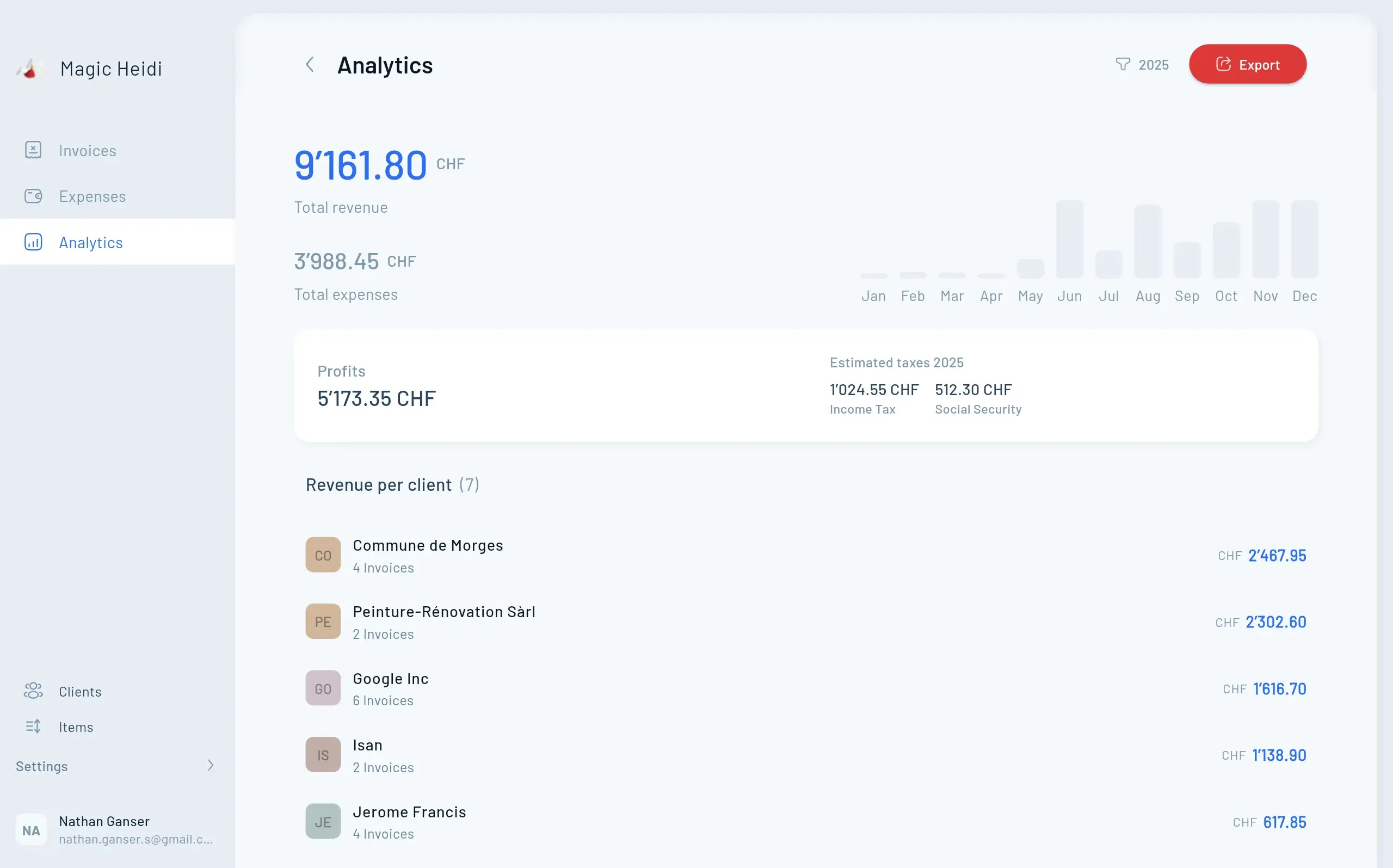
With clean bookkeeping, the whole thing takes less than 15 minutes: you essentially transfer four or five numbers. That's exactly where software helps — Magic Heidi calculates VAT on every invoice and receipt automatically and shows you the return figures ready to copy over. For more detail on online filing, see the guide to filing your VAT return online; to check your figures against your books before submitting, use the Swiss VAT reconciliation guide.
Swiss VAT Deadlines 2026
The same deadline applies to filing and payment: 60 days after the end of the reporting period. For 2026 that means:
| Reporting period | Return & payment due |
|---|---|
| Q4 2025 (Oct–Dec) | End of February 2026 |
| Q1 2026 (Jan–Mar) | End of May 2026 |
| Q2 2026 (Apr–Jun) | End of August 2026 |
| Q3 2026 (Jul–Sep) | End of November 2026 |
| Q4 2026 (Oct–Dec) | End of February 2027 |
| 1st semester 2026 (net tax rate) | End of August 2026 |
| 2nd semester 2026 (net tax rate) | End of February 2027 |
Two practical tips from experience:
- Deadline extensions can be requested online. If time gets tight, you can request a free filing extension in ePortal. Careful though: late payments still accrue default interest.
- Set the VAT aside as you go. The VAT you collect is never your money. A separate account where you park the VAT share of every paid invoice saves you a nasty surprise in February.
Input Tax: Reclaiming VAT on Your Expenses
The input tax deduction is the big compensation for the reporting effort: as a registered business (using the effective method), you deduct the VAT you paid on business expenses from the VAT you owe.
Worked example for a freelancer:
- Quarterly turnover: CHF 30'000 → VAT invoiced to clients: CHF 2'430 (8.1%)
- Business expenses: CHF 5'000 (laptop, software, coworking) → input tax paid: CHF 405
- Owed to the FTA: 2'430 − 405 = CHF 2'025
The condition: you can back up every expense with a receipt showing the VAT. Collecting receipts pays off twice — for your taxes and for input tax. The easiest way is digital: with Magic Heidi's AI expense scanning, you photograph the receipt and the amount, date, and VAT share are captured automatically.
VAT for Freelancers and Sole Proprietors
For the self-employed, the VAT question usually comes in three phases:
- Below CHF 100'000 turnover: You are exempt. No VAT on invoices, no returns — but no input tax deduction either. Keep an eye on your turnover: the registration obligation arrives faster than many expect.
- Approaching the threshold: Check whether voluntary registration makes sense (high expenses? B2B clients?) and choose your reporting method.
- Registered: From now on, VAT goes on every invoice and you file quarterly or semi-annually. With the right setup, it becomes routine rather than stress.
One special case affects many freelancers with EU clients: for services provided to foreign business customers, the place-of-recipient principle usually applies — the invoice goes out without Swiss VAT. The guide on VAT numbers and EU clients explains what to watch out for. All freelancer-specific questions — from your first VAT invoice to filing — are covered in depth in the guide to VAT for freelancers.
How Simple Swiss VAT Is with Magic Heidi
Managing VAT manually means applying the right rate everywhere, recording every input tax amount, and keeping every deadline in your head. Magic Heidi was built for Swiss freelancers and handles it in the background.
- 🧾Correct VAT on Every Invoice
Add your VAT number once — the right rate is applied automatically to your QR invoices
- 📸AI Receipt Scanner
Photograph a receipt and you're done: amount, date, and VAT share captured automatically for input tax
- 🧮Return Figures at the Push of a Button
Turnover and input tax per period calculated and ready — you just copy the numbers into ePortal
- 🇨🇭100% Swiss
Built for Swiss sole proprietors and freelancers: Swiss VAT rates, QR invoices, Swiss hosting
- Invoice #3
Magic Heidi
CHF 500
Jan 29
- Invoice #2
Webbiger LTD
CHF 2000
Jan 24
- Invoice #1
John Doe
CHF 600
Jan 20
Frequently Asked Questions About Swiss VAT
How much is VAT in Switzerland in 2026?
Three rates apply in 2026: 8.1% standard rate for most goods and services, 2.6% reduced rate for everyday essentials (food, books, medication), and 3.8% special rate for accommodation. The rates have been unchanged since 01.01.2024.
At what point do I have to charge VAT?
VAT liability starts once your business generates more than CHF 100'000 of taxable turnover per year. After crossing the threshold, you must register with the Federal Tax Administration within 30 days. Below it you are exempt, but you can register voluntarily.
How do I file my Swiss VAT return online?
Via the FTA's ePortal (eportal.admin.ch): log in with AGOV, activate the VAT return service, enter your turnover and input tax for the period, and submit electronically. Electronic filing is mandatory — paper forms no longer exist.
What are the deadlines for the Swiss VAT return?
Filing and payment are due 60 days after the end of the reporting period. With quarterly reporting: Q1 by end of May, Q2 by end of August, Q3 by end of November, Q4 by end of February of the following year. A filing extension can be requested online.
What's the difference between the effective method and the net tax rate method?
With the effective method you file quarterly: VAT on turnover minus the input tax you actually paid. With the net tax rate method you apply a flat industry-specific rate to your turnover semi-annually — no input tax deduction, but far less admin. It's open to businesses up to CHF 5'024'000 turnover and CHF 108'000 tax liability.
What is input tax?
Input tax is the VAT you pay on business expenses — a laptop, software, or materials. As a registered business using the effective method, you deduct these amounts from the VAT you owe. The condition is receipts showing the VAT amount.
What does a Swiss VAT number look like?
The Swiss VAT number is based on the business identification number (UID) and has the format CHE-XXX.XXX.XXX MWST, for example CHE-123.456.789 MWST. You receive it after registering with the FTA and must show it on your invoices.
Do I have to charge VAT as a freelancer below CHF 100'000 turnover?
No. Below CHF 100'000 annual turnover you are exempt and issue invoices without VAT. You may not show VAT on invoices and cannot deduct input tax. Voluntary registration is possible and pays off mainly with high expenses or B2B clients.
Do I charge Swiss VAT to foreign clients?
Usually not: for services to business customers abroad, the place-of-recipient principle generally applies — the service is taxed where the client is based, and your invoice goes out without Swiss VAT. The details depend on the type of service.
What happens if I miss the VAT registration deadline?
The FTA claims the VAT retroactively from the moment you became liable — plus default interest. Since you can rarely charge that VAT to past clients afterwards, you effectively pay it out of your own pocket. Keeping an eye on your turnover is worth it.
Conclusion: Swiss VAT Is Manageable Once Your System Is Set Up
VAT in Switzerland is no dark art: three rates (8.1%, 2.6%, 3.8%), a clear registration threshold at CHF 100'000, two reporting methods, and an online filing that takes a quarter of an hour with clean books. The most common mistakes don't happen in the return itself, but before it: registration missed, receipts lost, VAT money spent.
Your next steps:
- Turnover below CHF 100'000? Keep an eye on the threshold and check whether voluntary registration pays off.
- Crossed the threshold? Complete your VAT registration within 30 days and choose your reporting method.
- Already registered? Capture receipts digitally, park the VAT money separately, and make the ePortal return a routine.
Magic Heidi takes over the tedious part: correct VAT on every QR invoice, receipts captured by photo, return figures calculated and ready. Try it for free — 3 invoices and 3 expenses free, no credit card required.
Swiss VAT Under Control — Without Excel and Paperwork
Magic Heidi calculates VAT on every invoice and receipt automatically. At filing time, you just copy the finished numbers into ePortal.