 Magic Heidi
Lifting the objection: how to apply for Rechtsöffnung
Lift your client's objection without a lawyer: when a signed quote is enough, which enclosures the court wants and what lifting the objection costs.

Founder of Magic Heidi

Your client has filed an objection (Rechtsvorschlag / opposition), and your debt enforcement (Betreibung / poursuite) has stalled. To get rid of the objection, you apply to the court at the place of debt enforcement for lifting the objection (Rechtsöffnung / mainlevée).
If your client signed something that states the amount, such as your fixed-price quote, the route is provisional lifting of the objection (provisorische Rechtsöffnung / mainlevée provisoire) under Article 82 of the Debt Enforcement and Bankruptcy Act (SchKG / LP): a written application, a few enclosures and a court fee of CHF 50 to 300 for claims of CHF 1,000 to 10,000. If you have nothing signed, the route runs through conciliation and a lawsuit.
Key points at a glance
- The objection stops debt enforcement. It only continues with a court decision: lifting the objection (Articles 80 to 84 SchKG) or a judgment that expressly sets the objection aside (Article 79 SchKG).
- Provisional lifting needs your client's signature. A signed quote with a fixed price can be enough if you prove that you delivered. An invoice and reminders alone are never enough.
- The clock runs for one year. The right to continue expires one year after service of the payment order (Zahlungsbefehl / commandement de payer); the period is suspended while the court proceedings are pending (Article 88 SchKG).
- Court fee of CHF 50 to 300 for claims of CHF 1,000 to 10,000 (Article 48 of the SchKG Fees Ordinance, GebV SchKG). You advance it; in the end, the losing party pays.
- 20 days for the action disputing the debt. If your client doesn't sue within 20 days after the objection is lifted, the lifting becomes definitive (Article 83 SchKG).
At this point, many self-employed people hear: “Without an acknowledgement of debt, you can forget it.” That's not quite right. And an invoice with three reminders isn't enough either.
How to start debt enforcement is covered in our guide initiating debt enforcement in Switzerland. This one is about the next step: check your title, find the court, gather the enclosures, know the costs.
Objection received: what next?
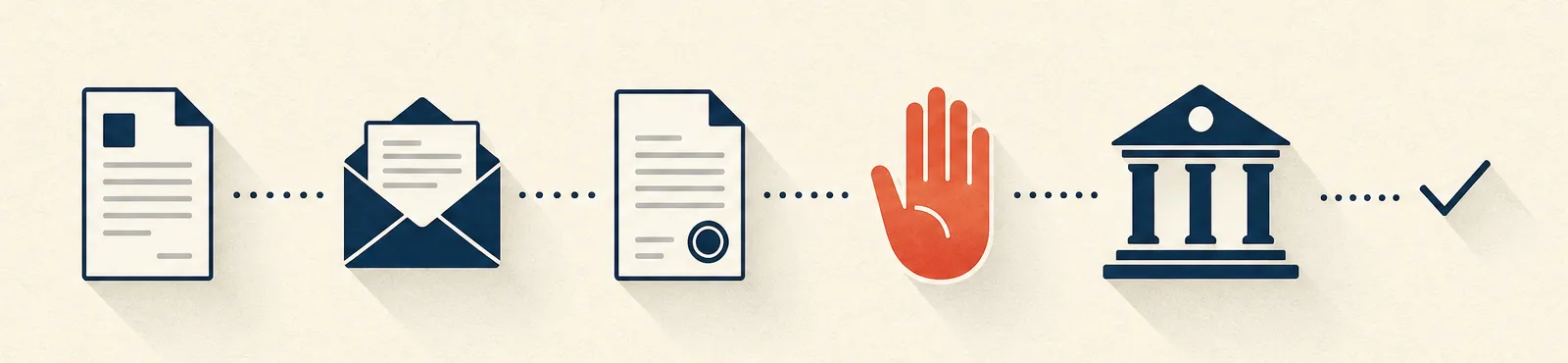
With the objection, your client disputes the claim, and the debt enforcement stops. They don't have to give reasons. Things only move again once a court sets the objection aside: in the fast procedure to lift the objection if you have a title, otherwise in ordinary court proceedings. It's up to you to show that your claim is justified (ch.ch).
Your client lodges the objection immediately on service or within 10 days at the debt enforcement office (Betreibungsamt / office des poursuites) (Article 74 SchKG). If they dispute only part of the claim, they must state the disputed amount precisely; otherwise the whole claim counts as disputed (Article 74 paragraph 2 SchKG). For the rest, which they don't dispute, you can generally request continuation.
Deadlines: by when you must get the objection lifted
| Deadline | What happens | Who acts | Legal basis |
|---|---|---|---|
| Immediately or 10 days after service | Objection | Client | Art. 74 para. 1 SchKG |
| 1 year from service of the payment order | Right to continue expires; the period is suspended while the court proceedings are pending | You | Art. 88 para. 2 SchKG |
| 5 days after the client's response | Court decides (in practice, longer at some courts) | Court | Art. 84 para. 2 SchKG |
| 10 days after notice of the decision | Request written reasons, if the court only gave notice of the decision without reasons | The losing party | Art. 239 para. 2 ZPO |
| 10 days after service of the reasoned decision | Appeal (Beschwerde / recours) | The losing party | Art. 321 paras. 1–2 ZPO |
| 20 days after the objection is lifted | Action disputing the debt | Client | Art. 83 para. 2 SchKG |
The second row matters most: the information sheet of the Bezirksgericht Frauenfeld (district court of Frauenfeld, TG) lists as a requirement that no more than one year has passed since service of the payment order. Don't wait until month eleven.
Three ways to get the objection lifted
Which route is open to you depends on one question: what do you have in hand?
| Definitive lifting (definitive Rechtsöffnung) | Provisional lifting (provisorische Rechtsöffnung) | Ordinary route (Anerkennungsklage) | |
|---|---|---|---|
| What you need | Enforceable judgment, court settlement or acknowledgement of debt made in court, enforceable public deed, enforceable decision of a Swiss administrative authority (Art. 80 SchKG) | Acknowledgement of debt in a public deed or confirmed by signature (Art. 82 SchKG) | No title; you prove the claim in court |
| Procedure | Summary, court at the place of debt enforcement | Summary, court at the place of debt enforcement | Conciliation first (Art. 197 ZPO), then simplified or ordinary procedure |
| What the client can object | Against a judgment, only repayment or deferral since the decision (proven by documents) or the statute of limitations; against an enforceable public deed, also defences that can be proven immediately (Art. 81 SchKG) | Defences they make immediately credible (Art. 82 para. 2 SchKG) | Anything; the court examines the claim in full |
| Afterwards | Continuation request | 20 days for an action disputing the debt, otherwise definitive | The judgment must expressly set the objection aside (Art. 79 SchKG) |
An ordinary notarised deed isn't enough for definitive lifting; it has to be an enforceable one under Articles 347 et seq. of the Civil Procedure Code (ZPO / CPC).
The quick decision in three questions:
- Do you have a judgment, a court settlement or an enforceable deed? → definitive lifting.
- Has your client signed something that states the amount or makes it determinable (quote, contract, acknowledgement of debt)? → provisional lifting.
- Nothing signed? → ordinary route via conciliation and an action for recognition of the debt.
For most self-employed people, question 2 is the one that decides. To make sure you can answer it with yes for your next client, use our quote template with a signature field.
Do you have a title to lift the objection? The check for the self-employed
The core of it is one sentence of the law:
“If the claim is based on recognition of the claim evidenced by a public deed or confirmed by signature, the creditor may request that the objection be set aside provisionally.”
Art. 82 para. 1 SchKG (English translation on Fedlex, for information only)
The court only examines this document, not who is right in the dispute (BGE 145 III 20 E. 4.3.3). That's why checking your title (Rechtsöffnungstitel / titre de mainlevée) is the most important step.
What counts as an acknowledgement of debt
Check your document against six points:
- Both parties clearly named: you as the creditor, your client as the debtor.
- Amount stated or easy to determine: “CHF 4,800” works, “time and materials” doesn't.
- Due date determinable: for example, “30 days after acceptance”.
- Clear acknowledgement of the obligation to pay, without conditions.
- Signature of the client or their representative.
- The claim is due. For contracts, that means: you have delivered your work.
Typical titles are a signed acknowledgement of debt or instalment agreement and a signed contract. An acknowledgement of debt doesn't even have to state the reason for the debt (Article 17 of the Code of Obligations, OR / CO). What a watertight acknowledgement of debt looks like is shown in our article on the acknowledgement of debt (Schuldanerkennung / reconnaissance de dette).
Signed quote or order confirmation: yes, with proof of delivery
The good news for freelancers: a quote or order confirmation that your client has signed is a bilateral contract. If it states the price and payment is due, it is in principle a provisional title (BGE 145 III 20 E. 4.1.1).
The catch: with a bilateral contract, you have to show that you've done your part. If the client claims you didn't deliver at all, that claim is enough, and you have to prove delivery (BGE 145 III 20 E. 4.3.2–4.3.3). For that you need proof of delivery, ideally an acceptance report or a delivery note signed by the client.
Take Nina, a fictional web designer from Bern. Her quote reads: website, fixed price CHF 4,800, payable 30 days after acceptance. The client signs the field at the end of the PDF and sends back the scan.
At go-live, he signs the delivery note: “Website accepted on 12 May 2026”. The invoice and two reminders go unanswered, and no notice of defects ever arrives. After the objection, Nina has everything: the quote as her title and the delivery note as proof that she delivered.
The Basel practice, explained simply
And if the client claims the work is defective? That's what the Basel practice (Basler Rechtsöffnungspraxis) is for, the approach most commonly applied by the cantonal courts (BGE 145 III 20 E. 4.3.1). Under it, a signed contract is enough if one of these applies:
- The client doesn't claim at all that you failed to perform or performed badly.
- They claim a defect, but it's obviously unfounded. (If they claim you didn't deliver at all, the rule of evidence above applies.)
- You immediately prove that you performed, for example with the signed delivery note.
- The client had to perform first, for example by paying an agreed deposit.
On top of that comes a rule from the Federal Supreme Court: if the client relies on a defect they should have notified, the objection is lifted unless they make it credible that they gave notice in time (BGE 145 III 20 E. 4.3.1, referring to Federal Supreme Court judgment BGer 5A_19/2016 on contracts for work). A “the website was never any good” months after acceptance carries little weight without a notice of defects.
What isn't enough
These documents help as evidence, but on their own they are not a title for lifting the objection:
- E-mail, WhatsApp or a click. A signature must be handwritten; the only equivalent is a qualified electronic signature with a qualified time stamp (Article 14 OR).
- Invoice plus reminders. You issue them yourself. They show what you're claiming, not what the client has acknowledged.
- The signed delivery note on its own. It confirms receipt, not an obligation to pay.
- Silence. If your client doesn't respond to reminders, that's not an acknowledgement (BGE 136 III 627 E. 3.3). Several documents only form a title together if the signed one refers to the others.
Picture Sandro, a fictional photographer from Winterthur. His client confirmed the CHF 2,400 shoot only by e-mail (“Great, let's do that”). After the objection, Sandro realises: no signature, no provisional lifting. All he has left is conciliation.
Hourly fees on a time basis: the problem with the amount
Back to Nina. For another client, her signed quote says “CHF 120 per hour, time and materials”. She bills 38 hours, but has no signed timesheet.
The amount can't be determined from the signed document; the hours only appear on Nina's own invoice. So the application for provisional lifting will probably be rejected. The lesson: for work billed by the hour, have the timesheet or delivery note signed at handover.
Applying for provisional lifting of the objection: the application in 5 steps
The procedure to lift the objection is summary: short, in writing, with documents as evidence. Here's how to file your application (Rechtsöffnungsbegehren, also called Rechtsöffnungsgesuch / requête de mainlevée):
- Find the competent court. The court at the place of debt enforcement is competent, meaning your client's domicile or, if your client is a company entered in the commercial register such as an AG or GmbH, its registered office (Articles 46 and 84 SchKG). In practice, it's the court in the district of the debt enforcement office that issued your payment order; in Thurgau, for example, the Bezirksgericht (district court).
- Write the application. You can use the optional form “Rechtsöffnungsbegehren” (application to lift the objection) from the Federal Office of Justice; cantons may offer their own forms, and a letter works too. The core is the prayer for relief (Rechtsbegehren):
In debt enforcement no. … of the debt enforcement office of …,
the objection is to be lifted provisionally
for CHF … plus interest at 5% since …;
costs and party compensation
to be borne by the respondent.
Debt enforcement offices and courts work in the canton's official language (German, French or Italian), so filing your application in that language avoids a request for translation. Add a few sentences on what was agreed, what you delivered and when payment fell due. The objection can only be lifted for the claim you put into debt enforcement; so interest only if it already appears on the payment order.
- Gather the enclosures. Copies are enough. The checklist follows below.
- File it. On paper with a handwritten signature, by post or at the counter, or electronically with a qualified electronic signature (Article 130 ZPO). The Federal Office of Justice expressly points out that filing by ordinary e-mail is not permitted. You don't need to go through conciliation first (Article 198 letter a ZPO).
- Pay the advance on costs and wait. In summary proceedings, the court can request the full expected court costs as an advance (Article 98 ZPO). Your client then responds, and the court can decide on the basis of the files without a hearing (Articles 253 and 256 ZPO).
Enclosures checklist
| Enclosure | Purpose |
|---|---|
| Payment order, front and back, with the objection noted on it | Shows the debt enforcement and the objection |
| Signed quote, order confirmation, contract or acknowledgement of debt | Your title for lifting the objection |
| Signed delivery note, acceptance report or timesheet | Proves that you delivered |
| Invoice | Amount and due date |
| Dated reminders | Evidence for default interest |
| Power of attorney | Only if someone represents you |
| One complete copy for the court and one for each opposing party | The court serves it on your client |
If you claim default interest (5% a year, Article 104 OR), show from when the client was in default: generally from your reminder, or, with a fixed agreed payment date, as soon as that date has passed (Article 102 OR). How to send a proper reminder is covered in our guide to writing a payment reminder in Switzerland.
This is where Magic Heidi helps you put it all together. Quote, order confirmation, delivery note, invoice and reminders are stored as PDFs under the same client. For each document, the send history shows on which day you sent it to which e-mail address and whether sending worked, and for letters also the postal events. So you can take the dates for the due date and default interest straight into your application. Add the client's signed scan.
Important: invoices and reminders are evidence, not a title. And Magic Heidi doesn't file anything with the court or the debt enforcement office; you do that yourself.
What does lifting the objection cost?
The decision fee is set by federal law and depends on the amount in dispute (Article 48 GebV SchKG):
| Amount in dispute | Decision fee |
|---|---|
| up to CHF 1,000 | CHF 40 to 150 |
| CHF 1,000 to 10,000 | CHF 50 to 300 |
| CHF 10,000 to 100,000 | CHF 60 to 500 |
| CHF 100,000 to 1,000,000 | CHF 70 to 2,000 |
| over CHF 1,000,000 | CHF 500 to 4,000 |
Who pays in the end? The losing party (Article 106 ZPO), but you advance the costs. If you win, the court refunds your advance and collects the costs from the client (Article 111 paragraph 1 ZPO). Without a lawyer, you don't get compensation for legal fees, but you do get your necessary expenses and, in justified cases, compensation for your time and effort (Umtriebsentschädigung, Article 95 paragraph 3 ZPO).
Nina's bill, amount in dispute CHF 4,800: The payment order cost CHF 60 plus CHF 7 per service attempt and expenses such as postage (Articles 13 and 16 GebV SchKG), and lifting the objection CHF 50 to 300, possibly in full as an advance. If she wins, the client bears the costs.
Want to document your claims properly from the start? With Magic Heidi's invoicing software, you create QR invoices and dated reminders, and a quote turns into an invoice with one tap.
After the decision: what happens next
Granted: your client can file an action disputing the debt within 20 days, otherwise debt enforcement continues. Rejected: you can appeal or take the ordinary route.
Objection lifted: 20 days for the action disputing the debt
Once the payment deadline has passed, you can request provisional seizure (provisorische Pfändung / saisie provisoire) or, for clients subject to bankruptcy enforcement (Konkursbetreibung / poursuite par voie de faillite), an inventory of assets (Article 83 paragraph 1 SchKG). Your client has 20 days to file an action disputing the debt (Aberkennungsklage / action en libération de dette) at the court at the place of debt enforcement, without conciliation (Article 83 paragraph 2 SchKG, Article 198 letter e number 1 ZPO). The claim itself is then decided in ordinary proceedings.
If they don't sue, or they lose, the lifting of the objection and the provisional seizure become definitive (Article 83 paragraph 3 SchKG). If you haven't requested provisional seizure yet, you now file the continuation request (Fortsetzungsbegehren / réquisition de continuer la poursuite) with the debt enforcement office, as described in our debt enforcement guide. The one-year period was only suspended while the court proceedings were pending; after that, it runs on.
Objection not lifted
There is no full appeal (Berufung), only the limited appeal (Beschwerde) within 10 days of service of the reasoned decision (Article 309 letter b number 3 and Article 321 paragraphs 1–2 ZPO). If the court gave notice of the decision without written reasons, you must first request the reasons within 10 days; otherwise you waive the appeal (Article 239 paragraph 2 ZPO). The appeal court's fee is at most one and a half times the fee the first instance was allowed to charge (Article 61 paragraph 1 GebV SchKG).
Your claim isn't lost: the court only examined the title. Whether you're owed the money is settled in ordinary proceedings.
No title? Lift the objection with an action for recognition of the debt
If your client hasn't signed anything, you sue for payment and expressly ask for the objection to be set aside. If the judgment doesn't say so, you can't continue directly and must first request definitive lifting of the objection on the basis of the judgment (Articles 79 and 80 SchKG). This is often called an action for recognition of the debt (Anerkennungsklage / action en reconnaissance de dette).
For small claims, it's less daunting than it sounds:
- Conciliation first (Article 197 ZPO).
- Up to CHF 2,000, the conciliation authority can decide the case itself at your request (Article 212 ZPO).
- Up to CHF 10,000, it can make a proposed decision (Entscheidvorschlag); if neither party rejects it within 20 days, it has the effect of a final decision (Article 210 paragraph 1 letter c, Article 211 paragraph 1 ZPO).
- Up to CHF 30,000, the simplified procedure applies (Article 243 ZPO).
Faster still is legal protection in clear cases (Rechtsschutz in klaren Fällen) (Article 257 ZPO), in summary proceedings and without conciliation. The requirement: the facts are undisputed or immediately provable, and the legal situation is clear. Otherwise, the court won't consider the application, and your claim is preserved. The Federal Office of Justice has a form for this too.
On your next job: have the title in hand from the start
The best moment for lifting the objection is the day you send the quote. Nina's two cases show it: once a signature under a fixed amount, once not.
- Send a quote with a signature field. In Magic Heidi, quote PDFs have a block for date and signature at the end, switched on by default.
- Ask for the signed PDF back before you start. The client signs by hand and sends the scan, or signs with their own qualified electronic signature. Magic Heidi has no built-in e-signature.
- For hourly work, have the timesheet or delivery note signed at handover.
- Send dated reminders and ask for complaints in writing.
- Check the client before big jobs, for example with an extract from the debt enforcement register (Betreibungsregisterauszug / extrait du registre des poursuites).
It takes two minutes per job and, if things go wrong, saves you conciliation and a lawsuit.
Conclusion: lifting the objection starts with a signature
An objection isn't the end of the road. With a signed quote, a contract or an acknowledgement of debt, you can get the objection lifted provisionally, for a court fee of CHF 50 to 300 on claims of CHF 1,000 to 10,000. Without a signature, you're left with conciliation. Either way: file within the year after the payment order.
Check your document against the six points above now. And on your next job, make sure the title is in your folder before your first working day. We answer the most common questions about lifting the objection below.
Sources
- SchKG and ZPO on Fedlex (English translations), GebV SchKG (German; no English version)
- Federal Office of Justice: forms for party submissions (German) and ch.ch: debt enforcement (German)
- BGE 145 III 20 and BGE 136 III 627
General information, not legal advice. For your case, contact a lawyer or your canton's legal advice service.