Calculate Your Real Take-Home Pay as a Swiss Freelancer
That CHF 100/hour rate looks attractive. But after AHV contributions, health insurance, taxes, and unpaid vacation days - what do you actually earn? Most freelancers in Switzerland overestimate their take-home pay by 30-40%.
Free Freelancer Net Income Calculator
Enter your details to see your real take-home pay
Input fields:
- Your hourly/daily/monthly rate
- Canton (location affects taxes significantly)
- Age (impacts pension contributions)
- Working model: Self-employed or Payrolling
Results show:
- Net monthly take-home pay
- Annual income after all deductions
- Breakdown of every contribution and tax
- Comparison with equivalent employee salary
Calculator integration placeholder - contact dev team
Where Your Money Goes
Understanding your results: breaking down every deduction
Social Insurance (AHV/IV/EO)
Self-employed freelancers pay between 5.37% and 9.65% of net income for AHV/IV/EO, graduated by income level. This covers old-age pension, disability insurance, and income compensation.
- Old-age pension (AHV)
- Disability insurance (IV)
- Income compensation (EO)
- Lower rate than employees but no employer matching
Pension Fund (BVG)
Self-employed aren't required to join BVG. This saves money now but creates a retirement gap. With payrolling, you contribute 7-18% (age dependent) and your employer matches it.
- Optional for self-employed freelancers
- Mandatory with payrolling model
- Employer matching doubles savings
- Typical contribution: 7-18% based on age
Health Insurance
Unlike most countries, Swiss health insurance isn't deducted from salary. But you still pay it. Budget CHF 300-500 monthly for basic coverage.
- Not deducted from salary automatically
- Hits take-home pay just as hard
- Basic coverage: CHF 300-500/month
- Required for all Swiss residents
Income Tax (Cantonal Variation)
Switzerland's cantonal tax system creates huge variations. A freelancer earning CHF 100,000 in Zug pays ~CHF 13,000 vs Geneva at ~CHF 22,000.
- Zug: ~13% tax rate (lowest)
- Zürich: ~18% tax rate (medium)
- Geneva: ~22% tax rate (highest)
- Canton choice = thousands in savings
Business Expenses
The calculator shows gross-to-net, but remember ongoing costs that dramatically affect your actual spendable income.
- Accounting: CHF 1,500-3,000/year
- Insurance: CHF 500-2,000/year
- Software/equipment: CHF 1,000-5,000/year
- Office costs: CHF 3,000-12,000/year
The Real Numbers
Example: IT Freelancer billing CHF 100/hour (218 working days/year, 8 hours daily = 1,744 billable hours)
| Income Item | Self-Employment | Payrolling |
|---|---|---|
| Gross Annual Income | CHF 174,400 | CHF 174,400 |
| Social Contributions | CHF 18,584 | CHF 23,777 |
| Payrolling Fee | CHF 0 | CHF 8,720 |
| Health Insurance | CHF 4,800 | CHF 4,800 |
| Income Tax | CHF 31,000 | CHF 28,000 |
| Business Expenses | CHF 5,000 | CHF 2,000 |
| Net Monthly Take-Home | CHF 9,585 | CHF 8,741 |
| Paid Vacation Worth | CHF 0 | CHF 13,415 |
| Sick Pay + Benefits | CHF 0 | CHF 6,104 |
| Employer BVG Matching | CHF 0 | CHF 12,208 |
| Total Compensation Value | CHF 115,016 | CHF 138,540 |
| Net Benefit | — | +CHF 23,524/year |
When Payrolling Makes Financial Sense
The 5% payrolling fee might be the smartest investment in your freelance career
One Main Client Risk
If one client represents 50%+ of income, you risk Scheinselbständigkeit classification. Your client could face tens of thousands in retroactive employer contributions. Payrolling eliminates this risk entirely.Security Without Sacrifice
The 5% fee buys: Full unemployment rights (70-80% salary for 400 days), comprehensive sick pay (80% from day one), employer pension matching (doubles retirement savings), and work permit eligibility.Transitioning From Employment
Suddenly losing automatic pension contributions, sick pay, unemployment protection, and accident insurance creates gaps that cost more than 5% to fill privately. Payrolling maintains employment status with freelance flexibility.Avoid These Calculation Mistakes
Most freelancers get their income calculations wrong. Here's why.
Forgetting Unbillable Time
You don't bill 365 days yearly. After weekends, holidays, vacation, sick days, and admin time, expect 200-220 billable days - not 260. Calculate rates on 260 days and you underprice yourself by 20%.
Ignoring Lumpy Income
Employees get consistent monthly salaries. Freelancers face payment delays (30-90 days), project gaps, and seasonal fluctuations. Budget for 2-3 months expenses in reserves.
Underestimating Business Costs
Software subscriptions, faster internet, accounting, insurance, marketing, continuing education - these add CHF 5,000-10,000 annually (CHF 400-800 monthly) that never shows in take-home calculations.
Wrong Salary Comparisons
CHF 80/hour ≠ CHF 166,400/year employee salary. After deductions and unbillable time, that's equivalent to roughly CHF 75,000-85,000 as an employee. Always compare net-to-net.
Cantonal Tax Differences: Location Matters
Switzerland's cantonal tax system means where you live directly impacts your take-home pay by thousands annually. Moving from Geneva to Zug saves CHF 9,000 on CHF 100,000 income - equivalent to a 9% raise.

Tax Burden on CHF 100,000 Net Income (Single, No Children)
Low-tax cantons:
- Zug: ~13% = CHF 13,000
- Schwyz: ~14% = CHF 14,000
- Appenzell Innerrhoden: ~15% = CHF 15,000
Medium-tax cantons:
- Zürich: ~18% = CHF 18,000
- Aargau: ~18% = CHF 18,000
- St. Gallen: ~19% = CHF 19,000
High-tax cantons:
- Geneva: ~22% = CHF 22,000
- Basel-Stadt: ~23% = CHF 23,000
- Vaud: ~20% = CHF 20,000
The CHF 100,000 VAT Threshold
Once your revenue exceeds CHF 100,000 annually from VAT-liable services, you must register for VAT
Impact on Your Take-Home
You charge 8.1% VAT on invoices, collect it from clients, then remit to authorities quarterly.
Cash flow consideration: You hold this money temporarily but can't spend it. Many freelancers forget and face painful tax bills.
Input tax deduction: You reclaim VAT on business expenses. For most service freelancers, you remit slightly less than you collect.
Net effect on take-home: Minimal if managed properly, but creates administrative burden.
Magic Heidi automatically handles VAT calculations and tracking, preventing nasty surprises at quarter-end.
Real Freelancer Income Data: Switzerland 2024
Based on 141 self-reported Swiss freelancer salaries and market analysis
CHF 95,000 - CHF 120,000
CHF 70,000 - CHF 90,000
CHF 65,000 - CHF 85,000
CHF 100,000 - CHF 150,000
CHF 55,000 - CHF 75,000
CHF 80,000 gross (before deductions)
What's Your Minimum Viable Rate?
Work backwards from your required net income
Example: You Need CHF 7,000/Month Net
Annual requirement: CHF 84,000
Add back:
- Health insurance: +CHF 4,800
- AHV/IV/EO (assume 9%): +CHF 8,000
- Income tax (assume 18%): +CHF 16,800
- Business expenses: +CHF 5,000
Gross income needed: CHF 118,600
Billable hours (220 days × 8 hours): 1,760 hours
Minimum hourly rate: CHF 67.40/hour
At CHF 60/hour, you earn less than your target despite working full time.
Track Your Real Income with Magic Heidi
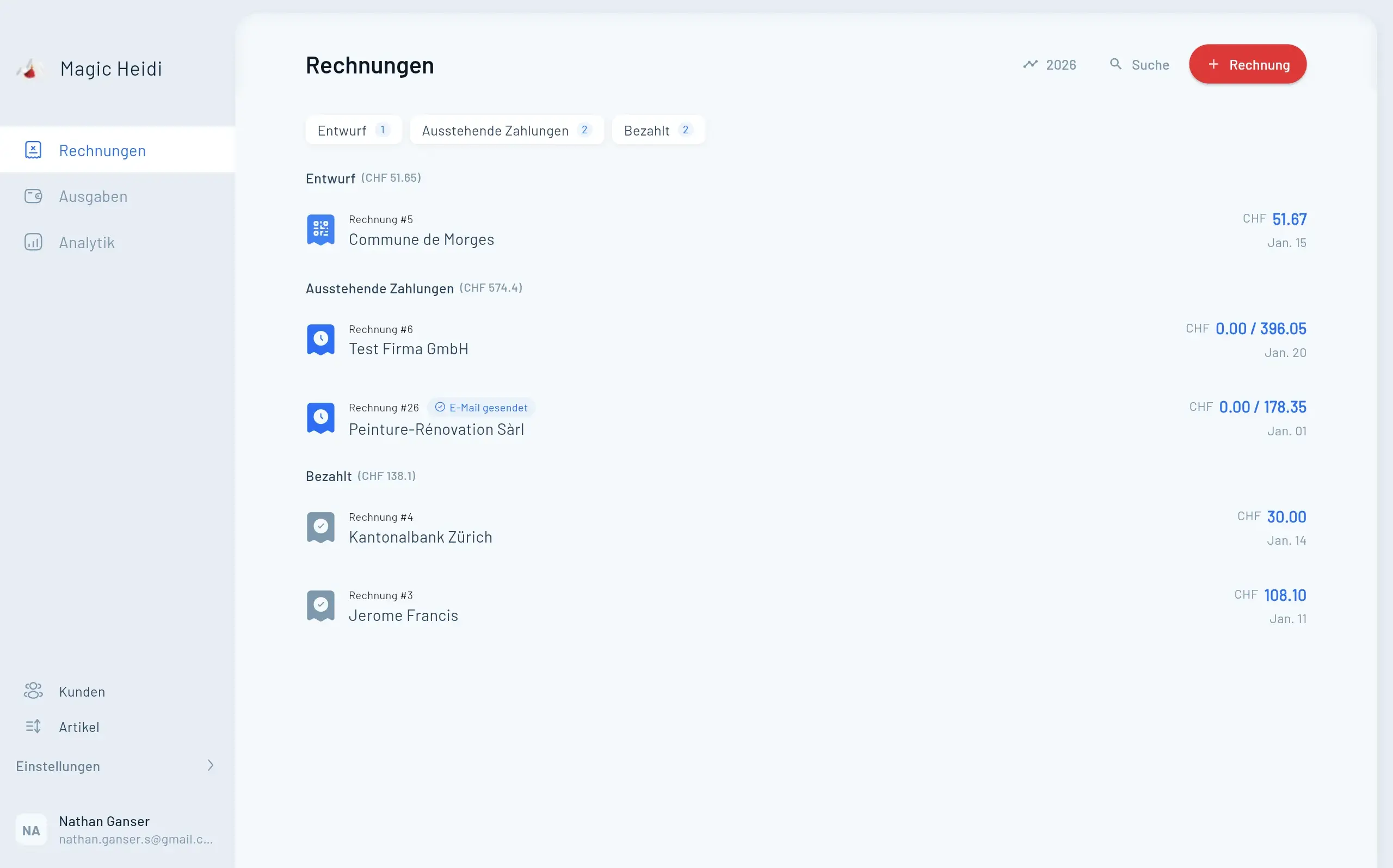
Your calculated take-home is just an estimate. What you actually earn depends on tracking reality. Magic Heidi helps you capture every franc earned and spent.
Never Lose Track of Your Money
Purpose-built for Swiss freelancers who want to maximize take-home pay
Invoice Management
Generate professional invoices in seconds, ensuring you bill correctly and track all revenue. Every CHF 100 you forget to invoice costs CHF 60-70 net.
- QR invoice generation in 30 seconds
- Automatic payment tracking
- Multi-currency support
- Revenue forecasting
Expense Tracking
You can't deduct expenses you don't document. Magic Heidi's AI captures every business expense - software, equipment, travel, meals - reducing taxable income.
- AI-powered receipt scanning
- Automatic VAT extraction
- Expense categorization
- Real-time deduction tracking
VAT Management
Once you cross CHF 100,000, VAT becomes complex. Magic Heidi automatically calculates VAT on invoices, tracks collections, and shows what you owe - preventing nasty surprises.
- Automatic 8.1% VAT calculation
- Quarterly filing preparation
- Input tax deduction tracking
- Cash flow management
Financial Reports
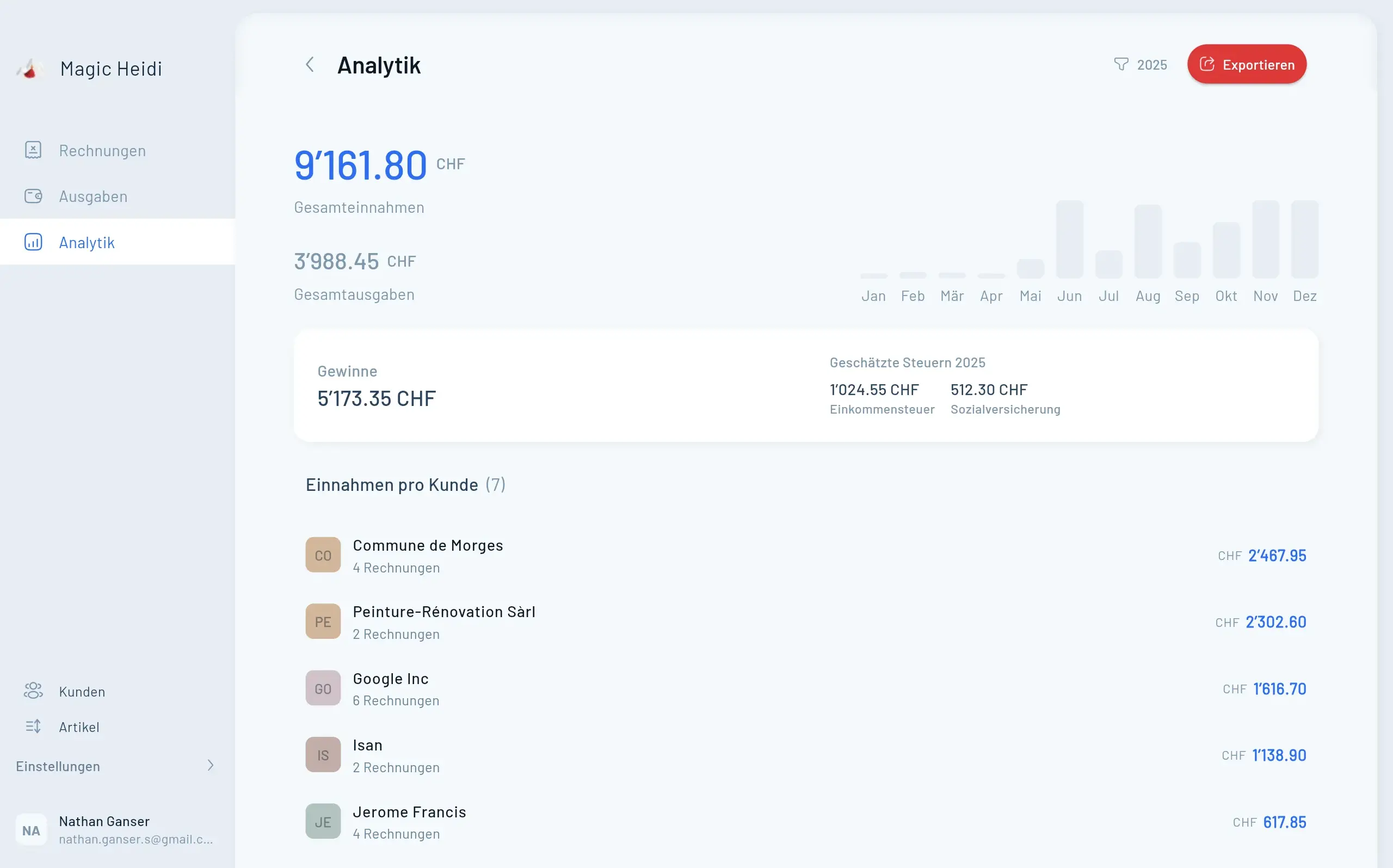
How much did you actually net last month? Not your bank balance. Magic Heidi's reports show true profit and loss, helping you understand if your hourly rate delivers the take-home you need.
- Real-time P&L statements
- Tax-ready financial reports
- Income trend analysis
- Client profitability tracking
Frequently Asked Questions
How much do freelancers really earn in Switzerland?
Median gross income is CHF 80,000 annually before deductions. After social contributions, taxes, health insurance, and business expenses, expect CHF 50,000-60,000 net take-home - roughly equivalent to a CHF 65,000-75,000 employee salary.
What's the minimum income to be considered self-employed?
CHF 2,500 annually from self-employment activities. Below this as a side activity, you're exempt from registering for social insurance contributions.
Do I pay less social insurance as a freelancer?
Partly. Self-employed pay 5.3-9.65% for AHV/IV/EO versus 10.6% total for employees (split with employer). But you lose employer BVG contributions, unemployment insurance, and accident coverage - often worth more than the AHV savings.
Can I avoid Scheinselbständigkeit risk?
Have multiple clients. If one client represents 50%+ of income, or you claim fewer than three different clients, AHV may classify you as pseudo-employed, triggering retroactive social contributions. Payrolling eliminates this risk entirely.
Is payrolling worth the 5% fee?
If you value security, yes. That 5% buys unemployment insurance, sick pay, accident coverage, employer pension matching, and eliminates Scheinselbständigkeit risk. For many, these benefits exceed 5% of income.
How many billable hours should I expect yearly?
200-220 days is realistic (approximately 1,600-1,760 billable hours). Many freelancers overestimate at 240-260 days, underpricing themselves by 20%.
Which canton has the lowest taxes for freelancers?
Zug has Switzerland's lowest tax burden, followed by Schwyz and Appenzell Innerrhoden. On CHF 100,000 income, you'll save CHF 5,000-9,000 annually versus high-tax cantons like Geneva or Basel-Stadt.
When do I need to register for VAT?
Above CHF 100,000 annual revenue from VAT-liable services. You charge clients 8.1% VAT, collect it, and remit quarterly. This creates administrative work but minimal impact on net income if managed properly with tools like Magic Heidi.
Calculate Your Real Take-Home Pay Now
Stop guessing what you'll actually earn. See your true net income after all deductions, compare employment models, and discover your minimum viable hourly rate. Then track your actual income with Magic Heidi.