VAT Registration for the self-employed in Bern: cantonal offices and Bernese client work

What canton Bern adds to the picture: the Handelsregisteramt des Kantons Bern, the cantonal compensation office — and how to bill federal-administration contracts, bilingual invoices and accommodation in the Bernese Oberland correctly.

Swiss Business Office

Planning to hit CHF 100,000 in revenue this year in canton Bern? Congratulations — but there's one administrative task to handle: VAT registration.

Swiss VAT is a federal tax administered by the Federal Tax Administration (FTA), not by the cantonal tax office in Bern. The threshold, the form, the deadlines and the accounting methods are the same in Bern as in Chur, and the complete national procedure is covered in the VAT registration guide.

This page covers what is specific to canton Bern: the Handelsregisteramt des Kantons Bern for your UID and commercial-register entry, the cantonal compensation office (Ausgleichskasse des Kantons Bern) for your self-employed status — and the three client situations that are far more common in Bern than anywhere else.

Quick Reference: Key VAT Numbers
You Need to Know

Before we dive in, here are the critical figures every Swiss freelancer should memorize:

💰

CHF 100,000

Mandatory registration threshold
📊

8.1%

Standard VAT rate (as of January 2024)
⏱️

30 days

Deadline to register after becoming liable
📅

60 days

Deadline to file each VAT return
📁

10 years

How long you must keep VAT records

What is different in canton Bern

Federal administration contracts. Nowhere else do so many self-employed people work for federal offices. The same applies to federal bodies: you invoice normally at 8.1%, but you need clean references (purchase-order number, creditor number) and the VAT shown separately, otherwise the invoice stalls in accounts payable. If you bid in a public procurement, you normally quote net of VAT — an 8.1% price difference that matters when awards are decided.

Bilingual Biel/Bienne and the Bernese Jura. Invoices may be in German or French; what matters is that the wording is consistent. The VAT number officially carries the suffix MWST, TVA or IVA (e.g. CHE-123.456.789 MWST).

Accommodation in the Bernese Oberland. If you rent out holiday flats or provide guest services in Interlaken, Grindelwald or Adelboden, you bill the special rate of 3.8%, not 8.1%. Add-on services such as ski lessons or transfers fall under the standard rate, which in practice means you have to book them separately.

Current VAT rates

Identical nationwide: 8.1% standard, 2.6% reduced (food, books, medicines), 3.8% accommodation. Most Bernese freelancers charge the standard rate.

Registration Requirements

Do You Need to Register for VAT?

This is the first question to answer. Swiss VAT registration follows clear rules based on your revenue.

Mandatory Registration

You must register for VAT if your annual worldwide turnover from taxable supplies reaches CHF 100,000.

Voluntary Registration

Even below CHF 100,000, you can choose to register voluntarily if it benefits your business situation.

30-Day Deadline

From the start of your tax liability, you have 30 days to register — otherwise you risk a fine (Art. 98 MWSTG).

Mandatory Registration: The CHF 100,000 Threshold

"Worldwide turnover" is the part many freelancers miss: it means all your revenue, not just Swiss clients. If you earn CHF 70,000 from EU clients and CHF 40,000 from Swiss clients, you've crossed the threshold.

What counts is the business year, not a rolling 12-month period. For an existing business, liability starts after the end of the business year in which you reached the threshold. For a new business or an expansion of your activity, it starts immediately if it is foreseeable that you will reach the threshold within the next 12 months (Art. 14 para. 3 MWSTG). From the start of your liability you have 30 days to register. If you miss this deadline you risk a fine (Art. 98 MWSTG), plus you'll owe backdated VAT and default interest (2026: 4.0% per year).

Voluntary Registration Below the Threshold

Even if you're earning less than CHF 100,000, you can choose to register voluntarily. This makes sense in several situations:

When voluntary registration helps:

  • You have significant business expenses with VAT (office equipment, software subscriptions, coworking space)
  • You work mainly with other VAT-registered businesses who can reclaim it anyway
  • You want to appear more established to enterprise clients
  • You're close to the threshold and want to smooth the transition

When to wait:

  • Most of your clients are consumers who care about final price
  • You have minimal business expenses
  • You're focused on keeping administration simple
  • Your revenue is nowhere near CHF 100,000

Critical commitment: If you register voluntarily, you're locked in for at least one tax period (one calendar year, Art. 11 MWSTG). Make sure the benefits justify the paperwork.

The 30-Day Registration Deadline (Don't Miss This)

Here's where many freelancers stumble: You must register within 30 days of becoming VAT liable, not when you feel like it.

For an existing business, liability starts after the end of the business year in which you reached CHF 100,000. For a new business or a new line of business, it starts immediately if it's foreseeable that you'll reach CHF 100,000 within the next 12 months – so if you start in March with a contract that clearly pushes you over the threshold, you need to register by early April.

What Happens If You Miss the Deadline?

The Federal Tax Administration doesn't take this lightly:

  • A fine for failing to register (Art. 98 MWSTG)
  • Backdated VAT liability (you owe VAT from when you should have registered)
  • Default interest on unpaid amounts (2026: 4.0% per year)
  • Potential audit of your records

Pro tip: Start the registration process when you hit CHF 80,000. The FTA's review takes time, and you don't want to be scrambling at CHF 99,000.

Filing Methods

Choosing Your VAT Filing Method

Switzerland offers different methods for calculating and reporting VAT. Your choice significantly impacts your administrative burden and potential tax savings.

The Effective (Actual) Method

Track all VAT you charge clients (output tax) and all VAT you pay on business expenses (input tax). Pay the difference to the tax authority.

  • Most accurate method
  • Best for freelancers with significant expenses
  • Quarterly filing required
  • Full input VAT deduction

The Net Tax Rate Method (Saldosteuersatz)

Apply a fixed percentage to your total turnover. Much simpler bookkeeping but can't claim input VAT deductions.

  • Simplified calculations
  • Half-yearly filing
  • Industry-specific rates (0.1% to 6.8%)
  • Best for low-expense businesses

Cash vs. Accrual Basis

Choose when to account for VAT: when you issue invoices (accrual) or when you receive payment (cash basis).

  • Accrual: VAT due on invoice date
  • Cash: VAT due on payment date
  • Better cash flow with slow-paying clients
  • Cash basis: on request to the FTA

The Effective (Actual) Method - Detailed

How it works:

  • Track all VAT you charge clients (output tax)
  • Track all VAT you pay on business expenses (input tax)
  • Pay the difference to the tax authority (or claim a refund)

Example calculation:

  • VAT charged to clients: CHF 16,200
  • VAT paid on expenses: CHF 3,240
  • Amount owed: CHF 12,960

Filing frequency: Quarterly (every three months), with returns due 60 days after the quarter ends.

The Net Tax Rate Method - Detailed

Eligibility requirements:

  • Annual turnover of at most CHF 5,024,000
  • Annual tax due of at most CHF 108,000 (Art. 37 MWSTG)

For example, if your net tax rate is 6.8% and you invoice CHF 150,000:

  • VAT owed: CHF 150,000 × 6.8% = CHF 10,200

You still charge clients 8.1% VAT, but only remit the net tax rate percentage.

Think the choice through: if you opt for the effective method, you can switch to the net tax rate method after three years at the earliest (Art. 37 para. 4 MWSTG).

Bern-specific Contact Points

VAT registration runs through the federal government – but UID, commercial register and self-employed status go through cantonal Bernese offices.

🏛️ Handelsregisteramt Bern
💳 AK Bern
🆔 UID number
🇨🇭 CHE format
📋
Handelsregisteramt Bern

Responsible for the commercial-register entry. Registration is mandatory from CHF 100'000 turnover.

💼
Ausgleichskasse des Kantons Bern

Confirms your self-employed status (AHV) – ideally before the VAT registration. Online: akbern.ch

🔢
UID number

Business identification number in the format CHE-123.456.789 – a prerequisite for the VAT number

🏛️
Business location Bern

Advice for founders through the business promotion of the Canton of Bern (berninvest.be.ch)

Registration Process

The sequence from a Bernese point of view

Registration is done online in the FTA ePortal. The application itself is identical nationwide; what differs is where in canton Bern you clear the preliminary steps.

VAT Registration Process
Sequence

The five stages for Bernese freelancers

The fine print of the FTA form is in the national VAT registration guide — this is about the order and the Bernese offices.

Step 1

Get Your UID Number

The UID (Unternehmens-Identifikationsnummer), or business identification number, is the basis of your VAT number.

  • Registered businesses: Already have one (CHE-XXX.XXX.XXX format)
  • Sole proprietors without a commercial-register entry: the FTA assigns the number when you register for VAT
  • Commercial-register entry: Handelsregisteramt des Kantons Bern
UID Number
Step 2

Prepare Required Information

Gather all necessary details before starting your application

  • UID number (if you have one) and social security (AHV) number
  • Business name, address, and legal form
  • Business activity description
  • Expected annual turnover and start date
  • Bank account information for refunds
Required Documents
Step 3

Register Online in the FTA ePortal

Registration runs through the FTA ePortal at estvportal.estv.admin.ch

  • Need AGOV account (the federal government login)
  • AGOV has been mandatory since October 31, 2026; CH-LOGIN will be switched off at the end of 2027
  • Complete form carefully to avoid delays
  • Common errors: incorrect UID, unrealistic projections, missing bank details
Online Registration
Step 4

Submit and Wait for Confirmation

The FTA reviews your application and confirms the registration

  • FTA reviews your application
  • May contact you for clarification
  • Respond promptly to avoid delays
Application Review
Step 5

Receive Your VAT Number

Once approved, you'll receive your official documentation

  • Official VAT number (UID with MWST suffix)
  • Confirmation of filing method and frequency
  • Instructions for first return
  • Access to online filing portal
VAT Number

After Registration: Your Ongoing Obligations

Getting your VAT number is just the beginning. Here's what happens next and how to stay compliant with Swiss tax authorities.

📊 Q1: Due May 30
📈 Q2: Due August 29
📉 Q3: Due November 29
📋 Q4: Due March 1
📅
Quarterly Filing

Submit returns within 60 days after each quarter ends

💰
Payment Deadlines

VAT payments due same day as return submission

🧾
Invoicing Requirements

Include VAT number and proper formatting on all invoices

📁
Record Keeping

Keep all VAT documents for 10 years minimum

Payment Deadlines and Interest

VAT payments are due within the same deadline as your return—60 days after the period ends. Late payments incur default interest without any reminder (2026: 4.0% per year).

Pro tip: Set aside VAT collected immediately. It's not your money—it belongs to the tax authority. Keep it in a separate account to avoid cash flow crunches.

Invoicing Requirements

Your invoices must include:

  • Your VAT registration number (CHE-XXX.XXX.XXX MWST)
  • Date and invoice number
  • Client details (name and address)
  • Description of services/goods
  • Net amount, VAT rate and amount, gross total

Example invoice line:

  • Consulting services: CHF 5,000.00
  • VAT 8.1%: CHF 405.00
  • Total: CHF 5,405.00

Record Keeping Requirements

Keep all VAT-related documents for 10 years: invoices issued to clients, receipts for expenses with input VAT, bank statements, VAT returns filed, and correspondence with tax authorities.

Common Mistakes

Common VAT Registration Mistakes to Avoid

Learn from others' expensive errors and save yourself back payments and penalties.

Missing the 30-Day Window

Many freelancers wait until they've actually earned CHF 100,000 rather than when projected to earn it.

  • Cost: Retroactive VAT liability plus penalties
  • If you should have registered in March but waited until October, you owe VAT from March
  • Late registration fines apply
  • Fix: Start process at CHF 80,000

Miscalculating Worldwide Turnover

Only counting Swiss clients when determining if you've exceeded CHF 100,000.

  • Reality: Threshold includes all revenue worldwide
  • Example: CHF 60,000 EU + CHF 45,000 Swiss = CHF 105,000 total
  • Must register even if Swiss revenue alone is below threshold
  • Include all taxable supplies globally

Applying Wrong VAT Rates

Charging 8.1% on services that should be taxed differently or charging VAT on exempt services.

  • Common: Wrong rate for mixed supplies
  • Charging VAT on services to non-Swiss clients (often zero-rated)
  • Not knowing exempt services (healthcare, education)
  • Fix: Double-check FTA rate guidelines

Forgetting Input VAT Claims

Paying VAT on business expenses but not claiming it back on returns.

  • Opportunity cost: Paying 8.1% more than necessary
  • Deductible: Office supplies, software, equipment, coworking, travel
  • Keep every receipt marked clearly
  • Use software to track automatically

Ignoring the Minimum Commitment

Registering voluntarily without realizing you must stay registered for at least one tax period.

  • Scenario: Register at CHF 80,000, business slows to CHF 60,000
  • Still filing quarterly returns for minimal benefit
  • Locked in for at least one full tax period
  • Fix: Only register voluntarily if confident in sustained revenue

Cross-Border Services and International Clients

Freelancers with international clients face additional complexity. Here's what you need to know.

B2B Services to EU/Non-Swiss Clients

General rule: Services to business clients outside Switzerland are typically zero-rated (0% VAT). You don't charge VAT, but you still report the revenue in your VAT return.

On your invoice: Include a statement like: "Reverse charge applies - VAT to be accounted for by recipient" or "Services provided outside Switzerland - no Swiss VAT applies."

What you need from clients: Their VAT registration number (if EU) to prove they're a business. Keep this documentation for audits.

B2C Services to Non-Swiss Consumers

Services delivered remotely (consulting, design, programming): Generally no Swiss VAT applies if the client is outside Switzerland.

Services performed in Switzerland (photography session, on-site consulting): May be subject to Swiss VAT even if the client is foreign. Location of performance matters.

Regulatory Changes Since 2025

The Swiss VAT system is modernizing. Stay ahead of these changes to avoid compliance issues.

💻

Mandatory Online Filing

All VAT returns must be submitted electronically (since January 2025)
📅

Annual Filing Option

Businesses with turnover of up to CHF 5,005,000 can apply to file annually instead of quarterly, with instalment payments during the year
🔐

AGOV Login Required

The federal government login, mandatory for the FTA ePortal since October 31, 2026. CH-LOGIN will be switched off at the end of 2027

How Accounting Software Simplifies VAT Management

Managing VAT manually means tracking dozens of transactions, applying correct rates, calculating input vs. output tax, and meeting strict deadlines. Modern accounting software handles the complexity automatically.

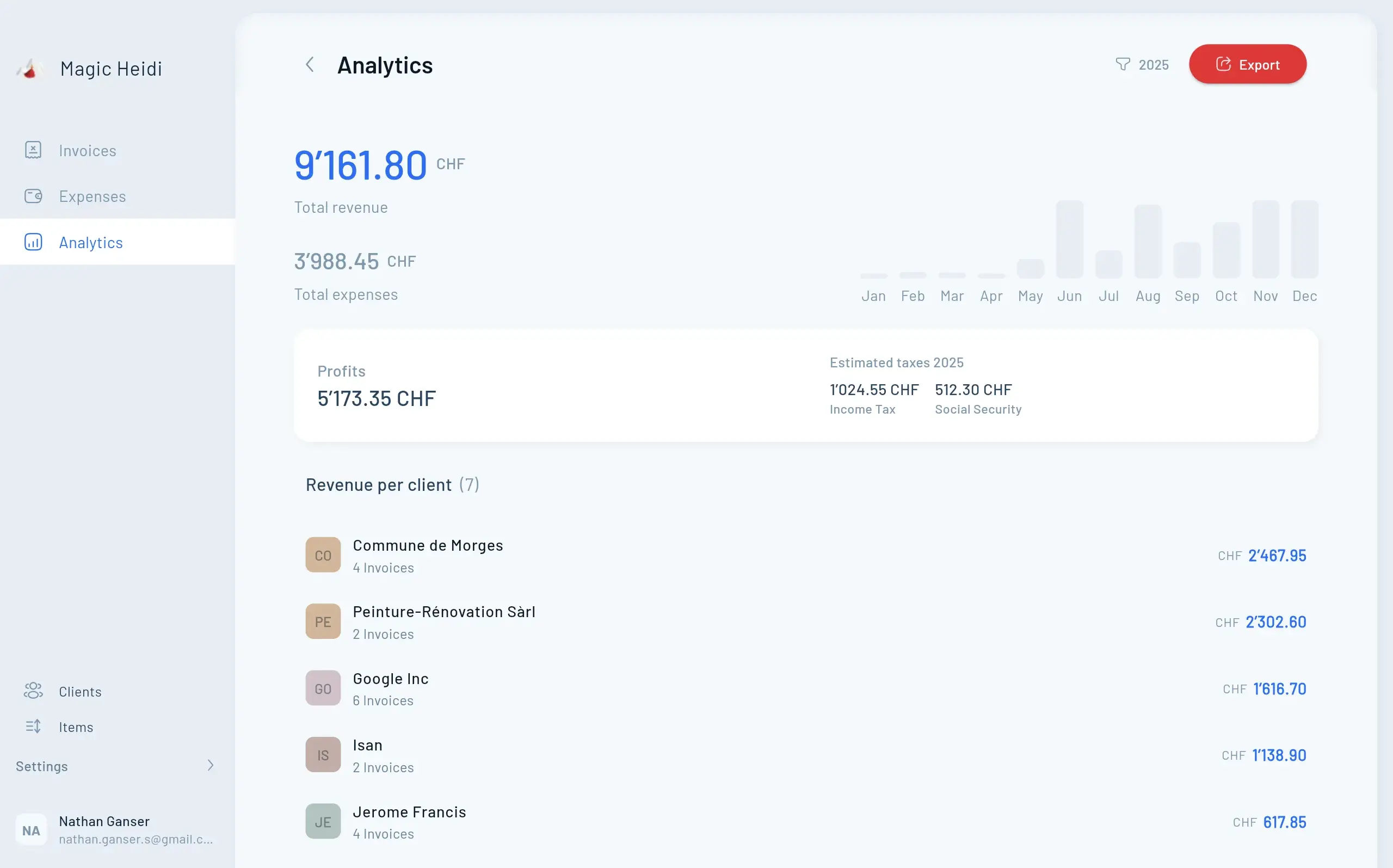
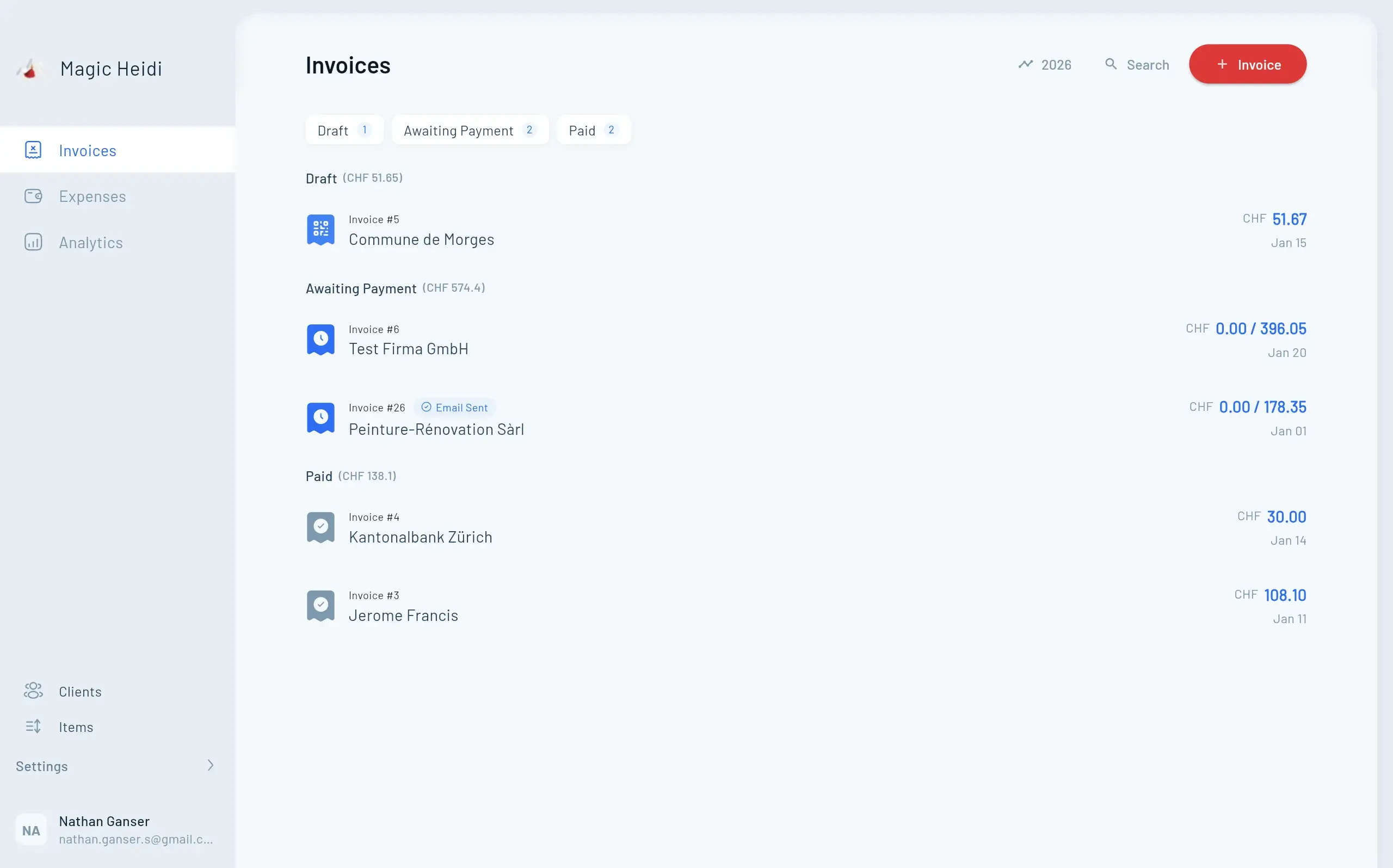
Magic Heidi Analytics Dashboard
Automation Benefits

Less Manual Work on VAT

Accounting software like Magic Heidi calculates the VAT on invoices and receipts as you go and prepares the figures for your return.

Automatic VAT Calculation

Apply the correct 8.1% rate to invoices automatically, eliminating calculation errors.

Expense Tracking

Every business expense logged with VAT split out, so you can see exactly what you can reclaim.

Filing Preparation

Generate VAT return data with one click instead of manually totaling spreadsheets.

Audit Trail

Every transaction documented. With Magic Heidi Archiv, included in every paid plan, the records are kept unalterable for 10 years.

FAQ

Frequently Asked Questions

Can I backdate my VAT registration?

The tax authority will register you from when you became liable (for an existing business, after the end of the year in which you reached CHF 100,000), not when you applied. You'll need to account for this period in your first return, including any VAT you should have charged but didn't.

What if my revenue drops below CHF 100,000 after registering?

If you registered mandatorily, you can request deregistration once your annual revenue falls below CHF 100,000 and is expected to stay below it. If you registered voluntarily, you must stay registered for at least one tax period (one calendar year) before requesting deregistration.

Do I charge VAT to clients in Zurich, Geneva, or other Swiss cantons?

Yes. VAT applies nationwide in Switzerland. Charge 8.1% to all Swiss clients regardless of their canton.

What happens during a VAT audit?

The FTA may audit your returns and records. They'll verify you've charged correct rates, claimed only eligible input VAT, and filed accurately. Keep meticulous records—invoices, receipts, contracts, and correspondence. Most audits find minor errors; significant issues can lead to back taxes, interest, and penalties.

Can I issue credit notes if I overcharge VAT?

Yes. If you make an error, issue a credit note referencing the original invoice and adjust your next VAT return accordingly. Errors from a business year must be corrected at the latest in the filing period that contains the 180th day after the end of that business year (Art. 72 MWSTG).

How do I handle VAT if I work from home?

You can only deduct input VAT where VAT was charged in the first place: renting a home is exempt from VAT, so there is nothing to deduct there. For purchases with mixed use, such as furniture, equipment or your internet connection, you deduct the business share. Keep careful documentation.

Is there a threshold for simplified filing?

The net tax rate method is available up to CHF 5,024,000 in annual turnover and at most CHF 108,000 in tax due per year (Art. 37 MWSTG). Since January 2025, businesses with turnover of up to CHF 5,005,000 can also apply to file annually.

What if I provide services both in and outside Switzerland?

Track these separately. Swiss services are taxable (8.1%). Services to foreign business clients are typically zero-rated. Services to foreign consumers depend on where they're performed. Your VAT return will have separate lines for each category.

When to Get Professional Help

You can handle VAT registration yourself, but some situations call for professional advice:

Consider hiring a tax advisor if:

  • You have complex cross-border sales
  • You're unsure which filing method optimizes your situation
  • You've missed deadlines and face penalties
  • You operate in multiple cantons or countries
  • Your business structure is complex (partnerships, holding companies)
  • You're being audited by the tax authority

Cost consideration: Advice costs money, but an error caught early saves you back taxes, interest and penalties.

Your VAT Registration Checklist

Here's your action plan, in order:

3-6 Months Before CHF 100,000

  • Set up proper bookkeeping to track revenue accurately
  • Get your UID number if you don't have one
  • Research which filing method suits your business
  • Set up separate bank account for VAT collected

At CHF 80,000 or When Crossing Threshold is Certain

  • Create your AGOV login account
  • Prepare all required information and documents
  • Submit online registration via FTA portal
  • Update invoice templates to include VAT

After Receiving VAT Number

  • Add VAT number to all invoices and correspondence
  • Start charging 8.1% VAT to Swiss clients
  • Set up quarterly filing reminders (60-day deadlines)
  • Review expense receipts to track claimable input VAT
  • File your first VAT return on time

Ongoing

  • File returns within 60 days of each period end
  • Keep all VAT records for 10 years
  • Review filing method annually to optimize
  • Stay updated on rate and regulation changes

Last updated: November 2026. VAT regulations change periodically. Always verify current rates and rules with the Federal Tax Administration (ESTV) at estv.admin.ch.

Take Control of Your VAT Obligations

VAT registration is a milestone—it means your freelance business is succeeding. Magic Heidi calculates the VAT on invoices and expenses as you go and prepares the figures for your return.