VAT Registration in Aargau: cantonal offices and Aargau client work

What canton Aargau adds: recognition by SVA Aargau, entry with the Handelsregisteramt in Aarau β€” and how construction, installation and industrial mandates in Baden, Brugg or the Fricktal are treated for VAT.

Swiss Business Office

Three questions that always come up in Aargau

Aargau is a canton of trades, installation and industrial service providers β€” and a canton where a very large share of self-employed people have their clients outside the canton. That is exactly where the most common VAT misunderstandings come from.

πŸ—οΈ

Construction and installation work

Where the work is performed decides β€” not where your office is
πŸš—

Clients in Zurich and Basel

Crossing a cantonal border changes nothing for VAT β€” a persistent myth
πŸ‡©πŸ‡ͺ

Work across the national border

Fricktal and Zurzibiet: when an invoice to Germany goes out without VAT

What is different in canton Aargau

First things first: VAT is a federal tax. You register with the Federal Tax Administration (FTA), not with the cantonal tax office in Aarau, and the CHF 100,000 threshold applies in Aarau exactly as it does in Geneva. The complete national procedure β€” form, deadlines, processing time, receiving your number β€” is covered in the VAT registration guide.

What is cantonal:

  • SVA Aargau recognises your status as self-employed. Get that recognition before you file the VAT application.
  • Handelsregisteramt des Kantons Aargau in Aarau: registering your sole proprietorship is mandatory above CHF 100,000 in turnover β€” the same figure that triggers VAT liability. The entry gives you your UID.
  • The Aargau sector mix: trades, construction, installation and technical services dominate. Net tax rates for these sectors are considerably higher than for pure consulting, so the choice of accounting method often comes out differently in Aargau than in a services canton.
  • Border location in the Fricktal and Zurzibiet: many Aargau freelancers have clients in southern Germany. Exports of goods are only zero-rated with a customs export assessment.
Registration Requirements

Do You Need to Register for VAT in Aargau?

The CHF 100,000 threshold is your primary decision point. Here's how it works:

Mandatory Registration

You must register within 30 days of becoming liable once your annual turnover reaches CHF 100,000

Voluntary Registration

Register below the threshold to reclaim VAT on expenses or project an established image

No Registration Needed

Stay below CHF 100,000 in turnover from taxable supplies, or only provide supplies that are exempt from the tax

Mandatory Registration

You must register for VAT if your annual turnover from Switzerland-based services or sales exceeds CHF 100,000. This includes all taxable revenue across your entire business, not just income from Aargau clients.

The critical detail: You need to register within 30 days of becoming liable. For an existing business, liability starts after the end of the business year in which you reached CHF 100,000 (so billing CHF 9,000 per month all year makes you liable from January 1 of the following year). For a new business or a new line of business, liability starts immediately if it's foreseeable that you'll reach CHF 100,000 within the next 12 months.

Example: Sarah, a web developer in Aarau, starts her business in March and signs a CHF 40,000 contract right away. Combined with CHF 65,000 in further confirmed projects, she can foresee reaching CHF 100,000 within her first 12 months. She is liable from the start and registers for VAT in April, well before actually receiving all payments.

Voluntary Registration

Even below CHF 100,000, you can choose to register voluntarily. This makes sense when:

  • You have significant business expenses with VAT that you want to reclaim
  • You work with corporate clients who prefer VAT-registered suppliers
  • You're approaching the threshold and want to avoid mid-year registration
  • You want to project a more established business image

Important: Voluntary registration commits you for a minimum of one tax period (one calendar year). You can't simply deregister after a few months if the administrative work becomes burdensome.

VAT Rates

Understanding Swiss VAT Rates

Switzerland applies three VAT rates depending on what you sell. Most Aargau freelancers will charge the 8.1% standard rate on their services.

Standard Rate: 8.1%

Applies to most goods and services, including professional services like consulting, design, programming, standard goods, and digital services.

  • Professional services (consulting, design, programming)
  • Standard goods and products
  • Digital services
  • Most freelancer offerings

Reduced Rate: 2.6%

Applied to essential goods like food, medicines, and media.

  • Food and beverages (non-alcoholic)
  • Medicines
  • Books, newspapers, magazines
  • Agricultural products

Accommodation Rate: 3.8%

Exclusively for hotel and lodging services.

  • Hotel services
  • B&B accommodations
  • Holiday rentals
  • Lodging facilities
Preparation

What You Need Before Registering

Gather these essential elements before starting your VAT registration process:

Essential Documents

UID Number & Business Information

Your UID (Unternehmens-Identifikationsnummer) is Switzerland's unique business identifier. If you are entered in the commercial register, you already have oneβ€”otherwise the FTA assigns you the number when you register for VAT.

  • UID number, if you already have one (look it up at uid.admin.ch)
  • Complete business name and trading name
  • Business address in Aargau
  • Personal details and bank information
Swiss Business Documentation
Financial Data

Revenue Projections & Expense Records

Prepare realistic estimates of your annual turnover, expected revenue breakdown, and compile information about business expenses that include VAT.

  • Annual turnover projections
  • Swiss vs. foreign client revenue split
  • Breakdown of services offered
  • VAT-eligible expense documentation
Financial Analytics
Registration Process

Step-by-Step: Registering for VAT in Aargau

Follow this straightforward process to complete your VAT registration:

1. Choose Method

Select EasyGov.swiss or the FTA ePortal

2. Complete Form

Enter business details, financial information, and select your filing method

3. Submit & Track

Save the confirmation and respond quickly to any questions from the FTA

4. Get VAT Number

Receive your VAT number and update all invoices

Where Aargau applicants trip up

The application itself runs through EasyGov.swiss or directly through the FTA ePortal β€” both free. How to fill in the form field by field is covered in the national VAT registration guide.

Three points affect Aargau applicants in particular:

Your activity description decides your net tax rate. "Sanitary installations" and "technical consulting" lead to completely different sector rates. In an industrial and trades-heavy canton like Aargau this is the most expensive mistake in the form β€” describe precisely what you actually bill for.

Registered office vs. place of work. You state your Aargau business address even if you carry out most of your work in Zurich, Basel or Zug. The canton is irrelevant for VAT β€” only for work on real property does the location of the property decide whether Swiss VAT applies at all.

Revenue forecast including foreign work. Invoices to German clients from the Fricktal or Zurzibiet count toward the CHF 100,000 threshold even though no Swiss VAT is charged on them. Estimate only your Swiss turnover and you will register too late.

Filing Methods

Choosing Your VAT Filing Method

The law provides three filing methods. For the self-employed and SMEs, the effective method and the net tax rate method are the options β€” flat tax rates are reserved for public bodies, associations and foundations.

MethodActual MethodNet Tax RateFlat Tax Rate
Best Forβœ“ High expensesSimple businesses up to CHF 5,024,000 in turnoverPublic bodies, associations, foundations
Record-KeepingDetailed trackingβœ“ MinimalSimplified
VAT Recoveryβœ“ MaximumIncluded in the rate as a lump sumIncluded in the rate as a lump sum
CalculationTrack all VATβœ“ Fixed %Flat rate per activity
ComplexityHigherβœ“ LowerMedium

Actual Method (Effective Method)

How it works: Track every franc of VAT you charge clients and every franc of VAT you pay on business expenses. Report the difference quarterly.

Example: Marcus, a photographer in Baden, charges CHF 10,810 (including 8.1% VAT = CHF 810). He paid CHF 2,430 for equipment (including CHF 182 VAT). He owes CHF 628 (CHF 810 - CHF 182) for that quarter.

Pros: Most accurate; maximize input VAT recovery
Cons: Requires detailed record-keeping

Net Tax Rate Method (Saldosteuersatz)

How it works: Apply a fixed percentage to your total turnover based on your industry sector. No need to track individual VAT amounts.

Requirements: at most CHF 5,024,000 in annual turnover and at most CHF 108,000 in tax due per year (Art. 37 MWSTG). You file half-yearly.
Pros: Simple calculations; less paperwork
Cons: May pay more VAT than with Actual Method if you have many expenses

Flat Tax Rate Method (Pauschalsteuersatz)

Flat tax rates are reserved for public bodies and related institutions (such as private hospitals and schools or licensed transport companies) as well as associations and foundations (Art. 37 para. 5 MWSTG). This method is not an option for the self-employed and SMEs.

Annual filing: Since 2025, with annual turnover of up to CHF 5,005,000 you can apply to file annually instead of quarterly or half-yearly.

Compliance

After Registration: Your Ongoing Obligations

Getting your VAT number is just the beginning. Here's what happens next and how to stay compliant.

VAT Invoice Management
First Steps

Immediate Actions After Registration

Complete these essential tasks as soon as you receive your VAT number:

Update Invoices

Add VAT number, itemize VAT amounts, include invoice dates and numbers

Inform Clients

Notify existing clients about VAT addition to your pricing

Setup Records

Organize invoice systems and expense tracking for VAT compliance

Mark Deadlines

Calendar quarterly filing dates 60 days after each quarter end

Filing Requirements

Your VAT return is due 60 days after the end of each filing period. Under the effective method you file quarterly:

  • Q1 (Jan-Mar): Due May 30
  • Q2 (Apr-Jun): Due August 29
  • Q3 (Jul-Sep): Due November 29
  • Q4 (Oct-Dec): Due March 1 of the following year (February 29 in leap years)

With the net tax rate method you file half-yearly (due August 29 and March 1).

Record Retention

You must keep all VAT-related records for 10 years:

  • All issued invoices
  • All received invoices and receipts
  • Bank statements
  • VAT return calculations
  • Correspondence with tax authorities

Payment Obligations

After filing each return:

  • If you owe VAT, payment is due within the same 60 days
  • If your input VAT exceeds your output VAT, the FTA pays the credit out to you
  • Late payments incur default interest without any reminder (2026: 4.0% per year)

Common Mistakes to Avoid

Learn from others' errors and save yourself time, money, and stress by avoiding these frequent VAT registration pitfalls.

⏰

Waiting Too Long

Register within 30 days of your liability startingβ€”don't wait for the FTA to contact you
πŸ’°

Wrong VAT Rates

Verify your service classification before issuing first invoice
πŸ“Š

Missing Deductions

Review all expenses quarterly for VAT recovery opportunities
πŸ“

Poor Record-Keeping

Implement a digital system from day one to stay organized
🏦

Mixing Expenses

Maintain separate business and personal accounts always
🌍

International Rules

Understand place-of-supply rules for foreign client work
Consequences

Penalties and Consequences

Understanding penalties helps you take VAT compliance seriously. If you report a mistake yourself before the authority discovers it and help to correct it, you are not prosecuted (voluntary disclosure, Art. 102 MWSTG).

Procedural Obligations

Anyone who fails to register, or who does not file a return despite a reminder, is fined (Art. 98 MWSTG)

Late Payment Interest

2026: 4.0% per year on overdue amounts, from the due date and without a reminder

Tax Evasion

Anyone who reduces the tax claim intentionally or through negligence risks a fine of up to CHF 400,000 (Art. 96 MWSTG)

FAQ

Frequently Asked Questions

What happens if I don't register after exceeding CHF 100,000?

You become liable for all VAT you should have collected, plus penalties and interest. The FTA can discover this through audits, cross-referencing with client records, or tax authority data sharing. Always register on time.

Can I claim VAT on expenses incurred before registration?

Partly. With subsequent input tax deduction (Einlageentsteuerung, Art. 32 MWSTG) you can recover the input VAT on goods and services you bought before registering and now use for taxable supplies β€” for goods already in use, only on their current value. Keep the receipts.

Do I charge VAT to foreign clients?

For most services, noβ€”if your client is based outside Switzerland and uses the service there. However, place-of-supply rules are complex, especially for digital services. Verify your specific situation.

What if my revenue drops below CHF 100,000 after registering?

If you registered voluntarily, you must stay registered for at least one tax period (one calendar year). If you were required to register but revenue sustainably drops below CHF 100,000, you can request deregistration, but the process isn't automatic.

Can I change my filing method?

Yes, in each case from the start of a tax period. You have to keep the net tax rate method for at least one tax period (one year). If you opt for the effective method, you can switch to the net tax rate method after three years at the earliest (Art. 37 para. 4 MWSTG).

How does VAT work with partial payments or payment plans?

It depends on your reporting method. The default is reporting on agreed consideration: VAT is owed when you invoice, even if the client pays in installments. On request, you can report on collected consideration β€” then you only owe the VAT once the money arrives (Art. 39 MWSTG).

What if I make a mistake on my VAT return?

File a correction as soon as you discover the error. The FTA is more lenient with self-reported corrections than with errors they discover during audits.

How does VAT registration affect my pricing?

You can either absorb the VAT (reducing your margin) or pass it to clients. Most B2B clients expect VAT to be added to rates since they can reclaim it. B2C clients will see your pricing increase by 8.1% unless you adjust your base rates.

Getting Help

When to Get Professional Help

While VAT registration is manageable on your own, consider professional support in these situations:

Complex Transactions

International transactions or multiple revenue streams

Method Selection

Unsure which filing method suits your situation

Catching Up

Fallen behind on filings and need to get current

Audit Support

Facing an FTA audit or rapid business growth

Simplify VAT

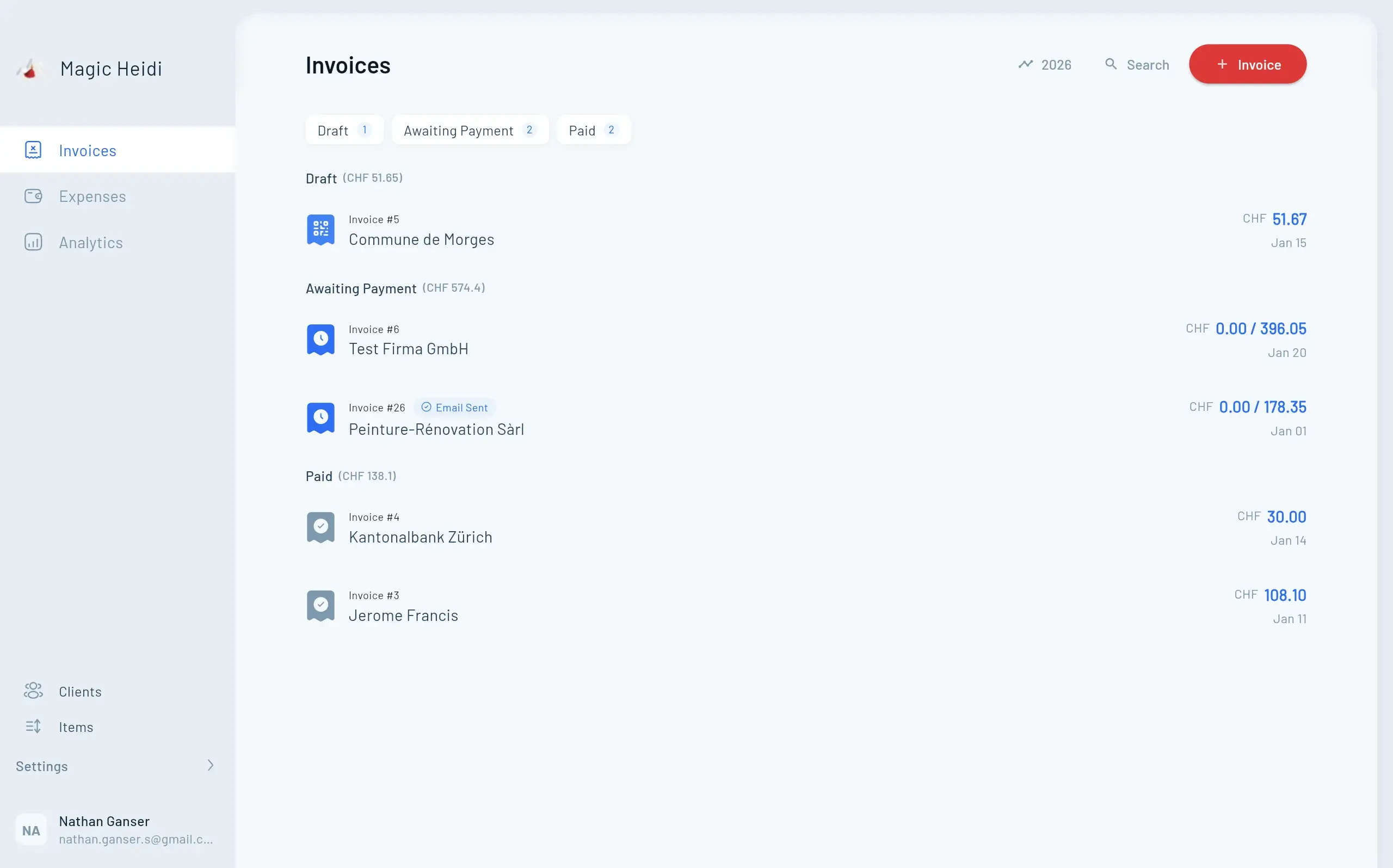
Simplify VAT Management with Magic Heidi

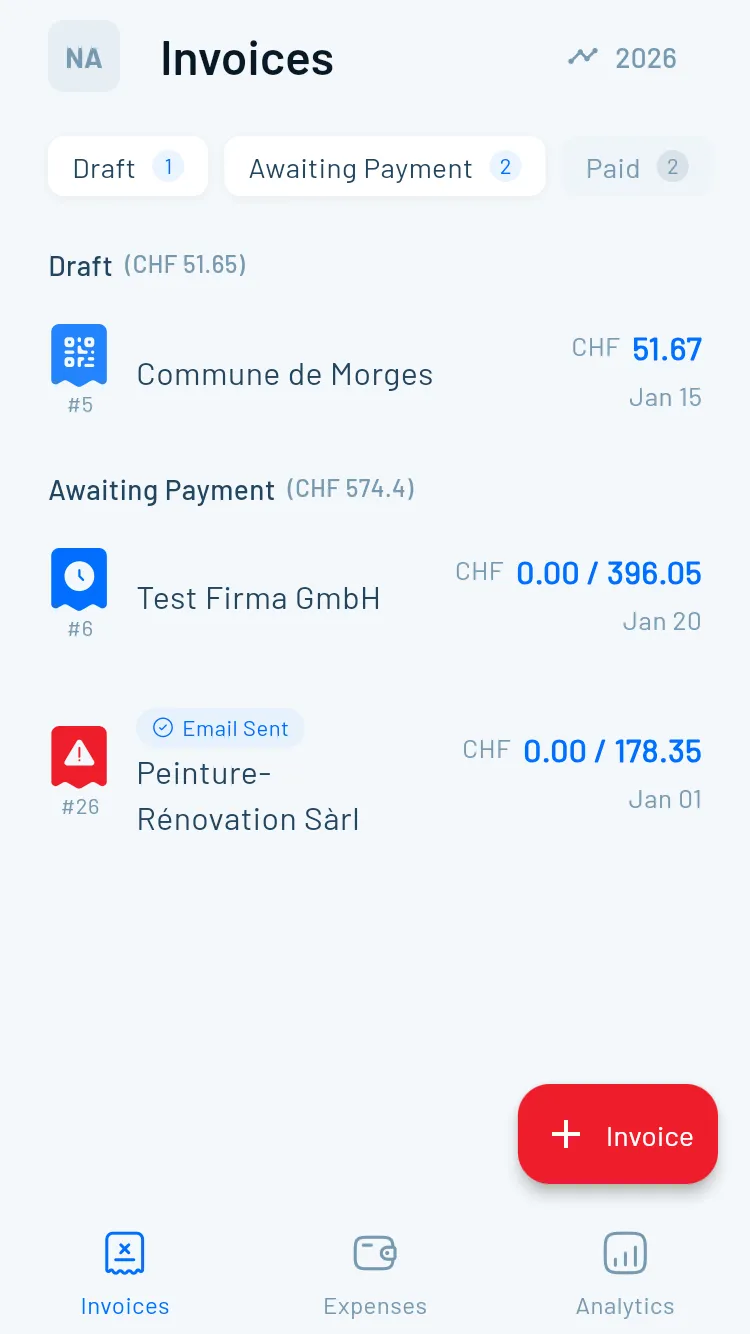
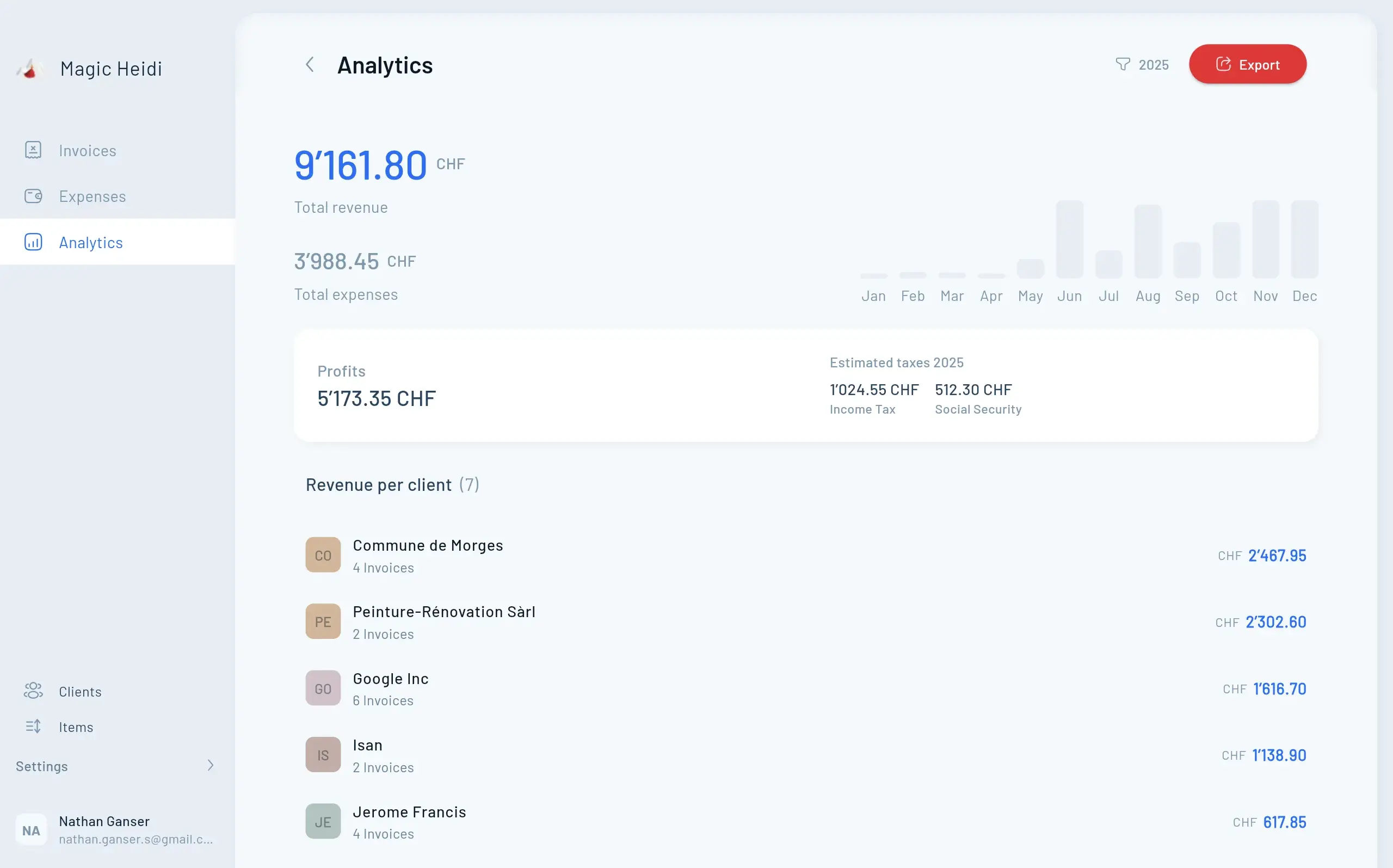
VAT compliance doesn't have to be complicated. Magic Heidi automatically tracks your income and expenses, calculates VAT, and prepares your quarterly returnsβ€”all in one platform designed specifically for Swiss freelancers.

Magic Heidi VAT Management

Built for Swiss Freelancers

Focus on your client work while Magic Heidi handles your VAT compliance. Every feature is designed specifically for the Swiss market and regulatory requirements.

πŸ‡¨πŸ‡­ Swiss Made
πŸ”’ Secure
πŸ’¬ Support in 4 Languages
⭐ 4.8β˜… Rated
🧾
Automatic VAT Calculation

On all invoices and expenses

πŸ“Š
Input VAT Tracking

Never miss a deduction

πŸ“…
Quarterly Returns

Prepared automatically

🎯
Revenue at a Glance

Your income per year at a glance

🏦
Bank Import

Automatic categorization

πŸ“
Magic Heidi Archiv Included

Records kept unalterable for 10 years

Disclaimer: This guide provides general information about VAT registration in Switzerland. Tax regulations can change, and individual circumstances vary. For specific advice regarding your situation, consult the Federal Tax Administration or a qualified Swiss tax professional.

Start Managing Your VAT Today

Try Magic Heidi for free. No credit card required. Get your VAT compliance under control in minutes, not hours.