Tax Deductions 2026

AVS and LaMal for Swiss Freelancers: What's Deductible?

Which mandatory payments reduce your business taxes, and which only lower your personal tax bill? The answer directly impacts your take-home income.

Swiss Tax Planning for Freelancers

As a Swiss freelancer, you face a puzzle that employed workers never think about: which mandatory payments reduce your business taxes, and which only lower your personal tax bill?

The answer directly impacts your take-home income. Misclassifying AVS social security contributions or LaMal health insurance premiums can cost you thousands of francs annually—or worse, trigger audit penalties.

This guide cuts through the confusion with 2026-updated rates, clear legal classifications, and practical strategies. Whether you're launching your freelance career in Zurich or optimizing your tenth year as a Basel consultant, you'll learn exactly how to handle these two largest "overhead" costs.

The short answer: AVS contributions are business expenses that reduce your net profit. LaMal premiums are personal deductions that lower your taxable income. The distinction matters enormously for your bottom line.

2026 Updates

Why This Question Matters More in 2026

Two major changes make this topic especially relevant right now.

13th AVS Pension Starts

Following the March 2024 referendum, every Swiss retiree receives an additional month's pension each December. Understand your contributions matter—you're investing in tangible retirement benefits.

Women's Retirement Age Increases

Rises to 64.5 years in 2026 (born 1962), reaching 65 by 2028. If you're a female freelancer, these changes affect your contribution period and benefit calculations.

LaMal Premiums Jump 4.4%

Average premiums increased 4.4% in 2026, with Geneva exceeding CHF 500 monthly. For freelancers with variable income, these rising fixed costs demand smarter tax planning.

The Clear Answer

AVS vs. LaMal: The Key Differences

Understanding this distinction is worth thousands of francs annually.

AspectAVS Social SecurityLaMal Health Insurance
Tax classificationBusiness expensePersonal deduction
When deductedFrom gross revenue (before net profit)From net income (personal tax return)
Legal basisDBG Article 27Income tax deductions
Amount5.371%–10% of net incomeCHF 400–500+ monthly
Income-based✓ Yes—progressive rate✗ No—flat rate
RegistrationCantonal compensation officePrivate insurer
Business purpose✓ Tied to self-employment✗ Universal obligation

Why the distinction matters

When AVS is deducted as a business expense, it reduces your net business income before taxes are calculated. This lowers both your income tax and any percentage-based charges tied to business profits.

When LaMal is a personal deduction, it reduces your taxable income on your personal return, along with other general deductions (commuting, meals, Pillar 3a). The tax savings are real but calculated differently.

Example: You're a freelance graphic designer earning CHF 100,000 gross in 2026.

  • After business expenses (software, equipment, office): CHF 85,000
  • AVS contribution (10%): CHF 8,500 → deducted here
  • Net business income: CHF 76,500 ← this is what gets taxed
  • Then on your personal return, you deduct LaMal premiums (CHF 5,400 annually) along with other personal deductions

If AVS weren't deductible as a business expense, you'd pay income tax on CHF 85,000 instead of CHF 76,500—a difference of thousands in tax depending on your canton.

AVS Deep Dive

AVS as a Business Expense

Understanding 2026 contribution rates, registration steps, and common mistakes to avoid.

2026 Contribution Rates

Progressive Rate Structure

As a self-employed person, you pay the full AVS contribution yourself.

  • Income up to CHF 60,500: Sliding scale from 5.371% to 8%
  • Income CHF 60,500 and above: 10%
  • Includes AVS/AHV (8.7%), IV/AI (1.4%), EO/APG (0.5%)
  • Minimum contribution: CHF 530 annually (even with low income)
AVS Contribution Calculator
Registration Process

How to Register for AVS

Within 30 days of starting freelance work, register with your cantonal compensation office.

  • Determine your self-employment status
  • Contact your cantonal office at ahv-iv.ch
  • Submit proof of self-employment and income estimates
  • Receive provisional billing (quarterly or annually)
  • Annual adjustment based on actual tax assessment
Swiss Business Registration
Special Cases

Registration Exceptions

Different registration paths for specific sectors and situations.

  • Construction sector: Register via SUVA instead
  • Professional associations: Specialized offices for artists, medical practitioners
  • Multiple activities: Coordinate employed and freelance contributions
  • Part-time employed + freelance: Separate AVS registrations required
Swiss Administrative Process
Practical Examples

Calculating Your Actual Contribution

Three real-world scenarios for 2026, showing exactly what you'll pay.

AVS Calculation Examples

Three 2026 scenarios

Scenario 1: Lower-income freelancer

  • Net business income: CHF 45,000
  • AVS rate: ~7.5% (sliding scale)
  • Annual contribution: CHF 3,375
  • Monthly equivalent: CHF 281

Scenario 2: Mid-level consultant

  • Net business income: CHF 90,000
  • AVS rate: 10%
  • Annual contribution: CHF 9,000
  • Monthly equivalent: CHF 750

Scenario 3: High-earning IT contractor

  • Net business income: CHF 150,000
  • AVS rate: 10%
  • Annual contribution: CHF 15,000
  • Monthly equivalent: CHF 1,250

Pro tip: Set aside 10-12% of your gross monthly income for AVS plus potential tax. This ensures you're never caught short when quarterly bills arrive.

Common Mistakes

AVS Mistakes to Avoid

These errors cost freelancers thousands in penalties and interest.

Late Registration

Forgetting to register within 30 days means retroactive bills covering months or years, plus 5% annual interest penalties.

Underestimating Income

Report CHF 60,000 but earn CHF 100,000? The adjustment two years later will be painful. Be conservative but realistic.

Mixing Income Types

Part-time employed + freelance requires coordination to avoid overpaying or gaps in coverage.

Poor Record-Keeping

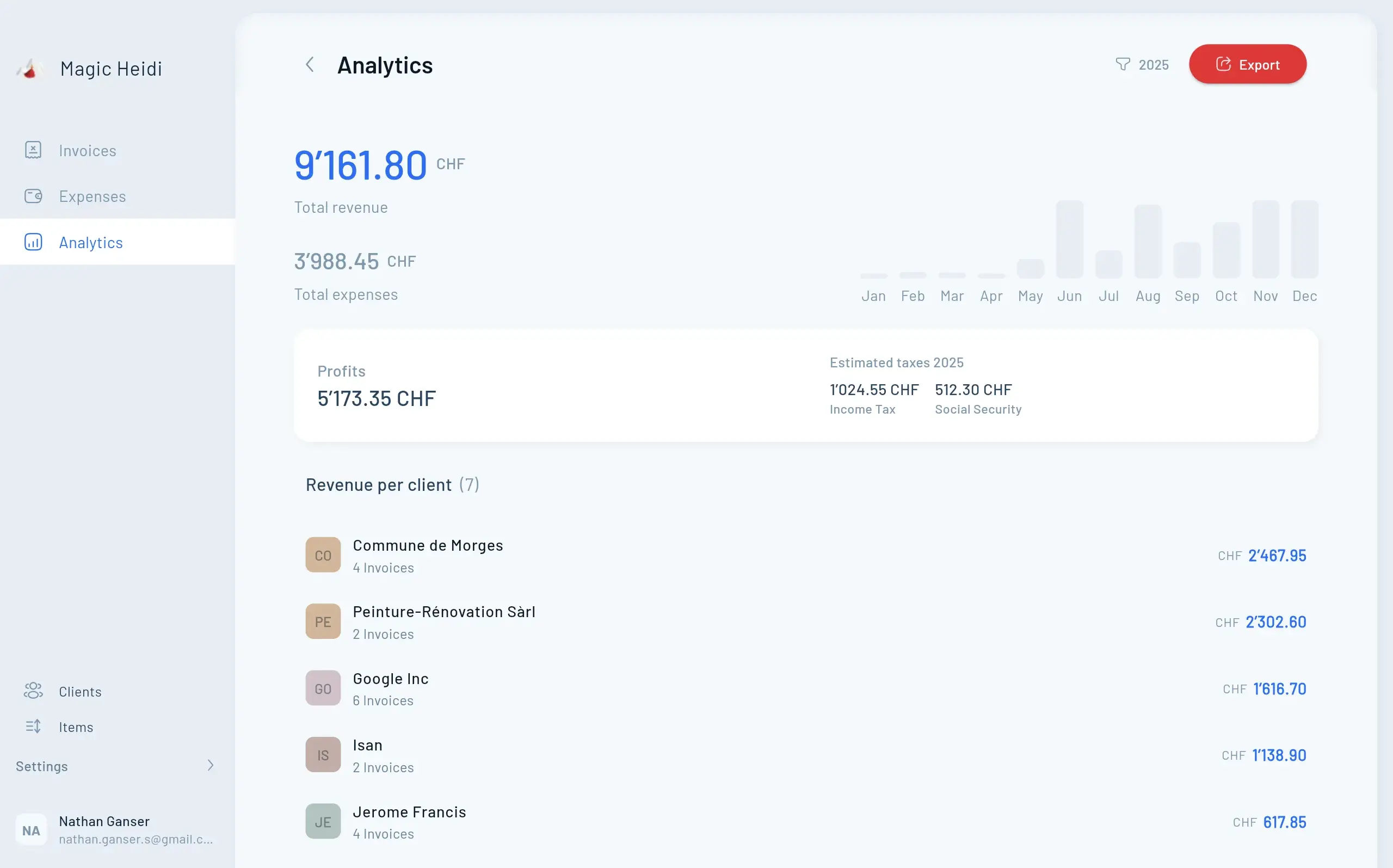
AVS audits happen. Maintain detailed accounts with Swiss accounting software like Magic Heidi, bexio, or CashCtrl.

Ignoring Minimum Contributions

Even with low income, the CHF 530 minimum applies. Gaps in contribution years reduce your future pension.

LaMal Explained

Understanding LaMal: The Personal Deduction

Why health insurance isn't a business expense—and how to maximize your deduction anyway.

Swiss Freelancer Health Insurance

Why LaMal isn't a business expense

Unlike AVS, which exists because you're self-employed, LaMal is mandatory for all Swiss residents regardless of employment status. Students, retirees, employees, and freelancers all pay LaMal premiums.

Legal reasoning: The Federal Direct Tax Act (DBG) Article 27 defines business expenses as "costs necessary to generate income from business activities." Since LaMal is a universal resident obligation—not specific to your freelance work—it doesn't qualify.

However, LaMal premiums are deductible on your personal tax return as part of general insurance deductions.

2026 premium landscape

Average monthly premiums for adults with a CHF 300 deductible:

  • Geneva: CHF 500+ (highest in Switzerland)
  • Basel-Stadt: CHF 470–500
  • Zurich: CHF 430–460
  • Bern: CHF 390–420
  • Appenzell Innerrhoden: CHF 320–350 (lowest)

Premiums increased an average of 4.4% in 2026, but cantonal variations are dramatic. Moving from Geneva to Appenzell could save you CHF 2,000+ annually on health insurance alone.

Maximizing Deductions

LaMal Deduction Strategies

How to claim the maximum on your cantonal tax return.

Basic Deductions

Deduct basic LaMal premiums, supplementary insurance (VVG-compliant), and combined life insurance on your cantonal return.

Deduction Limits

Single persons: CHF 1,800. Married couples: CHF 3,700. These limits apply to combined health, accident, and life insurance premiums.

Out-of-Pocket Costs

If healthcare costs exceed 5% of net income, deduct those too. Includes deductible payments, co-payments, non-covered treatments.

Premium Subsidies

Many freelancers qualify for Prämienverbilligung. Check your canton—income thresholds typically CHF 40,000–60,000 for singles.

Strategic Deductibles

Healthy freelancers with savings: CHF 2,500 deductible saves CHF 1,200–1,800 annually. Weigh against variable cash flow risk.

Subsidy Applications

Some cantons grant subsidies automatically; others require applications. Check social services website—even CHF 100–200 monthly helps.

Beyond AVS & LaMal

Maximizing Tax Benefits:
Pillar 3a and Beyond

Your biggest tax wins as a Swiss freelancer in 2026.

Pillar 3a Private Retirement

The largest single deduction for Swiss freelancers. 2026 contribution limits: Self-employed without Pillar 2: 20% of net income, maximum CHF 36,288. With Pillar 2: CHF 7,258.

  • CHF 100,000 net income → CHF 20,000 contribution possible
  • At 30% tax rate: CHF 6,000 immediate tax savings
  • Funds locked until retirement or specific life events
  • Open account at Swiss bank or insurance provider

Business Meal & Travel

CHF 15 per workday when traveling for business (max CHF 3,200 annually). Plus commuting deductions if you travel to fixed client locations.

  • 70 centimes/km for car travel (max CHF 3,200/year)
  • 40 centimes for motorcycles
  • CHF 700 flat rate for bicycle commuting
  • Only applies to regular client location travel

Professional Development

Maximum CHF 13,000 annually for courses, conferences, certifications directly related to your freelance work.

  • Online courses and certifications
  • Industry conferences and events
  • Advanced degrees in your field
  • Professional association memberships

Home Office & Operating Expenses

Deduct proportional rent, utilities, insurance if you use space exclusively for business. Plus all software, equipment, and professional services.

  • Calculate by square meters (e.g., 20m² office / 100m² = 20%)
  • Software subscriptions (Adobe, Microsoft 365, project tools)
  • Professional liability insurance
  • Accounting software (Magic Heidi, bexio, CashCtrl)

Special Scenarios

Special Scenarios and Pitfalls

Critical situations every Swiss freelancer needs to understand.

Part-Time Employed + Freelance

Managing Dual Income Streams

Increasingly common: 60-80% employment plus side freelancing.

  • Employer deducts 5.3% AVS from salary (they contribute 5.3%)
  • Self-employment income requires separate AVS registration
  • Coordinate with compensation office for proper crediting
  • Business expenses only offset freelance income, not salary
Freelancer Working Part-Time
Reclassification Risk

The Disguised Employment Danger

Critical warning: Authorities sometimes reclassify freelance relationships.

  • Working almost exclusively for one client (80%+ income)
  • Client dictates work hours, location, and methods
  • Integrated into client's organization (email, meetings)
  • Lack of independence in completing tasks
Swiss Employment Protection
International & VAT

International Clients and VAT Registration

Freelancers earning over CHF 100,000 annually must register for VAT (8.1% standard rate).

  • EU/EFTA clients: Reverse-charge mechanism may apply
  • Worldwide clients: Generally no Swiss VAT on exported services
  • Double taxation treaties with 100+ countries
  • Register via EasyGov portal at CHF 80,000–90,000
Swiss International Business
Implementation

Your 2026 Action Plan

Practical steps to optimize your Swiss freelance taxes this year.

Swiss Freelance Financial Planning

Monthly budgeting formula

For every CHF 100 you earn as a freelancer, allocate:

  • 10–12%: AVS contributions
  • 5–8%: LaMal premiums (varies by canton)
  • 15–25%: Income taxes (Geneva 40%+, Zug 20%)
  • 5–10%: Business expenses (software, insurance, equipment)
  • 10–20%: Pillar 3a savings (optional but highly recommended)

This leaves approximately 35–50% as take-home income. Adjust based on your canton and personal situation.

Accounting software for Swiss freelancers

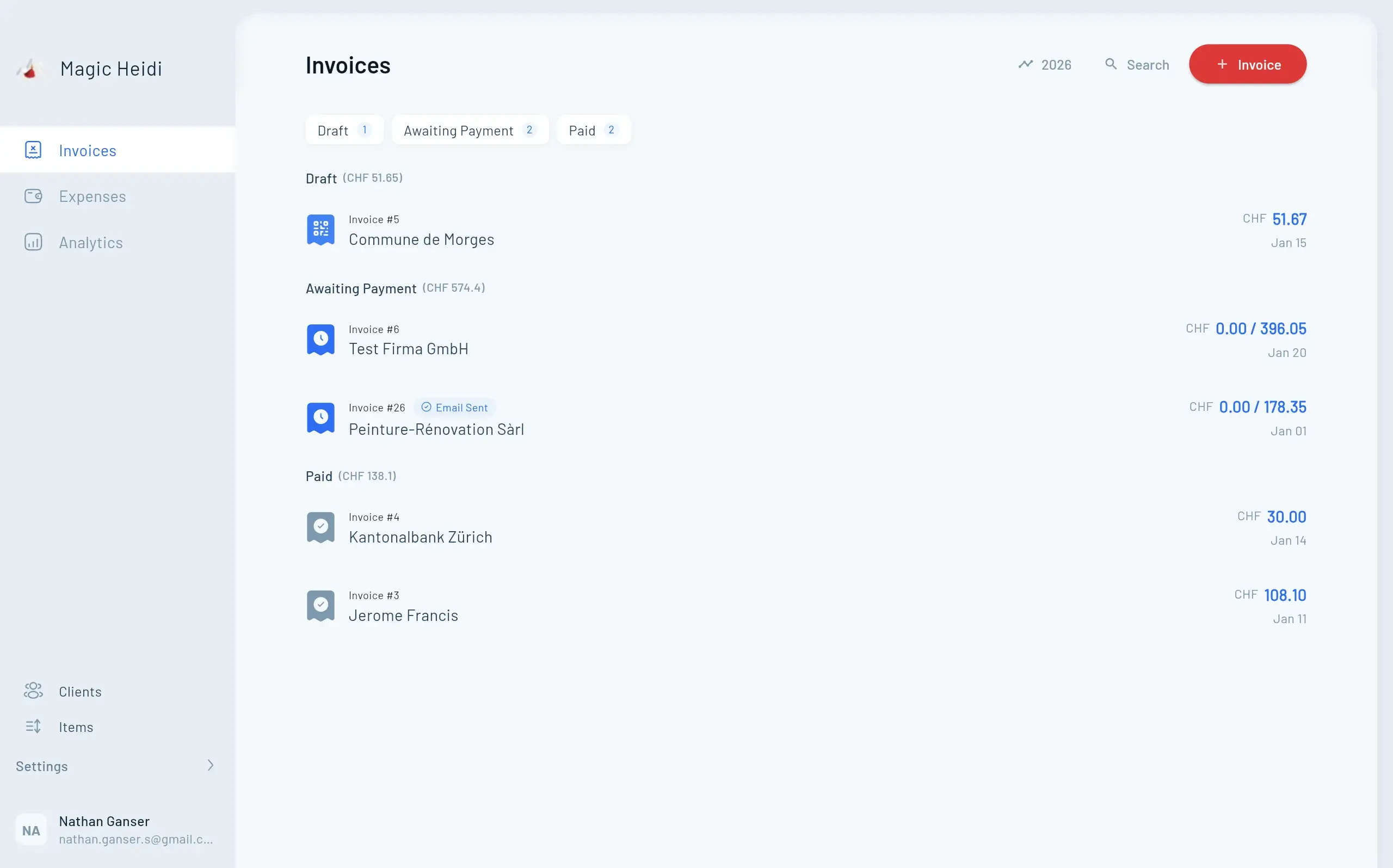
Manual tracking is error-prone and time-consuming. Swiss-specific tools handle AVS calculation, LaMal recording, VAT compliance, QR invoice generation, expense categorization, and tax report generation.

Top options:

  • Magic Heidi: AI-powered receipt scanning, mobile-friendly, no accounting jargon—designed for non-accountants
  • bexio: Used by ~90,000 Swiss SMEs, comprehensive features
  • CashCtrl: Budget-friendly, clean interface
  • Banana Accounting: Swiss classic, free basic version

Pricing: CHF 20–40/month for entry plans, CHF 50–100+ for comprehensive packages. The time saved and accuracy gained far outweigh the cost.

Working with a fiduciary (optional)

For freelancers earning CHF 150,000+ or with complex situations (multiple income streams, international clients, investments), hiring a Swiss fiduciary (accounting firm) makes sense.

Services they provide:

  • AVS registration and communication
  • Quarterly/annual tax return preparation
  • VAT reporting (if applicable)
  • Business structuring advice (when to form a GmbH/AG)
  • Audit representation

Cost: CHF 1,500–3,000+ annually depending on complexity. Often deductible as a business expense.

2026 Calendar

Compliance Calendar

Stay on top of your Swiss freelance obligations throughout the year.

January (1–30)

Review previous year's AVS provisional vs. actual income. Open or maximize Pillar 3a contributions if you haven't yet.

February–March

Receive LaMal premium adjustments for the year. Organize business expense receipts for tax filing.

April–June

File cantonal tax returns (deadlines vary; often March 31 with extension to end of June). Submit AVS income declaration if requested.

Quarterly

Pay AVS provisional contributions (if on quarterly billing). Review year-to-date income and adjust estimates.

October–November

Review health insurance options for next year during open enrollment period. Compare premiums across cantons.

December

Finalize Pillar 3a contributions before December 31. Prepay deductible expenses to maximize current-year deductions.

Your Next Steps as a Swiss Freelancer

Whether you're just starting or optimizing your tenth year, these action items will save you thousands in 2026.

If you're starting freelancing in 2026:

  1. Register with your cantonal AVS office within 30 days
  2. Enroll in LaMal basic health insurance within 3 months of starting self-employment
  3. Set up a Pillar 3a account and schedule automatic monthly contributions
  4. Choose Swiss accounting software to automate tracking
  5. Open a separate business bank account (not legally required but highly recommended)

If you're an established freelancer:

  1. Review your AVS payment history—ensure no gaps or underreporting
  2. Maximize your Pillar 3a contribution (up to CHF 36,288 if eligible)
  3. Audit your business expenses—are you claiming everything legitimate?
  4. Check if you qualify for LaMal subsidies (especially if income dropped recently)
  5. Consider switching health insurance during the next enrollment period to reduce premiums

If you're approaching CHF 100,000 income:

  1. Prepare for VAT registration (or structure to stay just under if possible)
  2. Consider forming a GmbH or AG for liability protection and potential tax benefits
  3. Consult a fiduciary about optimization strategies

The Bottom Line

AVS social security contributions are business expenses that directly reduce your taxable profit. LaMal health insurance premiums are personal deductions that lower your income tax. Understanding this distinction is worth thousands of francs annually.

With Switzerland's complex cantonal tax system, rising health insurance costs, and new retirement changes in 2026, staying informed isn't optional—it's essential for financial health.

The smartest freelancers don't just track income. They optimize every deduction, automate compliance with modern tools, and plan proactively for taxes and retirement. By implementing the strategies in this guide, you'll join their ranks.

Need help automating your AVS tracking, expense categorization, and tax-compliant invoicing? Magic Heidi's Swiss-built platform handles the complexity while you focus on your work. Try it for free and see how simple freelance accounting can be.