Magic Heidi
Further reading:
Last updated: April 2026.
When someone searches for Hauptbuch in Switzerland, they usually don’t want a dry definition. The practical questions are: how is it different from the journal, when do you really need it, and how does it help you understand accounts, balances, and year-end reporting?
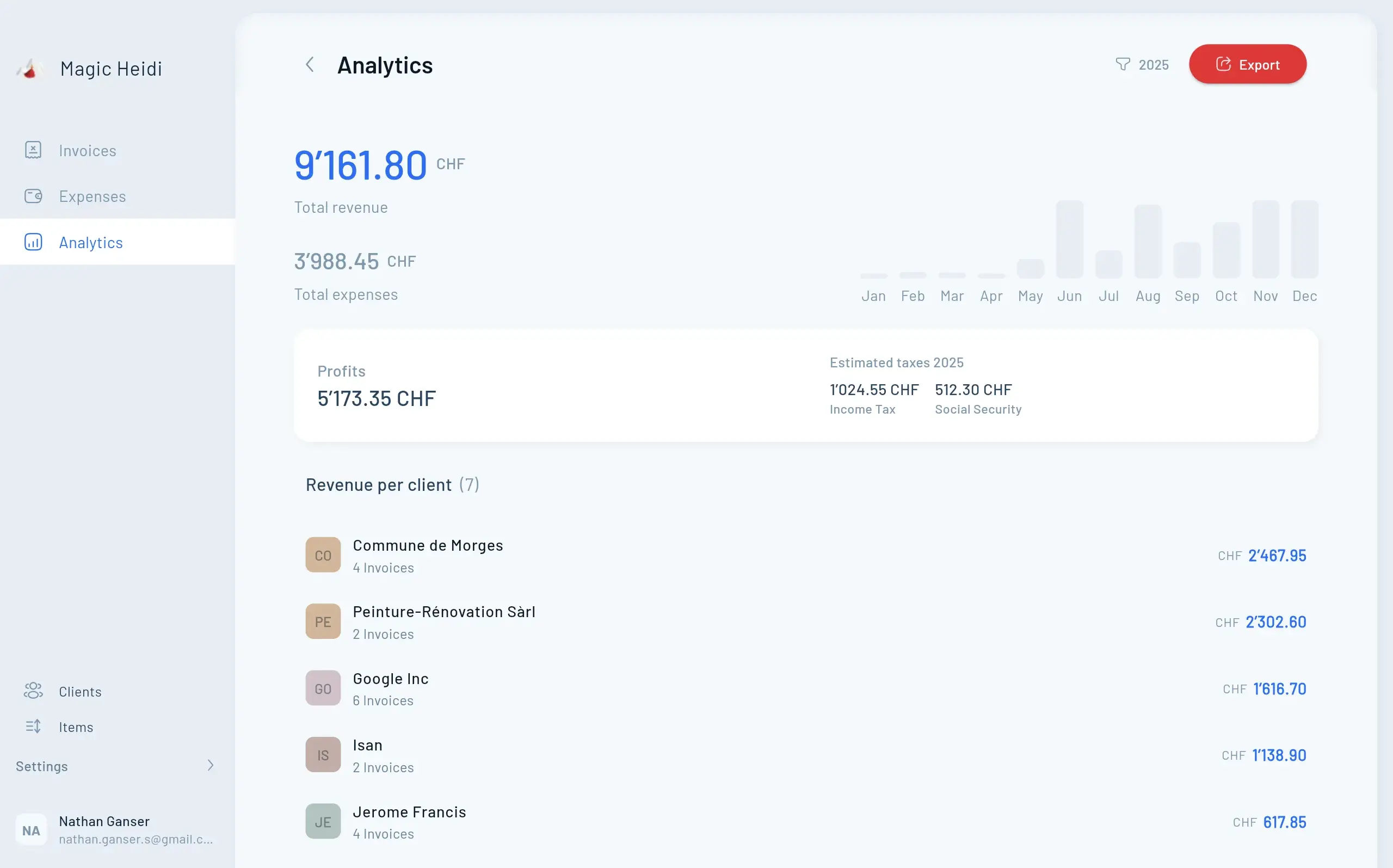
Short answer: the Hauptbuch is the account-based view of your bookkeeping (your general ledger). While the Buchungsjournal shows transactions in chronological order, the general ledger shows which account each movement affects, how the balance changes, and which accounts later feed into the balance sheet and income statement.
For very small Swiss sole proprietorships under CHF 500’000 turnover, a fully formal general ledger is not always the first problem to solve. But once you have multiple invoices, payments, receivables, payables, VAT, or you want clean monthly and year-end checks, the general ledger becomes valuable because it answers questions like:
If you need the chronological view first, start here: Buchungsjournal Switzerland.
The general ledger becomes useful when you want bookkeeping you can actually explain, not just a list of transactions.
It’s the central collection of accounts. It groups entries by account (not by date) and shows balances and account history.
Each account shows its movements and running balance.
Entries are recorded chronologically in the journal and appear in the impacted ledger accounts.
Balance sheet and income statement are built from ledger accounts and balances.
Which accounts you use depends on legal form, industry, and complexity.
People often mix the terms because they belong together. A simple separation helps:
| View | Question | Typical output |
|---|---|---|
| Journal | What happened when? | Chronological list of entries |
| General ledger | Which account changed and how? | Account history and balances |
A simple example:
You issue an invoice for CHF 1’200.
This is why the ledger becomes so useful as soon as you start asking: “Where does this number come from?”
The threshold is not only legal. It’s operational:
Not true. Large companies need it more formally, but small businesses benefit once there are multiple accounts, invoices, and reconciliations.
That’s closer to the journal. The ledger groups the same entries by account.
A chart of accounts is the structure. The general ledger shows what actually happened within that structure.
Problems usually come from unclear accounts, missing counterpart entries, or balances without context.
Then you look for chronology in an account report (or the reverse).
Without movements behind them, differences are hard to explain.
Accounts are far less useful if entries can’t be traced back to documents.
Often it’s a chart-of-accounts problem, not a ledger problem.
Further reading:
Last updated: April 2026.
The journal lists transactions chronologically. The general ledger groups the same movements by account and makes balances and account history visible.
Requirements depend on Swiss bookkeeping rules (Obligationenrecht) and on your business. In practice, an account-based structure becomes central once you want clean reconciliation and year-end numbers.
Mainly for account reconciliation, preparing year-end, answering balance questions, and making receivables/payables and VAT easier to understand.
Yes. Switzerland generally allows electronic bookkeeping if readability, access, and traceability are ensured.
Typically bank, cash, receivables, payables, VAT, equity, revenue, and expense accounts. The exact list depends on your chart of accounts.
Magic Heidi helps you keep invoices, payments, and bookkeeping logic in one place so your accounts and reports remain understandable as you grow.