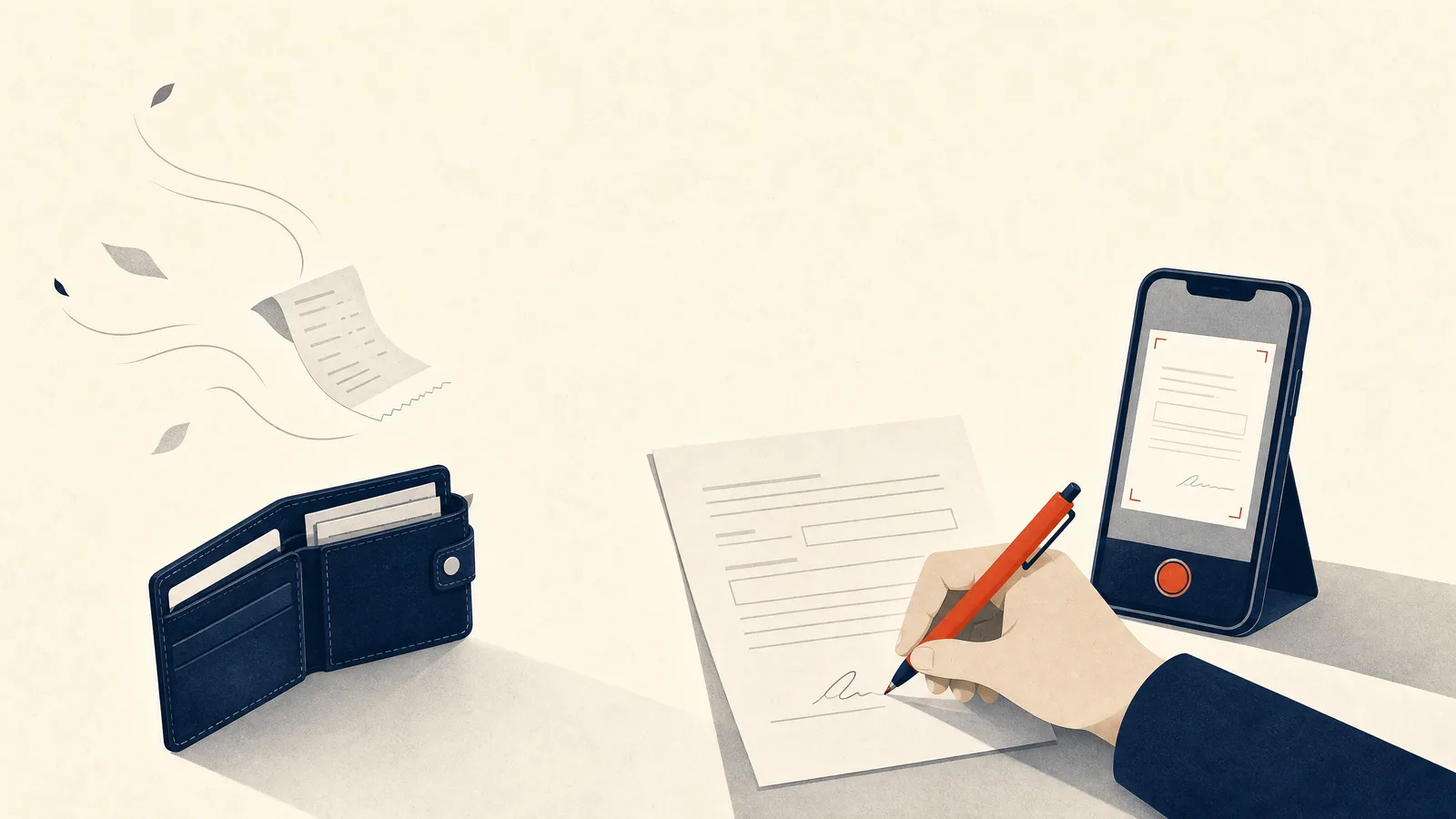
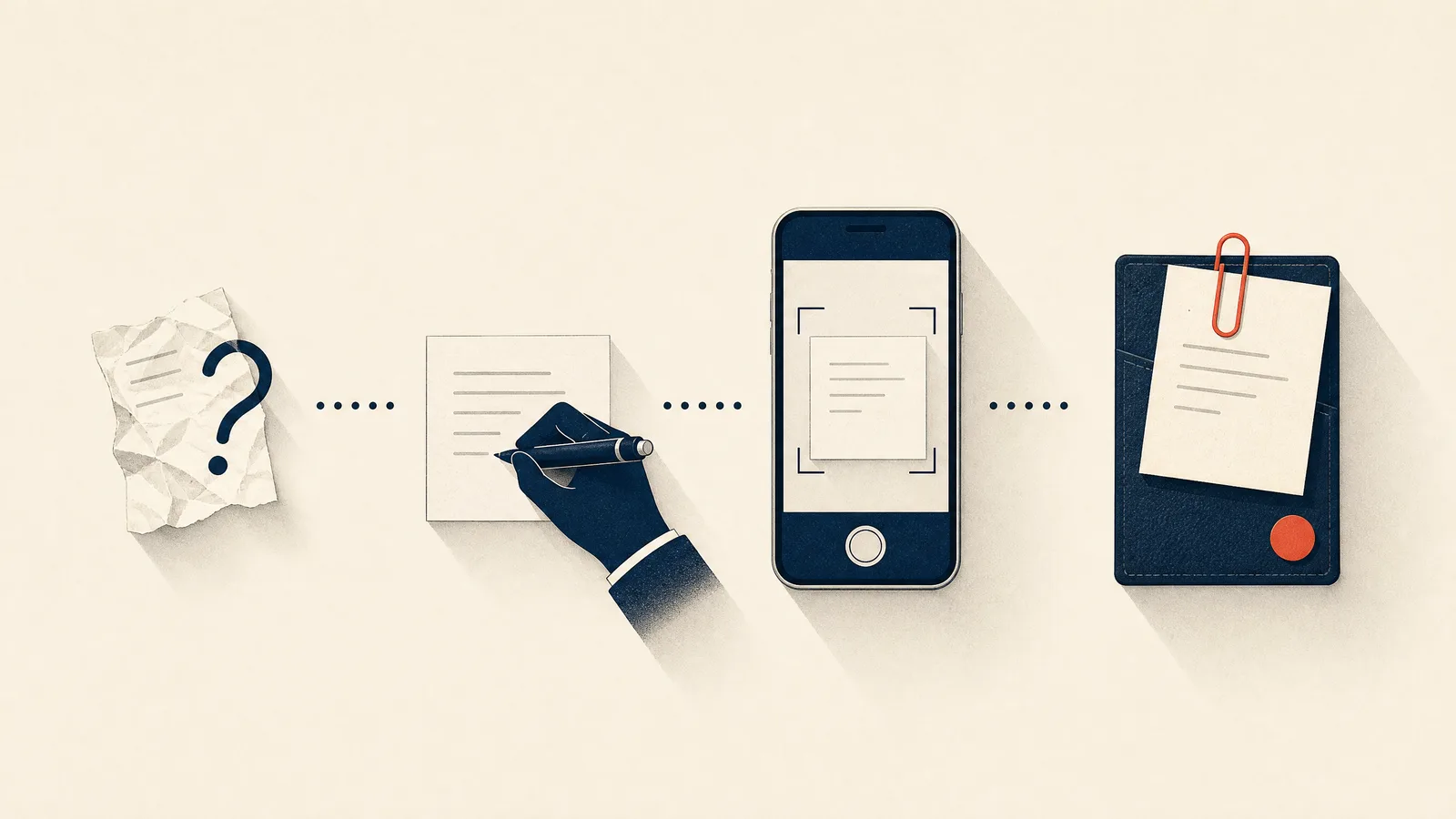
The honest answer: often yes, if it's plausible, but it isn't guaranteed. Whether the tax administration accepts a self-made receipt is decided case by case. Plausibility and supporting evidence are what tip the balance.
As a self-employed person with simplified bookkeeping, you enclose statements of income, expenditure and your asset position with your tax return (Art. 125 para. 2 let. b of the Direct Federal Tax Act, DBG). You must produce the individual receipts on request and keep them for 10 years (Art. 126 DBG).
A single, plausible replacement receipt with a bank statement and a clear purpose has a good chance here. It gets tricky when many receipts are missing.
If your figures can't be determined properly because reliable records are missing, the tax authority may assess you at its dutiful discretion (Art. 130 para. 2 DBG). It then estimates your figures.
This is where Switzerland differs from Germany in the details, and German guides won't help you here. You may only deduct VAT that was "invoiced" to you (Art. 28 para. 1 let. a VAT Act), and you have to prove the amount of the tax. According to the ESTV, the invoice must show at least the tax amount or the tax rate for this (VAT Info 09, section 1.1). But a self-made receipt doesn't come from the supplier, and it doesn't prove which VAT rate the supplier charged.
That's why a self-made receipt on its own usually gives no input tax deduction. It isn't completely ruled out: in VAT proceedings, the principle of free assessment of evidence applies (Art. 81 para. 3 VAT Act). If there is no single conclusive piece of evidence, the overall picture of several pieces of evidence can, according to the ESTV, possibly still amount to conclusive proof, for example contracts, receipts and payment confirmations (VAT Info 09, section 1.6).
The evidential value is examined case by case. I wouldn't rely on it. The safe route to input tax is an invoice or invoice copy from the supplier. According to the ESTV, the surest way to provide proof is a formally correct invoice, and where the evidence is unclear, the ESTV itself recommends asking the supplier for a correct invoice.
Not VAT-registered or on the net tax rate method? Then this doesn't affect you.
You become liable for VAT from CHF 100,000 in annual revenue in Switzerland and abroad from supplies that are not exempt from tax (more on this under VAT for freelancers). Below that, you're not VAT-registered unless you register voluntarily, and you have no input tax deduction. If you account using the net tax rate method (Saldosteuersatz), input tax is already taken into account in the rate (Art. 37 para. 3 VAT Act). In both cases, your self-made receipt only has to support the income tax deduction, and that's exactly what it's made for.
- Proof of payment attached: bank statement, card statement or booking email.
- Written promptly: as soon as you notice the loss, not three years later.
- Real amount: to the centime, not "about" CHF 50.
- Clear business purpose: client, project, appointment.
- Rare: a few self-made receipts a year look normal; dozens don't.
One limit always applies: a self-made receipt must be true. Never backdate it, never invent amounts and never write one for an expense that didn't happen. Anyone who evades tax using documents that are false in content commits tax fraud (Art. 186 DBG).
 Magic Heidi