Accountant Guide 2026

Working with an Accountant as a Swiss Freelancer

Handling your own books feels manageable until it doesn't. One missed VAT deadline. A deduction you didn't know existed. A tax bill that could have been CHF 3,000 lower.

Swiss Business Office

Do You Actually Need
an Accountant?

Let's start with the honest answer: legally, no. Unlike France, Switzerland doesn't require freelancers to hire certified accountants. You can handle everything yourself if you have the knowledge and time. But 'can' doesn't mean 'should.'

✅

DIY Works Fine

Under CHF 100k, simple structure
🤝

Need Professional Help

Over CHF 100k, GmbH, employees
💡

The Smart Middle Ground

Hybrid approach saves money
When to DIY

When You Can Manage Yourself

You can likely handle your own accounting if your business stays simple.

Under CHF 100,000 Revenue

VAT registration not yet required

Fewer Than 50 Transactions

Monthly transaction volume is manageable

Sole Proprietorship

Simple Einzelfirma business structure

Good Software Tools

Swiss-compliant accounting software

When to Hire

When You Need Professional Help

Consider working with a Treuhänder (fiduciary/accountant) in these situations.

Revenue Over CHF 100,000

VAT registration becomes mandatory

GmbH or AG Structure

More complex legal requirements

You Have Employees

Payroll and social contributions

Multi-Canton or International

Complex tax situations

The Middle Ground Most Freelancers Miss

Here's what competitors don't tell you: you don't need full-service accounting.

Many Swiss freelancers overpay by hiring accountants for everything when they only need help with specific tasks. The smart approach?

  1. Handle daily bookkeeping yourself with good software
  2. Bring in a professional for annual tax filing
  3. Get strategic advice when needed

This hybrid model typically costs CHF 800-1,500 per year instead of CHF 3,000+.

Real Costs

What Accountants Actually Cost in Switzerland

Swiss accountant fees vary widely based on location, complexity, and service level. Here's what you can expect to pay.

Service TypeRangeAverage
Basic bookkeepingCHF 80-180/hrCHF 150/hr
Annual accountsCHF 140-250/hrCHF 180/hr
Tax advisoryCHF 100-400/hrCHF 200/hr
Payroll administrationCHF 110-200/hrCHF 160/hr
Annual Costs

Yearly Costs by Business Type

Understanding what you'll actually pay based on your business structure.

Sole Proprietor (Einzelfirma)

Self-managed with annual review: CHF 800-1,500. Full bookkeeping service: CHF 2,000-4,000.

Small GmbH (2 employees)

Basic package: CHF 1,500-3,800/year. Including payroll: CHF 3,000-6,000/year.

Tax Declaration Only

Simple self-employed: CHF 800+. Complex situations: CHF 1,200-2,500.

Save Money

How to Lower Your
Accountant Costs

The biggest cost driver? Disorganized records. Accountants charge by time. Every minute they spend sorting receipts comes out of your pocket.

Stay Organized

Clients who send organized, digital records pay 30-40% less than those who show up with a shoebox of receipts.

  • Categorize transactions as you go
  • Digitize receipts immediately
  • Reconcile accounts monthly
  • Provide complete documentation upfront

Use Smart Software

The right accounting software connects directly with your accountant, eliminating back-and-forth.

  • Swiss QR invoice support
  • VAT calculations at correct rates
  • Export formats accountants accept
  • One-click accountant exports

Prepare for Meetings

Make every meeting count by coming prepared with questions and updated reports.

  • List specific questions in advance
  • Update financial reports beforehand
  • Flag unusual transactions
  • Share business changes and plans
Swiss Requirements

Swiss Accounting Requirements 2025

Before you decide on your collaboration level, understand what's legally required. The rules change based on your revenue level.

Swiss Tax Requirements

Bookkeeping Methods

Under CHF 500,000 annual revenue: Simplified bookkeeping (Einnahmenüberschussrechnung) is permitted. You need:

  • Statement of assets and liabilities
  • Income and expenditure statement
  • Documentation of deductions
  • Records of private contributions

Over CHF 500,000 annual revenue: Full double-entry bookkeeping (Doppelte Buchhaltung) is mandatory:

  • Complete balance sheet
  • Profit and loss statement
  • Appendices and notes

Document retention: Keep all business records for at least 10 years.

VAT Registration
Updated for 2025

The CHF 100,000 threshold remains, but filing has changed. Registration is required within 30 days of exceeding the threshold.

🇨🇭 Swiss Compliant
📊 2025 Rates
✅ Officially Required
🔒 10-Year Retention
📝
Online Filing Required

VAT returns via ESTV ePortal

📅
Annual Filing Option

Under CHF 5,005,000 revenue

🏷️
Standard Rate: 8.1%

Most services and goods

🏨
Hotels: 3.8%

Accommodation services

Finding Help

Finding the Right Accountant

Not all Treuhänder are equal. Here's how to find one who fits your freelance business.

Questions to Ask

Before Hiring Any Accountant

Ask these key questions to find the right fit for your freelance business.

  • Do you have experience with freelancers in my industry?
  • What software do you work with?
  • What's your pricing model (hourly vs. fixed)?
  • How do you handle communication and availability?
  • Can you help with tax optimization, not just compliance?

Swiss Entrepreneur

Red Flags to Watch For

Avoid accountants who show these warning signs. A bad fit can cost you more than doing it yourself.

🚫

No Clear Pricing

Hidden fees and surprises
📠

Outdated Software

No modern cloud tools
🗓️

Only Available Tax Season

No ongoing support

Where to Find Swiss Accountants

  • Treuhand Suisse: Professional association directory
  • Local business networks: Often the best referrals
  • Your accounting software provider: Many maintain partner directories
  • Cantonal commerce chambers: Regional recommendations
Digital Workflow

Setting Up Your Digital Workflow

The right software setup makes accountant collaboration seamless and affordable. Look for Swiss-specific features that save time.

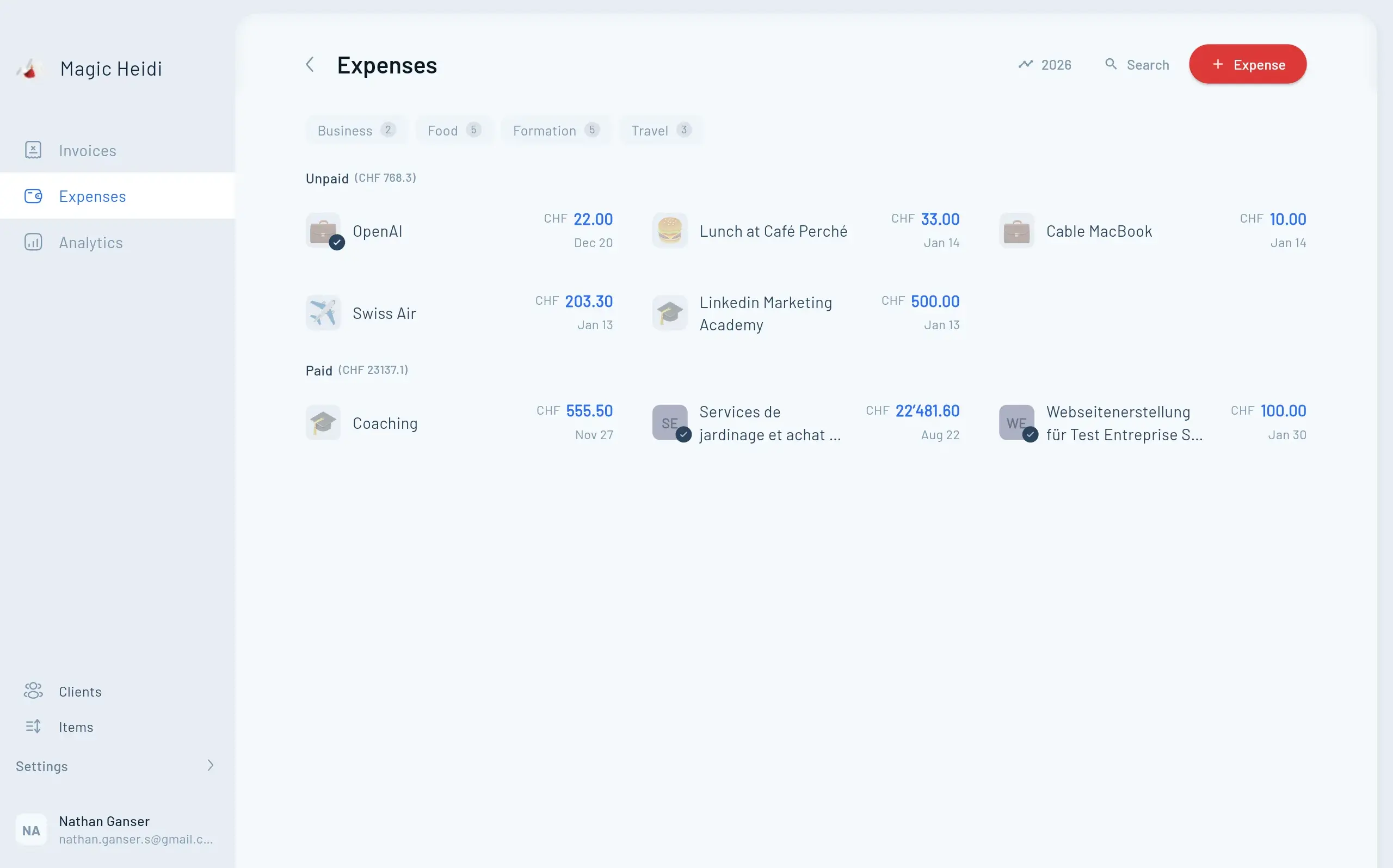
Magic Heidi Expenses List
Software Features

What to Look For in Accounting Software

For Swiss freelancers, your software should handle local requirements out of the box.

  • 🧾
    Swiss QR Invoices

    Compliant invoice format

  • 💰
    VAT Calculations

    Correct Swiss rates

  • 🔗
    Accountant Exports

    One-click data sharing

  • 🏦
    Bank Import

    ISO 20022 format support

Invoices
  • Invoice #3

    Magic Heidi

    CHF 500

    Jan 29

  • Invoice #2

    Webbiger LTD

    CHF 2000

    Jan 24

  • Invoice #1

    John Doe

    CHF 600

    Jan 20

Receipt Management

The Receipt Problem
And How to Solve It

Lost receipts are the #1 source of accountant frustration and extra charges. Fix it with a simple system.

Photograph Immediately

Your phone works fine for quick snaps

Use AI Extraction

Apps that auto-categorize receipt data

Link to Transactions

Connect receipts in your software

Weekly Cleanup

15-minute receipt review reminder

Expense Tracking That Does Itself

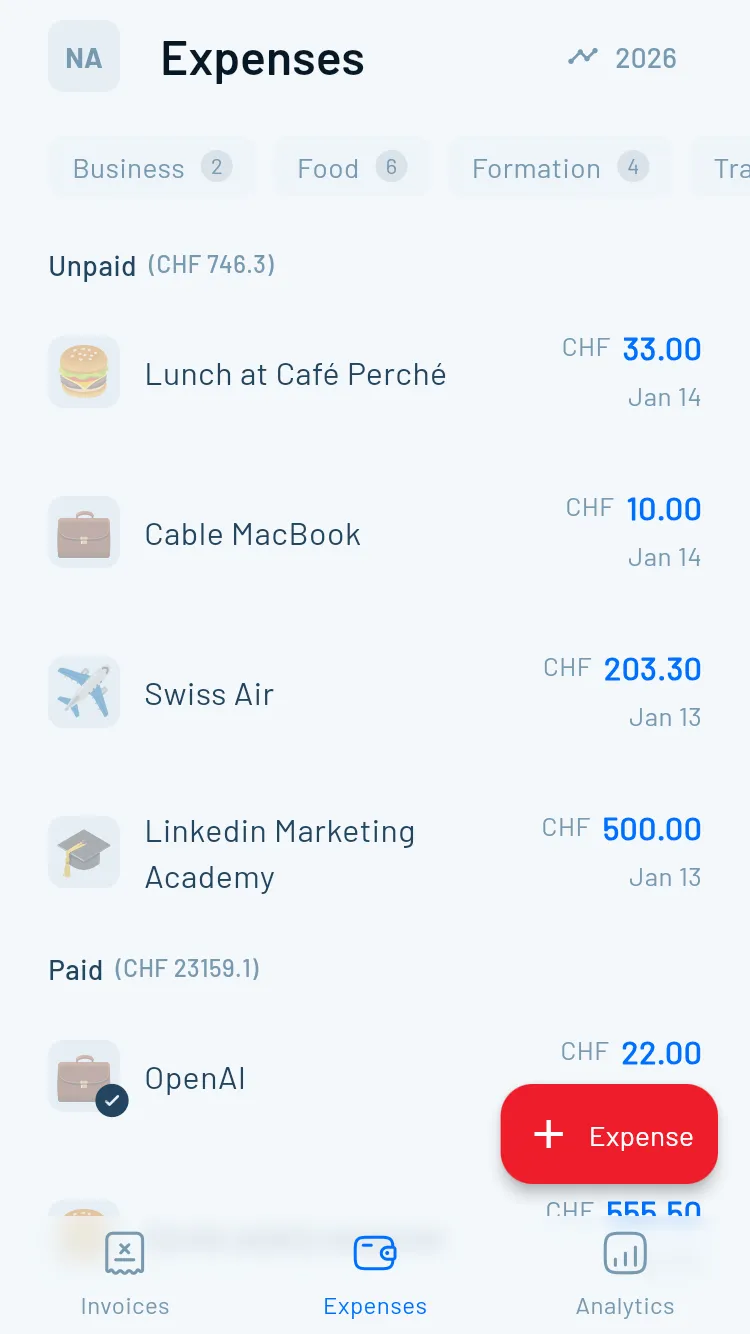
Magic Heidi's expense tracking automatically links receipt photos to transactions, so when you export, your accountant gets complete supporting documentation.

Magic Heidi Expense Tracking Mobile

Making Meetings Count

Most freelancers need 2-4 accountant meetings per year. Make them productive.

Key Discussion Points by Season

Q1 (January-March):

  • Review previous year's final numbers
  • Tax declaration preparation
  • Pillar 3a contribution planning

Q2 (April-June):

  • First quarter review
  • Cash flow adjustments
  • Any structural changes needed

Q3 (July-September):

  • Mid-year tax estimate
  • Deduction opportunities before year-end
  • Equipment or investment timing

Q4 (October-December):

  • Year-end tax optimization
  • Pillar 3a final contributions (2025 limit: CHF 7,258 with pension fund, CHF 36,288 without)
  • Planning for next year
Tax Savings

Tax Optimization:
What Your Accountant Should Help With

A good accountant doesn't just file taxes—they reduce them legally. Make sure you're claiming everything you're entitled to.

Home Office Deductions

Deduct proportional room cost based on square meters if you work from home without a separate office.

  • Room cost by square meters
  • Electricity proportional share
  • Heating allocation
  • Internet costs

Professional Development

Courses, books, conferences, and certifications related to your work are all deductible.

  • Training courses
  • Professional books
  • Industry conferences
  • Certifications

Insurance & Retirement

Professional insurance and Pillar 3a contributions are powerful deductions most freelancers underutilize.

  • Liability insurance
  • Professional indemnity
  • Equipment insurance
  • Pillar 3a contributions (up to CHF 7,258 or CHF 36,288)

Cantonal Differences Matter

Switzerland has 26 cantons, each with different tax rates and rules. Your accountant should understand:

  • Where your business is registered vs. where you live
  • Cantonal deduction variations
  • Inter-cantonal taxation if you work across borders

A Zurich-based freelancer and a Zug-based freelancer with identical income can have vastly different tax bills.

Alternative Option

The Umbrella Company Alternative

Some freelancers skip the accountant question entirely by using umbrella companies (Portage salarial).

How It Works

The umbrella company becomes your technical employer, handling invoicing, accounting, tax filing, and social contributions.

What You Get

Freelancer flexibility with employee-level administrative simplicity. No direct accountant relationship needed.

The Tradeoff

Fees typically 5-10% of revenue. Less control over financial decisions. Not suitable for all business types.

Best For Certain Freelancers

This works best for new freelancers testing the market or those who genuinely hate all administrative work.

FAQ

Frequently Asked Questions

Do I legally need an accountant as a Swiss freelancer?

No, Switzerland doesn't require freelancers to hire certified accountants. You can handle everything yourself if you have the knowledge and time. However, professional help becomes more valuable as your business grows past CHF 100,000 revenue.

How much should I expect to pay an accountant?

For sole proprietors, a hybrid approach (self-managed with annual review) typically costs CHF 800-1,500/year. Full bookkeeping services run CHF 2,000-4,000/year. Tax declaration only starts around CHF 800 for simple situations.

When does VAT registration become mandatory?

VAT registration is required within 30 days of exceeding CHF 100,000 in global turnover. As of 2025, VAT returns must be filed online through the ESTV ePortal.

How can I reduce my accountant costs?

Stay organized! Accountants charge by time. Categorize transactions as you go, digitize receipts immediately, reconcile monthly, and use software that exports clean data for your accountant. Organized clients pay 30-40% less.

What's the difference between simplified and full bookkeeping?

Under CHF 500,000 revenue, simplified bookkeeping is permitted. Over CHF 500,000, full double-entry bookkeeping (Doppelte Buchhaltung) with complete balance sheet and profit/loss statement becomes mandatory.

Start Collaborating Smarter

Magic Heidi handles invoicing, expenses, and bookkeeping for Swiss freelancers—with one-click exports for your Treuhänder. No more endless email chains or hunting for files.