 Magic Heidi
How to Write a Payment Reminder: Stay Friendly, Get Paid Faster
How to write a payment reminder in Switzerland: 3 free templates, deadlines and tips. Remind kindly, get paid faster. Read the guide!

Founder of Magic Heidi
The payment deadline has passed, and the money still hasn't arrived. Your first impulse might be frustration – or uncertainty: How do I ask for my money without losing the customer? In most cases, the answer is the same: the payment reminder. It's the friendly first step before anything formal happens. And it works remarkably well. Experience from Swiss practice shows: most open invoices get paid after a short, polite reminder – often within a few days, without a single dunning letter ever being needed.
In this article, I'll show you how to write a payment reminder that prompts payment instead of a dispute. You'll get three ready-made templates to copy, the proven 3-stage model for when the customer doesn't respond, and the most common mistakes that cost you time and money.
The key points at a glance
- The first payment reminder is free. No fees, no threats – it costs you two minutes and preserves the customer relationship.
- Set a new deadline: Ask for payment by a specific date; 7 days is customary. A reminder without a deadline is a pleasantry with no effect.
- Send the QR-bill (QR-Rechnung) again: Anyone who has to dig through their inbox pays later. The QR code lowers the barrier to almost zero.
- Reminder first, dunning letter second: The first dunning letter with a CHF 10.00 to CHF 20.00 reminder fee only follows once the reminder has gone unanswered.
- Remind automatically: Software like Magic Heidi sends reminders according to your rules – from CHF 25.00 a month.
Why the friendly payment reminder works so well
Let's start with the psychology, because that's the real trick. There is usually no ill will behind an unpaid invoice. The invoice landed in the spam folder. It went to the wrong person in accounting. The customer was on holiday. Or the invoice runs through the customer's business partner on their side – and they simply overlooked it.
If that's true, a harsh dunning letter would be a mistake. It implies something that usually isn't the case: that the customer doesn't want to pay. People respond to accusations predictably – with defensiveness, excuses or a dispute about the invoice. A friendly payment reminder implies the opposite: 'You've probably missed this.' It lets the customer save face and simply pay. That's exactly what you want.
Three psychological principles make the friendly reminder so effective:
- Respect creates cooperation. Anyone who reminds politely signals: I believe this was an oversight. The customer is glad to correct an oversight – it costs them none of their standing.
- A specific date creates action. 'Please by 30 October' becomes a calendar entry. 'Whenever it suits you' becomes nothing. Making it easy instead of lecturing. A reminder that attaches the QR-bill again lowers the barrier to payment to almost zero. The customer doesn't have to search or ask – just scan the QR code.
One more practical point: those who start friendly keep their escalation options open. If you start with a sledgehammer, you have nothing left to escalate with – the only option after a harsh first message is debt enforcement (Betreibung). If you start friendly, every following stage (dunning letter, final dunning letter, threat of debt enforcement) is a legitimate, documented next step. The escalation then doesn't come across as excessive but as appropriate.
Mini-story: Claudia, graphic designer from Zurich. Claudia had invoiced CHF 2,400.00 for a logo redesign, payment terms 30 days. On day 33, still no money. She wrote a two-line, friendly payment reminder: invoice number, amount, 'probably slipped through', a new 7-day deadline, QR-bill attached again. The customer replied within two hours: 'Oops, sorry – the invoice was sitting in my business partner's inbox.' On day 35, the CHF 2,400.00 was in her account. No conflict, no dunning letter, and the business relationship continues to this day.
The 3-stage model: payment reminder, first dunning letter, final dunning letter
The payment reminder is never a standalone step. It's stage one of three. Once you have the model in your head, writing gets easy, because every stage has a clear job:
| Stage | Timing (after the due date) | Tone | Fee |
|---|---|---|---|
| 1. Payment reminder | 3–7 days | Friendly, no pressure | none |
| 2. First dunning letter | approx. 2 weeks after the reminder | Firm, formal | CHF 10.00 – CHF 20.00 |
| 3. Final dunning letter | approx. 10 days after the 1st dunning letter | Formal, with threat of debt enforcement | CHF 20.00 – CHF 40.00 |
Stage 1 – payment reminder: It goes out 3 to 7 days after the payment deadline expires. It is not a dunning letter in the legal sense but a courtesy: a polite notice without the character of a formal demand. Things only become formal with the dunning letter. That's exactly why the reminder shouldn't include a fee – more on that in the FAQ below.
Stage 2 – first dunning letter: If the reminder goes unanswered, things get formal. The dunning letter carries that label in the subject line, sets a clear deadline (customarily 10 days) and may include a reasonable reminder fee. How high the fees may be and how to show them correctly for VAT is explained in detail in the guide to reminder fees in Switzerland.
Stage 3 – final dunning letter: The tone is now matter-of-fact and formal, the deadline is short (5 to 7 days), and debt enforcement is explicitly threatened. In parallel, default starts running: anyone who doesn't pay after the due date falls into default under OR Art. 102 (Swiss Code of Obligations) – and from that moment you can demand default interest of 5% per year (OR Art. 104). How to calculate the interest to the exact day is covered in the article on default interest in Switzerland.
Legally, by the way, you are not obliged to send a reminder first and a dunning letter afterwards. You could send a dunning letter right away. But anyone who does that gives away money and goodwill – the friendly reminder collects the invoice in most cases without fees, interest or lawyers being needed. And if you do eventually have to initiate debt enforcement, the documented escalation gives you a clean chain of evidence: reminder on day X, dunning letter on day Y, final dunning letter on day Z. That turns the debt enforcement request into a formality instead of a dispute.
What belongs in every payment reminder
A good payment reminder is short. Four to six sentences are enough. But every element has a job – don't leave any of them out:
- Invoice number and invoice date. Without a number, the customer (or their accounting team) has to search first. The number is the fastest route to the matter.
- The outstanding amount in CHF. State the exact amount, for example CHF 2,400.00 – including VAT (MWST), exactly as it appears on the invoice. Not 'the outstanding amount' but the figure.
- A new, specific deadline. 'Please pay by 30 October 2026 at the latest' – with a date, not 'within a week'. A date goes into the calendar.
- The QR-bill attached again. This is the most underestimated lever. The customer doesn't have to dig through their inbox. The QR-bill contains all the details that the invoice also needs under Art. 26 MWSTV (VAT Ordinance) – invoice number, UID, VAT statement, QR-IBAN and reference number. How a correct QR-bill is structured is covered in the pillar guide on creating a QR-bill.
- A polite, blame-free tone. No 'despite', no 'repeatedly', no passive aggression.
- Your contact details for questions. If something is wrong with the invoice, the customer should ask – not stay silent and not pay. A sentence like 'If you have any questions about the invoice, feel free to reach out' noticeably reduces blockages.
And what does not belong in it: reminder fees, default interest, threats, emojis (yes, they show up in real reminders – don't) and long explanations of why you urgently need the money. Your liquidity problem is not an argument; it just comes across as pitiful.
One more word on the subject line: 'Payment reminder for invoice no. 2026-0415' is better than 'Open invoice' or even 'Urgent'. The number makes the email findable, and the word 'payment reminder' is neutral and honest. And send the reminder by email – that is entirely sufficient and customary in Switzerland. A letter is only needed for the final dunning letter, possibly by registered mail, so that the chain of evidence is complete.
Mini-story: Reto, marketing consultant from Zug. Reto had an open invoice of CHF 5,800.00 – and waited. Only after eight weeks did he write, and in a tone that resembled an apology: 'I'm sorry, I don't want to be pushy, but if it were possible, I'd be glad about a payment at some point.' No date, no amount, no invoice attached. The customer kept putting it off. After three months and zero payment, Reto got formal – and in the end had to threaten debt enforcement to get his money. The lesson: excessive politeness without a deadline isn't kindness, it's non-commitment. Friendly means: warm in tone, clear in the matter.
Writing a payment reminder: three templates to copy
Here are three templates for the three tones you need in the collection process. Copy them, replace the placeholders in square brackets – done.
Template 1: The friendly payment reminder (first reminder after the deadline)
Subject: Payment reminder for invoice no. invoice number
Dear Name,
our invoice no. 2026-0415 of 01.09.2026 for CHF 2,400.00 has unfortunately not reached us yet. The payment has most likely slipped through – it happens.
We kindly ask you to transfer the amount by 30 September 2026 at the latest. The QR-bill is attached to this email again so you can pay directly with the QR code.
If you have already paid the invoice, please consider this message as void. If you have any questions about the invoice, I'll be happy to answer them promptly.
Kind regards Your name, Your company
Why this works: no blame, a concrete deadline, the invoice attached again, and two doors in case something is wrong (already paid / clarify a question). This is the template you'll use in eight out of ten cases.
Template 2: The firm second payment reminder (if the first was ignored)
Subject: Second payment reminder for invoice no. invoice number
Dear Name,
on date of first reminder we notified you of the still-open invoice no. 2026-0415 for CHF 2,400.00. Unfortunately, the payment still hasn't reached us.
We assume this is an oversight and ask you once again to settle the amount by date, approx. 7 days at the latest. The QR-bill is attached again.
If we have not received payment by this date, we will be forced to initiate formal collection proceedings. We would like to avoid that – so please get in touch briefly if payment is not possible or if anything is unclear.
Kind regards Your name, Your company
Why this works: the tone is still calm, but the pressure rises. You document that a reminder was already sent (important for the later chain of evidence) and announce the consequence without overdoing it. The sentence 'please get in touch briefly' opens the negotiation route – some customers have a problem and only say so when asked.
Template 3: The formal first dunning letter (when the reminder gets serious)
Subject: First dunning letter for invoice no. invoice number
Dear Name,
despite our payment reminders of date 1 and date 2, invoice no. 2026-0415 of 01.09.2026 for CHF 2,400.00 remains unpaid to date.
We hereby demand that you transfer the total amount of CHF 2,415.00 (invoice amount CHF 2,400.00 plus a reminder fee of CHF 15.00 incl. 8.1% VAT) by date, 10 days at the latest. You will find the payment details on the attached QR-bill.
After this deadline expires, we reserve the right to charge default interest under OR Art. 104 and to review further steps.
Kind regards Your name, Your company
From here on: everything in writing, everything dated, everything documented. The reminder fee must – if you are VAT-registered – be shown with 8.1% VAT; the details on fee levels and the VAT statement are in the guide linked above.
Common mistakes with payment reminders
In practice, I keep seeing the same five mistakes. Each one costs time, money or both:
- Mistake 1: Reminding too late. Many freelancers wait four, six, eight weeks out of misplaced consideration. The longer you wait, the more normal non-payment becomes – and the harder it gets to announce consequences later. Send your reminder 3 to 7 days after the deadline. That's neither pushy nor negligent. The usual payment terms in Switzerland give you the frame for this.
- Mistake 2: Not setting a new deadline. 'Just a quick reminder' without a date is a wish, not a demand. Without a deadline there is no measurable point at which you can even establish that the reminder failed – and therefore no clean transition to the dunning letter.
- Mistake 3: Charging fees on the first reminder. The payment reminder is free – that's what makes it work. Anyone demanding CHF 20.00 for the first polite notice comes across as greedy and angers exactly the customers who simply forgot. Fees start with the dunning letter, not the reminder.
- Mistake 4: The wrong tone. Two extremes are equally bad: the raging 'FINAL NOTICE!!!' with the first reminder and the submissive 'if it's not too much trouble'. Both cost respect. The formula is: warm in the relationship, clear in the matter.
- Mistake 5: Not attaching the invoice. A reminder without the QR-bill forces the customer to search – and searching is the most common reason why a reminder goes nowhere. Always attach the QR-bill again, with the same QR-IBAN and the same reference number as on the original invoice.
Mini-story: Fabienne, interior designer from Basel. Fabienne used to chase payments manually – 'whenever I thought of it'. That was irregular, sometimes after 10 days, sometimes after 6 weeks. Two customers with a combined CHF 7,300.00 in open invoices withdrew because her process looked chaotic. Today she reminds automatically: day 33 first payment reminder, day 47 first dunning letter, day 57 final dunning letter. Her average payment period dropped from 47 to 31 days. The reason isn't saber-rattling but reliability: customers take automatically reminded invoices seriously because they sense a system.
When a payment reminder becomes a dunning letter
The payment reminder has failed once the deadline you set has passed and no money has arrived. At that point you have three options:
Option 1: Ask briefly (only with an important customer). A phone call: 'Is anything unclear about the invoice?' Sometimes there's a real problem behind it – a complaint the customer never communicated. Clarify that first; a dunning letter against an angry customer with a legitimate objection gets expensive. Often an instalment plan works as a solution once things are cleared up.
Option 2: Continue the escalation. Dunning letter with a fee, final dunning letter with the threat of debt enforcement – the process above shows how. Remember VAT: if you are VAT-registered, reminder fees must also be charged at 8.1% and recorded in your VAT statement.
Option 3: Initiate debt enforcement. If even the final dunning letter fails, debt enforcement (Betreibung) is the next step. In Switzerland it's simpler than its reputation: a debt enforcement request filed with the debt collection office at the debtor's place of residence is enough – no lawyer needed, a form will do.
Remember one rule: never more than one reminder and two dunning letters. Anyone who keeps chasing forever signals that there are no consequences – and gives the delinquent debtor the chance to sit out the claim until it eventually becomes time-barred. Three letters, then debt enforcement. That's fair to customers who simply forgot and consistent with those who won't pay.
Conclusion: Remind kindly – and automate the process
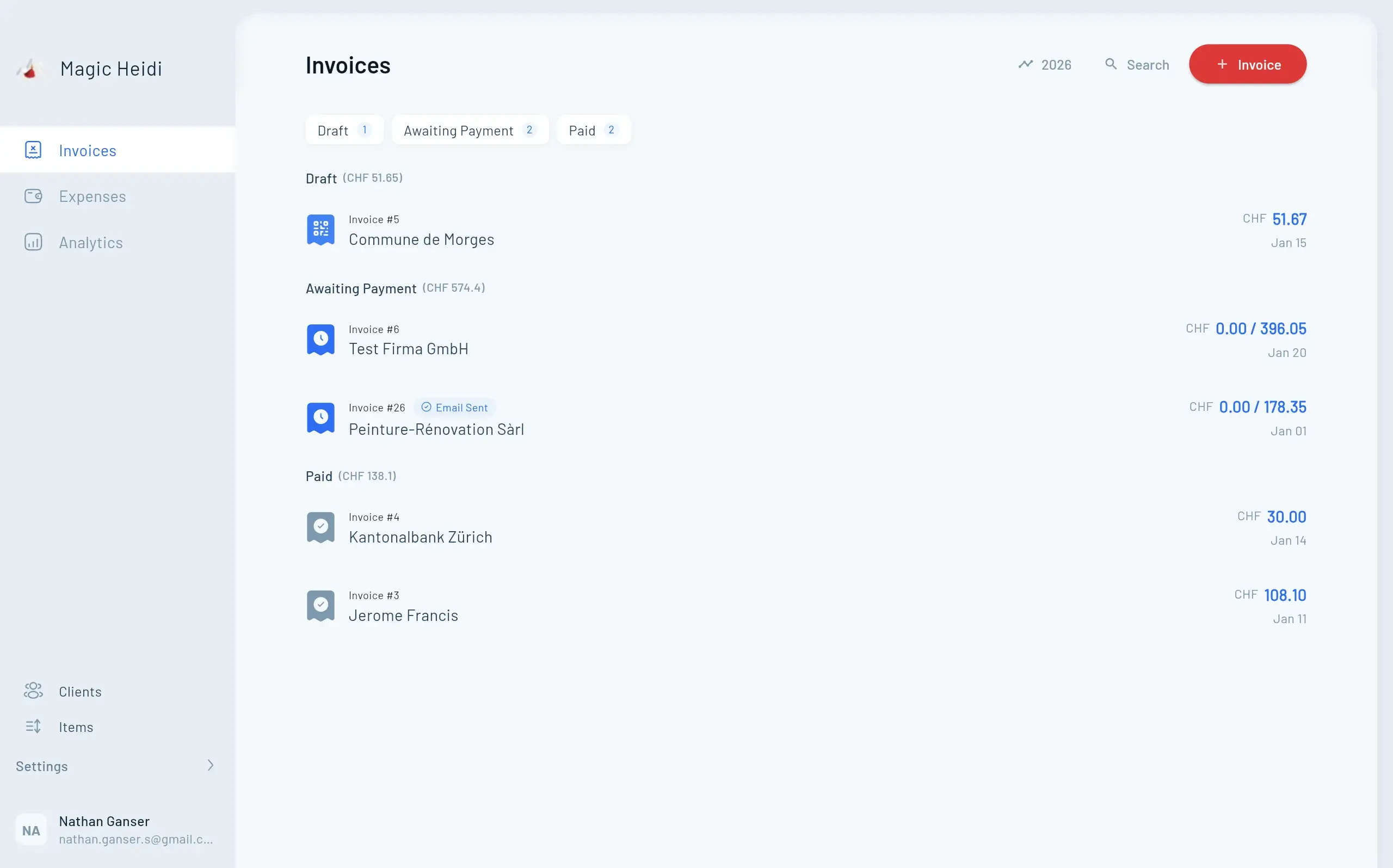
The most laborious part of reminding isn't the writing – it's staying on top of it. If you have 15 open invoices, you no longer know which customer's deadline expired today. This is exactly where invoicing software comes in. Magic Heidi monitors your open invoices and sends payment reminders and dunning letters automatically according to your rules:
- Define the stages once: day 3 after the due date a friendly reminder, day 14 the first dunning letter with a CHF 15.00 fee, day 24 the final dunning letter with the threat.
- Every reminder goes out with the original QR-bill – reference and QR-IBAN match, and the payment is automatically allocated to the right receivable.
- Fees and VAT are shown correctly and carried into the VAT statement.
- Every step is logged – if it ever comes to debt enforcement, you have the complete documentation.
The price: Magic Heidi costs from CHF 25.00 a month (see pricing) – significantly less than what you lose in liquidity and nerves when a single CHF 2,400.00 invoice arrives eight weeks late.
The conclusion is simple: the payment reminder is the cheapest lever in the entire collection process. It costs nothing but four sentences, saves the customer relationship in most cases – and gets your money in faster than any threat. The formula: friendly in tone, clear on the deadline, QR-bill attached. And if the reminder isn't enough, you now know exactly which stage comes next – from the first dunning letter to debt enforcement.
Send the first reminder 3 to 7 days after the deadline. With the three templates above, that takes less than five minutes. And with Magic Heidi's invoicing software it happens entirely without your input – you'll only notice it on your bank statement.
What is the difference between a payment reminder and a dunning letter?
A payment reminder is a friendly, informal notice that an invoice is still open – it assumes an oversight and includes no fee. The dunning letter is the formal demand for payment with a clear deadline and may include a reasonable reminder fee. In practice, the first dunning letter follows the reminder, and after that possibly the final dunning letter with the threat of debt enforcement.
Can you charge a fee for a payment reminder?
Legally, the line is not clearly drawn – in theory, a court could treat a reminder as a dunning letter. In practice, however, the first payment reminder is free, and that makes sense: anyone who charges a fee for the first polite notice comes across as greedy and annoys customers who simply forgot. Fees of CHF 10.00 to CHF 20.00 are customary only from the first dunning letter onwards.
How long should you wait before sending a payment reminder?
3 to 7 days after the payment deadline expires is ideal. Earlier feels pushy; later, you lose time and non-payment becomes a habit. With 30-day payment terms, that means sending the reminder around day 33 to 37 after the invoice date. The legal basis for due dates and default is OR Art. 102 – anyone who doesn't pay on time falls into default.
Is a payment reminder by email valid?
Yes. In Switzerland there is no formal requirement for payment reminders or dunning letters – email, letter or another channel is formally sufficient. What matters is only that you can prove the dispatch. In practice, emails with a read receipt are recommended, and for the final dunning letter possibly a registered letter, to secure the chain of evidence for any debt enforcement.
Does a payment reminder count as a dunning letter?
For your customer's payment morale: yes, it reminds them of the open debt. For the escalation: no. The payment reminder is the friendly preliminary stage; the dunning letter is the formal stage with a deadline and fee. What matters is the content: as long as no deadline is set and no consequence is threatened, it's a reminder – regardless of the wording in the subject line.
Do I have to attach the invoice to the payment reminder again?
Yes – ideally as a QR-bill. That's the strongest lever: the customer doesn't have to search their inbox but can pay directly with the QR code. The attached invoice should contain the mandatory details under Art. 26 MWSTV (VAT Ordinance), i.e. invoice number, date, VAT statement and UID – which is automatically the case with a freshly generated QR-bill.