 Magic Heidi
 Plumber Invoice Switzerland
QR-bills replaced red and orange payment slips in October 2022. A regular IBAN works with a Creditor Reference or no reference; a QR-IBAN must be paired with a QR reference. This change does not make a QR code mandatory on every invoice.
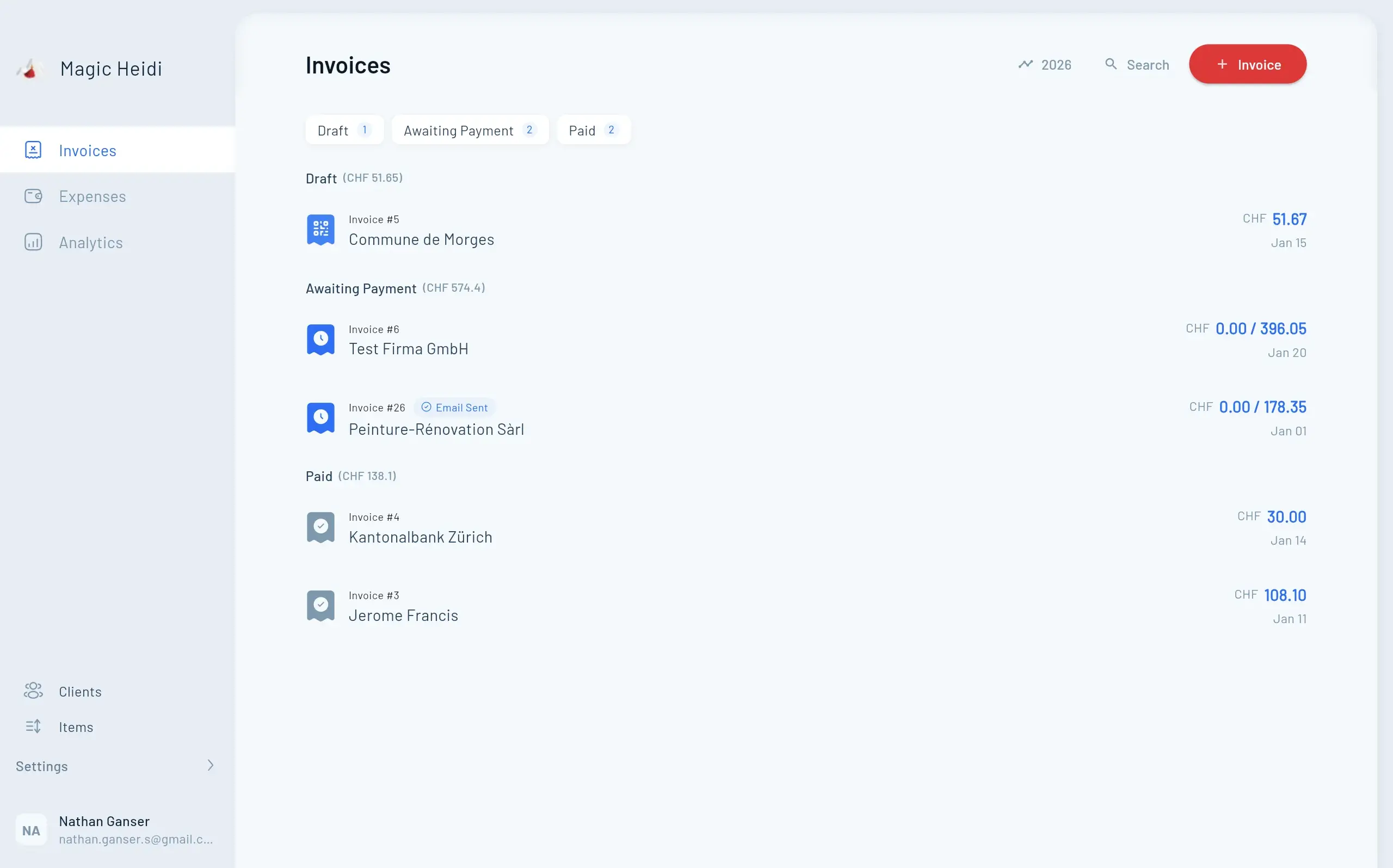
Why correct invoicing matters for Swiss plumbers
QR-bills replaced red and orange payment slips in October 2022. A regular IBAN works with a Creditor Reference or no reference; a QR-IBAN must be paired with a QR reference. This change does not make a QR code mandatory on every invoice.
8.1% MWST on all services
Plumbers are NOT MWST-exempt (unlike healthcare/education) — 8.1% standard rate since January 2024, no reduced rateQR-bill: Swiss payment standard
QR-bills replaced red and orange payment slips in October 2022. A regular IBAN works with a Creditor Reference or no reference; a QR-IBAN must be paired with a QR reference. This change does not make a QR code mandatory on every invoice.CHF 80.00–150/h hourly rates
Fees, surcharges and payment terms are negotiated. Obtain a quote for your situation; example amounts are not market data.7 mandatory elements Art. 26 MWSTG
MWST number, service description, net amount — miss one and the ESTV (Swiss Federal Tax Administration) refuses the input tax deductionKey takeaways
- 8.1% MWST applies to all plumbing services in Switzerland — no reduced rate, no exception.
- QR-bills replaced red and orange payment slips in October 2022. A regular IBAN works with a Creditor Reference or no reference; a QR-IBAN must be paired with a QR reference. This change does not make a QR code mandatory on every invoice.
- Fees, surcharges and payment terms are negotiated. Obtain a quote for your situation; example amounts are not market data.
- Article 26 of the VAT Act (MWSTG) sets out the required VAT invoice details. The Swiss invoice template helps organise them.
- MWST registration is mandatory once annual turnover exceeds CHF 100'000.00; voluntary registration below the threshold pays off because of the input tax deduction on materials, tools and vehicles.
QR-bills replaced red and orange payment slips in October 2022. A regular IBAN works with a Creditor Reference or no reference; a QR-IBAN must be paired with a QR reference. This change does not make a QR code mandatory on every invoice.
Fees, surcharges and payment terms are negotiated. Obtain a quote for your situation; example amounts are not market data.
Key takeaways For consistent invoice details and records, use the Swiss invoice template or bookkeeping software. Hypothetical example: amounts illustrate the calculation only. They do not describe a real customer or a guaranteed outcome.
Swiss invoicing rules — 7 mandatory elements per Art. 26 MWSTG
Every plumber invoice in Switzerland must contain seven mandatory elements, as set out in Art. 26 MWSTG. Miss one and your invoice is technically non-compliant — which can delay payment and, in rare cases, trigger queries from the ESTV (ESTV invoicing).
The seven mandatory elements are:
- Full name and address of the plumber — your company name, street, postcode and city. If you operate as an Einzelfirma (sole proprietorship), the registered company name goes here.
- Full name and address of the customer — the person or company receiving the plumbing work.
- Invoice date — the day the invoice is issued.
- Type and scope of the service — a clear description of the plumbing work carried out (e.g. "Renewal of shower installation, incl. mixer tap, siphon and 2m drain pipe").
- Net amount — the subtotal before MWST.
- MWST rate and MWST amount — for plumbers that's 8.1%, as a separate line with the calculated amount.
- MWST number (UID with MWST suffix) — your Swiss VAT number, required once you're MWST-registered.
QR-bills replaced red and orange payment slips in October 2022. A regular IBAN works with a Creditor Reference or no reference; a QR-IBAN must be paired with a QR reference. This change does not make a QR code mandatory on every invoice.
Plumber hourly rates in Switzerland — CHF 80.00–150/h
Fees, surcharges and payment terms are negotiated. Obtain a quote for your situation; example amounts are not market data.
Standard vs. specialised rates
- Fees, surcharges and payment terms are negotiated. Obtain a quote for your situation; example amounts are not market data.
- Fees, surcharges and payment terms are negotiated. Obtain a quote for your situation; example amounts are not market data.
The hourly rate you charge should reflect your actual cost structure — van, tools, insurance, AHV (Swiss social security) contributions and your target hourly wage. Underpricing to win jobs erodes margins fast; overpricing loses you repeat residential customers.
Material vs. labour — list separately
Fees, surcharges and payment terms are negotiated. Obtain a quote for your situation; example amounts are not market data.
Example of a line-item breakdown:
- Material: 1× Grohe mixer tap (brand) — CHF 180.00
- Material: 4m chrome copper pipe 15mm — CHF 48.00
- Material: 6× press fitting — CHF 32.00
- Fees, surcharges and payment terms are negotiated. Obtain a quote for your situation; example amounts are not market data.
- Travel costs: 24 km × CHF 0.80 — CHF 19.20
Travel costs (call-out charges)
Most Swiss plumbers charge travel costs as a per-kilometre flat rate (typically CHF 0.70–1.00/km) or a flat call-out fee within a defined radius (e.g. CHF 40.00–80 flat within 20 km). Distant callouts — say, driving from Bern to a construction site in the Alps — justify a higher flat fee. State your travel rate clearly in your quote and on the invoice so customers know what to expect.
Emergency callouts (out-of-hours service)
Emergency plumbing work after burst pipes, water leaks or heating breakdowns commands a surcharge. Typical emergency callout rates in Switzerland:
- Fees, surcharges and payment terms are negotiated. Obtain a quote for your situation; example amounts are not market data.
- Fees, surcharges and payment terms are negotiated. Obtain a quote for your situation; example amounts are not market data.
- Fees, surcharges and payment terms are negotiated. Obtain a quote for your situation; example amounts are not market data.
Fees, surcharges and payment terms are negotiated. Obtain a quote for your situation; example amounts are not market data.
SIA 118 standards for plumbers
The SIA 118 standards provide a framework for the construction and trades sectors in Switzerland, including guidelines for pricing, contract structure and billing practices. SIA 118 is the standard Swiss contractors reference when structuring multi-trade construction contracts. For plumbing work, industry-specific guidelines complement the SIA framework. Adhering to SIA standards signals professionalism — especially on commercial and multi-trade construction projects, where you work alongside roofers or electricians on the same site.
Akonto, partial and final invoices
Most plumbing projects span multiple days. A complete bathroom renovation, a heat pump installation or underfloor heating stretches over days or weeks. A single final invoice at the end strains your cash flow. Akonto invoices ensure money comes in as work progresses.
Typical phased billing
- Deposit / advance invoice (Akonto): 20–40% of the quoted total, billed before work begins. Covers pre-ordered materials (fittings, boilers, pipes, fittings) and secures the customer's commitment.
- Partial invoices (progress invoices): Issued at defined milestones — e.g. after demolition, after rough-in pipe installation, after fixture mounting. Each covers the value of work completed to date, minus the deposit already paid.
- Final invoice: Issued after project completion. Reconciles all partial invoices and the deposit, then bills the remaining balance with all materials and labour finalised.
On the final invoice, list every Akonto invoice already paid so the customer sees a clean reconciliation. That avoids disputes and "I thought I already paid that?" conversations. If you work alongside other trades — like a carpenter on a built-in furniture project — you benefit especially from clean phased logic.
Supplier material invoices
When you pre-order materials from a supplier (fittings, boilers, pipes), those supplier invoices land in your accounts payable. During the Akonto invoice phase, you typically bill the customer for materials at list price or with a standard markup. Track supplier invoices against each project so your final invoice reconciliation is clean. Tools that link orders to projects make this much easier — see our invoicing software and customer management.
Copy-ready plumber invoice template
QR-bills replaced red and orange payment slips in October 2022. A regular IBAN works with a Creditor Reference or no reference; a QR-IBAN must be paired with a QR reference. This change does not make a QR code mandatory on every invoice.
INVOICE

[Your company name]                        [Your address]
[Street, postcode, city]                  [Your phone]
[UID: CHE-XXX.XXX.XXX MWST]               [Your email]

Invoice no.: 2026-014
Date: 10 July 2026

Invoice to:
[Customer name]
[Customer street, postcode, city]

Service description: Shower installation renewal — removal
of old fittings, installation of new mixer tap, siphon, 4m
drain pipe, seal and wall finish.

MATERIAL
- 1× Grohe mixer tap — CHF 180.00
- 4m chrome copper pipe 15mm — CHF 48.00
- 6× press fitting — CHF 32.00
- 1× complete siphon set — CHF 45.00

LABOUR
- Fees, surcharges and payment terms are negotiated. Obtain a quote for your situation; example amounts are not market data.

TRAVEL (call-out costs)
- 24 km × CHF 0.80/km — CHF 19.20

Net subtotal:                CHF 561.70
MWST 8.1%:                   CHF 45.50
Total due (gross):           CHF 607.20

QR-bills replaced red and orange payment slips in October 2022. A regular IBAN works with a Creditor Reference or no reference; a QR-IBAN must be paired with a QR reference. This change does not make a QR code mandatory on every invoice.

[QR-Rechnung payment part with QR code attached]

Thank you for your business.
Notes on this template:
- All seven mandatory elements are present — company name/address, customer name/address, invoice date, service description, net amount, MWST rate and amount, UID/MWST number.
- QR-bills replaced red and orange payment slips in October 2022. A regular IBAN works with a Creditor Reference or no reference; a QR-IBAN must be paired with a QR reference. This change does not make a QR code mandatory on every invoice.
- Payment terms — 30 days net is standard in Switzerland. For new customers, consider 14 days or payment on delivery for the first job.
- Travel and emergency multipliers — shown as separate line items so customers see the breakdown.
If you want this template pre-configured with QR-Rechnung, 8.1% MWST and your company details, Magic Heidi generates it in under 30 seconds from your phone.
MWST rules for plumbers — 8.1% standard rate
Plumbing services in Switzerland are not MWST-exempt. Unlike medical, dental or educational services (which benefit from reduced or zero rates), plumbing work is a standard-taxed commercial service. Every invoice you issue as a plumber includes 8.1% MWST.
The 8.1% rate (since January 2024)
- Every invoice from 1 January 2024 uses 8.1%
Make sure your invoice template and invoicing software are configured for 8.1%. Outdated 7.7% templates are the most common MWST mistake Swiss plumbers make in 2024–2026. The current ESTV MWST rates confirm the standard rate of 8.1%.
CHF 100'000.00 threshold — when MWST registration becomes mandatory
You must register for MWST once your taxable annual turnover exceeds CHF 100'000.00. Below this threshold, registration is voluntary. Most full-time plumbers cross CHF 100'000.00 quickly — between materials, labour, travel and tools, a single large bathroom project can already bring you close to the threshold.
Fees, surcharges and payment terms are negotiated. Obtain a quote for your situation; example amounts are not market data.
Read our MWST guide for freelancers for a complete walkthrough of MWST registration, quarterly reporting and input tax deduction.
How to show MWST correctly on a plumber invoice
Your invoice should show three clear lines:
- Net amount — subtotal from materials, labour and travel before MWST
- MWST 8.1% — the calculated MWST amount (net × 0.081)
- Total (gross) — net + MWST, the amount the customer pays
Example:
- Net total: CHF 1'000.00
- MWST 8.1%: CHF 81.00
- Total: CHF 1'081.00
Round MWST amounts to the nearest 5 rappen (Swiss convention). Most invoicing tools handle this automatically.
Swiss compliance
built for plumbers
Magic Heidi creates QR-bills and quotes, records expenses and tracks payments. Explore the invoicing software.
QR-bills replaced red and orange payment slips in October 2022. A regular IBAN works with a Creditor Reference or no reference; a QR-IBAN must be paired with a QR reference. This change does not make a QR code mandatory on every invoice.
Standard rate preset — MWST number stored centrally, every invoice correctly stated
Per project: track Akonto invoices, progress invoices and final invoice
Create a cost estimate and convert it to an invoice with one click on order confirmation
How Magic Heidi simplifies plumber invoicing
Most Swiss plumbers don't need a full accounting suite. They need to send a correct invoice from the job site, get paid and move to the next job. That gap is what Magic Heidi fills.
Lean pricing vs. bexio
Compare the features your business needs and consult bexio pricing for current prices. Magic Heidi Free includes 3 invoices and 3 expenses. Pro costs CHF 24.99 a month billed annually (CHF 299.00 a year), or CHF 39.00 billed monthly. See pricing.
Mobile-first — invoice from the job site
Plumbers don't sit at a desk. You finish a job at 17:00 on a site in Dietikon, pull out your phone and send the invoice before you drive home. Magic Heidi is built mobile-first — the invoicing workflow runs cleanly on a phone screen, with the QR-Rechnung generated and attached automatically. No laptop, no spreadsheet, no "I'll do it when I'm back in the office."
QR-Rechnung native
QR-bills replaced red and orange payment slips in October 2022. A regular IBAN works with a Creditor Reference or no reference; a QR-IBAN must be paired with a QR reference. This change does not make a QR code mandatory on every invoice.
Project-based invoicing with Akonto invoices
Magic Heidi creates QR-bills and quotes, records expenses and tracks payments. Explore the invoicing software.
MWST 8.1% preset
The 8.1% MWST rate is preset. No risk of accidentally billing at the old 7.7% rate. Input tax deduction and quarterly MWST reporting are supported via our MWST guide for freelancers.
FAQ: Plumber invoices in Switzerland
How much does a plumber cost per hour in Switzerland?
Fees, surcharges and payment terms are negotiated. Obtain a quote for your situation; example amounts are not market data.
Are plumbing services MWST-exempt in Switzerland?
No. Plumbing services are subject to the standard rate of 8.1% MWST. Unlike medical or educational services, plumbing work is a standard-taxed commercial service. Every plumber invoice in Switzerland must show 8.1% MWST on the net amount, provided the plumber is MWST-registered (mandatory from CHF 100'000.00 annual turnover).
What must be on a plumber invoice in Switzerland?
QR-bills replaced red and orange payment slips in October 2022. A regular IBAN works with a Creditor Reference or no reference; a QR-IBAN must be paired with a QR reference. This change does not make a QR code mandatory on every invoice.
Do I have to register for MWST as a plumber?
Registration is mandatory once your taxable annual turnover exceeds CHF 100'000.00. Below this threshold, registration is voluntary — but most full-time plumbers cross the threshold quickly, especially with material costs. Voluntary registration pays off because of the input tax deduction for fittings, boilers, pipes, tools and your vehicle. See our MWST guide for freelancers for the registration steps.
Can I issue Akonto invoices as a plumber?
Yes. Akonto invoices are standard practice for multi-day plumbing projects. A typical structure: a deposit of 20–40% for pre-ordering materials (fittings, boilers, pipes), one or more partial invoices at defined milestones (demolition complete, rough-in pipe installation complete, fixtures mounted) and a final invoice that reconciles all previous Akonto invoices. Akonto invoices improve cash flow — you don't finance materials out of pocket.
Can I use Magic Heidi instead of bexio for my plumber invoices?
Compare the features your business needs and consult bexio pricing for current prices. Magic Heidi Free includes 3 invoices and 3 expenses. Pro costs CHF 24.99 a month billed annually (CHF 299.00 a year), or CHF 39.00 billed monthly. See pricing.
Conclusion
QR-bills replaced red and orange payment slips in October 2022. A regular IBAN works with a Creditor Reference or no reference; a QR-IBAN must be paired with a QR reference. This change does not make a QR code mandatory on every invoice.
For multi-day jobs, phased billing — deposit, Akonto invoices, final invoice — protects your cash flow. Don't finance a three-week bathroom renovation out of pocket; bill as work progresses. Most Swiss plumbers cross the CHF 100'000.00 MWST threshold within their first full-time year. So build MWST registration and quarterly reporting into your workflow from the start.
Compare the features your business needs and consult bexio pricing for current prices. Magic Heidi Free includes 3 invoices and 3 expenses. Pro costs CHF 24.99 a month billed annually (CHF 299.00 a year), or CHF 39.00 billed monthly. See pricing.
Create your first plumber invoice in 30 seconds
No credit card needed. QR-Rechnung, 8.1% MWST and project phase logic included — from your phone, right from the job site.