Carpenter Invoice Switzerland

Carpenter Invoice Switzerland

A carpenter invoice in Switzerland must show 8.1% VAT (MWST), include a QR-Rechnung payment part, and list seven mandatory elements per Art. 26 of the Swiss VAT Ordinance (MWSTV). Carpenters aren't VAT-exempt — every invoice you issue is subject to the standard rate of 8.1%, and once your annual revenue reaches CHF 100,000, VAT registration becomes mandatory.

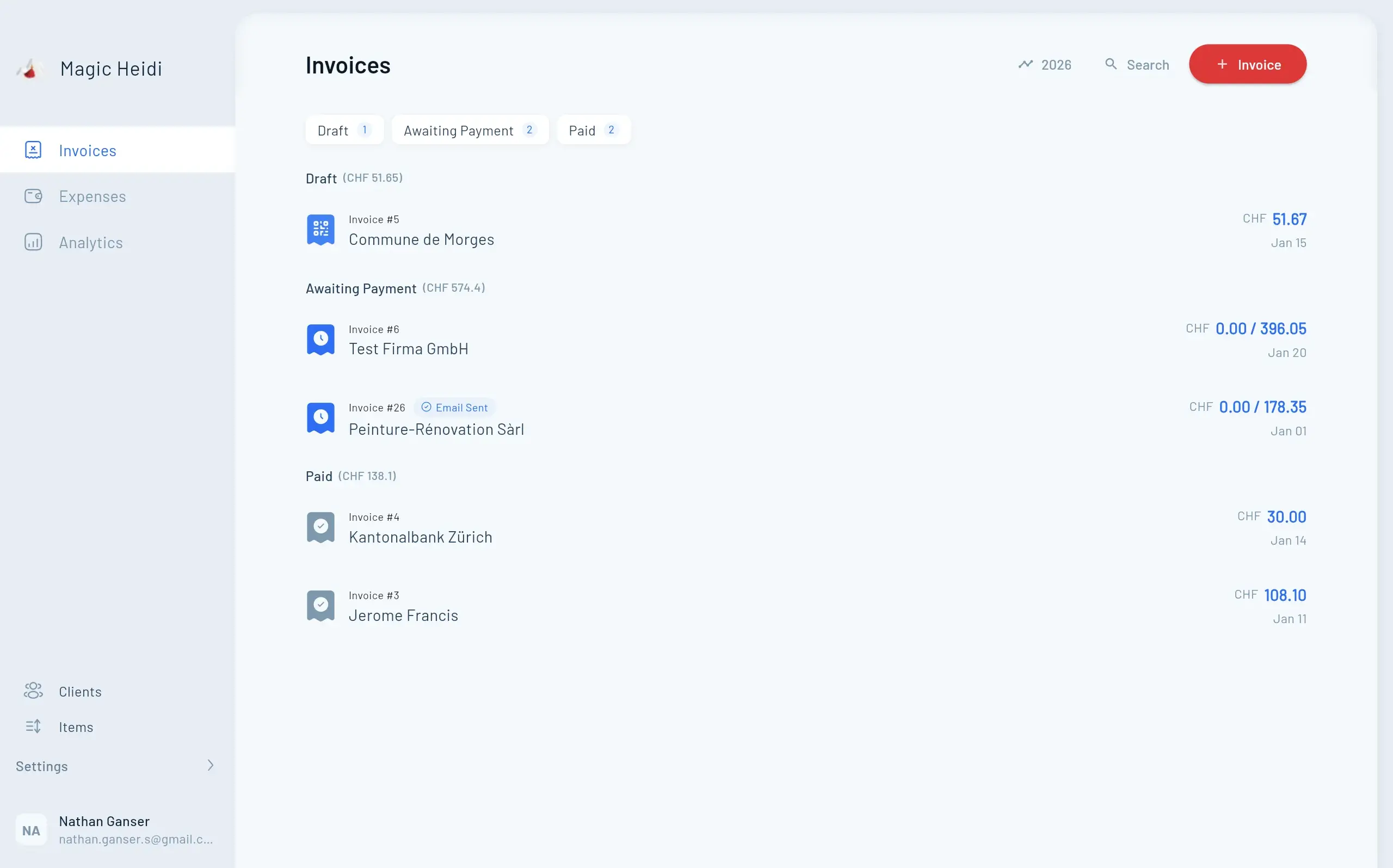
Magic Heidi invoice list

Why correct invoicing matters for Swiss carpenters

8.1% VAT on all carpentry services (no exceptions), QR-Rechnung mandatory since October 2022, typical hourly rates of CHF 70–150/h and seven mandatory elements per Art. 26 MWSTV — mistakes here lead to rejected input tax deductions, delayed payments, and customers who won't pay.

📐

8.1% VAT on all services

Carpenters are NOT VAT-exempt (unlike healthcare/education) — 8.1% standard rate since January 2024, no reduced rate
📱

QR-Rechnung mandatory since Oct. 2022

Old ISR/red-blue payment slips are gone — every invoice needs a QR-Code with QR-IBAN and QR-Reference
💰

CHF 70–150/h hourly rates

Standard work CHF 70–110/h, custom builds and specialty work CHF 110–150/h — list material and labor separately

7 mandatory elements per Art. 26 MWSTV

VAT number, service description, net amount — if one is missing, the ESTV (Swiss Federal Tax Administration) refuses the input tax deduction

Key takeaways

  • 8.1% VAT applies to all carpentry services in Switzerland — no reduced rate, no exceptions.
  • The QR-Rechnung has been mandatory since October 2022 for both electronic and printed invoices.
  • Typical carpenter hourly rate in Switzerland: CHF 70–150/h depending on specialization and region.
  • Seven mandatory invoice elements are required per Art. 26 of the Swiss VAT Ordinance (MWSTV).
  • VAT registration is mandatory once your annual revenue exceeds CHF 100,000; voluntary registration below the threshold pays off because of the input tax deduction on wood, hardware, and tools.

A carpenter invoice in Switzerland must show 8.1% VAT (MWST — the Swiss value-added tax), include a QR-Rechnung (Swiss QR-bill) payment part, and list seven mandatory elements per Art. 26 of the Swiss VAT Ordinance (MWSTV). That applies whether you've delivered a custom-made oak table for CHF 3,800 in Zurich or installed a complete fitted kitchen in Bern. Carpenters aren't VAT-exempt — every invoice you issue is subject to the standard rate of 8.1%, and once your annual revenue reaches CHF 100,000, VAT registration becomes mandatory.

Stefan, a carpenter in Bern, learned this the hard way. He ran a clean operation — quality work, loyal customers, good jobs — but he billed by scribbling hours and material on a notepad and sending a PDF without a QR-Code payment part. When he chased an unpaid invoice of CHF 4,800, the customer had lost the payment info and the invoice had no QR-IBAN. Stefan waited seven weeks for payment and received a stern letter from the ESTV (the Swiss Federal Tax Administration) about his missing VAT number. A missing QR-Rechnung and a missing VAT line cost him cash flow and peace of mind.

This guide explains everything a carpenter in Switzerland needs for correct invoicing: the seven mandatory invoice elements, the 8.1% VAT rate, typical hourly rates between CHF 70 and 150 per hour, progress invoices for multi-stage projects, material vs. labor, and a copy-ready carpenter invoice template. If you bill carpentry work in Switzerland, this is your checklist.

Swiss invoice requirements — 7 mandatory elements per Art. 26 MWSTV

Every carpenter invoice in Switzerland must contain seven mandatory elements, as set out in Art. 26 of the MWSTV (Mehrwertsteuerverordnung, the Swiss VAT Ordinance). If one is missing, your invoice is technically non-compliant — which can delay payment and, in rare cases, trigger queries from the Federal Tax Administration (ESTV).

The seven mandatory elements are:

  1. Full name and address of the carpenter — your company name, street, postal code, and city. If you operate as an Einzelfirma (sole proprietorship), the registered business name goes here.
  2. Full name and address of the customer — the person or company receiving the carpentry work.
  3. Invoice date — the day the invoice is issued.
  4. Type and scope of the service — a clear description of the carpentry work performed (e.g., "Custom-made oak table, 180×90 cm, oiled, including delivery").
  5. Net amount — the subtotal before VAT.
  6. VAT rate and VAT amount — for carpenters that's 8.1%, as a separate line with the calculated amount.
  7. VAT number (UID with VAT suffix) — your Swiss VAT number, required once you're VAT-registered.

Additionally, OR Art. 469 sets the minimum requirements for an invoice under Swiss contract law. For VAT-registered carpenters, however, the MWSTV requirements are stricter and lead the list of obligations.

Since October 2022, the QR-Rechnung has replaced the old red and orange payment slips (ESR). If you send invoices electronically or on paper, the payment part must use the QR-IBAN and QR-Reference format. Many carpenters still send PDFs without a QR-Code part — that's a compliance gap your customers' accounting departments will flag immediately.

Mini-story: Stefan and the missing payment

Stefan, a carpenter in Bern, had exactly this problem. He billed a business customer for installing a custom-made office furniture system — shelving, desk, and partitions, CHF 12,600. He listed everything correctly but included a conventional IBAN without a QR-Code. The customer's accounts payable department let the invoice sit for five weeks because their payment workflow required a QR-Rechnung scan. Stefan had to wait seven weeks for CHF 12,600. He updated his template that same evening and has generated every invoice with a QR-IBAN since — the average payment time dropped from 35 days to 12 days.

Carpenter hourly rates in Switzerland — CHF 70–150/h

The typical carpenter hourly rate in Switzerland ranges from CHF 70 to CHF 150 per hour, before VAT. The spread depends on specialization, region, and type of work.

Standard vs. specialty rates

  • Standard carpentry work (CHF 70–110/h): Window and door installation, repairs, standard furniture assembly, drywall woodwork, floor construction. This is the bread and butter of most residential and small-business carpenters.
  • Custom builds and specialty work (CHF 110–150/h): Custom-made furniture (tables, cabinets, fitted kitchens), historic window restoration, solid-wood furniture, marquetry, staircase construction. These jobs require specialized knowledge, higher material quality, and more lead time, and command higher rates.

The hourly rate you charge should reflect your actual cost structure — workshop, machinery, tools, insurance, AHV (Swiss old-age and survivors' insurance) contributions, and your target hourly wage. Underpricing to win jobs erodes margins quickly; overpricing loses you repeat residential customers.

Regional differences

Hourly rates in Zurich, Geneva, and Basel tend toward the upper end of the range. In rural cantons like Thurgau, Jura, or Valais, rates sit at the lower end. The difference is typically CHF 10–20/h between urban and rural regions. Adjust your rate to your market — a CHF 130/h rate in St. Gallen might work, the same rate in a small town in the Jura loses you jobs.

Mini-story: Karin improves her cash flow with progress invoices

Karin, a carpenter in St. Gallen, built a solid-wood dining set — table, six chairs, and a sideboard — for CHF 18,400. Until then she sent a single Schlussrechnung (final invoice) at the end of the project and financed the material out of her own pocket for four weeks. That blocked CHF 6,200 in material costs and strained her liquidity buffer. She switched to a three-stage phase billing: 30% deposit on order confirmation (CHF 5,520), an Akonto (progress) invoice after the wood-drying and rough-construction phase (CHF 7,000), and the Schlussrechnung after delivery and installation (CHF 5,880). The customer paid every invoice within 14 days. Karin never had to pre-finance the project out of pocket. That's what phase billing is for.

Material vs. labor — what belongs on a carpenter invoice

Separate material costs from labor costs on every carpenter invoice. Customers and their accountants expect to see what portion goes to material (wood, hardware, finishes) and what portion goes to your time. Material is typically billed at list price or with a standard markup of 15–25%. Labor is billed at your hourly rate multiplied by the hours worked.

Example of a line-item breakdown for an oak table:

  • Material: Solid oak, 180×90 cm — CHF 680.00
  • Material: Table legs, stainless-steel hardware — CHF 120.00
  • Material: Finish, hard wax oil — CHF 45.00
  • Labor: 14 h × CHF 95/h — CHF 1,330.00
  • Travel costs: 18 km × CHF 0.80 — CHF 14.40

Typical material line items on a carpenter invoice

  • Wood: Oak, beech, walnut, larch, ash, spruce — from CHF 80/m³ up to CHF 400/m³ for premium solid wood
  • Hardware: Hinges, slides, handles, connection hardware — CHF 2–50 per piece
  • Finishes: Oil, lacquer, wax, stain — CHF 30–120 per unit
  • Consumables: Glue, screws, dowels, sandpaper — smaller items, often billed as a flat rate

Travel costs

Most Swiss carpenters charge travel costs as a per-kilometer flat rate (typically CHF 0.70–1.00/km) or as a flat travel fee within a defined radius (e.g., CHF 40–80 flat within 20 km). Remote jobs — say, driving from Bern to a customer in the Engadin — justify a higher flat fee. State your travel rate clearly in the quote and on the invoice so customers know what to expect.

Transport and assembly

Large furniture pieces and built-in cabinets require transport and on-site assembly. Most carpenters bill this as a separate line item — typically CHF 80–150 flat or as additional labor hours at the regular hourly rate. If you need a third-party parking service or special lifting equipment, list it as a separate line.

Progress invoices and phases for carpentry projects

Most carpentry projects are multi-stage. A complete fitted kitchen, a staircase build, or a custom furniture system spans weeks. A single final invoice at the end strains your cash flow. Akonto (progress) invoices keep money coming in as work progresses.

Typical phase billing

  1. Quote / estimate: Before the order is placed, you send a cost estimate. This isn't an invoice — it's the price agreement. Once the customer accepts, the quote serves as the basis for subsequent invoicing.
  2. Deposit / advance invoice (Akonto): 30% of the quoted total, billed before work begins. Covers the pre-ordered material (wood, hardware, finishes) and secures the customer's commitment.
  3. Progress invoices (Akonto): Issued at defined milestones — e.g., after wood drying, after rough construction, after finishing. Each covers the value of the work completed to date, minus the deposit already paid.
  4. Final invoice (Schlussrechnung): Issued after project completion. It reconciles all progress invoices and the deposit, then bills the remaining balance with all material and labor finalized.

On the Schlussrechnung, list every already-paid Akonto invoice clearly so the customer sees a clean reconciliation. That avoids disputes and "I thought I already paid that?" conversations.

Practical tip: payment terms on progress invoices

Set the same payment deadline on Akonto invoices as on Schlussrechnungen — typically 30 days net. If you set 14 days on the deposit but 30 days on the final invoice, you signal inconsistency. Customers pay faster when terms are consistent. A clear quote with defined milestones and payment terms builds trust before the first piece of wood is cut.

QR-Rechnung for carpenters — mandatory since October 2022

The QR-Rechnung has replaced the old red and orange payment slips (ESR) since October 2022. Every invoice you issue as a carpenter — whether on paper or as a PDF — must include a QR-Rechnung payment part. The payment part consists of:

  • QR-IBAN: A specific IBAN that starts with "CH" and is provided by your bank for QR-Rechnungen. It's not the same as your regular business IBAN.
  • QR-Reference: A 27-digit numeric reference that uniquely identifies your invoice. It enables automatic posting of the payment in your accounting.
  • QR-Code: The visual code generated by the Swiss banking standard for QR-Rechnungen. Customers scan it with their banking app or pay at the counter.

Common QR-Rechnung mistakes

  1. Used a normal IBAN instead of a QR-IBAN — the QR-IBAN is a separate number your bank reserves for QR-Rechnungen.
  2. QR-Reference missing or incomplete — the 27-digit reference is mandatory; without it, the payment can't be posted automatically.
  3. Old ESR code still on the template — the red and orange payment slips have been invalid since October 2022.
  4. QR-Code generated but not placed on the PDF — the code must be physically visible on the invoice or as a separate payment part.

If you still have questions about the QR-Rechnung, our guide on creating a QR-Rechnung has everything you need. The ESTV has required the QR-Rechnung consistently since October 2022 — carpenters who still use old templates risk rejected payments and frustrated customers.

Copy-ready carpenter invoice template

Below is a copy-ready carpenter invoice template with all seven mandatory elements, QR-Rechnung payment data, and the 8.1% VAT line. Replace the placeholders with your details.

INVOICE

[Carpentry Company Name]                    [Your Address]
[Street, ZIP, City]                          [Your Phone]
[UID: CHE-XXX.XXX.XXX VAT]                   [Your Email]

Invoice No.: 2026-027
Date: July 14, 2026

Billed to:
[Customer Name]
[Customer Street, ZIP, City]

Service description: Custom-made oak table, 180×90 cm,
solid, oiled, including delivery and assembly.

MATERIAL
- Solid oak, 180×90 cm — CHF 680.00
- Table legs, stainless-steel hardware — CHF 120.00
- Finish, hard wax oil — CHF 45.00

LABOR
- 14 h × CHF 95/h — CHF 1,330.00

TRAVEL (travel costs)
- 18 km × CHF 0.80/km — CHF 14.40

Net subtotal:                CHF 2,189.40
VAT 8.1%:                    CHF 177.35
Total due (gross):           CHF 2,366.75

Payment terms: 30 days net
QR-IBAN: CH00 0000 0000 0000 0000 0
QR-Reference: 00 00000 00000 00000 00000 00000

[QR-Rechnung payment part with QR-Code attached]

Thank you for your order.

Notes on this template:

  • All seven mandatory elements are present — company name/address, customer name/address, invoice date, service description, net amount, VAT rate and amount, UID/VAT number.
  • QR-IBAN and QR-Reference — required for the QR-Rechnung payment part. Generate the QR-Code with your invoicing tool or your bank's QR-Rechnung generator.
  • Payment terms — 30 days net is standard in Switzerland. For new customers, consider 14 days or payment on delivery for the first order.
  • Material and labor listed separately — so customers see the breakdown and your accounting can reconcile cleanly.

If you want this template pre-configured with QR-Rechnung, 8.1% VAT, and your company details, Magic Heidi generates it in under 30 seconds from your phone. A generic invoice template helps you get started, but an industry-specific template saves you the manual assembly every time.

Mini-story: Markus switches to Magic Heidi

Markus, a furniture carpenter in Winterthur, ran his invoicing with Excel and a free QR-Code generator. He spent three evenings a month assembling QR-Rechnung PDFs and tracking who had paid. After switching to Magic Heidi, he cut that admin load to under an hour a month. He now sends invoices from his phone before leaving the workshop, and customers pay faster because the QR-Rechnung is right on the invoice. Markus pays CHF 25/month. He calculated that his old toolchain cost him about 8 hours of unpaid admin per month — at his hourly rate of CHF 115, that was CHF 920 in lost time. The same pattern applies to related trades: the roofer invoice and the electrician invoice guides show similar pitfalls in Swiss billing.

Swiss compliance
built for carpenters

Magic Heidi handles every Swiss-specific requirement for carpenter invoices automatically — QR-Rechnung generation, 8.1% VAT, project-based phase billing, and quote feature.

🇨🇭 Swiss Made
🔒 Zurich Server
📋 VAT-ready
QR-Rechnung-compliant
📱
QR-Rechnung native

Swiss QR-Code automatically generated from QR-IBAN and QR-Reference — no third-party generator

💰
8.1% VAT automatic

Standard rate pre-set — VAT number stored centrally, every invoice correctly displayed

🔧
Project & phase logic

📋
Quote feature

Create a cost estimate and convert it to an invoice with one click on order confirmation

How Magic Heidi simplifies carpenter invoicing

Most Swiss carpenters don't need a full accounting suite. They need to send a correct invoice from the workshop, get paid, and move on to the next job. That gap is what Magic Heidi fills.

Lean pricing vs. bexio

Magic Heidi costs CHF 25–39 per month. bexio starts at CHF 52 per month and climbs with additional users and features. For a solo carpenter or a small two-person operation, bexio's project accounting, payroll, and CRM modules are overkill — you're paying for features you'll never use. Magic Heidi strips the invoicing workflow down to what carpenters actually use: customer list, project-based invoicing, QR-Rechnung, 8.1% VAT pre-set, Akonto invoices, and payment tracking. See our pricing overview for the full comparison. If you're looking for a lean alternative to the established solution, our bexio alternative comparison has the details.

Mobile-first — invoice from the workshop

Carpenters don't sit at a desk. You finish a furniture build at 5 PM in the workshop, pull out your phone, and send the invoice before you drive home. Magic Heidi is built mobile-first — the invoicing workflow runs cleanly on a phone screen, with the QR-Rechnung automatically generated and attached. No laptop, no spreadsheet, no "I'll do it when I'm back at the office."

QR-Rechnung native

The QR-Rechnung payment part is automatically generated on every invoice — QR-IBAN, QR-Reference, QR-Code, all formatted to Swiss banking standards. No manual QR-IBAN entry, no third-party QR generator, no PDF assembly. If you still have questions about the QR-Rechnung, our guide on creating a QR-Rechnung has everything you need.

Project-based invoicing with Akonto invoices

Magic Heidi links invoices to projects, so you can send a deposit, Akonto invoices, and a Schlussrechnung that all reconcile against the same job. The quote feature turns a cost estimate into the first invoice with one click on order confirmation. If you've been looking for a generic invoice template, Magic Heidi gives you the industry-specific version without manual assembly.

VAT 8.1% pre-set

The 8.1% VAT rate is pre-set. No risk of accidentally billing with the old 7.7% rate. Input tax deduction and quarterly VAT reporting are supported via our VAT guide for freelancers. The current ESTV VAT rates confirm the standard rate of 8.1%.

Industry-specific templates instead of DIY solutions

Carpenters don't need a generic invoice template they have to adapt themselves. Magic Heidi delivers a carpenter invoice template that cleanly separates material and labor, automatically sets the 8.1% VAT line, and generates the QR-Rechnung payment part. The same goes for related trades — the florist invoice and the nail salon invoice guides show how industry-specific invoicing works in practice.

FAQ

FAQ: Carpenter invoices in Switzerland

How much does a carpenter charge per hour in Switzerland?

The typical carpenter hourly rate in Switzerland is CHF 70–150 per hour before VAT. Standard work — window and door installation, repairs, standard furniture assembly — ranges between CHF 70 and 110/h. Custom builds and specialty work like custom-made furniture, staircase construction, or historic restorations range between CHF 110 and 150/h. Transport and assembly costs are billed separately.

Are carpentry services VAT-exempt in Switzerland?

No. Carpentry services are subject to the standard rate of 8.1% VAT (MWST). Unlike medical or educational services, carpentry is a standard-taxed commercial service. Every carpenter invoice in Switzerland must show 8.1% VAT on the net amount, provided the carpenter is VAT-registered (mandatory from CHF 100,000 annual revenue).

What must be on a carpenter invoice in Switzerland?

Seven mandatory elements per Art. 26 of the Swiss VAT Ordinance (MWSTV): (1) your full name and business address, (2) the customer's full name and address, (3) the invoice date, (4) the type and scope of the carpentry service, (5) the net amount, (6) the VAT rate (8.1%) and VAT amount, and (7) your VAT number (UID with VAT suffix). Since October 2022, every invoice must also include a QR-Rechnung payment part with QR-IBAN and QR-Reference.

Do I need to register for VAT as a carpenter?

Registration is mandatory once your taxable annual revenue exceeds CHF 100,000. Below this threshold, registration is voluntary — but most full-time carpenters cross the threshold quickly, especially with material costs for wood and hardware. Voluntary registration pays off because of the input tax deduction for wood, hardware, tools, and your vehicle. See our VAT guide for freelancers for registration steps.

Can I issue progress invoices as a carpenter?

Yes. Progress invoices (Akonto-Rechnungen) are standard practice for multi-stage carpentry projects. A typical structure: a 30% deposit for pre-ordering material (wood, hardware, finishes), one or more progress invoices at defined milestones (rough construction complete, finishing complete), and a Schlussrechnung (final invoice) that reconciles all previous progress invoices. Progress invoices improve cash flow — you don't finance the material out of your own pocket.

Can I use Magic Heidi instead of bexio for my carpenter invoices?

Yes. Magic Heidi covers everything a carpenter needs: QR-Rechnung generation, 8.1% VAT pre-set, project-based progress invoicing, customer tracking, and payment status — all mobile-first, for CHF 25–39/month. bexio (from CHF 52/month) additionally offers payroll, multi-user accounting, and full ERP features that most carpenters never use. See pricing for the full plan comparison. If you're still building your business, our guide to registering an Einzelfirma walks you through registration first.

Conclusion

A carpenter invoice in Switzerland needs three things to be compliant: the 8.1% VAT rate, a QR-Rechnung payment part with QR-IBAN and QR-Reference, and the seven mandatory invoice elements per Art. 26 of the Swiss VAT Ordinance (MWSTV). Your carpenter invoice should separate material from labor, show travel costs transparently, and use progress invoices for multi-stage projects to protect your cash flow. Typical hourly rates range from CHF 70 to CHF 150 per hour, depending on specialization and region.

For multi-stage jobs, phase-based billing — quote, deposit, Akonto invoices, Schlussrechnung — protects your cash flow. Don't finance a three-week furniture build out of your own pocket; bill as work progresses. Most Swiss carpenters cross the CHF 100,000 VAT threshold within their first full-time year. So plan VAT registration and quarterly reporting into your workflow from the start.

Magic Heidi gives you the invoicing workflow carpenters actually need — QR-Rechnung native, 8.1% VAT pre-set, Akonto invoices, mobile-first — for CHF 25–39/month instead of bexio's CHF 52+. If you're still assembling QR-Rechnung PDFs by hand or sending invoices without a QR-IBAN, it's time to stop.

Start creating invoices with Magic Heidi →

Sources: Art. 26 MWSTV; OR Art. 469; AHVG Art. 2–3; ESTV invoicing; ESTV VAT rates; AHV/IV; ESTV QR-Rechnung requirements (since October 2022); VAT rate change to 8.1% since January 1, 2024.

Create your first carpenter invoice in 30 seconds

No credit card needed. QR-Rechnung, 8.1% VAT, and project phase logic included — from your phone, right from the workshop.