 Magic Heidi
 Invoicing as a Nail Salon: A Complete Guide for Switzerland
VAT, QR-Rechnung, AHV registration — everything your nail salon needs for correct invoices.
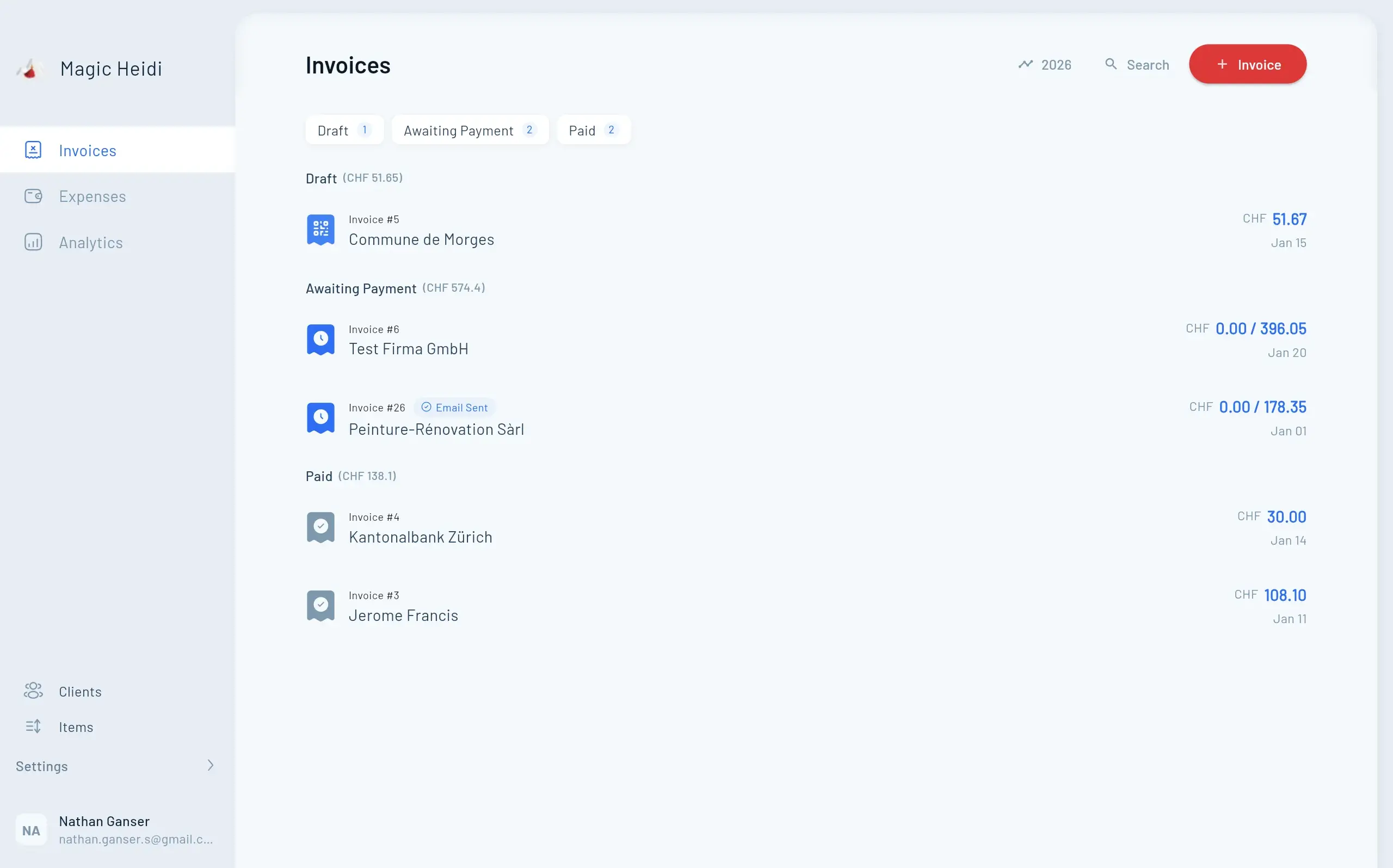
Nail Salon Invoice Switzerland: The Complete Guide
Article 26 of the VAT Act (MWSTG) sets out the required VAT invoice details. The Swiss invoice template helps organise them.
In this guide we'll walk through every step so your nail salon invoice in Switzerland is right from day one — from AHV (Alters- und Hinterlassenenversicherung, the Swiss state pension) registration, to the Einzelfirma (sole proprietorship) structure, VAT thresholds, the QR-Rechnung, deposit and final invoices, typical prices for gel nails and manicures, all the way to a ready-to-use template.
The Key Points at a Glance
- VAT liability kicks in at an annual revenue of CHF 100'000.00 — most nail salons start below that.
- The VAT rate is 8.1% on all nail services (gel nails, acrylic nails, manicures, nail art).
- AHV registration is mandatory as soon as you're self-employed.
- A QR-Rechnung belongs on every invoice that's paid by bank transfer.
- Typical prices: gel nails CHF 80.00–120.00, manicure CHF 40.00–60.00, acrylic nails CHF 90.00–140.00. Key takeaways For consistent invoice details and records, use the Swiss invoice template or bookkeeping software. Hypothetical example: amounts illustrate the calculation only. They do not describe a real customer or a guaranteed outcome.
Legal Basics: What Every Nail Salon Invoice Must Include
Two pieces of legislation are relevant to your nail salon invoice: the Swiss Code of Obligations (OR — Obligationenrecht) and the Swiss VAT Act (MWSTG — Mehrwertsteuerverordnung).
Article 26 of the VAT Act (MWSTG) sets out the required VAT invoice details. The Swiss invoice template helps organise them.
- Name and address of the recipient — first and last name, street, postcode and town of your client.
- Invoice date — the day you issue the invoice.
- Description of services — concrete and verifiable. "Gel nails with French look, fill" works. "Nails" doesn't.
- Amount — total amount, itemised if there are multiple line items.
Article 26 of the VAT Act (MWSTG) sets out the required VAT invoice details. The Swiss invoice template helps organise them.
- A sequential invoice number (e.g. 2026-001, 2026-002).
- Your UID number (Unternehmens-Identifikationsnummer — business identification number).
- The VAT rate (8.1%) and the stated VAT amount in CHF.
You'll find the official requirements on the website of the ESTV (Eidgenössische Steuerverwaltung — Federal Tax Administration). You can view the legal texts on admin.ch.
VAT in Your Nail Salon: When Does It Become Mandatory?
The most common question from nail salon owners: do I have to charge VAT? The answer depends on your annual revenue.
The CHF 100'000.00 Threshold
In Switzerland you're VAT-liable if your annual revenue exceeds CHF 100'000.00. For a typical nail salon with 3–4 treatments per day at an average of CHF 90.00, that means:
- 25 treatments/week × CHF 90.00 = CHF 2'250.00/week
- 52 weeks × CHF 2'250.00 = CHF 117'000.00/year
At this workload you become VAT-liable. That means:
- You must register with the ESTV
- Show 8.1% VAT on every invoice
- Account for and remit VAT quarterly or annually
- From that point on, use the QR-Rechnung with VAT breakdown
The VAT rules for the self-employed are straightforward. Magic Heidi handles VAT accounting automatically — you just enter your VAT rate.
Voluntary VAT Registration: Is It Worth It?
Many nail salon owners wonder whether they should register for VAT voluntarily — even if their revenue is below CHF 100'000.00. The answer: it depends on your input invoices.
Input Tax Deduction: Getting Money Back from the State
If you register voluntarily, you can reclaim input tax (Vorsteuer) on your purchases. That means: the VAT you pay for gel polish, UV lamps, furniture, rent or training courses is refunded by the ESTV. With annual material purchases of CHF 8'000.00 you get back about CHF 600.00 in VAT.
The catch: you have to add 8.1% VAT to your invoices. Your clients pay more — unless you absorb the markup in your prices. Many nail salons do this at first to stay competitive.
The ESTV offers an online tool for VAT registration. Registration is free — you just have to account annually or quarterly.
AHV Registration for Your Nail Salon
Before you write your first invoice, you have to register with the AHV. This applies to every nail salon — no matter how small. AHV registration is mandatory as soon as you're self-employed.
When Are You Considered Self-Employed?
Under AHVG (AHV-Gesetz — the AHV Act) Art. 2–3, you're considered self-employed if you:
- Carry out your activity independently and on your own account
- Run your own nail salon and bear the business risk
- Set your own prices
- Can organise your working hours freely
This applies to almost all nail salon owners. Even if you run a nail salon on the side (e.g. evenings and weekends), you must register. Learn more in the guide side-line self-employment in Switzerland.
How Does AHV Registration Work?
- Find your compensation fund: Every canton has a responsible compensation fund (Ausgleichskasse). The AHV/IV helps you find it.
- Submit your registration: Fill in the registration form and submit it with supporting documents (e.g. first invoices, business plan).
- Self-employed AHV/IV/EO contributions are around 10% of income, with a sliding scale for lower incomes. The compensation office determines the applicable amount.
- Receive your invoice: You get an AHV invoice, which you pay by QR-Rechnung.
Nail Salon Prices: What You Can Charge
Pricing in a nail salon is free — there are no statutory tariffs like for doctors or dentists. You set your own prices based on costs, experience and the local market.
Typical Price Ranges in Switzerland
Fees, surcharges and payment terms are negotiated. Obtain a quote for your situation; example amounts are not market data.
These prices vary depending on the canton, studio size and experience. In Zurich and Geneva prices tend to be higher than in rural areas.
What Do You Put on the Invoice?
Each service appears as a separate line item on the invoice. This gives clients transparency and protects you in disputes. An example:
Invoice No. 2026-045
Date: 12 July 2026

Nail Art Studio Zurich
Bahnhofstrasse 15, 8001 Zurich

Client: Maria Huber
Seestrasse 42, 8002 Zurich

Service                         Qty      Price        Total
────────────────────────────────────────────────────────────
Gel nails with extension        1        CHF 110.00   CHF 110.00
Nail art (3 nails)              3        CHF 8.00     CHF 24.00
────────────────────────────────────────────────────────────
Subtotal                                               CHF 134.00
VAT (8.1%)                                             CHF 10.85
────────────────────────────────────────────────────────────
Total                                                  CHF 144.85
This example shows a VAT-liable invoice. If you're below CHF 100'000.00 in revenue, the VAT breakdown is omitted — the total is then simply CHF 134.00.
You'll find a ready-made invoice template with all mandatory details at Magic Heidi. The template adapts automatically — with or without VAT.
Deposit and Final Invoices in the Nail Salon
For larger jobs — e.g. a complete wedding treatment for the bridal party — nail salons often work with a deposit (Akonto) and a final invoice.
How It Works
- Deposit invoice: You invoice a down payment before the service is provided. Typically 30–50% of the total price.
- Final invoice: After completing the work you invoice the remaining amount. The final invoice must deduct and show the already-paid deposit amount.
Example: Bridal party nails for 5 people, total price CHF 450.00.
- Deposit invoice: CHF 200.00 (at booking)
- Final invoice: CHF 250.00 (after treatment)
- The final invoice shows: "Deposit CHF 200.00 — already paid"
The QR-Rechnung works the same for deposit and final invoices. The only difference is the invoice type and the amount.
Common Mistakes in Nail Salon Invoices
Mistake 1: Showing VAT Without Being VAT-Liable
If you're not VAT-liable, you're not allowed to show VAT either. An invoice with VAT shown without being registered with the ESTV is invalid and can lead to clawbacks.
Solution: Check your annual revenue. Below CHF 100'000.00 = no VAT. Above CHF 100'000.00 = register with the ESTV.
Mistake 2: Confusing a QR-IBAN With a Normal IBAN
QR-bills replaced red and orange payment slips in October 2022. A regular IBAN works with a Creditor Reference or no reference; a QR-IBAN must be paired with a QR reference. This change does not make a QR code mandatory on every invoice.
QR-bills replaced red and orange payment slips in October 2022. A regular IBAN works with a Creditor Reference or no reference; a QR-IBAN must be paired with a QR reference. This change does not make a QR code mandatory on every invoice.
Mistake 3: Invoice Numbers Not Sequential
Invoice numbers must be sequential and gapless. If you issue invoices 001, 002, 004 — but 003 is missing — the ESTV may ask questions during an audit.
Solution: Magic Heidi assigns invoice numbers automatically and sequentially.
Mistake 4: Services Not Clearly Described
"Treatment" isn't enough as a description. Instead write: "Gel nails with extension, incl. French look." The more precise the description, the fewer misunderstandings with clients — and the better it looks in a possible tax audit.
Mistake 5: Ignoring AHV Contributions
Many nail salon founders forget the AHV registration. The consequence: back payments with surcharges. The AHV isn't voluntary insurance — it's anchored in law (AHVG Art. 2–3). Even if you're self-employed on the side, you must register.
Setting Up a Nail Salon as an Einzelfirma
Most nail salons in Switzerland are set up as an Einzelfirma (sole proprietorship). It's the simplest legal form — no capital, no commercial register entry (below CHF 100'000.00 revenue), minimal admin costs.
Steps to an Einzelfirma
- A sole proprietorship’s business name must contain the owner’s family name. The suffix “Einzelfirma” is not required.
- Register with AHV: As described above — mandatory before your first client.
- Check business insurance: Liability insurance is advisable (approx. CHF 200.00–400.00/year).
- Local regulations: Check cantonal regulations for nail salons (hygiene rules, room use).
- QR-bills replaced red and orange payment slips in October 2022. A regular IBAN works with a Creditor Reference or no reference; a QR-IBAN must be paired with a QR reference. This change does not make a QR code mandatory on every invoice.
Compare the features your business needs and consult bexio pricing for current prices. Magic Heidi Free includes 3 invoices and 3 expenses. Pro costs CHF 24.99 a month billed annually (CHF 299.00 a year), or CHF 39.00 billed monthly. See pricing.
Nail Salon Invoice as a Mobile Nail Artist
More and more nail designers work mobile — they come to the client's home. This doesn't fundamentally change invoicing, but a few points matter:
- Travel costs: You can charge a flat travel fee (typically CHF 20.00–50.00 depending on distance).
- Place of service: The place of service can appear on the invoice — but it's not mandatory.
- QR-Rechnung: Even when mobile, it's best to create invoices digitally — with the Magic Heidi app right after the treatment on your phone.
Mobile nail salons benefit particularly from a cloud-based solution: no paper invoices, no Excel lists, everything in one app. Just like hairdressers and tattoo artists, nail salons need simple, correct invoicing — whether in the salon or mobile. Personal trainers in Switzerland face similar questions: package prices, deposit payments, starting on the side.
Software for Your Nail Salon Invoice: Why Excel Isn't Enough
Many nail salons start with an Excel template or a Word document. That works for the first few invoices, but quickly gets messy. You lose track of open invoices, forget payment reminders, can't generate a QR-Rechnung, and spend more time on admin than with clients.
A better solution: Swiss invoicing software developed specifically for the self-employed and small businesses. Magic Heidi creates compliant invoices with QR-Rechnung in under 30 seconds, manages your clients automatically and generates tax-ready reports for your VAT and AHV accounting. All from your phone — ideal when you want to write an invoice quickly between two appointments.
Magic Heidi creates QR-bills and quotes, records expenses and tracks payments. Explore the invoicing software.
Conclusion: Your Nail Salon Invoice Switzerland — Safe and Correct
A correct nail salon invoice in Switzerland isn't rocket science. The most important points:
- Article 26 of the VAT Act (MWSTG) sets out the required VAT invoice details. The Swiss invoice template helps organise them.
- VAT from CHF 100'000.00 annual revenue (8.1%). Below that: no VAT, voluntary registration possible.
- AHV registration before your first client — otherwise back payments loom.
- QR-Rechnung for all bank transfers — the old ESR is no longer valid.
- Deposit and final invoices for larger jobs.
- Set prices freely — typically CHF 80.00–120.00 for gel nails, CHF 40.00–60.00 for manicures, CHF 90.00–140.00 for acrylic nails.
The biggest mistake we see isn't invoicing itself. It's doing everything manually with Excel and Word. That costs you time you could spend with your clients, and sooner or later leads to errors — a forgotten invoice number, a wrong VAT calculation, a payment reminder that was never sent. Software like Magic Heidi takes this effort off your hands so you can focus on what you do best: creating beautiful nails.
Frequently Asked Questions About Nail Salon Invoices
Do I have to charge VAT as a nail salon in Switzerland?
You must charge 8.1% VAT if your annual taxable revenue exceeds CHF 100'000.00. Below this threshold, VAT registration is voluntary. Many nail salons register voluntarily to reclaim input tax on materials, lamps and equipment — that can save several hundred francs a year.
What must be on a nail salon invoice?
Article 26 of the VAT Act (MWSTG) sets out the required VAT invoice details. The Swiss invoice template helps organise them.
Do I need a QR-Rechnung as a nail salon?
The QR-Rechnung replaced the old ESR (Einzahlungsschein mit Referenznummer, the Swiss payment slip) on 1 October 2022. Every invoice paid by bank transfer should contain a QR payment part. This makes it easier for your clients to pay and enables automatic payment matching via the 27-digit QR reference.
How do I register my nail salon with the AHV?
Self-employed AHV/IV/EO contributions are around 10% of income, with a sliding scale for lower incomes. The compensation office determines the applicable amount.
Can I start a nail salon on the side?
Fees, surcharges and payment terms are negotiated. Obtain a quote for your situation; example amounts are not market data.
How does a deposit invoice work in a nail salon?
For elaborate treatments like wedding nails, you issue a deposit invoice for 30–50% of the total price at booking. After the service, the final invoice follows, listing all services, crediting the deposit and showing the remaining balance. If you're VAT-liable, you show 8.1% VAT on the total amount, not just on the remaining balance.
Which software is suitable for nail salon invoices in Switzerland?
Compare the features your business needs and consult bexio pricing for current prices. Magic Heidi Free includes 3 invoices and 3 expenses. Pro costs CHF 24.99 a month billed annually (CHF 299.00 a year), or CHF 39.00 billed monthly. See pricing.
Create invoices for your nail salon in 5 minutes
Magic Heidi creates QR-bills and quotes, records expenses and tracks payments. Explore the invoicing software. Magic Heidi Free includes 3 invoices and 3 expenses. Pro costs CHF 24.99 a month billed annually (CHF 299.00 a year), or CHF 39.00 billed monthly. See pricing.