 Magic Heidi
Personal trainer invoice Switzerland
Invoice sessions, packages and subscriptions. Check Swiss VAT treatment, document cancellations and maintain a separate session and payment register.
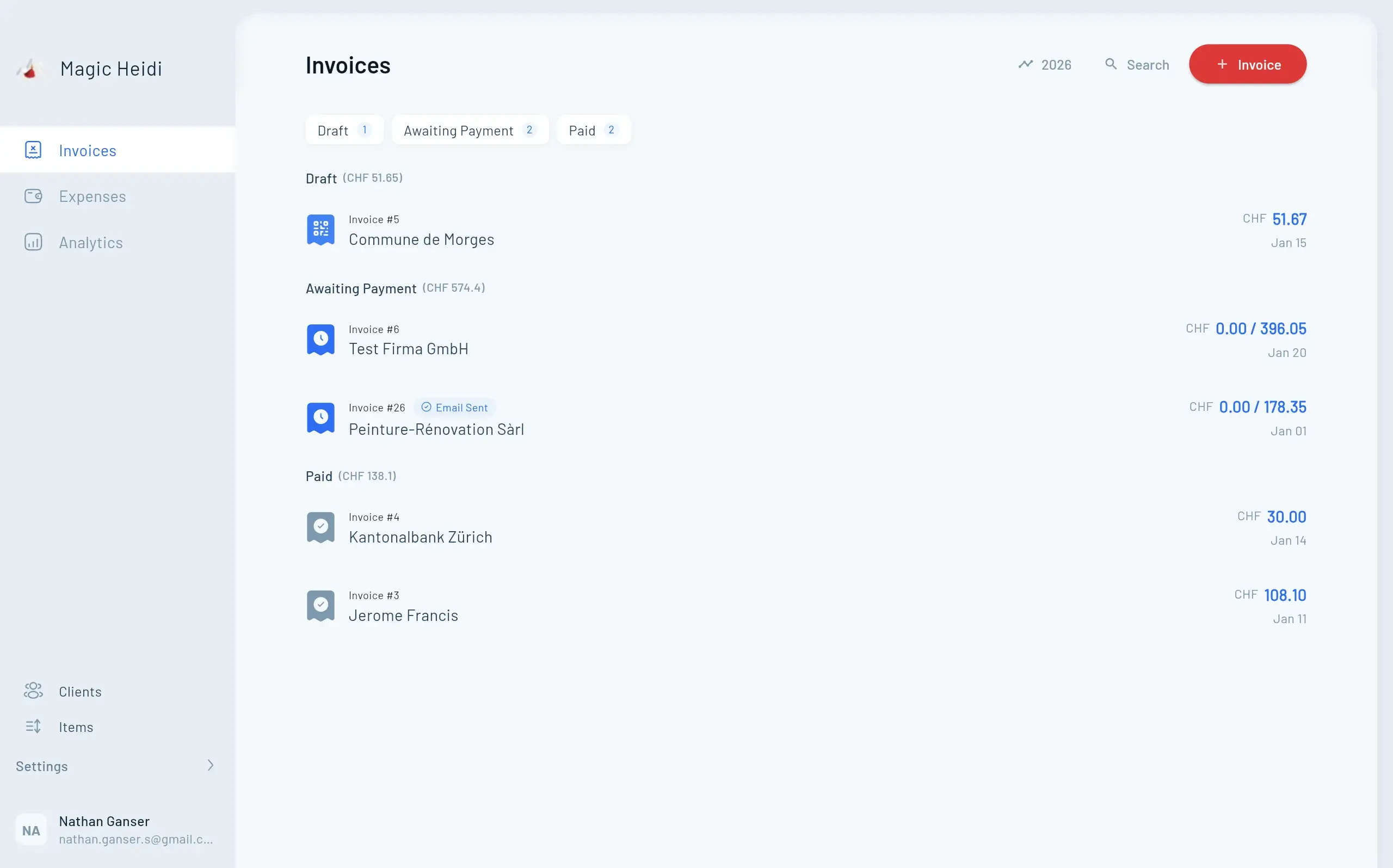
Why correct invoices count
for Swiss personal trainers
Document individual lessons and packages, track session consumption separately and check the tax based on the specific offer. A QR code does not guarantee a refund.
QR payment part: optional payment aid
Use a matching IBAN and reference type; a QR code does not certify invoice or insurer acceptance.Check VAT status and service classification
Ordinary fitness generally carries 8.1% when registered; assess qualifying education and medical treatment separately.10-session package tracking
Prepaid session packages need usage tracking — who has how many left?Check VAT status and service classification
Ordinary fitness generally carries 8.1% when registered; assess qualifying education and medical treatment separately.The most important things at a glance
- Ordinary fitness services are generally taxable with 8.1% when registered for VAT. Educational and medical treatment offers require a separate check.
- The QR-bill has been the Swiss payment slip since October 2022 — the old ISR notes are gone
- Seven mandatory elements according to Art. 26 VAT Act apply if you are VAT registered
- VAT threshold: generally CHF 100,000 relevant worldwide annual turnover; voluntary or continuing registration is possible below it
- Four billing models: individual lesson, 10-session package, monthly subscription, group training
The scope of services, session dates, price and payment status are crucial for personal trainer invoices. For packages, also document how many units have been purchased, used and are still open. The VAT treatment depends on the actual offer and your registration status.
Meet Marcus. He is a personal trainer in Zurich and initially sent his invoices via WhatsApp - simply sending customers his IBAN and a number. This worked for three months. Then one customer wanted a real invoice with VAT for his employer, another wanted to reclaim prevention funds from CSS, and the compensation fund sent him a registration form. Marcus realized that he had been doing everything wrong the whole time. No VAT number, no QR-bill, no session tracking. By the end of this article, you'll know exactly what Marcus learned the hard way — and how to do it right from day one. (Marcus is a fictional example.)
Swiss billing regulations for personal trainers
Once you are VAT registered, every personal trainer invoice in Switzerland must contain the mandatory elements according to Art. 26 of the VAT Act. If one is missing, your invoice is not simply unprofessional — it is not considered a correct VAT invoice, which can cause payment delays and hassle during a tax audit by the Federal Tax Administration (FTA).
The seven mandatory elements:
- Your full name and address — first name, last name, street, zip code, city. If you operate under a business name (e.g. “Marcus Fitness Zurich”), state both.
- Recipient's name and address — your customer's full details, not just their first name.
- Invoice Date — the date on which you issue the invoice; also indicate the date of the training session if it differs.
- Quantity and description of the service - e.g. “Personal Training, 60 min, 03.07.2026.” Be specific. Vague descriptions like “training” don’t hold water.
- Consideration — the agreed amount; a net amount is not the only permitted presentation.
- VAT statement — the applicable rate and tax amount. If the consideration includes VAT, the applicable rate alone is sufficient under Art. 26 para. 2 let. f of the VAT Act (for example, CHF 108.10 incl. 8.1% VAT).
- Your VAT number — once registered with the FTA, this number (format CHE-XXX.XXX.XXX VAT) appears on every invoice.
The QR-bill standard
Since 1. October 2022 the old orange (ESR) and red payment slips disappeared. If you enclose a payment slip with a Swiss bill, today that is the QR-bill — the payment part with a scannable QR code that contains your IBAN or QR-IBAN, the amount and a reference. Your customer's banking app scans the QR code and everything is pre-filled. No manual typing, no errors.
If you're still sending a naked IBAN via email, stop. Swiss banks no longer process old ISR notes, and customers increasingly expect the QR code for mobile payments. Use the documented invoicing workflow and check its output before sending.
VAT rules for personal trainers: the specific performance counts
Ordinary fitness and training services are generally taxable at the standard rate of 8.1% for VAT-registered providers. However, not every offer can be classified based on the job title alone. In the case of genuine educational services, a possible exception according to Art. 21 VAT Act must be examined separately; Qualifying medical treatment requires the statutory conditions and the provider’s required professional authorisation or admission. A fitness subscription does not become VAT-exempt just because it is called a “course”.
Check your relevant worldwide sales and your actual VAT status. The usual threshold is generally CHF 100,000, voluntary or continuing registration is possible below it. Check effective start and deregistration dates; low turnover does not end registration automatically. Unregistered businesses do not report VAT. The calculation example CHF 120 × 25 sessions × 48 weeks results in CHF 144,000 sales - it is not a statement about how much a typical trainer achieves.
Input tax is only available on tax that has actually been charged and is entitled to be deducted. Studio rent does not automatically include 8.1% VAT: Room rental and infrastructure services may be treated differently. Check billing, usage and billing method. The VAT basics and Art. 21, 25 and 28 VAT Act help with the classification.
Billing models: individual lesson, 10-session package, monthly subscription, group training
How you bill depends on your business model. Here are the four most common pricing structures for Swiss personal trainers.
1. Individual lesson (individual session)
The simplest model. One session, one invoice. Most trainers charge CHF 100 – 150 per 60 minute session. The typical hourly rate is around CHF 120/hour in Zurich and Geneva, CHF 90–110 in smaller cities.
Personal Training, 60 min, 03.07.2026 CHF 120.00
VAT 8.1% CHF 9.72
Total CHF 129.72
2. 10-session package (prepaid session package)
Customers pay in advance for 10 sessions at a reduced price — usually CHF 100/session instead of CHF 120. The full CHF 1,000 will be invoiced and paid in advance and VAT is due as soon as payment is received. Then you track the usage against the 10 sessions.
10 personal training subscription — 10 sessions at 60 min CHF 1,000.00
VAT 8.1% CHF 81.00
Total CHF 1,081.00
The tricky part: session tracking. You must record every session against the 10-session package so that you know when it is used up.
3. Monthly subscription (recurring monthly)
Customers commit to a fixed number of sessions per month at a fixed price. Frequently: 2×/week = 8 sessions/month at CHF 90/session = CHF 720/month. You issue a recurring invoice at the beginning of each month.
August 2026 — 8x Personal Training (2x/week) CHF 720.00
VAT 8.1% CHF 58.32
Total CHF 778.32
If your software supports recurring invoices, check the frequency and amounts before activation. Otherwise, a monthly resubmission is sufficient; Package or session management has not yet been set up.
4. Group training (small group)
Small group training (2–6 participants) shares the costs. At CHF 160/session for 4 participants, that's CHF 40/person — attractive for customers, efficient for you.
Group training functional fitness, 4 participants, 60 min CHF 160.00
VAT 8.1% CHF 12.96
Total CHF 172.96
Health insurance and SPTV/Qualitop refunds
Contributions from supplementary insurance depend on the specific policy, insurance year, offer and provider recognition. Membership or certification with SPTV or Qualitop does not guarantee reimbursement. No general annual, per-session or certification amounts are promised here.
Here's how it works
- Confirm recognition first. The customer asks their insurer whether your offer and recognition qualify under their policy for the relevant insurance year. Check current training, continuing-education and fee requirements with the certification body before applying.
- Record attendance. The customer attends and you track the sessions.
- Submit evidence. The customer submits the required invoices, payment and attendance evidence under the policy. The insurer decides reimbursement and limits; do not promise a fixed amount per session.
- Invoice the customer, not the insurer. The agreed full price is owed separately from the insurer’s reimbursement.
The invoice shows the agreed full service price with VAT treatment appropriate to your status and offer; a QR payment part is optional. Do not automatically deduct expected insurance contributions from the customer price. Provide required attendance confirmations separately, without unnecessary health data.
Cancellations, no-shows and session tracking
Cancellation on invoices
Swiss personal trainers typically charge 50 – 100% of the session fee for cancellations within 24 hours. This must be in your Terms and Conditions (general terms and conditions) and referenced on every invoice:
- Cancellation > 24h before session: no fee
- Cancellation < 24h: 50% of the session fee
- No-Show: 100% of the session fee
A cancellation or no-show request must be based on your agreement and clearly documented. Whether it is to be classified as payment for a service or as real compensation for damages must be examined separately - not taxed as a flat rate like the training hour. The following numerical example only applies if the amount is actually taxable at the standard rate:
No-Show Personal Training, 03.07.2026, 60 min CHF 60.00
VAT 8.1% CHF 4.86
Total CHF 64.86
Track 10-session package usage
For prepaid packages you need a system that shows: total sessions purchased, sessions used, remaining sessions and data. One table is enough for 5 customers. For 20+ customers across multiple subscriptions, it becomes a full-time admin job. A clear, constantly updated counter prevents the unpleasant conversation “Lisa, you have actually already used up all 10 sessions”.
Document no-shows
Always log no-shows with the date, scheduled time and your confirmation that you were there in the studio. A short note in the session tracker (“03.07.2026, 18:00, customer did not show up, trainer on site”) protects you if the customer disputes the debit.
Invoice template for Swiss personal trainers
This fictional structure example assumes a registered business providing ordinary taxable domestic training. For this example only, the separately agreed no-show payment is assumed to be taxable consideration at 8.1%; genuine damages must instead be treated separately without VAT and the invoice recalculated. All prices are net. Payment fields are explicitly non-payable placeholders:
═══════════════════════════ ════════════════════════════
                    INVOICE No. 2026-047
═══════════════════════════ ════════════════════════════

From: To:
Marcus Weber Lisa Meier
Personal Training Zurich Bahnhofstrasse 12
Langstrasse 45 8001 Zurich
8004 Zurich Switzerland
Switzerland

VAT number: CHE-123.456.789 VAT
Invoice date: 05.07.2026
Date of service: 03.07.2026

═══════════════════════════ ════════════════════════════
Description Quantity Price Total
═══════════════════════════ ════════════════════════════
Personal training, 60 min, 1 120.00 120.00
03.07.2026
No Show Training, 02.07.2026, 1 60.00 60.00
60 min (AGB <24h: 50%)
─────────────────────────── ────────────────────────────
Net total 180.00
VAT 8.1% 14.58
═══════════════════════════ ════════════════════════════
Invoice amount (including VAT) 194.58
═══════════════════════════ ════════════════════════════

Payment by QR-bill:
QR-IBAN: [your own valid bank-issued QR-IBAN — non-payable placeholder]
QR reference: [matching valid 27-digit QRR — non-payable placeholder]
Payment term: 30 days

Terms and Conditions: Cancellations <24h: 50% of the session fee.
No shows: 100%. Unused sessions in 10-session packages expire
after 6 months only if these example terms were validly agreed.

═══════════════════════════ ════════════════════════════
         [Place QR code here]
═══════════════════════════ ════════════════════════════
Use the template as a structural example. Check your registration status, your agreed package conditions and payment details. A QR payment part is optional; QRR is required for QR-IBAN, with normal IBAN SCOR or no reference is possible.
Deductible business expenses for personal trainers
Check the business-related share of every expense and retain receipts. Income-tax deduction and VAT input-tax deduction are separate tests. Exclude private use; recognition, capitalisation and depreciation depend on applicable rules and the tax year. Possible items to review:
- Studio rent — document business premises and infrastructure, excluding private use; no blanket full-deduction promise.
- Equipment — Kettlebells, TRX systems, resistance bands, mats, dumbbells, boxing gloves. Keep every receipt; You may have to capitalize larger purchases and write them off over several years.
- Education and training — check the professional connection, type of education and applicable conditions; certification is not automatically fully deductible.
- Customer travel — keep a log with date, distance and business purpose. Check actual costs or a method recognised in the relevant tax year and canton; do not assume a universal CHF 0.70/km allowance.
- Home office — document necessity, room use and the business share; there is no general 10–20% deduction for rent or utilities.
- Professional liability — document the business insurance purpose and premiums paid; treat private coverage separately.
- Phone and software — document business use and exclude private shares.
If you use a receipt-scanning tool, verify the extracted amounts and tax treatment against the original receipt. A scan does not establish deductibility; preserve the evidence in a suitable archive.
You can find the official SME guide to deductible expenses at kmu.admin.ch.
Maintain invoicing software and session list separately
Invoicing software can help you with invoicing, but does not automatically replace the proof of use of a 10-session package. Keep a list for each package with invoice reference, units sold, session date, consumption and remaining stock. Document cancellations separately so that a charged fee does not count as a used unit without being noticed.
Fictional register example: 10 sessions purchased, with sessions attended on the 3rd, 10th and 17th of the month. Three sessions used; seven remain. Only transfer services that have not yet been invoiced to new invoices. A package that has already been paid for is not an outstanding invoice amount.
The Product information and Prices help with comparison. Native session counters, automatic package debiting, health records and insurance billing are not guaranteed here.
FAQ: Personal trainer invoices in Switzerland
Do I have to pay VAT as a personal trainer?
Check your actual Swiss VAT registration and the relevant worldwide turnover. The usual mandatory registration threshold is CHF 100,000; voluntary registration and the start of liability must be assessed separately. Unregistered businesses do not show VAT. Apply the appropriate rate only to taxable services with a Swiss place of supply. Ordinary fitness services are generally taxable; educational or medical exemptions require their own legal conditions.
When will I be self-employed as a personal trainer?
You are considered self-employed as soon as you regularly earn income from personal training on your own account. You have to register with your cantonal compensation fund and pay AHV/IV/EO contributions - up to 10% of your income, less for lower incomes (decreasing scale). Even if you have a part-time job or are below the VAT threshold, the AHV obligation applies from the start; Only for additional income of up to CHF 2,500 per year are contributions only charged upon request.
Can I invoice from the gym?
Yes. After the session, record its date, duration and agreed price. Check whether a paid package already covers it; if so, update package usage rather than invoicing it again. For uninvoiced services, use a suitable mobile app or browser to create an invoice with customer details, service date, amount and appropriate VAT statement. Check the PDF and payment data before sending through an agreed channel. Avoid exposing customer details on shared devices.
How does my customer bill the health insurance company?
The customer first checks the policy, insurance year, recognised provider and exact offer with their insurer. Invoice the agreed full price with the appropriate tax treatment and provide the required attendance and payment evidence. The customer submits it under their policy; the insurer decides reimbursement and limits. Neither certification nor a QR code guarantees a contribution. Insurance reimbursement is separate from your customer invoice.
What expenses can I deduct as a personal trainer?
Review business-related shares of studio rent, equipment, professional training, customer travel, insurance, telephone and software. Retain receipts and a travel log, exclude private use and check capitalisation and depreciation for larger purchases. Home office, education and travel costs depend on the tax year and canton; no universal mileage or percentage deduction is promised. Assess income-tax and input-VAT deductions separately.
Do I need a QR-bill?
A QR payment part is optional, not a requirement for every invoice or bank transfer. If you include one, use a QR-IBAN with a 27-digit QR reference (QRR), or a normal IBAN with an SCOR reference or no reference (NON). Check the finished payment part; scanning alone does not authorise or prove payment.
Conclusion
A clear personal trainer invoice shows services, period, price and payment. Separate usage documentation is included for packages. Check the VAT based on your specific offer and status; an invoice or QR code alone does not constitute an insurance refund.
A clear invoice and a current session register make the next reconciliation easier. Track your sessions, document cancellations, deduct your expenses and register with the AHV from day one.
References: SPTV for trainer certification · Qualitop for prevention program standards · ESTV for VAT regulations · SME Admin for guide to deductible expenses.