 Magic Heidi
Keep Late Payments Under Control: Less Manual Chasing
Late payments drain your business. 85% of freelancers experience them. Here's how to keep open invoices in view and remind clients with little effort, while preserving client relationships.
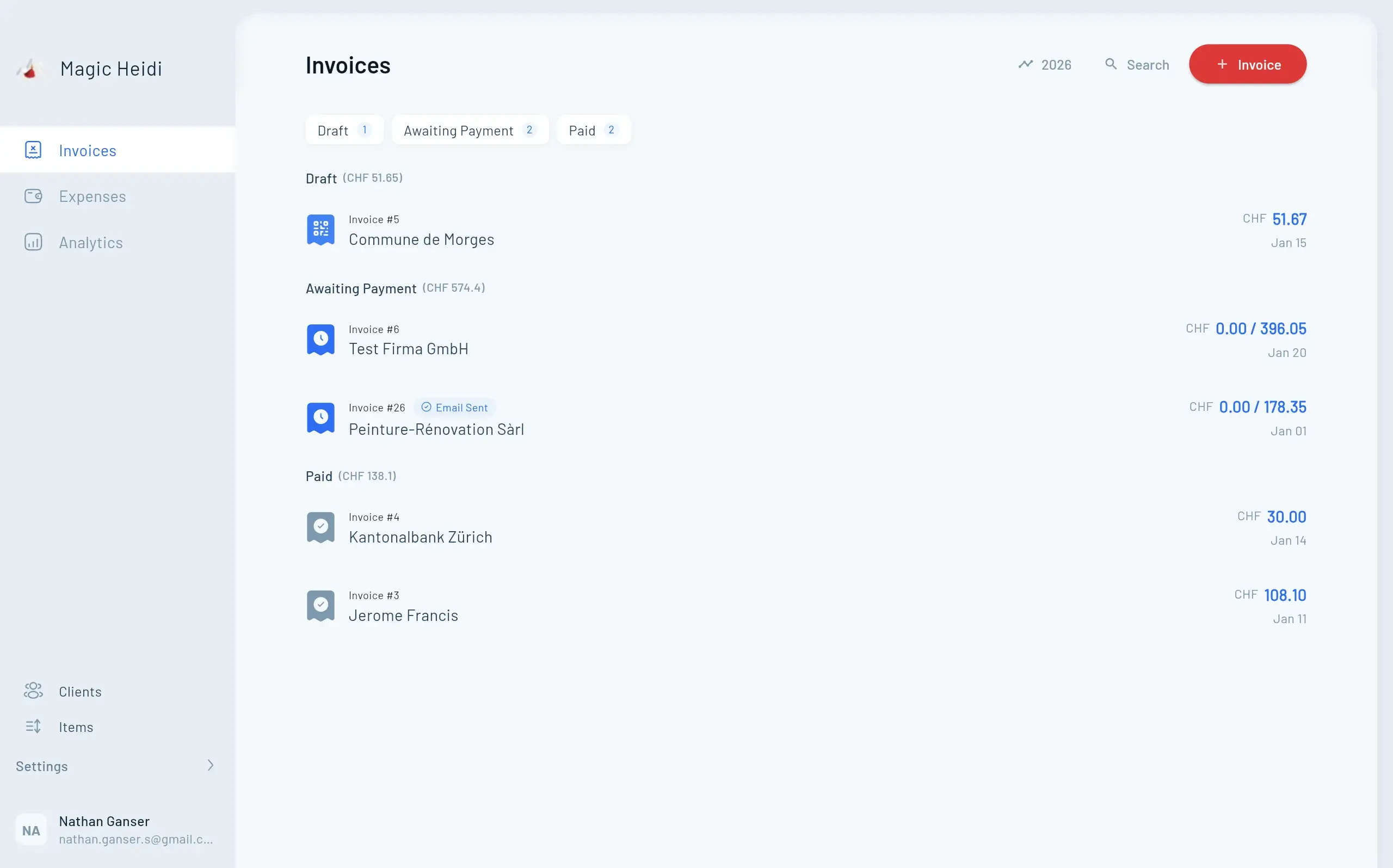
Late Payments Hit Swiss Freelancers.
Harder Than You Think.
According to Remote's 2025 Contractor Management Report, 85% of freelancers experience late payments. Even worse, 21% get paid late more often than on time. Every hour spent tracking down overdue invoices is an hour not spent on billable work.
Hours wasted
Writing follow-up emails manuallyAwkward conversations
Personally asking clients for moneyCash flow gaps
Dipping into savings to cover billsThe Real Cost of Chasing Payments
The 2025 Global Freelance Payment Analysis reveals the scale of this problem:
- 63% of freelancers wait more than 30 days for payment after completing work
- 31% experience delays exceeding 60 days
- Late payments cost the global freelance economy an estimated CHF 79 billion annually in lost productivity
A study by the Association of Independent Professionals found that 43% of freelancers have considered quitting self-employment entirely because of payment stress.
What Swiss Law Says About Payment Reminders
Here's something many Swiss freelancers don't realise: payment reminders aren't legally required in Switzerland.
5% Default Interest
From the start of default, clients owe 5% interest a year (Art. 104 Code of Obligations, OR / CO). Default generally starts with your reminder, or when an agreed fixed due date passes.
Reminder Fees
Reminder fees are on the safest legal footing when they are set out in your contract or general terms.
No Waiting Period
Set 10-day, 14-day, or 30-day terms—whatever works for your business.
Immediate Collection
Creditors usually send a reminder before debt enforcement (Betreibung / poursuite), but there is no obligation to.
The Three-Tier Reminder Process
Swiss businesses typically follow a three-step process:
- Zahlungserinnerung (payment reminder) – A friendly nudge
- Mahnung (formal dunning notice) – A firmer request with consequences mentioned
- Betreibung (debt enforcement) – The legal enforcement option
Following a fixed routine for the first two steps lets you stay professional while protecting your cash flow. More on default interest and reminder fees.
Payment Reminders With Less Manual Work
You don't need to write every reminder from scratch or track due dates in a spreadsheet. With invoicing software, you see which invoices are open, create the reminder straight from the invoice, and keep a record of every send. You decide the timing and the tone.
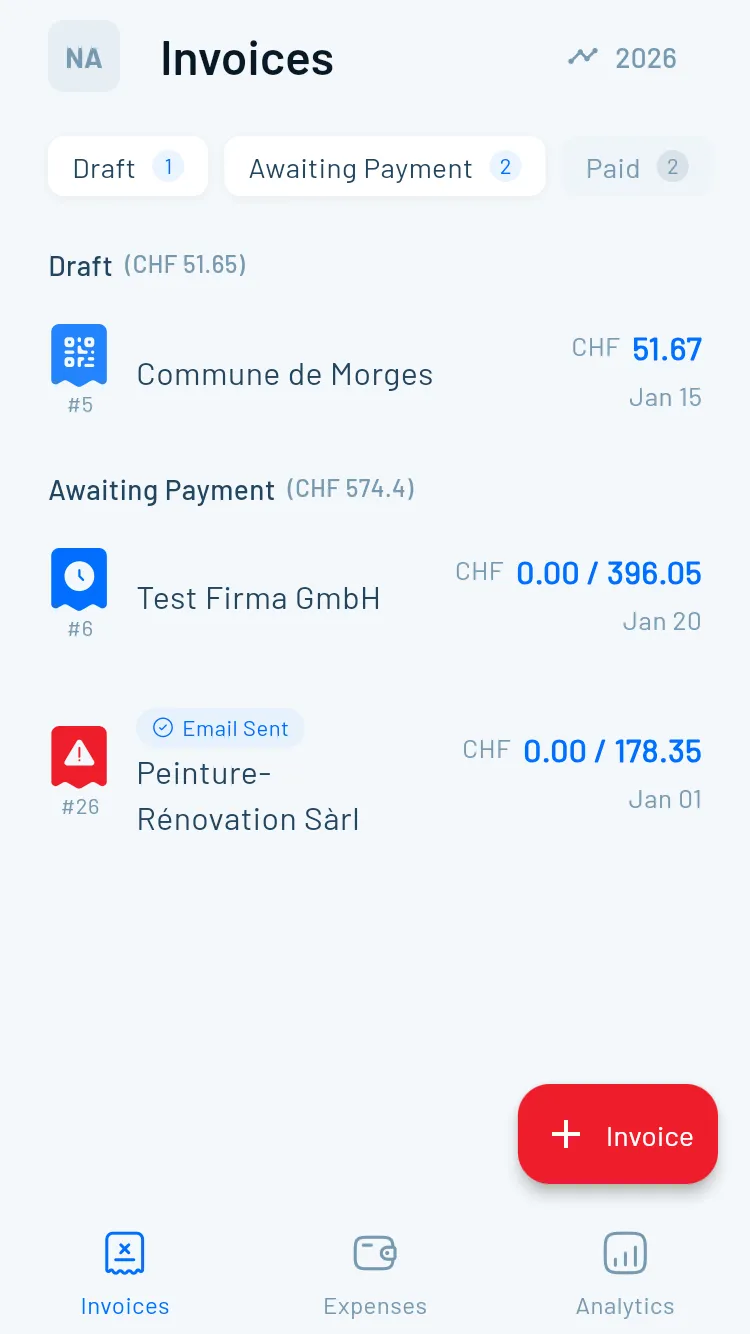
Where Software
Saves You Work
You decide when and how to remind a client. The routine work around it doesn't have to be yours.
Spot Overdue Invoices
Every invoice shows its status, open or paid, so you quickly see which ones are overdue.
- Open or paid status
- Find overdue invoices quickly
- Preset default payment terms
- Clear deadline on every invoice
Reminders in a Few Clicks
Create a payment reminder or formal notice straight from the open invoice.
- Created from the open invoice
- QR bill kept (with your IBAN saved)
- Sent by email
- Or as a B Mail letter
A Clear Record
Every send is logged with its date.
- Date of every send
- Documents when you reminded the client
- A basis for your next step
- No digging through your inbox
Automatic Recurring Invoices
For subscriptions, retainers and ongoing mandates, invoices go out on a schedule.
- Monthly, quarterly or yearly
- Or every 2 or 3 years
- Switched on per invoice
- No forgotten invoices
Your Reminder Timeline
The most effective reminder sequence balances persistence with professionalism. Here's a Swiss-specific timeline that works. Set it once and check your open invoices every week.
Day 0: Invoice Sent
Send promptly with clear terms and QR-code. Since 2022, QR-invoices are the Swiss standard.
Day 7-14: First Reminder
Friendly nudge: 'Perhaps it slipped through? Here's the QR code for convenience.'
Day 15-20: Second Reminder
Firmer tone: 'Default interest of 5% a year applies from the start of default. Please pay within 7 days.'
Day 30: Final Warning
Reference next steps: 'If unpaid in 10 days, I'll consider formal collection.'
Customising for Your Clients
Consider your client relationships when you set your reminder schedule:
- Long-term trusted clients: Start reminders later with softer language
- New clients: Stick to the standard schedule
- Large corporations: Expect 30 or 60-day standard terms
- International clients: Payment norms vary by country
Also consider language. Switzerland has four official languages, and your reminders should match your client's preference. Most Swiss invoicing software supports German, French, Italian, and English templates.
Choosing the Right
Swiss Software
Your invoicing software should take work off your plate when you follow up. Look for features that fit Swiss invoicing.
Essential for Swiss payments
Created in a few clicks
Every send dated
Sent automatically on a schedule
Best Practices for Effective Reminders
A fixed schedule handles the timing, but your messaging still matters.
Keep It Professional
A fixed routine removes the awkwardness. Avoid emotional language.
Always Include the Invoice
Attach the original with QR payment code. Fewer steps = faster payment.
Reference Your Terms
Citing contract terms adds legitimacy. It's not personal—it's business.
Clear Next Steps
Amount due, how to pay, deadline, and contact info for questions.
When Clients Still Don't Pay
A clear process resolves most situations, but some clients need more intervention:
Step 1: Personal Contact
After your written reminders, pick up the phone. Sometimes a direct conversation uncovers problems—cash flow issues, disputes, or administrative errors.
Step 2: Formal Demand Letter
Send a registered letter (Einschreiben) stating the outstanding amount, accrued interest, a 10-day deadline, and your intention to pursue legal collection.
Step 3: Debt Enforcement (Betreibung / poursuite)
Switzerland's debt enforcement system lets you assert a claim without a prior court judgment:
- File a request at the competent debt enforcement office (Betreibungsamt / office des poursuites)
- Once the payment order is served, the debtor has 10 days to file an objection (Rechtsvorschlag / opposition) and 20 days to pay
- Entry affects client's credit for 5 years
- Use only when other options fail
The full procedure is explained in starting debt enforcement.
Step 4: Know When to Walk Away
For small amounts, collection costs may exceed the debt's value. Write off bad debt and find clients who pay reliably.
Prevent Late Payments Before They Happen
The best collection strategy is never needing one. These practices reduce late payments from the start.
- 📅Shorter Payment Terms
Use 10-14 days, not 30
- 💵Require Deposits
25-50% upfront for large projects
- ⚡Invoice Immediately
Send the moment work completes
- 🎁Early Payment Discount
2% off for payment within 10 days
- Invoice #3
Magic Heidi
CHF 500
Jan 29
- Invoice #2
Webbiger LTD
CHF 2000
Jan 24
- Invoice #1
John Doe
CHF 600
Jan 20
Have Clear Contracts
Your contract should specify:
- Payment terms (due date, accepted methods)
- Late payment interest (5% is standard, higher requires agreement)
- Reminder fees (if any)
- Consequences of non-payment
Vet New Clients
Ask about payment processes during onboarding. Large companies often have fixed payment cycles. Understanding this helps you set realistic expectations.
Take Control of Your Cash Flow
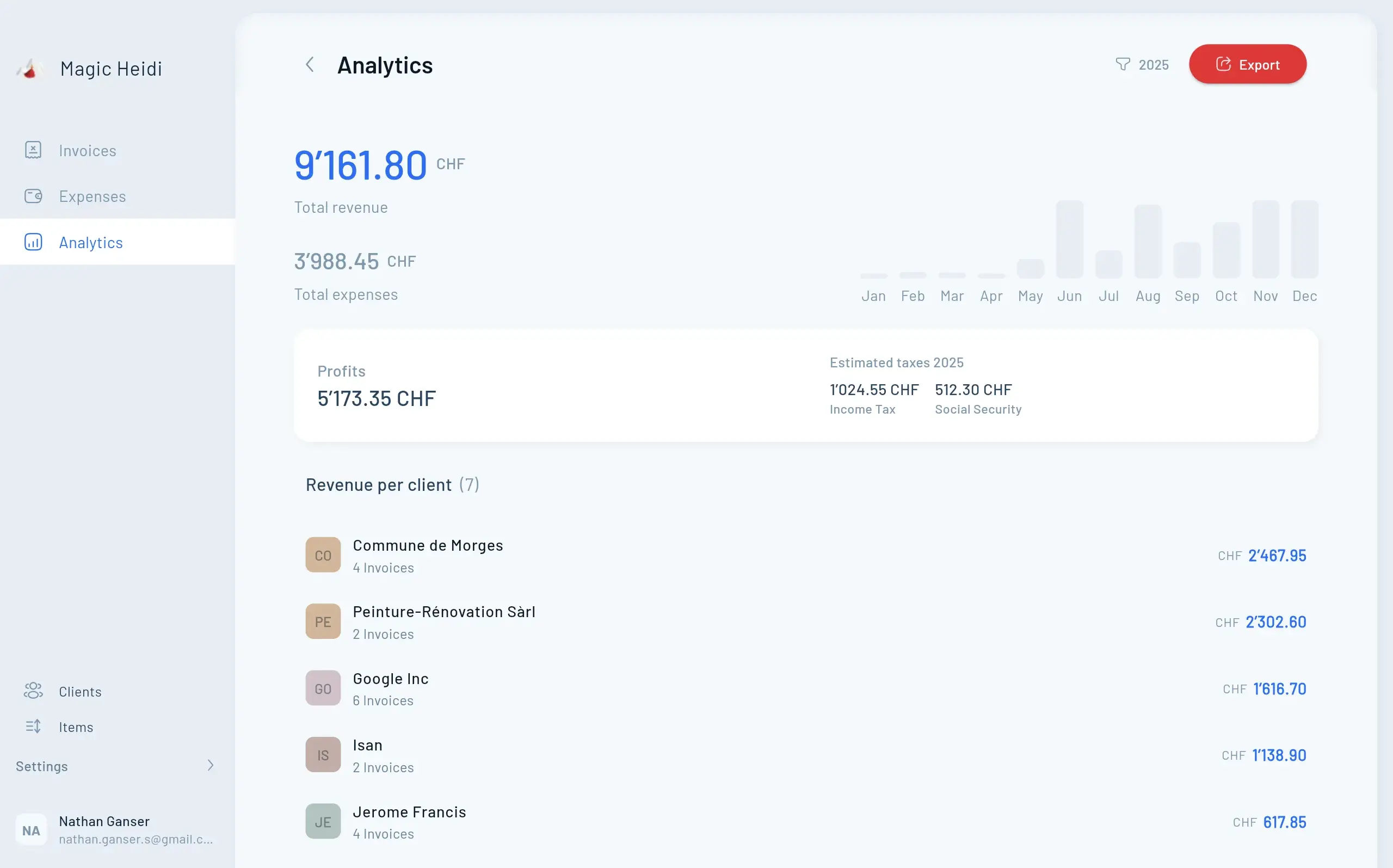
With Magic Heidi, you see open invoices at a glance, create payment reminders in a few clicks and send them by email or as a B Mail letter, with the QR bill if your IBAN is saved. Every send is logged with its date, and recurring invoices go out automatically on schedule.

Frequently Asked Questions
Are payment reminders legally required in Switzerland?
No. Under Swiss law, you can technically initiate debt enforcement (Betreibung / poursuite) immediately after a payment deadline passes. However, a structured reminder process is better for maintaining client relationships and usually resolves most late payments.
What interest rate can I charge on late payments?
Under Art. 104 of the Swiss Code of Obligations, clients owe 5% interest a year from the start of default. Default generally starts with your reminder, or when an agreed fixed due date passes. Higher rates generally require a contractual agreement.
What does Magic Heidi make easier when it comes to payment reminders?
Invoices show their status, open or paid, so you spot overdue ones quickly. You create a payment reminder or formal notice from the open invoice in a few clicks, with the QR bill if your IBAN is saved, and send it by email or as a B Mail letter. Every send is logged with its date. What runs automatically is recurring invoices: monthly, quarterly, yearly, or every 2 or 3 years, switched on per invoice. You decide when to send a reminder.
What payment terms should I use as a Swiss freelancer?
While 30 days is common in Switzerland, freelancers often use 10-14 day terms. Shorter deadlines create urgency and improve cash flow. You can preset default payment terms in Magic Heidi.
What if a client still doesn't pay after all reminders?
If your written reminders don't work, try personal contact first. If that doesn't work, send a formal demand letter via registered mail. As a last resort, you can start debt enforcement proceedings at the competent debt enforcement office (Betreibungsamt / office des poursuites).