 Magic Heidi
 Swiss UID Number: Format, Lookup and How It Works
The Swiss UID number (CHE-123.456.789) explained: format, how it differs from the VAT number, how to look it up and how to get your own.

Founder of Magic Heidi
The Swiss UID number is the unique identifier for every company and follows the format CHE-123.456.789 (UID stands for company identification number). If you're VAT-registered, that exact number with the suffix "MWST" is also your VAT number. One company, two functions, one number.
Sounds simple. In practice, the UID number still causes plenty of confusion. Is the UID the same as the VAT number? Do I even need one as a sole proprietor? Where do I find a client's number, and how do I get my own?
We know these questions because we asked them ourselves when we started out as Swiss freelancers. In this guide we'll clear up the format, the differences from your tax number and commercial register number, how to search the UID register, and the question of when the number belongs on your invoice.
The key points in brief
- The UID always uses the format CHE-123.456.789 and is issued by the Federal Statistical Office.
- The VAT number is the same UID plus the suffix "MWST" (the German-region VAT label; it's "IVA" in Ticino and "TVA" in French-speaking Switzerland).
- You can search the UID register for free on uid.admin.ch, by name or by number.
- You don't apply for the UID separately: you get it automatically as soon as you register your business.
- You only become VAT-liable above CHF 100,000 in annual turnover; below that, you don't need a VAT number on your invoice.
What is the UID number?
The UID (company identification number) is a unique number that identifies every active business in Switzerland. It's issued by the Federal Statistical Office (BFS) and applies nationwide, across all authorities and language regions.
Think of the UID like the AHV number (Swiss social security number) but for companies. It's the central reference that lets authorities, business partners and registers identify you unambiguously. Whether you run a sole proprietorship, a GmbH or an AG, your UID always stays the same, even if you change the company name or move.
The UID was introduced to clean up the old mess of numbers. A company used to have several different numbers for VAT, the commercial register and statistics. Since the UID arrived, there's a single number that bundles all those roles. The old six-digit VAT number was completely replaced by the UID.
Who gets a UID? Essentially every economically active entity: from solo self-employed people to associations to large corporations. As soon as your business is recorded by a relevant body, such as the AHV compensation office, the commercial register or the VAT authority, it lands in the UID register and is assigned the number.
Just starting out as self-employed? Then the guide to setting up a sole proprietorship is the right next step, because the UID comes practically automatically when you register.
The UID format explained: CHE-123.456.789
The UID always uses the same format: CHE followed by nine digits, grouped into three blocks of three. An example: CHE-123.456.789. The "CHE" stands for Switzerland, and the last digit is a check digit that makes typos detectable.
Those nine digits are purely random, with no hidden meaning. So you can't read off the UID when a company was founded or which canton it's based in. That's intentional: the number is meant to be neutral and permanent.
Depending on how it's used, a suffix is added to the UID: "MWST" for VAT (it's "TVA" in French-speaking Switzerland, "IVA" in Ticino) and "HR" for the commercial register entry. The important part: it's always the same number. The suffix only tells you which function it's appearing in.
UID vs. VAT number vs. tax number vs. commercial register number
This is where the most common mix-up happens. The UID, VAT number and commercial register number are essentially the same number in different roles. The big exception is your personal tax number: for income tax, sole proprietors don't use the UID but their AHV insurance number or cantonal tax ID. You'll find all four numbers compared side by side in the table further down.
For more on exactly how VAT works for the self-employed, see our guide to VAT for freelancers. The full picture – from the registration threshold through the rates to filing – is in the Swiss VAT overview.
How do I find a UID number? (UID register)
You can find a company's UID number for free in the official UID register at uid.admin.ch. You search either by company name or directly by the UID, and the register shows you the entry with its status, address and registered functions. The search takes three simple steps, which you'll find as an overview further down.
This search is worth its weight in gold when you're checking an invoice from a new supplier or want to verify a business partner. You can tell at a glance whether the company is real and active.
If you also need legal details such as authorised signatories or the founding date, the Zefix portal (the central company index of the commercial register) is the second place to look. But for a simple UID lookup, the UID register is all you need.
Picture Lara, a fictional web designer from Bern. A new client from Zurich asks her for a substantial upfront commitment before there's even a contract in place. Before she says yes, Lara types the company name into the UID register. Within ten seconds she sees it: the company is active, listed in the commercial register and has been registered for years. That little bit of due diligence costs her nothing and gives her the confidence to take the work.
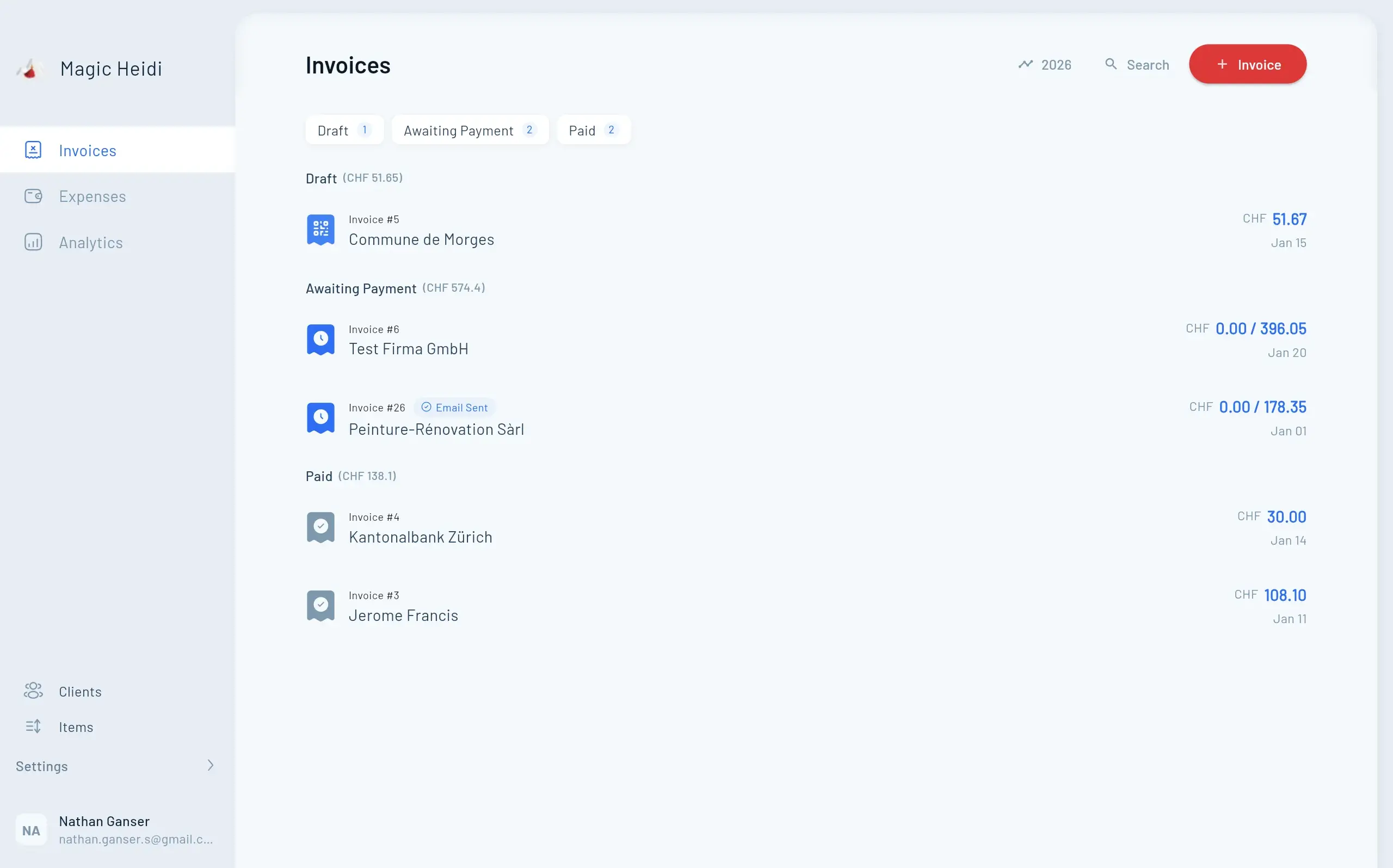
Tip: If you regularly enter client data, you can save yourself the manual typing. With Magic Heidi's customer management, you pull company details straight from the Swiss commercial register instead of entering every address by hand.
How do I get a UID number?
You don't "apply" for the UID separately with its own form. You get it automatically as soon as your business is recorded by an authority for the first time. That usually happens at one of three points, which you can see in the overview below.
Which of these points you reach first depends on your situation. Many solo self-employed people get their UID via the AHV registration, long before VAT or the commercial register are even on the radar.
The VAT function is only added to the UID later, namely when you register for VAT with the Federal Tax Administration (ESTV). From that moment on, you may use your UID with the suffix "MWST".
Take Marco, a fictional IT consultant from Lugano. He registers as self-employed with the compensation office and receives his UID in the process. Only two years later does he cross the CHF 100,000 turnover threshold, register for VAT and add the suffix "IVA" to his existing UID from then on. He never needs a new number: it's the same UID from the very start.
UID number for sole proprietorships and the self-employed
A question we hear often: "Do I even need a UID as a small sole proprietorship?" The honest answer: you get one as soon as you're officially registered as self-employed, with no extra effort at all.
As long as you only write the odd invoice and aren't yet recognised as self-employed by the AHV, you usually don't have a UID yet, and that's completely fine. An invoice is valid without a UID too. The number only becomes relevant once you officially go self-employed or become VAT-liable.
A private individual with no business activity has no UID. Don't confuse this with the personal AHV number that everyone resident in Switzerland has. The UID is strictly for businesses.
Checking and validating a UID number
You check a UID by looking it up in the UID register and reviewing its status. If the company name matches the number and the entry is "active", the UID is valid. The built-in check digit also catches simple typos.
Why bother? Mainly for two reasons. First, input VAT deduction: if you want to claim input VAT from a supplier's invoice, the supplier's VAT number should be correct and active. Second, the legitimacy check: a quick UID lookup shows you whether a new business partner really is a registered company.
Foreign clients are a special case. Switzerland isn't part of the EU VAT system, so a Swiss UID doesn't appear in the European VIES database. That means if you invoice EU clients, you don't need to put an EU VAT number on your Swiss invoice. Which details make sense in that case depends on the specific service; when in doubt, a quick check with your accountant is worth it.
The VAT number on your invoice
As soon as you're VAT-liable, your VAT number (i.e. the UID with the suffix "MWST") belongs on every invoice. It's mandatory, and at the same time a signal of trust: clients see that you run a properly registered business.
If you're not yet VAT-liable, you may not charge VAT and may not put a VAT number on the invoice. You simply state the invoice amount without VAT. That's the common case for freelancers below the CHF 100,000 turnover threshold.
A correct Swiss invoice, when you're VAT-liable, includes your VAT number in the format CHE-123.456.789 MWST, the VAT rate applied (as of 2026: 8.1%, 2.6% or 3.8%), the clearly stated VAT amount, plus your name and address and those of your client.
Think of Sophie, a fictional photographer from Lausanne. For a long time she built her invoices in Word and, after registering for VAT, typed in the number and tax rate by hand every time. On one invoice she forgot the "TVA" suffix; on another she got the rate wrong. Since she stored her number centrally just once, that no longer happens: the format and the calculation are correct automatically.
How the UID fits into your accounting
The UID is more than a mandatory line on the invoice. It's the thread that ties your business records together: outgoing invoices, supplier invoices with input VAT, and the VAT return to the ESTV.
For most solo self-employed people, simple, tidy bookkeeping is perfectly enough. You don't have to keep double-entry accounts as long as you stay below the relevant thresholds. The only thing that matters is that your receipts and numbers are correct and findable. We show what a lean solution for the self-employed looks like on our page about accounting software for the self-employed.
Conclusion: one number, many roles
The Swiss UID number seems more complicated than it is. If you remember one thing, make it this: it's always the same number in the format CHE-123.456.789, and the suffix ("MWST", "TVA", "IVA" or "HR") only tells you which role it's playing at the moment. You'll find the key points summarised once more below.
The practical next step: store your VAT number in your invoicing software once, and it'll appear correctly on every invoice automatically, so you never have to remember the format again.
This article offers general orientation, not tax or legal advice. For your specific situation, when in doubt it's worth a quick check with your accountant or directly with the ESTV.