 Magic Heidi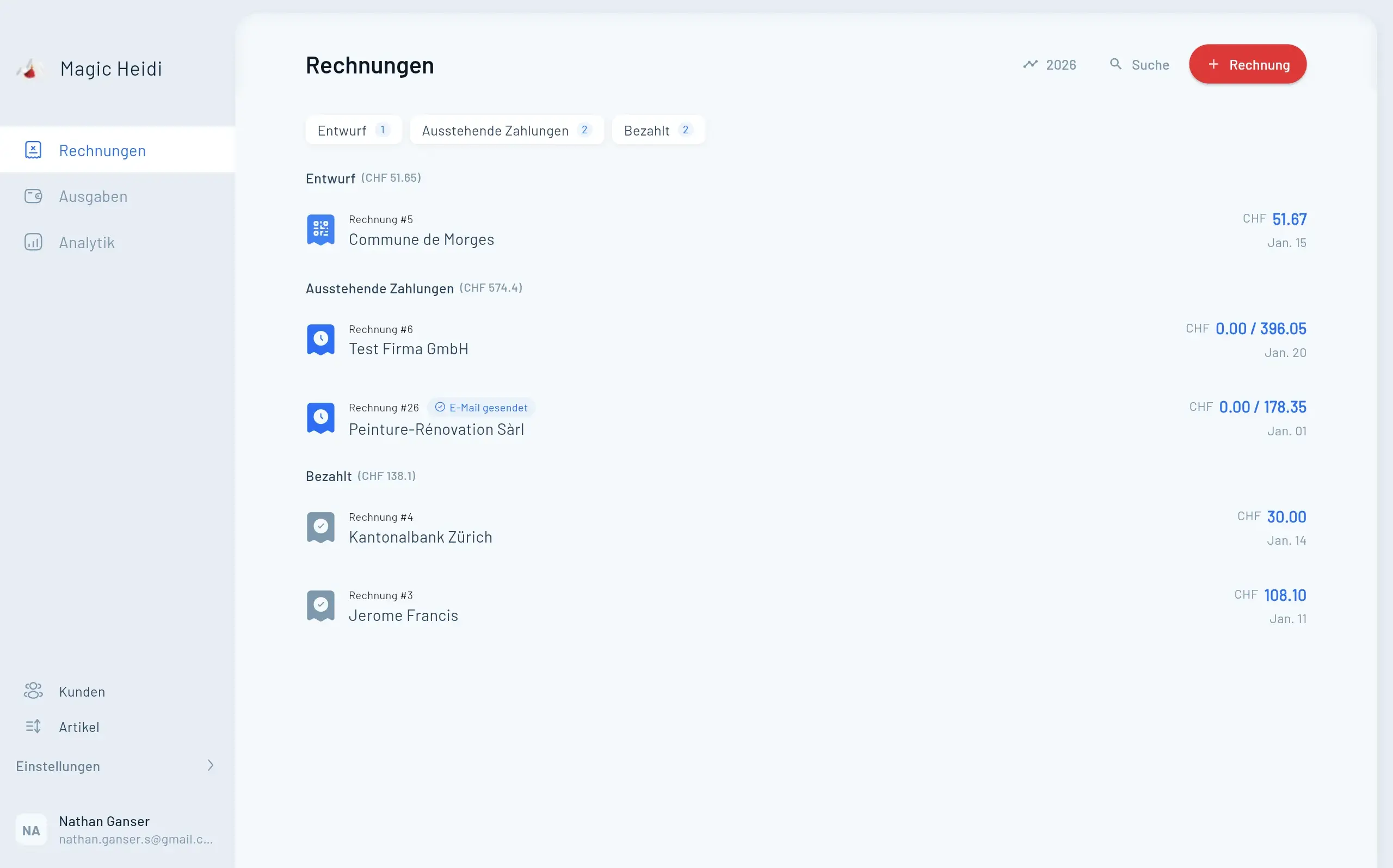
What a Treuhänder Does: Switzerland 2026
What does a Treuhänder do? All tasks explained: bookkeeping, MWST, taxes, annual closing. Plus what they cost and when you need one. Read the guide now.

Founder of Magic Heidi
Magic Heidi creates QR-bills and quotes, records expenses and tracks payments. Explore the invoicing software. Magic Heidi Free includes 3 invoices and 3 expenses. Pro costs CHF 24.99 a month billed annually (CHF 299.00 a year), or CHF 39.00 billed monthly. See pricing.
Key takeaways For consistent invoice details and records, use the Swiss invoice template or bookkeeping software. Hypothetical example: amounts illustrate the calculation only. They do not describe a real customer or a guaranteed outcome.
Key takeaways
“Treuhänder” is not a protected title in Switzerland. Check the actual qualifications, experience and references.
Key takeaways
Fees, surcharges and payment terms are negotiated. Obtain a quote for your situation; example amounts are not market data.
A bookkeeping obligation does not itself require hiring a fiduciary. Under Article 957 CO, qualifying sole proprietorships below CHF 500'000 use simplified records; larger businesses and legal entities have broader accounting duties. Magic Heidi does not provide double-entry bookkeeping.
The essentials at a glance
- Fees, surcharges and payment terms are negotiated. Obtain a quote for your situation; example amounts are not market data.
- Monthly care for a sole proprietorship: around CHF 200.00–500 a month for bookkeeping and MWST.
- Annual closing, sole proprietorship: CHF 800.00–1,500; for a GmbH/AG CHF 1'500.00–3,000.
- Tax return for the self-employed: CHF 400.00–1,000 once a year.
- Magic Heidi creates QR-bills and quotes, records expenses and tracks payments. Explore the invoicing software. Magic Heidi Free includes 3 invoices and 3 expenses. Pro costs CHF 24.99 a month billed annually (CHF 299.00 a year), or CHF 39.00 billed monthly. See pricing.
What is Treuhand — and what does a Treuhänder do?
If you hear the term for the first time, you often ask: what is Treuhand anyway? Treuhand literally means "trust administration." A Treuhänder manages — on behalf of and in the trust of a client — money, receipts and documents the client doesn't want to, or can't efficiently, handle themselves. In the Swiss context, a Treuhänder is usually a licensed accounting and tax professional who takes care of financial administration for businesses, foundations and private individuals.
What does a Treuhänder do in day-to-day practice? Their core tasks cover bookkeeping, MWST accounting, payroll, annual closing, tax returns and strategic advice. So they're not simply a "bookkeeper" but a mix of financial manager, tax adviser and compliance partner. The legal basis for the bookkeeping obligation a Treuhänder fulfills is Art. 957 OR on admin.ch — it states that every business must keep books, and small businesses get a simplified form under Art. 957a OR.
If you want to dig deeper into what belongs to bookkeeping, the article bookkeeping for beginners is worth a read — it explains the foundations every Treuhänder builds on.
What a Treuhänder does: the 7 core tasks
The question what does a Treuhänder do is best answered through their core tasks. In practice, a fiduciary covers these seven areas:
1. Bookkeeping and record management
The Treuhänder records your income and expenses, assigns each to the right account in the chart of accounts (usually the Swiss KMU Kontenrahmen) and archives receipts for the required retention period. Clean books are the basis for everything — from the MWST return to the annual closing. A proper Treuhänder makes sure your records survive a tax audit.
2. MWST accounting
Every MWST-liable company must report input and output MWST to the ESTV on a regular basis — normally quarterly. The Treuhänder checks the invoices, secures the input tax deduction and files the return on time. Do it yourself and make a mistake, and you risk back-payments and fines — a classic case where the Treuhänder pays for themselves quickly. More on how MWST works as a freelancer is on our MWST page for freelancers.
3. Annual closing
At the end of the financial year comes the closing: for a sole proprietorship it's an income statement and balance sheet (or simply a revenue-expense record), for a GmbH or AG the full annual closing with notes. The Treuhänder prepares the documents, files them with the commercial register and the tax authorities. A step-by-step overview is in the post annual closing checklist.
4. Tax return for the self-employed and individuals
The Treuhänder fills in the tax return — for the sole proprietorship the "self-employed" form, for private individuals the main form. They use every legal deduction, avoid gaps in your evidence and communicate with the tax authority. What you need to prepare for that is explained in the guide tax return documents Switzerland.
5. Payroll and AHV
As soon as you have employees, the Treuhänder takes over payroll: salary slips, withholding tax, BVG, the family compensation fund and above all the contributions to the AHV compensation fund (the Swiss old-age insurance). It's an area where mistakes get expensive fast — for both the employer and the employee.
6. Company formation and register changes
Anyone forming a GmbH or AG needs a Treuhänder — at the latest for the opening balance sheet. They also handle the formalities with the commercial register for changes to the articles, capital increases or partner changes.
7. Advice and planning
Beyond the repetitive tasks, the Treuhänder advises on questions like: does a change of legal form pay off? Should we set up a holding? How do we optimise the tax burden on investments? This strategic layer is an essential part of what a Treuhänder delivers beyond pure number-keeping.
What does a Treuhänder cost in Switzerland?
Treuhänder costs depend on three factors: type of mandate, revenue size and region. Here are the realistic ranges in Switzerland:
Fees, surcharges and payment terms are negotiated. Obtain a quote for your situation; example amounts are not market data.
Budget around CHF 2'000.00–4,000 a year for the complete package (bookkeeping, MWST, closing, tax return) for a small sole proprietorship with CHF 60'000.00–150,000 in revenue, MWST-liable, no staff. Rates trend higher in urban cantons like Zurich or Geneva, and a touch lower in rural regions.
Fees, surcharges and payment terms are negotiated. Obtain a quote for your situation; example amounts are not market data.
When do you actually need a Treuhänder?
Not every business needs a fiduciary — but in three situations it's your turn:
1. GmbH, AG or other corporations. These legal forms need double-entry bookkeeping and a proper annual closing signed by the board. Here a Treuhänder is practically indispensable.
2. Sole proprietorship above CHF 500'000.00 in revenue. Under OR Art. 957, small businesses get simplified bookkeeping; from CHF 500'000.00 in annual revenue, the duty to keep double-entry books kicks in. At that point a Treuhänder makes economic sense, because the complexity of the books outgrows a skilled layperson.
3. Complex situations. Foreign clients, withholding tax, multiple partners, real estate, staff — the more variables, the more a professional pays off. A Treuhänder is also worth their weight in gold during an ongoing tax audit.
Magic Heidi creates QR-bills and quotes, records expenses and tracks payments. Explore the invoicing software. Magic Heidi Free includes 3 invoices and 3 expenses. Pro costs CHF 24.99 a month billed annually (CHF 299.00 a year), or CHF 39.00 billed monthly. See pricing.
Treuhänder vs. Magic Heidi: who does what
Many self-employed people think they have to choose between a Treuhänder and software. That's only partly true — the two play in different leagues. Here's an honest comparison:
What the Treuhänder does and software can't:
- Signs the annual closing and represents you with the commercial register.
- Files the tax return with a professional signature and represents you with the tax authority.
- Advises on legal-form questions, holding structures, complex tax topics.
- Handles payroll including AHV reporting, legally sound.
- Reviews and corrects tricky bookings, e.g. withholding tax or cross-border status.
What Magic Heidi does better and faster:
- Create invoices with a correct QR-Rechnung in seconds — with the invoicing software from Magic Heidi.
- Calculate MWST automatically, show 8.1% correctly and prepare quarterly figures.
- Bookkeeping without chart-of-accounts knowledge: you photograph the receipt, the software books it.
- Magic Heidi Free includes 3 invoices and 3 expenses. Pro costs CHF 24.99 a month billed annually (CHF 299.00 a year), or CHF 39.00 billed monthly. See pricing.
- A quick overview of open invoices, reminders and incoming payments.
The honest recommendation: with a simple sole proprietorship and clear transactions, you handle the operational work yourself with Magic Heidi and bring the Treuhänder in only for the closing and tax return. If you run a GmbH, have staff or are growing fast, it's better to hand the whole financial administration to a fiduciary.
If you want to move on from a pricier all-in-one solution, the bexio alternative page has a detailed comparison.
When software (partly) replaces the Treuhänder
For the self-employed with a simple structure, software isn't an "either/or" with the Treuhänder but often a better split. Three concrete scenarios:
Scenario A — the sole proprietorship under CHF 100'000.00. Whether you're MWST-liable or not, you deliver a clear service and have few receipts a month. Here software is plenty: invoicing, revenue-expense record, MWST calculation — all digital. The annual closing and tax return go to a Treuhänder who gets the finished evaluations. Software cost: CHF 300.00–468 a year, plus CHF 800.00–1,000 for the closing and tax return. Total: around CHF 1'200.00–1,500 a year instead of CHF 3'000.00+ for full care.
Scenario B — the growing sole proprietorship between CHF 100'000.00 and CHF 500'000.00. Bookkeeping gets more complex here, and the MWST return more error-prone. Software still handles the operational layer, but it pays to bring a Treuhänder in at least for quarterly checks and advice. That catches errors early — instead of only in the annual closing.
So software doesn't fully replace the Treuhänder, but it takes the recurring operational work off both of you. What remains is the strategic part: advice, closing, representation. And that's exactly where the Treuhänder is indispensable — when you need them.
How to find the right Treuhänder
If you decide on a fiduciary, take your time choosing. Three criteria separate good from mediocre Treuhänders:
1. Qualification and licensing. A serious Treuhänder holds a recognised credential: Treuhänder with Swiss federal certificate (eidgenössischer Fachausweis), diplomed expert in accounting and controlling, or a comparable title. Ask directly about their training and references from your sector.
2. Sector experience. A Treuhänder who mainly serves construction firms knows the MWST details of the trades but maybe not the subtleties of an agency with international clients. Pick someone who knows your sector and your typical bookings — it saves hours and avoids errors.
3. Digital vs. traditional. Some Treuhänders still work with paper orders and Excel lists, others are fully digital — receipts via app, real-time booking, access through an online portal. A digital fiduciary fits better with a tool like Magic Heidi, because you can hand over the evaluations easily. Ask explicitly which tools the fiduciary uses and what collaboration looks like in practice.
4. Transparent costs. Ask for a quote with a flat price for the recurring services (bookkeeping, MWST, closing) and clear hourly rates for advisory mandates. Anyone who only bills "by effort" without an estimate is a warning sign.
5. Reachability and language. You want someone who reacts fast when you have a question or a tax audit. Check which language the fiduciary normally works in and how quickly they usually reply.
Get two to three quotes and compare not just the price but what's included. The cheapest Treuhänder is rarely the cheapest once hidden services get added later.
Frequently asked questions (FAQ)
What exactly does a Treuhänder do?
A Treuhänder runs the bookkeeping, prepares the MWST returns, files the tax return and produces the annual closing. Depending on the mandate they also handle payroll, company formations and strategic advice. In short: they're the financial and tax confidant of a business.
How much does a Treuhänder cost in Switzerland?
Fees, surcharges and payment terms are negotiated. Obtain a quote for your situation; example amounts are not market data.
Do I need a Treuhänder as a sole proprietor?
Not necessarily. A sole proprietorship may keep its own books as long as revenue stays under CHF 500'000.00 (simplified bookkeeping under OR Art. 957). From CHF 500'000.00 double-entry bookkeeping becomes mandatory and a Treuhänder makes economic sense. Professional help for the annual closing and tax return is still recommended below that threshold.
What's the difference between a Treuhänder and a bookkeeper?
“Treuhänder” is not a protected title in Switzerland. Check the actual qualifications, experience and references.
Can I do my bookkeeping myself?
Magic Heidi creates QR-bills and quotes, records expenses and tracks payments. Explore the invoicing software. Magic Heidi Free includes 3 invoices and 3 expenses. Pro costs CHF 24.99 a month billed annually (CHF 299.00 a year), or CHF 39.00 billed monthly. See pricing.
Conclusion: Treuhänder yes or no — and when software is enough
That's exactly where Magic Heidi comes in: invoices with QR-Rechnung in seconds, MWST calculated correctly and automatically, bookkeeping without chart-of-accounts knowledge — all in a mobile app for CHF 24.99 a month. Try Magic Heidi for free and find out in a few minutes how much of your bookkeeping you can confidently handle yourself. After that, you only need the Treuhänder for what they really do best.