 Magic Heidi
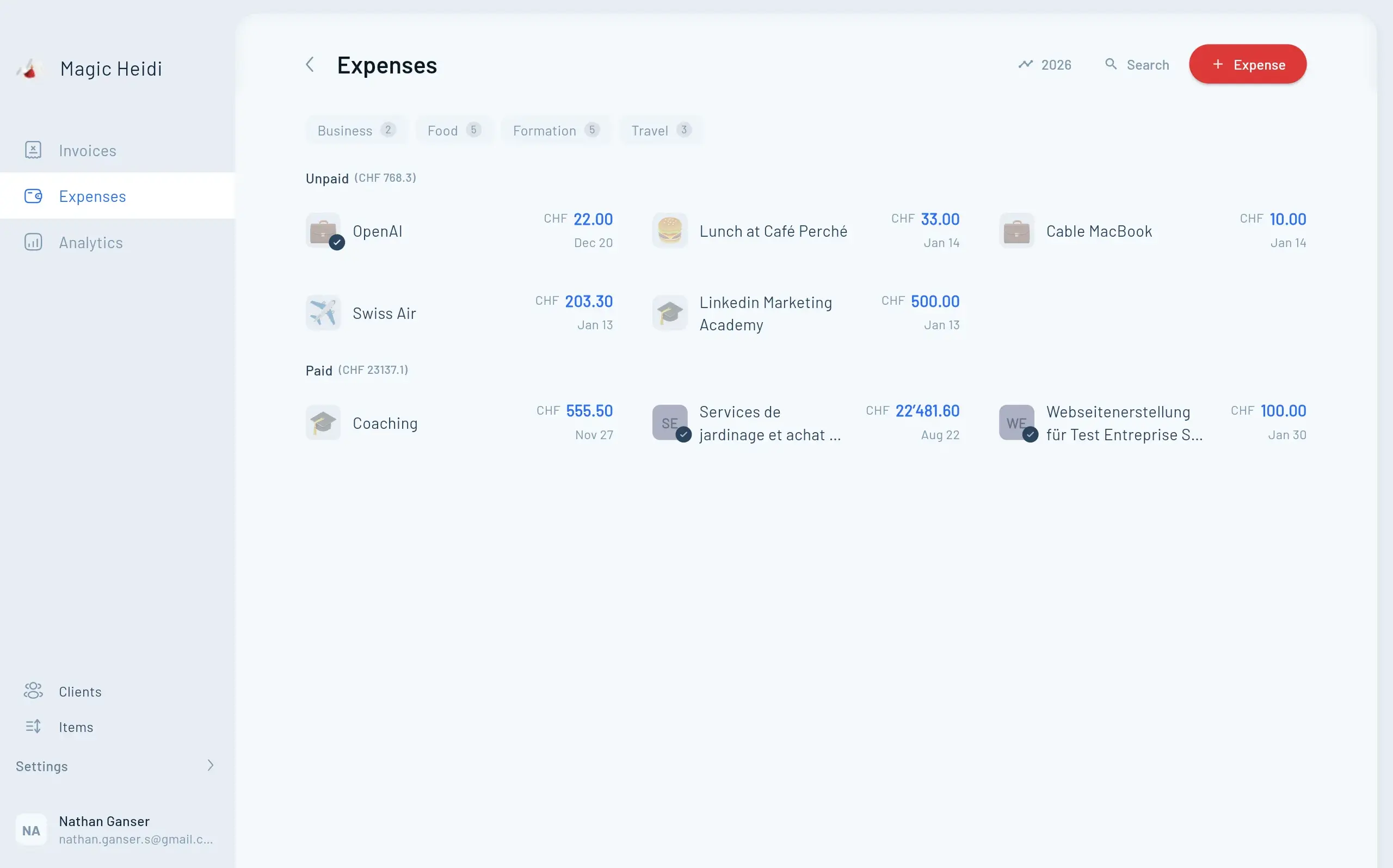
Swiss Expense Reports: Guide and Template
Record receipts, purpose and mileage. Distinguish your own expense recharges from true disbursements and agree customer reimbursement terms.

Founder of Magic Heidi
An expense report organizes business expenses by date, purpose, receipt and amount. Separate on-billing to customers from employer reimbursements and your own tax deductions. For VAT-registered companies, their own costs that are passed on are generally part of the remuneration; as ancillary service they follow the main service. 8.1% does not automatically apply to every expense (Art. 24 VAT Act).
In this guide I will show you which expenses should be included in the billing, how to calculate the mileage allowance correctly and how the VAT treatment works for further billing. With a template to copy, real CHF amounts, three practical examples – and without bureaucratic overkill.
What an expense report is – and who needs it
An expense report is the ordered list of all expenses that arise in connection with an order or your self-employment: travel, overnight stays, meals, small materials, postage, software licences. Each item has a date, a description, a receipt reference and a CHF amount. The document itself is informal - what is crucial is that a third party can understand every position: your customer, your accounting, the FTA.
But informal does not mean arbitrary. Anyone who passes on expenses to customers attaches the billing to an invoice - and this requires the usual invoice information; if VAT is required, the information according to Art. 26 VAT Act. Anyone who claims expenses as business costs must be able to provide evidence of them to the tax authorities. In both cases, the expense report is the link between expenditure and billing.
Case 1: You pass on expenses to customers
You are traveling for a customer: train travel, hotel nights, a business lunch with their team. These costs do not belong to you - they belong to the invoice. To do this, you need two things: an expense report as a documented basis and a clear agreement as to what you will charge for and at what rates.
Ideally, you should regulate this in the offer or in a short expense regulation before the first order. Three questions are enough:
- Travel: agree the customer rate, for example CHF 0.70/km, or actual ticket costs. The customer rate is not a general tax tariff.
- Accommodation and meals: Effective price with receipt - or a daily flat rate?
- Surcharge: Do you add expenses to the cost price or with a surcharge?
Half an A4 sheet with these three answers almost prevents any later discussion. The guide Write a fee invoice shows how such expenses are incorporated into a professional invoice - including all mandatory information according to Art. 26 VAT Act.
And: bill promptly. The usual approach is monthly or per project - if you accumulate expenses over months, you lose receipts and an overview. In addition, your customer's willingness to uncritically accept three-month-old taxi receipts decreases. Freshly billed expenses are practically always undisputed.
Fictional example: Priska, graphic designer in Bern. Priska looks after a customer in Zurich and was there for three days in September. Your expense report: 3× Train return 2. Class at CHF 102.00 = CHF 306.00, 2 Hotel nights at CHF 145.00 = CHF 290.00, meals with receipts CHF 96.50, taxi and parking CHF 42.00. Total CHF 734.50 net. Because Priska passes on the expenses as an ancillary service to her graphics fee, she reports 8.1% VAT: CHF 59.49, final total CHF 793.99. The customer pays without a single query - every item has a receipt, every number has a source.
Case 2: You provide evidence of expenses to the tax authority or employer
The second case has nothing to do with further billing: you document your own business costs. As a self-employed professional, you deduct expenses as professional expenses - and the tax authorities require the same discipline as your customer: date, business purpose, receipt. The same expense report works twice: as the basis for your invoice to the customer and as proof for the tax authorities.
You can read about everything you can deduct - from travel expenses to work rooms to business vehicles - in the guide to business vehicle expenses and in the overview of all tax deductions for the self-employed. We'll look at the VAT basics in detail below.
These expenses belong in - categories and guidelines
Not every expense is an expense, and you are not allowed to charge every expense indefinitely. These six categories cover the everyday life of most freelancers and small businesses:
| category | What belongs in it? | Guideline value (indication) |
|---|---|---|
| Public rides | Train, bus, tram, flight (usual: 2. Class) | Effective amount with ticket as receipt |
| Private car rides | Business kilometres with trip journal | Rate agreed with the customer; Example CHF 0.70/km, no official standard tariff |
| Food | Business lunch, meals away | Agree customer price; assess tax deductions and employer rules separately, with no universal flat rate |
| Overnight stay | Hotel including breakfast | Effective amount with receipt; in Swiss cities usually CHF 120.00–200.00/night |
| Parking & Taxi | Parking garage, parking metre, taxi rides | Effective amount with receipt |
| Work equipment | Specialist literature, software, small materials, postage | Cost price with invoice receipt |
| Telecom & Internet | Business portion of subscription and connection | Document actual use; recharge only under the customer agreement |
On the mileage rate: CHF 0.70/km is just a freely chosen calculation example. Agree the rate with the customer and record distance and business purpose. For employer reimbursements and your own tax deductions, however, check the current regulations or the rules for the tax year and canton. A customer price does not have to correspond to a tax deduction rate.
The Receipt Rule: Record actual costs with an invoice or receipt and the business purpose. You document a contractually agreed kilometre allowance with the date, route and kilometres. A higher customer rate is not automatically prohibited just because a tax rule specifies a different rate. Tax recognition must be checked separately.
Cost price or surcharge? The most common and least discussed variant is charging at the cost price: What it cost you costs the customer. A surcharge – for example 10% for recording and administration – is possible, but must be included in the expense regulations. Anyone who silently includes surcharges risks losing trust in the entire billing the next time the invoice is audited.
Telecom and work equipment: Determine the business share based on actual use and document the division. A general standard deduction of 30–50% is not guaranteed here. Your customer agreement also determines whether a project-related expense can be passed on.
Recalculate expenses: treat VAT correctly
The question that is most often answered incorrectly when recalculating: Is the expense markup taxable or not? The answer depends on on whose behalf you are making the expense.
Fictional example: Case A: Passing on your own costs. According to Art. 24 Paragraph 1 VAT Act, reimbursement of costs is also generally part of the remuneration. If it is an ancillary service to a taxable Swiss service at the standard rate and you are registered, 8.1% applies in the calculation example. If the main service or location is different, the treatment must be checked separately. Priska's figures above explicitly assume a taxable base of CHF 734.50 net; An input tax deduction from included supplier taxes must be agreed separately.
Case B: Genuine disbursements. Only separately disclosed expenses incurred in the customer's name and on their account fall outside your tax base under Art. 24(6)(b) VAT Act. Document representation and the original receipt. A register extract ordered in the customer's name and on their account may be a disbursement. Your own purchases and recharges need separate assessment by main service, place of supply and registration: not always the supplier's rate and not always 8.1%. Ask your fiduciary if the distinction is unclear.
Distinguish advance payments. VAT on received advances for taxable services generally arises on receipt (Art. 40(1)(c) VAT Act). First clarify registration, service classification and genuine disbursements. Reconcile already invoiced and paid advances with the final invoice.
Once again a note so that this guide remains slim: threshold value of CHF 100,000.00, voluntary registration, billing with the FTA - these basics are detailed in the article on VAT for Freelancers. You can find the legal texts in full at admin.ch.
The template: your expense report for copying
Fictional template assuming an expressly agreed net recharge of your own costs as an ancillary service to a taxable domestic service at the standard rate, by a registered provider. These are not general tax deduction rates; assess input VAT on supplier receipts separately.
Expense report no. 2026-S-007
From: [your name/company], [address]
For: [customer name], [address]
Project: [project or order]
Period: 1.–30. September 2026

Item Date Description Document Amount CHF
1 02.09.2026 Train Bern–Zurich back, 2. Class B-101 102.00
2 02.09.2026 Lunch customer visit, occupied B-102 48.50
3 02.09.2026 Parking garage station B-103 28.00
4 03.09.2026 Hotel, 1 Night incl. breakfast B-104 145.00
5 03.09.2026 Taxi to customer location B-105 23.50
6 05.09.2026 Private car, 24 km at CHF 0.70 Journal 16.80
7 05.09.2026 Specialist literature for project B-106 89.90

Subtotal expenses net CHF 453.70
VAT 8.1% (Arts. 19 and 24 VAT Act) CHF 36.75
Total CHF 490.45

Receipts will be provided upon request.
Position 6: Flat rate per kilometre (guide value, trip journal is included).
Four notes on the template:
- Adjust the VAT line: only without liability and effective registration should you omit VAT. Identify genuine disbursements separately. Your own costs do not become disbursements merely because you are unregistered.
- Document numbers assigned without gaps: B-101, B-102, B-103 - so each position finds its receipt, and you can find it 10 years later.
- Agree flat rates: document rate, distance and purpose. The label “guide value” replaces neither the customer agreement nor tax evidence.
- As an attachment to the invoice: The expense report is the detailed list; The invoice itself requires the usual invoice information; if VAT is required, that according to Art. 26 VAT Act. Magic Heidi's free invoice template relieves you of this mandatory information.
Digital expense reports instead of paperwork
Do you know that? Receipts in my jacket pocket, a “chaos” folder in my cell phone, a piece of paper in the car that has become recycled. At the end of the month, a third of the receipts are missing and the expense report becomes detective work. This doesn't just cost time - it costs real money because unbilled expenses are simply gone.
Capture receipts promptly, for example with a receipt photo. Check extracted amounts, dates and VAT against the original. Review the business share, category and project reference yourself; automatic correct project assignment is not promised.
Fictional workflow: Marco, IT freelancer in Lucerne. He photographs each receipt, checks the extracted data and adds business purpose and project reference himself. Each month he reconciles receipts with the bank and customer billing. This describes a workflow, not measured time or money saved by software.
Digital retention must preserve legibility, integrity, retrievability and necessary evidence for the statutory period. Check exports, backups and access after cancellation. Automatic ten-year provider retention is not guaranteed here.
Four mistakes that make your expense report expensive
1. Mix private and business. The classic – and the most expensive. As soon as private expenses end up on the expense report, you not only lose the deduction for this item: you lose credibility for the entire statement.
Mini-story (fictional example): Lena, hairdresser in Basel. Lena runs her salon as a sole proprietorship and has paid for her customer coffees on the same card as her Sunday brunches. Both ended up on the expense report – around CHF 640.00 private café visits per year. This was discovered during the tax inspection: a reduced deduction, additional tax and late-payment interest, plus an unpleasant conversation. Since then, Lena has had a simple system: business purchases always with the company card, private purchases with the private card. Two cards, zero gray area.
2. Confuse customer price and tax deduction. Agree on reimbursement of car costs with customer. An example rate of CHF 0.70/km is neither a general legal upper limit nor automatically the correct value for your tax return. Keep a record of business journeys; Check tax flat rates by year, canton and regulations.
3. Receipts are missing or unreadable. A faded thermal receipt from the checkout area does not count, nor does a photo in the “later” folder on your cell phone. Capture receipts promptly, then ensure they remain legible, complete, protected against untraceable changes and retrievable for the applicable retention period. Digital capture alone does not prove that the archive meets the ten-year requirement.
4. Alcoholic drinks at business meals. A glass of wine with a customer lunch is business-related. Half the wine list, on the other hand, is not: Rich alcoholic beverages are a classic point of reduction when it comes to further calculations and tax deductions - they do not appear to be necessary for business, but rather as a private pleasure. Stay moderate or make up the difference yourself.
Frequently asked questions about expense reports
What belongs in an expense report?
Date, description, receipt reference and CHF amount for each item. Typical categories: trips (public or private car with a mileage allowance), accommodation, meals, parking, work equipment and the business telecom portion. Only expenses incurred for business reasons - and each item must be able to be understood by a third party without your help.
How much mileage allowance can I charge?
Agree the customer reimbursement rate contractually. CHF 0.70/km is just a calculation example here, not a general official tariff. Different rules apply to employer reimbursement and tax deductions; Check the year, canton and regulations and keep a trip journal.
Do I have to declare VAT on expenses that are passed on?
When registering, your your own recharged expenses are generally included in the fee; As an ancillary service, they follow the main service in terms of rate and place of supply. This is not always 8.1%. Only separately stated expenses in the name and on behalf of the customer remain outside the tax base as true disbursements.
Are flat rates allowed without receipts?
Distinguish between customer agreements, employer regulations and tax recognition. An agreed kilometre allowance requires a clear journey journal. For other flat rates and tax deductions, check the applicable rules; a universal maximum rate is not specified here.
What is the difference between expense reporting and travel expense reporting?
Travel costs are the subset: expenses that arise on a business trip - travel, accommodation, meals outside. The expense report covers all business expenses, including work equipment, postage or telecommunications that are not travel-related. Anyone who passes on bills to customers as a freelancer uses the expense report as a higher-level document; Travel expense reporting in the narrower sense is particularly common in salaried employment - there with the employer's forms.
Conclusion: Expenses are your money – bill them properly
The fictional example shows CHF 734.50 of agreed net recharges. Whether you can charge costs to the customer follows from the engagement. Assess tax treatment under Arts. 19 and 24 VAT Act, invoice information under Art. 26, and retention requirements separately. Customer prices, employer reimbursements and your own tax deductions are not the same thing.
Sources: Arts. 19, 24 and 26 VAT Act; Art. 958f OR and GeBüV on retention. All example amounts are fictional calculation assumptions; assess tax year, canton and regulations separately.