VAT Registration in St.Gallen: cantonal offices and eastern-Switzerland practice

What self-employed people in canton St.Gallen actually have to do: get recognised by SVA St.Gallen, register with the Handelsregisteramt St.Gallen — and invoice clients in Liechtenstein, Vorarlberg and southern Germany correctly.

Swiss Business Office in St.Gallen

Swiss VAT is a federal tax. You always register with the Federal Tax Administration (FTA) in Bern, never with the cantonal tax office in St.Gallen. The complete national procedure — threshold, form, processing time, receiving your number — is covered in the VAT registration guide.

This page adds what is genuinely different in canton St.Gallen: which cantonal offices you need first, and how to handle the cross-border situations that St.Gallen freelancers run into constantly — clients in Liechtenstein, in Vorarlberg, and in southern Germany.

Cantonal offices

Your offices in canton St.Gallen

The VAT registration itself goes through the FTA. But what you do beforehand in canton St.Gallen decides whether your FTA application clears on the first attempt.

SVA St.Gallen

The cantonal social insurance office recognises your status as self-employed. Without it, the FTA has no proof that you work on your own account. Allow several weeks and apply before your VAT application.

Handelsregisteramt St.Gallen

Registering your sole proprietorship becomes mandatory above CHF 100,000 in turnover — exactly the threshold that also triggers VAT. In St.Gallen the two steps almost always happen together. The entry gives you your UID.

Cantonal tax office St.Gallen

Responsible for your income and wealth tax, not for VAT. Questions about VAT returns are answered only by the FTA — a common misunderstanding among new St.Gallen businesses.

Startnetzwerk & IHK St.Gallen-Appenzell

Cantonal advisory bodies for founders in St.Gallen, Rorschach, Wil and the Rhine Valley — useful if you want to settle your revenue forecast and legal form before registering.

The 30-Day Rule You Can't Ignore

Many freelancers miss this crucial detail: you must inform the FTA within 30 days of when exceeding the threshold becomes foreseeable. This doesn't mean after you've hit CHF 100,000—it means as soon as you can reasonably predict you'll reach it.

Missing this deadline can result in:

  • Backdated VAT liability (you may owe VAT retroactively)
  • Interest charges on unpaid amounts
  • Potential penalties for non-compliance
  • Requirement to register anyway, with added complications

The good news? Once you notify the FTA, your VAT liability doesn't start retroactively—it begins from the date you inform them.

Which rate applies to St.Gallen work?

The rates are identical nationwide — what matters is what you sell. Consulting, design and trades billed out of canton St.Gallen almost always run at the standard rate; the special rate covers accommodation, for instance in Toggenburg or on Lake Constance.

📝 MWST (German)
🇫🇷 TVA (French)
🇮🇹 IVA (Italian)
⚠️ Never 'VAT'
📊
Standard Rate: 8.1%

Applies to most services freelancers provide—consulting, design, development, marketing

🍎
Reduced Rate: 2.6%

Food, books, medicines, newspapers

🏨
Accommodation Rate: 3.8%

Hotels and lodging services

🇨🇭
Always Use MWST/TVA/IVA

Never use 'VAT' on Swiss documents—use the correct local term

Voluntary Registration

Should You Register Voluntarily?

Not quite at CHF 100,000 yet? You can still register voluntarily, and there are solid reasons to consider it.

Benefits

Why Register Before CHF 100,000

Voluntary registration can provide strategic advantages for growing freelancers

  • Professional credibility: A MWST number signals you run a legitimate, established business
  • Input VAT deduction: Reclaim VAT on business expenses—office supplies, equipment, software, professional services
  • Competitive positioning: Some clients specifically seek VAT-registered freelancers
  • Cash savings: For businesses with significant expenses, deductions can add up to thousands of francs annually
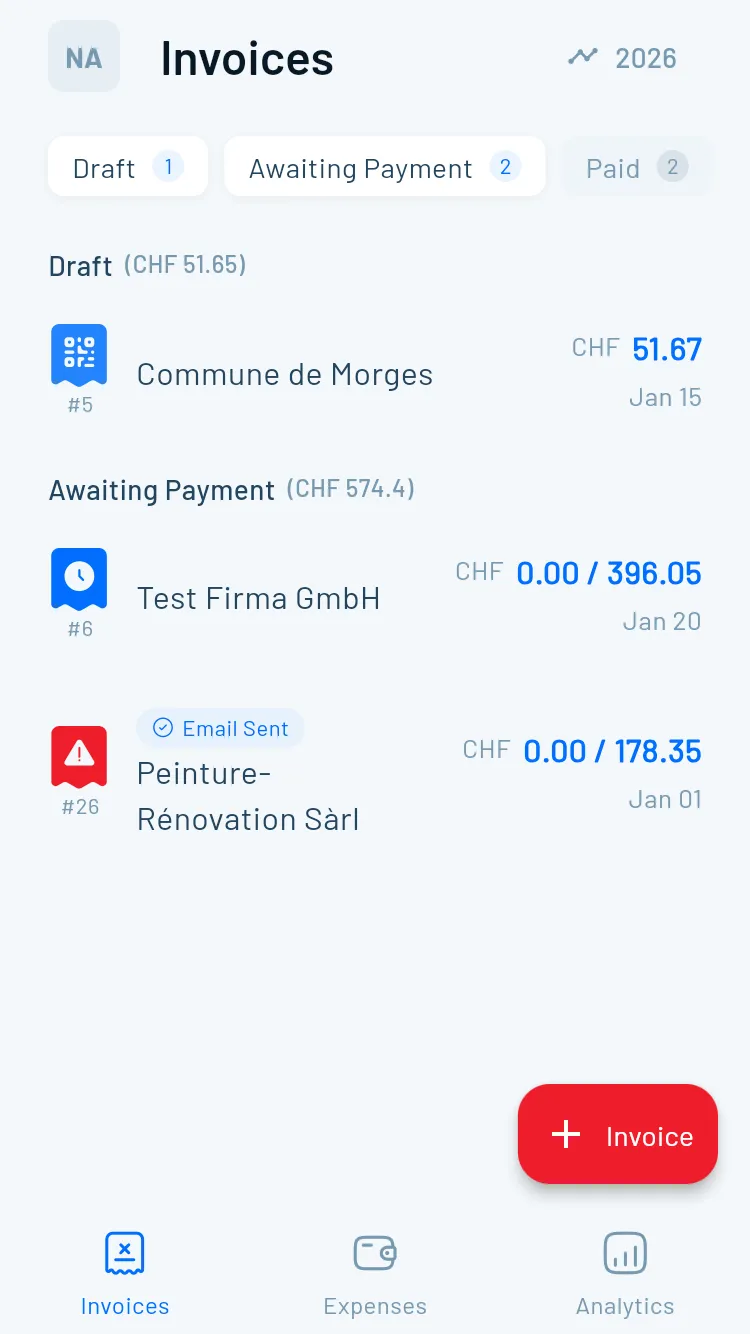
Magic Heidi Invoice on Mobile
Considerations

Drawbacks to Consider

Voluntary registration isn't right for everyone—understand the tradeoffs

  • Administrative burden: Quarterly VAT returns require meticulous record-keeping
  • Cash flow impact: You collect VAT but must remit it quarterly, affecting working capital
  • Price sensitivity: Adding 8.1% might make you less competitive for private consumers
  • Ongoing compliance: Once registered, you can't easily deregister
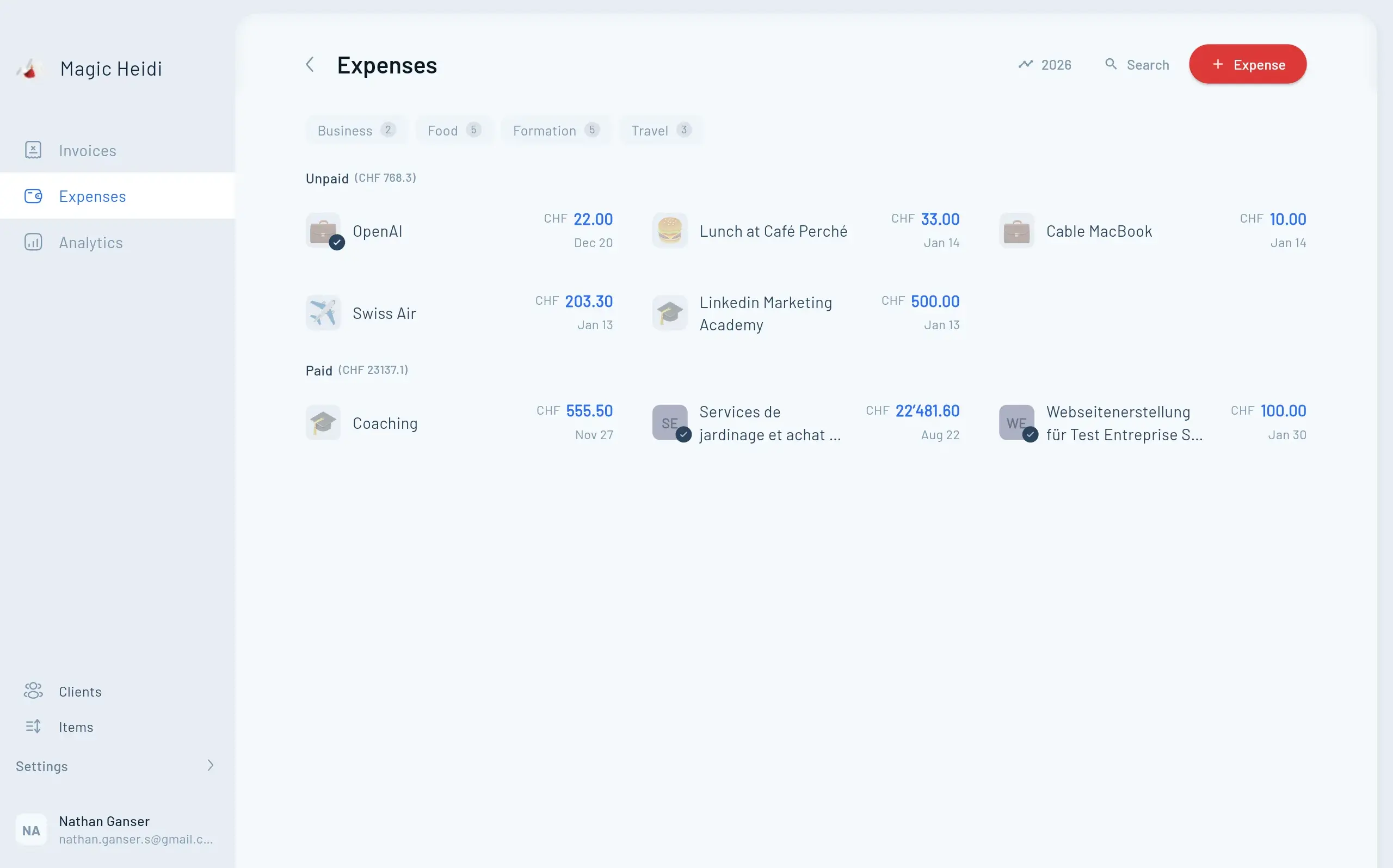
Magic Heidi Expense List
Filing Methods

Choosing Your VAT Filing Method

Switzerland offers three VAT accounting methods. Your choice affects both your administrative workload and potential tax optimization.

1. Effective Method

Track every franc of VAT charged and paid, remit the difference. Required if turnover exceeds CHF 5,005,000. Best for: freelancers with substantial expenses. Effort: High

2. Net Tax Rate Method

Apply a fixed percentage (0.1%-6.7%) to total revenue based on your industry. Requires: turnover under CHF 5,005,000 and FTA approval. Best for: service-based freelancers with low expenses. Effort: Low

3. Flat Tax Rate Method

Similar to Net Tax Rate but with less flexibility on deductions. Best for: very simple business models with minimal expenses. Effort: Low

Most St.Gallen freelancers start with the Effective Method to maximize deductions, then potentially switch to Net Tax Rate after establishing a track record.

Invoicing across the border: Rhine Valley, Liechtenstein, Lake Constance

No canton has as many self-employed people with clients on the other side of a border as St.Gallen. These four cases come up constantly in the Rhine Valley — and are regularly invoiced wrong.

🇱🇮 Liechtenstein = domestic
🌍 Zero-rated exports
🧾 Acquisition tax
🏞️ Rhine Valley & Lake Constance
🇱🇮
Liechtenstein counts as domestic

The principality forms a joint VAT territory with Switzerland. An invoice to Vaduz or Schaan is not an export — you charge 8.1% exactly as you would for a client in Wil.

🇦🇹
Austria is an export

Services to a business in Vorarlberg are not taxable in Switzerland (place-of-recipient rule). Add the note to the invoice, record the client's VAT ID, and keep the evidence for the FTA.

🚚
Shipping goods across the border

Exporting goods to Austria or Germany is zero-rated — but only with a customs export assessment. Without that proof the FTA will charge you 8.1% after the fact.

🧾
Acquisition tax on EU purchases

If you buy services from a German or Austrian supplier (software, agency, consulting), you owe acquisition tax yourself — even if you are not yet VAT-registered, once you pass CHF 10,000 per year.

The St.Gallen sequence

The order that works in St.Gallen

The FTA application itself is described in the national guide. What matters here is the order in which St.Gallen freelancers should clear the cantonal steps.

Business Paperwork and Documents

The St.Gallen sequence in four stages

1. SVA St.Gallen first. Apply for recognition as self-employed before you send anything to the FTA. The SVA wants to see contracts or invoices from at least two or three different clients — anyone working for a single client is usually classified as an employee and never gets as far as the VAT question.

2. Handelsregisteramt St.Gallen. Above CHF 100,000 in turnover the entry is mandatory anyway, and it gives you your UID in the format CHE-XXX.XXX.XXX. Have your St.Gallen business address ready — for people living in another eastern-Swiss municipality, the actual place of business decides which office is competent.

3. Get the revenue forecast right. Count Liechtenstein clients (domestic!) and Austrian or German clients too — the threshold is measured on worldwide turnover. This is exactly where Rhine Valley freelancers miscalculate and register a year too late.

4. Register with the FTA. From here the process is identical nationwide: form, choice of accounting method, waiting time, number. Every detail is in the VAT registration guide.

After that, update your invoice templates with the new number, set up storage for the ten-year retention requirement, and record input VAT from day one — accounting software takes care of most of it for you.

Ongoing Compliance

Your Ongoing VAT Obligations

Registration is just the beginning. Here's what you must do quarterly to stay compliant.

Quarterly VAT Returns

Returns due 60 days after each quarter-end: Q1 (May 31), Q2 (Aug 31), Q3 (Nov 30), Q4 (Feb 28/29). New for 2025: Annual reporting option available.

Compliant Invoices

Must include: MWST number, net amount + VAT separated, complete addresses, invoice date & number, service description, QR-bill (if over CHF 1,000)

10-Year Record Keeping

Maintain all VAT documents for 10 years: invoices issued, expense receipts, bank statements, VAT returns, FTA correspondence. Digital acceptable.

International Clients

Services to non-Swiss clients are generally zero-rated. Must verify client location, note 'Service not subject to Swiss VAT' on invoice.

Common Mistakes

Mistakes to Avoid

Learn from others' errors—here are the most common VAT registration and compliance mistakes St.Gallen freelancers make.

MistakeWhy It's WrongWhat To Do Instead
Using 'VAT' terminologyIncorrect for Swiss documentsAlways use MWST/TVA/IVA on official forms and invoices
Mixing personal & businessCan't deduct full VAT on shared itemsTrack business-use percentage for all shared expenses
Missing 30-day deadlineTriggers retroactive liability and penaltiesRegister immediately when you project hitting CHF 100k
Wrong rate applicationMost services are 8.1%, not 2.6% or 3.8%Verify your industry rate in FTA guidance
Poor documentationNo receipt = no VAT deductionKeep all receipts showing VAT separately for 10 years
Automation Tools

Tools to Simplify VAT Management

Manual VAT tracking is tedious and error-prone. Modern accounting software built for Swiss businesses automates most of the work—saving 3-4 hours per quarter.

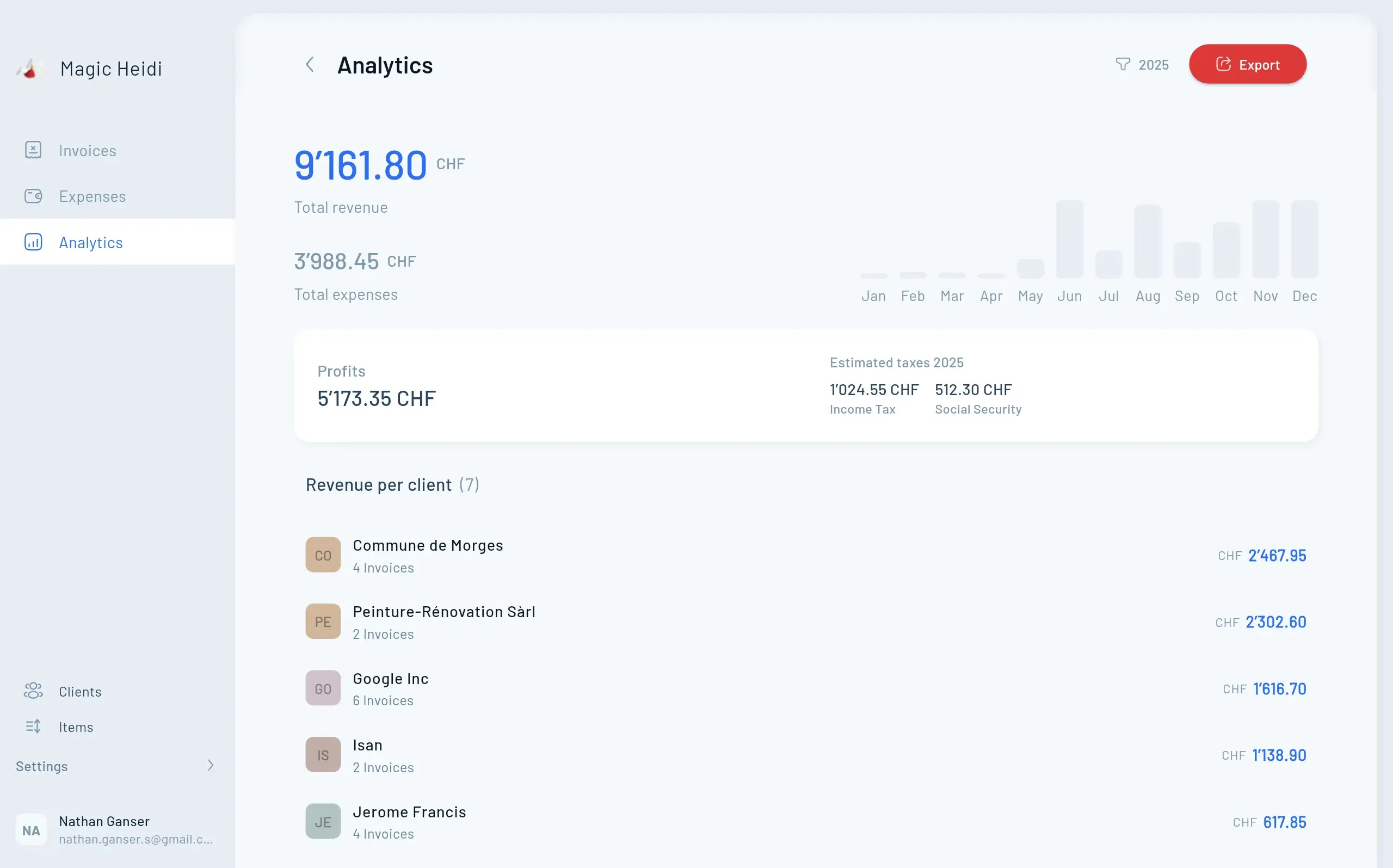
Magic Heidi Analytics Dashboard
Magic Heidi Features

Magic Heidi handles Swiss VAT automatically

Built specifically for Swiss freelancers, with MWST calculation, expense tracking, and quarterly return preparation.

Automatic MWST Calculation

Every invoice automatically applies the correct 8.1% rate with proper formatting and your MWST number.

  • Compliant invoice templates
  • QR-bill generation
  • Multi-currency support
  • International client handling

AI Expense Scanning

Snap a photo of receipts—AI extracts date, amount, VAT, category, and vendor automatically.

  • Automatic VAT extraction
  • Category suggestions
  • 10-year digital archive
  • Input VAT tracking

Quarterly Return Preparation

All figures calculated and formatted for FTA submission—just review and file.

  • Pre-filled VAT returns
  • Revenue/expense breakdown
  • Deadline reminders
  • Mobile apps (iOS/Android)
FAQ

Frequently Asked Questions

What happens if I exceed CHF 100,000 unexpectedly?

Inform the FTA immediately. As long as you notify them within 30 days of realizing you'll exceed the threshold, you avoid retroactive liability.

Can I deregister if my revenue drops below CHF 100,000?

Not automatically. You must apply for deregistration and demonstrate that your revenue will remain below threshold for the foreseeable future. The FTA will review and decide.

Do I charge MWST to private individuals?

Yes, if you're registered. VAT applies to all sales regardless of whether the buyer is a business or individual. Private clients simply can't reclaim it.

What if I make a mistake on my VAT return?

File a corrected return as soon as you discover the error. The FTA is more lenient with self-reported corrections than errors they uncover during audits.

How long does registration remain valid?

Indefinitely, as long as you continue operating and filing returns. You're registered until you formally deregister.

Can I switch VAT methods later?

Yes, but you must notify the FTA before the start of a new accounting period. Switching between methods requires FTA approval and justification.

Next Steps

Your Action Checklist

VAT registration might seem daunting, but broken into steps, it's manageable—even for non-accountants.

Calculate Revenue

Project your 12-month revenue to see if you're approaching CHF 100,000

Gather Documents

Prepare ID, business details, financial projections, and bank info

Register on EasyGov

Submit application within 30 days of foreseeable threshold

Choose VAT Method

Start with Effective Method if unsure about expenses

Update Invoices

Add MWST number format to all invoice templates

Set Up Software

Implement accounting software that handles Swiss VAT automatically

Mark Deadlines

Add quarterly filing deadlines to your calendar

Archive System

Establish document storage for 10-year retention

Most St.Gallen freelancers successfully manage their own VAT registration and returns, especially with proper software support. However, if your situation is complex—multiple revenue streams, international clients, partnership structures—consulting a Swiss tax advisor for the initial setup is a worthwhile investment.

The key is acting proactively. Don't wait until you're past the threshold and scrambling to catch up. Register properly, maintain good records, and VAT compliance becomes just another routine part of running your successful St.Gallen freelance business.

Ready to Simplify Your VAT Management?

Magic Heidi handles MWST calculations, invoice formatting, and quarterly returns automatically—giving you more time to focus on your actual work.