 Magic Heidi
 VAT Registration in Geneva: international clients, missions and TVA
What Geneva freelancers and small businesses need on top of the federal rules: the cantonal offices (Registre du commerce, OCAS), invoicing international organisations and diplomatic missions, and the VAT treatment of clients in neighbouring France.
If you freelance or run a small business in Geneva, VAT (French: TVA) is a federal tax run by the Swiss Federal Tax Administration (FTA/ESTV) — the canton of Geneva has nothing to do with it. The threshold, the form, the deadlines and the accounting methods are therefore identical to the rest of Switzerland and fully described in the VAT registration guide.
This page covers what is genuinely different in Geneva — and that is more than in any other canton, because the Geneva client mix is unusual:
- Invoices to international organisations (UN, WHO, WTO, ICRC, ILO) and diplomatic missions
- Clients in neighbouring France and across the Grand Genève
- Geneva's commodity trading sector with a largely foreign client base
- The cantonal preliminaries: Registre du commerce de Genève and OCAS / Caisse cantonale genevoise de compensation
At a glance (Geneva)
- Competent authority: the FTA in Bern — not the Geneva Administration fiscale cantonale
- Cantonal preliminary: recognition as indépendant by the Geneva compensation office, then entry in the Registre du commerce
- Geneva speciality: services to international organisations and missions can be exempt from Swiss VAT
- Terminology: on invoices use TVA or MWST — never "VAT"
The Geneva special case: international organisations and missions
No other canton comes close in institutional client density. If you work for the UN, WHO, WTO, the ICRC or a permanent mission, a special rule applies: supplies to institutional beneficiaries and beneficiary persons under the Host State Act are exempt from Swiss VAT — with the right to reclaim input tax.
In practice:
- The organisation gives you an official confirmation document issued by the competent federal body. Without it you invoice normally at 8.1%.
- You invoice without VAT, note the exemption on the invoice and file the confirmation with your records. In an FTA audit it is the only proof you have.
- Your input tax remains deductible — unlike with exempt-without-credit turnover. That is why voluntary registration pays off unusually often for Geneva service providers working with the international sector.
- This turnover still counts toward the CHF 100,000 threshold. People who work mostly for international organisations, and therefore barely charge VAT, still become liable.
Clients in France and the Grand Genève
The second Geneva speciality is the border. For services to a business established in France the place-of-recipient rule applies: the supply is not taxable in Switzerland, you invoice without VAT with the corresponding note, and the French client accounts for the tax itself (autoliquidation). The turnover still counts toward the Swiss threshold.
The reverse also holds: if you buy services from French suppliers — an agency, a lawyer, software — you owe acquisition tax above CHF 10,000 per year and must declare it to the FTA even if you are not yet VAT-registered. Geneva freelancers overlook this regularly.
Private clients in France (B2C) follow different rules from businesses — depending on the type of service, the supply remains taxable at your place of business, i.e. with Swiss VAT.
Which rate applies to Geneva work?
The rates are identical nationwide: 8.1% standard (consulting, IT, design, translation — the Geneva default), 2.6% reduced, 3.8% accommodation. What matters is what you sell, not where in Switzerland you are based.
Do you need VAT registration in Geneva? (Decision tree)
VAT registration is about Swiss VAT liability, not whether you have an office in Geneva or clients in Geneva. Use this decision logic as a starting point.
Step 1: Estimate your turnover against the CHF 100,000 threshold
In many common scenarios, you must register if your turnover exceeds CHF 100,000 (per year) from supplies that count toward the threshold.
Important nuance: for many businesses, the test is not “Geneva turnover” or even “Swiss turnover” only—often it’s tied to worldwide turnover from relevant taxable/zero-rated supplies. This catches expats and cross-border service providers by surprise.
Example:
- You live in Geneva and freelance for clients in Switzerland and abroad. If your worldwide qualifying turnover is over CHF 100,000, you may become liable for Swiss VAT.
Because the “what counts” question can get technical quickly (taxable vs exempt, place of supply, reverse charge), consider confirming borderline cases with official guidance or a fiduciary—especially if you have cross-border clients or digital services.
Step 2: Check whether your services are taxable or exempt
Not all activities are treated the same under Swiss VAT.
- If you provide typical taxable services (e.g., consulting, design, marketing, software development), VAT registration is usually straightforward once you hit the threshold.
- If you provide VAT-exempt services (certain education, healthcare, financial services, etc.), the situation changes:
- You may not charge VAT
- You generally cannot reclaim input VAT on related costs
- Registration may be unnecessary or may not produce the benefit you expect
Step 3: Consider whether voluntary VAT registration makes sense
If you’re under the threshold, registration is often optional. Voluntary registration can be smart—but only in the right business model.
Voluntary registration tends to be beneficial when:
- Most of your clients are Swiss VAT-registered businesses (B2B) who can reclaim VAT
- You have meaningful business expenses with VAT (equipment, software, coworking, professional services)
- You want the credibility and procurement-readiness that comes with a VAT number
Voluntary registration can hurt when:
- You sell mainly to consumers (B2C) or non-recovering clients
- Your pricing is VAT-sensitive (adding 8.1% may reduce conversions unless you lower your net price)
- Your admin capacity is limited (invoicing rules + filings + recordkeeping)
Rule of thumb: If your clients can reclaim VAT, being VAT-registered often doesn’t make you “more expensive”—it mainly changes the invoicing mechanics. For B2C, it can directly affect your final price.
When must you register? Don’t wait until year-end
Once you become liable to VAT, you’re generally expected to register promptly—often cited as within 30 days of becoming liable in many contexts (especially referenced for foreign businesses). Practically, the key is: register as soon as you can tell you’ve crossed (or will cross) the liability point.
Practical timing examples (freelancers in Geneva)
- You sign a long contract in March that makes it clear you’ll exceed CHF 100,000 by September
→ Register early so your invoicing stays consistent and compliant. - You cross the threshold unexpectedly in November
→ Don’t wait until December 31. VAT may apply from the liability date and you don’t want messy retroactive invoice corrections.
If your turnover is close to the threshold and you’re unsure, start preparing your checklist early (next section). The administrative part is much easier when you’re not rushing.
Choose your VAT accounting method (effective vs net tax rate)
Switzerland commonly distinguishes between:
1) Effective method (actual method)
You charge VAT at the applicable rate on your invoices, and you reclaim input VAT on eligible expenses. Your VAT payable is essentially:
VAT collected from clients − VAT paid on costs
Best for businesses that:
- Have significant VAT-bearing expenses
- Want precise VAT reporting
- Have mixed VAT rates or more complex transactions
2) Net tax rate method (Saldosteuersatz / SSS)
Instead of calculating input VAT per expense, you apply a net tax rate to your turnover (the percentage depends on your activity category). This simplifies administration.
Best for businesses that:
- Want simpler bookkeeping
- Have relatively low input VAT and predictable activity
- Prefer fewer detailed VAT calculations
Watch-outs:
- Eligibility and the applicable net tax rate depend on your business activity classification.
- Switching methods can require corrections or careful timing—don’t treat it like a casual toggle.
If you’re unsure, a fiduciary can usually recommend a method quickly based on:
- Your service type
- Your cost structure (how much VAT you pay on expenses)
- Whether you do mostly Swiss domestic work or cross-border work
What you need before you start (VAT registration checklist)
Before you register, gather the essentials. Having this ready prevents delays and back-and-forth.
Business identity & details
- Your business name and legal form (e.g., sole proprietorship / “raison individuelle”)
- Address in Switzerland (Geneva) and contact details
- Start date of activity (or planned start date)
Turnover and activity information
- Turnover to date and an estimate/forecast for the current year
- Description of your activity (what you sell, to whom, and where your clients are)
- Whether you invoice mainly B2B or B2C
- Any cross-border elements (clients abroad, platforms, digital services)
UID vs VAT number: don’t confuse these
In Switzerland you’ll often see:
- UID / IDE (business identification number; format often shown as CHE-123.456.789)
- UID‑MWST (your VAT registration status attached to the UID; used as your VAT number on invoices)
They’re related, but not identical concepts. Many people refer to the VAT number as “CHE-… MWST” (or “TVA/MWST”), and that’s often what clients want to see on invoices.
If you’re a foreign provider selling into Switzerland
Non-Swiss businesses can trigger Swiss VAT registration depending on their situation and turnover tests (commonly linked to worldwide turnover and Swiss supplies). Foreign businesses may also need:
- A Swiss tax representative
- Additional documentation and coordination
If that’s you (e.g., non-Swiss SaaS or digital service provider invoicing Swiss clients), get professional advice early—cross-border VAT mistakes are expensive to unwind.
The sequence for Geneva freelancers
The application goes exclusively through the Swiss Federal Tax Administration (FTA/ESTV) — Geneva has no VAT authority of its own, and the Administration fiscale cantonale only handles your income and wealth tax. How to fill in the form field by field, what processing times apply and what you receive at the end is fully covered in the VAT registration guide.
The Geneva order:
- OCAS / Caisse cantonale genevoise de compensation: recognition as indépendant. Without it you have no proof of self-employed activity.
- Registre du commerce de Genève: entry is mandatory above CHF 100,000 in turnover and gives you your UID.
- Calculate your revenue forecast in full: turnover with international organisations, French clients and other foreign mandates all count, even if no VAT is charged on them.
- Submit the FTA application and choose your accounting method.
Cost: The FTA charges no fee. Your only costs are your own time or fiduciary support.
After you receive your VAT number: what changes immediately
Once you’re VAT-registered, you’ll want to update your invoicing and bookkeeping right away.
1) Update your invoices (must-have fields)
While invoice requirements can vary based on transaction type, in practice you should ensure your invoices clearly show:
- Your business name and address
- Your VAT number (UID‑MWST)
- Invoice date and unique invoice number
- Description of services/products
- Net amount, VAT rate (e.g., 8.1%), VAT amount, and gross total
- Customer details (especially for B2B)
If you work with both Swiss and international clients, you may need different invoice treatments depending on the place of supply and whether VAT is charged.
2) Track VAT on expenses (input VAT)
VAT-registered businesses often reclaim VAT paid on eligible business expenses. To do that confidently, you need:
- Clean receipts and supplier invoices
- Proper categorization (business vs private)
- Consistent recordkeeping
3) Prepare for VAT returns and payments
VAT returns are periodic. The exact cadence and reporting detail can depend on your method and setup. What matters most is building a routine:
- Reconcile income and expense records
- Separate net and VAT components
- Keep supporting documents audit-ready
Common mistakes Geneva freelancers make (and how to avoid them)
Mistake 1: Thinking “Geneva turnover” is the threshold
Swiss VAT is federal. The threshold analysis often hinges on broader rules than “local client revenue.” If you work internationally, confirm whether worldwide turnover matters in your case.
Mistake 2: Waiting too long to register
If you cross the threshold, delayed registration can mean:
- Invoices need corrections
- You may have to account for VAT retroactively
- More admin time and higher advisory costs
Mistake 3: Choosing the VAT method based on convenience alone
The net tax rate method can be simpler, but it’s not automatically cheaper. Your best choice depends on your expenses, activity type, and client mix.
Mistake 4: Confusing UID with UID‑MWST
Clients usually want the VAT number format that confirms VAT registration (UID‑MWST). Make sure what you display on invoices is correct and consistent.
FAQs: VAT registration in Geneva (TVA / MWST)
Do I need to register if I make exactly CHF 100,000?
The threshold is a key trigger point, but what matters is how the law defines the turnover that counts. If you’re at or near CHF 100,000, treat it as a compliance boundary and confirm your specific turnover calculation (especially with cross-border work or exempt services).
Is Swiss VAT registration handled by the Geneva tax office?
No. Swiss VAT is administered by the Swiss Federal Tax Administration (FTA/ESTV) at the federal level.
How do I register for VAT in Switzerland online?
You register through the official FTA/ESTV VAT registration process (online-first). Prepare your business details, turnover forecast, and activity description before you start.
How long does it take to receive a Swiss VAT number?
For electronic submissions, confirmation can arrive within a few days according to the FTA, though timing can vary based on complexity and whether additional information is required.
Should I register voluntarily if I’m under CHF 100,000?
Often yes for B2B freelancers with meaningful expenses and clients who can reclaim VAT. Often no for B2C businesses where VAT would increase the customer-facing price. Consider your client mix and margin.
What’s the difference between UID and VAT number in Switzerland?
The UID (IDE) identifies the business. The VAT registration status is commonly shown as UID‑MWST, which is what you typically put on invoices as your VAT number.
Which VAT method is best for freelancers: effective or net tax rate (SSS)?
- Effective: best if you have significant input VAT or want exact calculations.
- Net tax rate (SSS): best if you want simplicity and your situation fits the eligibility rules.
A quick comparison with a fiduciary (or a robust bookkeeping tool) often clarifies the right choice.
What VAT rate should I charge my Geneva clients?
It depends on what you sell. Many services use the 8.1% standard rate (2024+). Some goods/services qualify for reduced or special rates.
Can foreign freelancers or SaaS providers trigger Swiss VAT registration?
Yes, depending on their worldwide turnover and Swiss supplies. Foreign businesses may need a Swiss tax representative and should seek advice early.
Do I need to add VAT to invoices for non-Swiss clients?
Often not, but the correct treatment depends on the place of supply rules and whether the customer is a business. Don’t guess—set rules in your invoicing process.
Make VAT registration painless: a simple system beats willpower
VAT isn’t hard because the rules are impossible—it’s hard because it adds process:
- You need clean invoices
- You need consistent expense tracking
- You need VAT-ready reports when it’s time to file
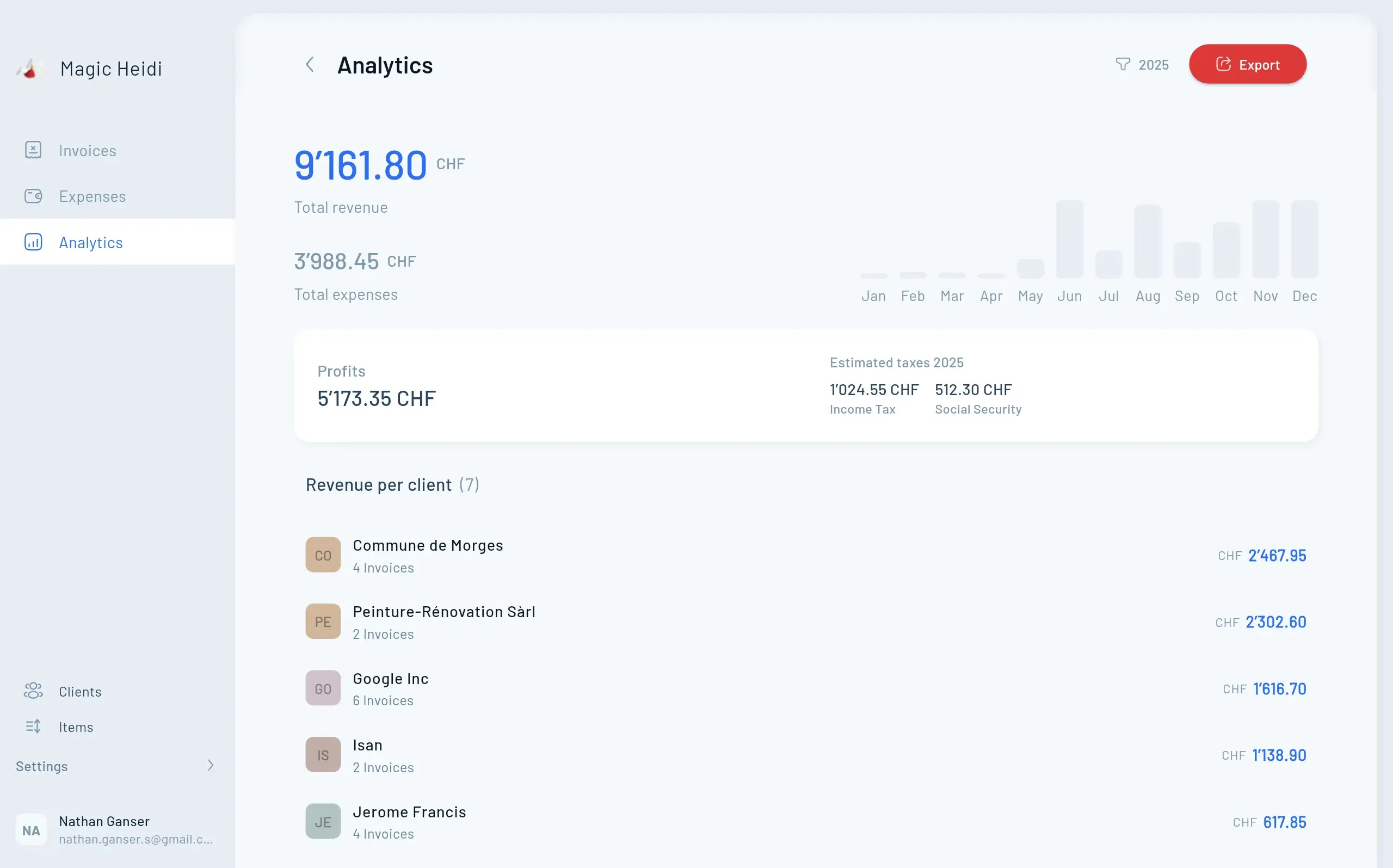
That’s exactly where lightweight accounting software helps: it keeps your invoicing, expenses, and VAT logic in one place, so you’re not rebuilding your numbers at filing time.
Ready to stay compliant (and save time every month)?
If you’re approaching the CHF 100,000 threshold—or you’re already there—set up your VAT workflow now:
- Create VAT-ready invoices with your VAT number
- Track expenses and input VAT automatically
- Keep everything organized for your next VAT return
Try Magic Heidi free and set up your VAT-ready invoicing and bookkeeping in minutes—so Swiss VAT doesn’t become a recurring admin headache.
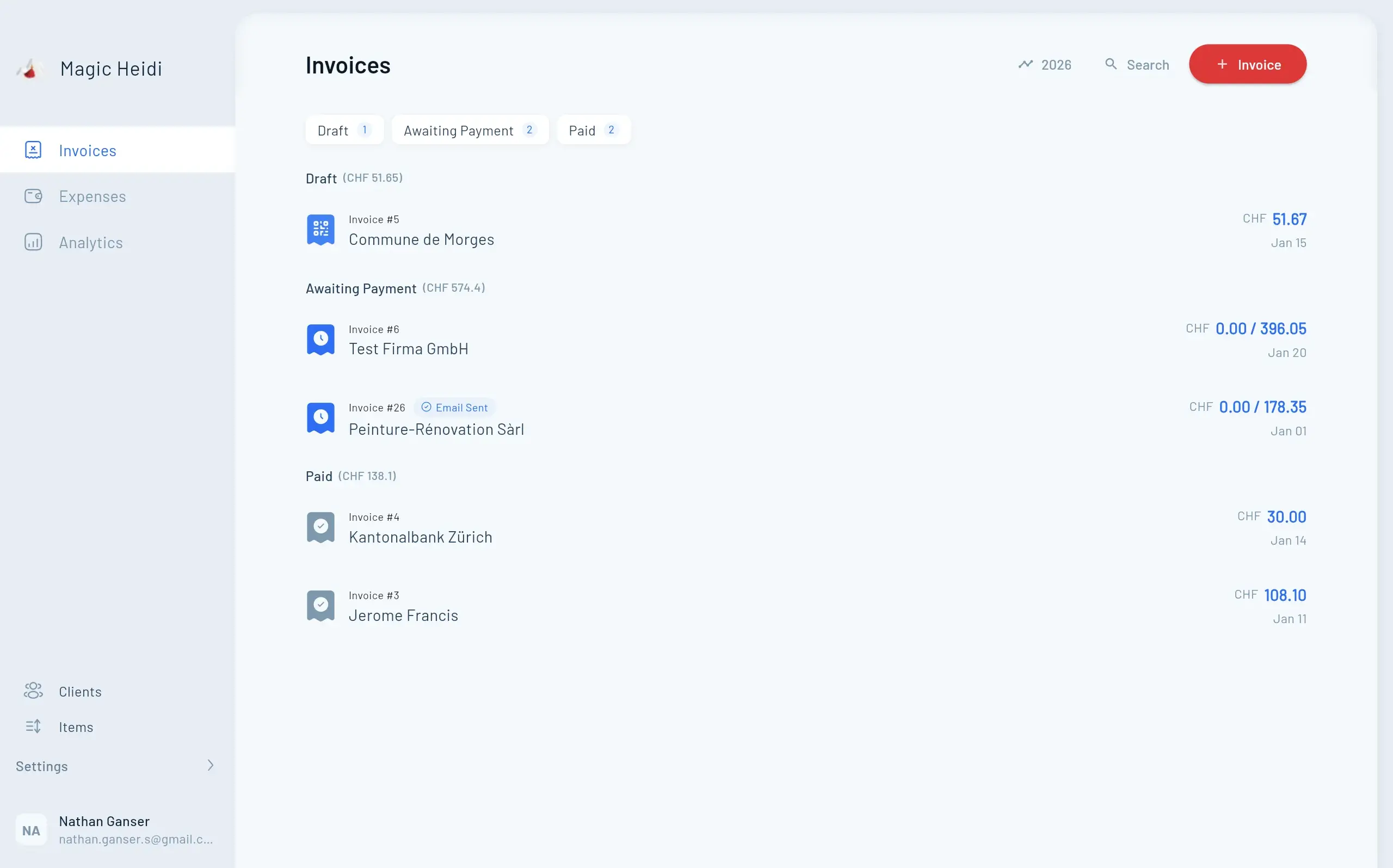
VAT-ready invoices with your UID‑MWST
Once registered, your invoices need the right fields (VAT number, rates, net/VAT/gross amounts). Keep it consistent so filing your next VAT return is straightforward.
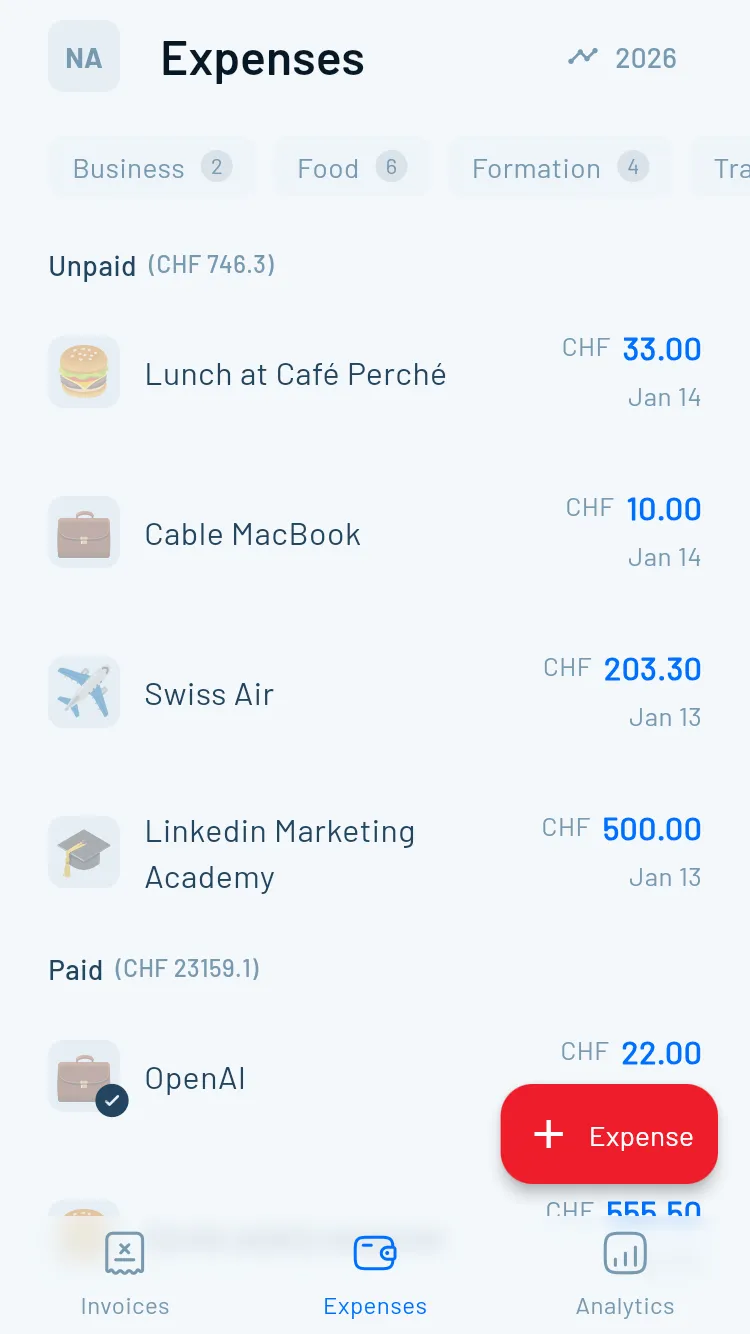
Track expenses and input VAT without chaos
If you’re VAT-registered, clean receipts and consistent categorization matter. A simple system makes input VAT tracking and audit-readiness much easier.
Ready for Swiss VAT without the admin headache?
Set up VAT-ready invoicing and expense tracking now—before the threshold (or the paperwork) catches up with you.