 Magic Heidi
 VAT Registration in Ticino:
IVA, trading with Italy and cantonal offices
What Ticino freelancers need on top of the federal rules: the difference between Swiss VAT and Italian IVA, acquisition tax on Italian suppliers, import tax on goods from Italy — and the cantonal offices in Bellinzona.
Swiss VAT is a federal tax. You register with the Federal Tax Administration (FTA/ESTV), not with the Divisione delle contribuzioni of canton Ticino. The threshold, the form, the deadlines and the accounting methods are identical nationwide and fully described in the VAT registration guide.
This page covers what is different in Ticino — which is relevant to almost every self-employed person here, because the Italian border shapes daily business.
Terminology: in Switzerland the same tax is called MWST (DE), IVA (IT) and TVA (FR). Ticino's IVA is Swiss VAT — not Italian IVA. That sounds trivial but it is the most common source of expensive mistakes in cross-border work.
Swiss IVA vs Italian IVA: the perennial Ticino problem
Both are called IVA, but they operate separately. Your Swiss VAT number (CHE-XXX.XXX.XXX IVA) has nothing to do with an Italian partita IVA, and holding an Italian partita IVA does not exempt you from Swiss registration if you operate out of Chiasso, Lugano or Bellinzona.
Four situations come up constantly in Ticino:
1. You invoice an Italian business. Services to a business established in Italy are not taxable in Switzerland under the place-of-recipient rule: invoice without VAT, add the note, and the Italian client applies reverse charge. The turnover still counts toward the CHF 100,000 threshold.
2. You buy services from Italy. Hire a designer in Como, a lawyer in Milan or an Italian software subscription and you owe acquisition tax (imposta sull'acquisto) yourself — above CHF 10,000 of services per year even if you are not yet VAT-registered. This is by far the biggest blind spot among Ticino freelancers.
3. You import goods. Materials, equipment or stock from Italy trigger import tax at customs. Once VAT-registered you reclaim it as input tax — but only with the assessment decision from the Federal Office for Customs and Border Security. Keep it; the freight forwarder's invoice alone is not enough.
4. You sell goods to Italy. Exports are zero-rated, but only with a customs export assessment. Without that proof the FTA will charge you 8.1% after the fact.
Cantonal offices in Bellinzona
- Istituto delle assicurazioni sociali (IAS): recognises your status as indipendente. Get this before your VAT application.
- Ufficio del registro di commercio: registering the ditta individuale is mandatory above CHF 100,000 in turnover and gives you your UID.
- Divisione delle contribuzioni: handles cantonal and municipal taxes, not VAT.
FTA forms and the VAT return are fully available in Italian — you do not have to file in German.
Which rate applies to Ticino work?
Identical nationwide: 8.1% standard, 2.6% reduced, 3.8% accommodation (relevant for rentals on Lake Maggiore and Lake Lugano). What matters is what you sell, not that you are based in Ticino.
Do you need to register for VAT in Ticino? (CHF 100,000 threshold)
The CHF 100,000 rule (the one that triggers most registrations)
In Switzerland, you generally become VAT-liable when your annual turnover from taxable supplies exceeds CHF 100,000.
Key points freelancers often miss:
- It’s based on turnover (revenue), not profit.
- It’s about taxable activities, not whether you personally “want” VAT.
- It’s a federal rule—Ticino doesn’t have a separate VAT regime.
If you’re approaching CHF 100k, plan your VAT setup early so you’re not scrambling after the fact.
What counts toward the threshold (and what may not)
In plain terms, your threshold calculation depends on the nature of your services:
- Taxable supplies generally count (many consulting, design, marketing, IT services, etc.).
- Some activities can be VAT-exempt or outside the scope depending on the service type and place of supply rules.
If you’re in a field where VAT treatment is commonly misunderstood (e.g., education/training, healthcare-related services, cultural services, financial services), it’s worth checking your classification.
Tip: If you have mixed activities (some taxable, some exempt), VAT can get complex quickly—especially for input VAT recovery. Consider professional help or robust VAT-capable accounting software.
When does VAT liability start?
VAT doesn’t only matter “at year-end.” If you cross the threshold, you typically become liable from the relevant moment defined by the VAT rules (often connected to when it becomes foreseeable or when it occurs).
Practical takeaway:
- If your pipeline makes it clear you’ll exceed CHF 100,000, it’s usually safer to register proactively rather than reacting late.
For the most up-to-date rules and timing, rely on the FTA guidance (and a fiduciary for edge cases).
Voluntary VAT registration (even under CHF 100,000): when it’s worth it
You can often opt into VAT voluntarily even if you’re under the threshold. This can be a smart move when:
- You have significant business expenses with VAT (laptop, phone, software, coworking, tools, subcontractors)
- You work mainly B2B (your clients can often reclaim VAT, so VAT doesn’t “raise” the true cost for them)
- You want to look more enterprise-ready (some larger clients prefer VAT-registered suppliers)
- You expect to cross CHF 100k soon and want a clean transition
When voluntary registration can be a bad idea:
- You sell mostly to private clients (B2C) in Switzerland (VAT increases the final price unless you absorb it)
- Your admin capacity is limited and you don’t have a system for compliant invoicing and returns
- Your services are largely exempt, limiting the benefit of input VAT recovery
VAT-ready invoicing starts with the right workflow
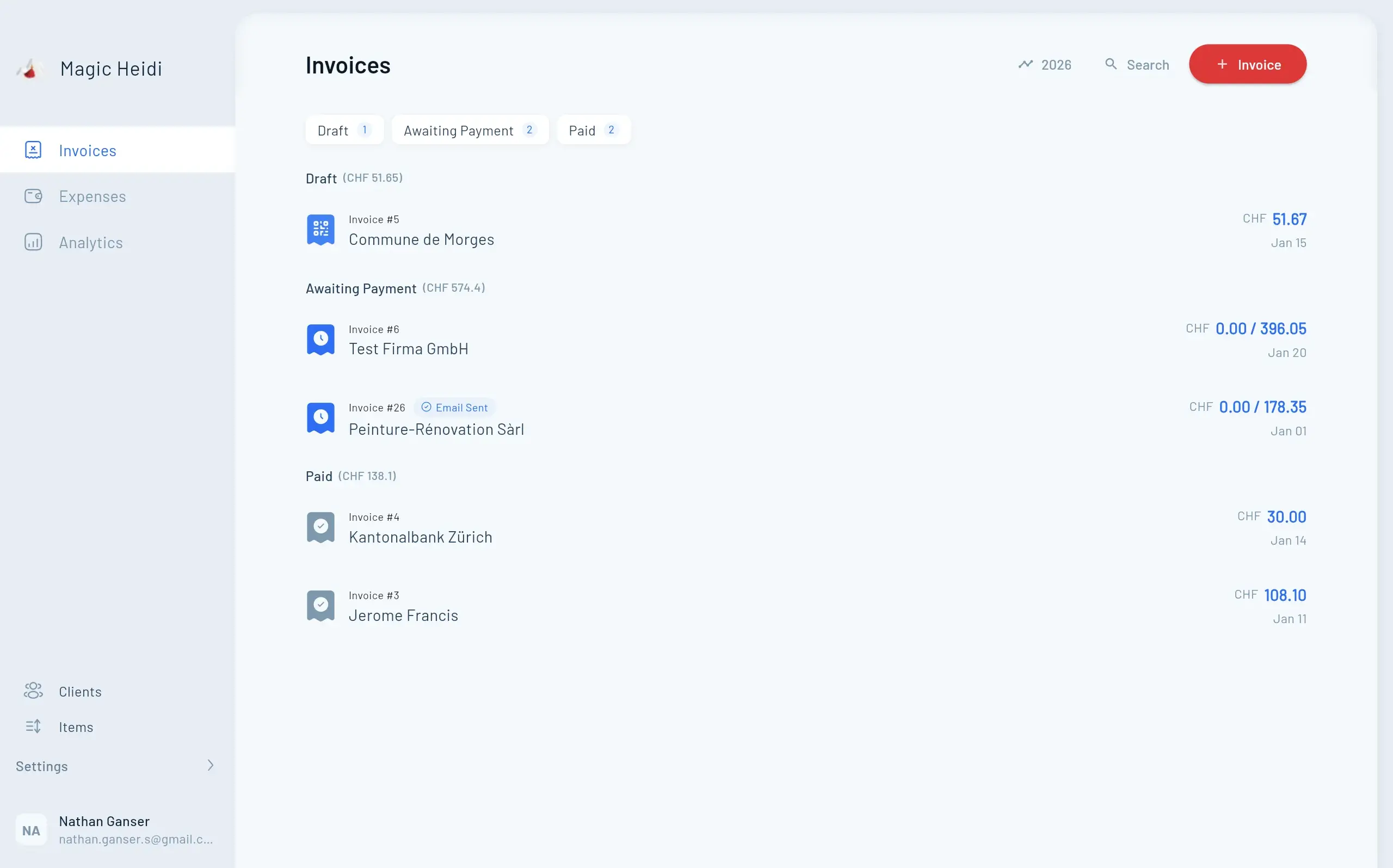
Once you register, you’ll need compliant invoices, correct Swiss VAT rates, and reliable bookkeeping. This is where a VAT-capable invoicing system saves hours (and prevents expensive mistakes).
Before you register: a freelancer’s VAT checklist (Ticino-ready)
VAT registration is straightforward if you prepare the right info upfront.
Use this checklist before you start the application.
1) Confirm your business setup (sole proprietor / freelancer)
Most freelancers in Ticino operate as a sole proprietorship (Italian: ditta individuale; German: Einzelunternehmen).
VAT registration is still federal, but your legal form affects:
- how you’re identified,
- how your business name appears,
- which identifiers you provide.
2) Get your identifiers ready (UID / CHE number, AHV/AVS, etc.)
The FTA registration process typically asks for identification and business details, commonly including:
- Personal information (name, address in Switzerland, contact details)
- AHV/AVS social security number (commonly relevant for sole proprietors)
- Business identifiers such as UID (company identification) depending on your setup and how you’re registered
Important nuance: Many people assume they must “go to the Ticino business register to get a UID.” In reality, the UID is part of the Swiss business identification system and can be linked to commercial register publication timing for some entities. Follow the official process and provide what applies to your case.
Official reference: https://www.estv.admin.ch
3) Prepare your turnover estimate (and supporting info)
Expect to provide:
- Expected turnover (first year / next 12 months)
- If you’re already operating: recent turnover figures, business activity description
- Potentially: information on your sector/activity (important for choosing a VAT method like net tax rate)
4) Decide your invoicing readiness (you’ll need compliant invoices)
Once registered, you must invoice correctly. That means you need:
- invoice numbering and recordkeeping,
- VAT rate handling (standard/reduced/special if relevant),
- the correct VAT number display format when applicable.
This is where many freelancers lose time (and make expensive mistakes) using non-VAT-ready templates.
Choose your VAT accounting method (effective vs net tax rate)
Your VAT method affects:
- how much VAT you pay,
- how much you can reclaim,
- how often you file,
- how complex your bookkeeping will be.
Switzerland commonly offers:
- Effective method (actual VAT in/out)
- Net tax rate method (Saldosteuersatz, sometimes confused online with “flat rate”)
Why this section matters: picking the wrong method can cost you money, not just time.
1) Effective method (actual VAT)
With the effective method, you:
- charge VAT on your invoices (output tax),
- reclaim VAT on eligible business expenses (input tax),
- remit the net difference to the tax authority.
Best for freelancers who:
- have meaningful input VAT (equipment, subcontractors, office costs),
- want precision (you pay VAT based on real margins),
- have variable cost structures.
Trade-offs:
- more detailed bookkeeping,
- you must track VAT on every purchase and sale correctly.
2) Net tax rate method (Saldosteuersatz / “net tax rate”)
With the net tax rate method, you generally calculate VAT due by applying a fixed percentage to your turnover, based on your industry/activity classification.
It can be attractive because:
- it reduces bookkeeping complexity,
- it can simplify VAT return prep.
But there are important constraints:
- eligibility limits (turnover and/or tax due caps may apply),
- industry rate selection rules,
- switching rules and post‑2025 adjustments can add complexity.
The net tax rate method is widely discussed by Swiss fiduciaries and advisory sources, especially after the partial VAT law revision effective 1 January 2025. If you’re considering it, make sure you’re working with current guidance and confirm eligibility before choosing it.
Helpful background (non-official but detailed):
- Net tax rate method overview: https://www.nexova.ch/en/tax-and-legal/net-tax-rate-method/
- VAT changes context (from 1 Jan 2025): https://www.kendris.com/en/news-insights/2024/11/28/partial-revision-of-the-swiss-vat-act-as-per-1-january-2025-changes-at-a-glance/
“Flat rate method” vs “net tax rate” (avoid this common confusion)
Some articles use “flat rate” as a generic phrase. In Switzerland, the term you’ll see most for freelancers/small businesses is the net tax rate method (Saldosteuersatz)—and the details matter.
If a guide doesn’t use Swiss-specific terminology (or mixes methods), double-check before you decide.
The sequence for Ticino freelancers
The application goes to the Swiss Federal Tax Administration (FTA/ESTV) — not to the Divisione delle contribuzioni. How to fill in the form, what processing times apply and what you receive afterwards is fully covered in the VAT registration guide.
In Ticino, work through it in this order:
- IAS Bellinzona: apply for recognition as indipendente.
- Ufficio del registro di commercio: register the sole proprietorship above CHF 100,000 and get your UID.
- Calculate your revenue forecast in full — including every invoice to Italian clients, even where no Swiss VAT applies.
- Check acquisition tax: have you bought more than CHF 10,000 of services from Italy in the last twelve months? Then a declaration obligation already exists, regardless of your turnover.
- Submit the FTA application in Italian and choose your accounting method.
After registration, show your number in the format CHE-XXX.XXX.XXX IVA on every invoice and keep domestic turnover, exports to Italy and acquisition-tax cases cleanly separated in your bookkeeping.
Invoicing basics after VAT registration (freelancers’ quick checklist)
While requirements depend on your exact scenario, VAT-compliant invoicing usually means:
- Clear supplier identity (your name/business, address)
- Client identity
- Invoice date and unique invoice number
- Service description and period
- Net amount, VAT rate, VAT amount, gross total
- Your VAT number (after registration)
- Correct handling of special cases (e.g., foreign clients, reverse-charge situations)
If you don’t want VAT to turn into a weekly admin burden, use a tool that:
- supports Swiss VAT rates,
- outputs compliant invoice layouts,
- tracks VAT automatically,
- prepares VAT reports for filing.
Expense tracking with VAT visibility
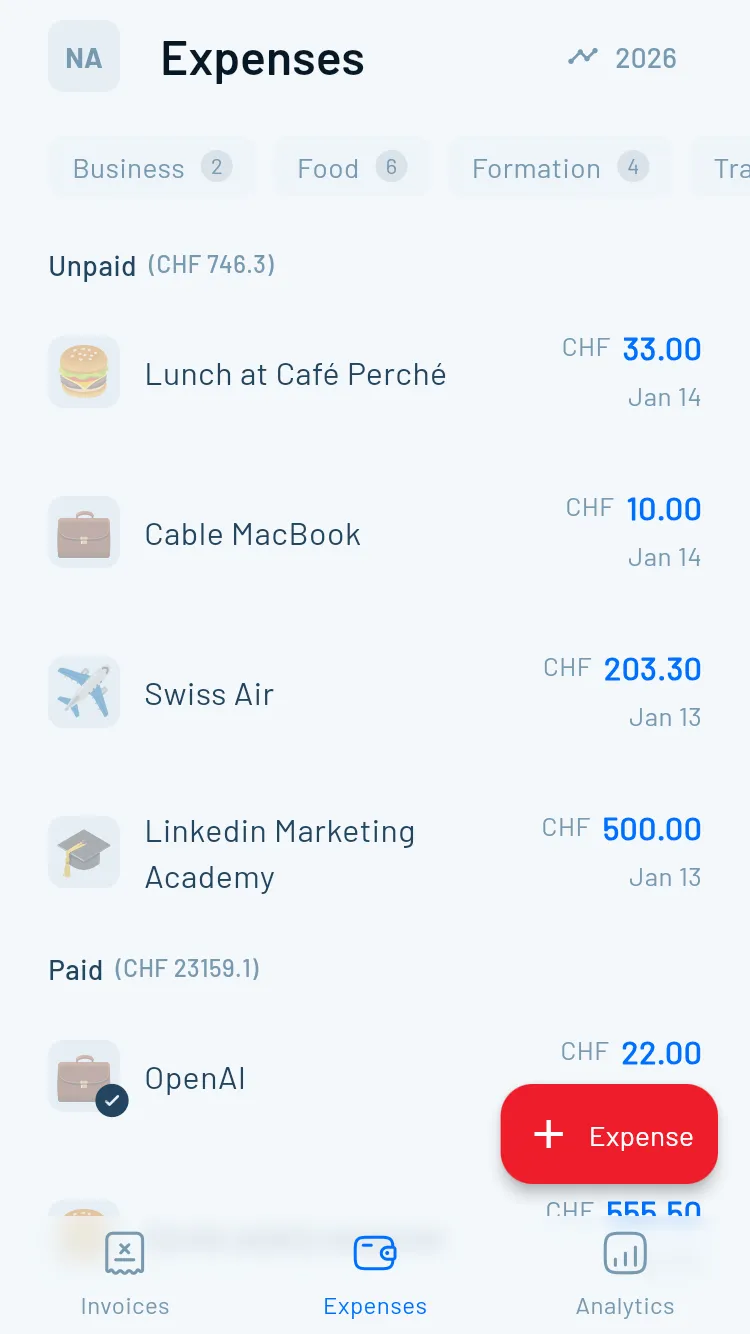
Once you’re registered, it’s not just about invoices—your expenses and VAT codes matter too. A VAT-ready workflow helps you see input VAT clearly and stay audit-ready.
Practical Ticino examples (common freelancer scenarios)
Example 1: Consultant in Lugano invoicing Swiss B2B clients
- You provide strategy consulting to Swiss companies.
- If you exceed CHF 100,000 taxable turnover: VAT registration is typically required.
- Most B2B clients can reclaim VAT, so VAT usually isn’t a “real” cost to them—pricing impact is often manageable.
Best focus: method selection (effective vs net tax rate) and clean invoicing.
Example 2: Designer in Ticino with mostly foreign clients
- You invoice clients outside Switzerland.
- VAT treatment depends on place-of-supply rules and client type (B2B vs B2C).
- You may still need VAT registration depending on your overall taxable turnover and the Swiss rules.
Best focus: get clarity early—cross-border VAT can affect invoicing wording and VAT reporting even when invoices are “VAT 0%” or outside Swiss VAT scope.
Example 3: Mixed activities (taxable + exempt)
- Part of your work may be exempt (depending on the service type), part taxable.
- You may not be able to reclaim all input VAT, or you may need a proportional allocation.
Best focus: bookkeeping structure and professional advice—this is where mistakes become expensive.
FAQs: VAT registration in Ticino (IVA/MWST/TVA)
1) Is VAT in Ticino different from the rest of Switzerland?
No. VAT is federal. Ticino doesn’t set separate VAT rates or a separate registration authority.
2) Where do I register—Ticino tax office or the Confederation?
You register with the Swiss Federal Tax Administration (FTA/ESTV). Start here: https://www.estv.admin.ch
3) Is there a fee to register for VAT?
The FTA registration process is generally presented as an administrative submission and is typically understood as no government registration fee. Your costs are usually internal time and/or fiduciary support.
4) I’m under CHF 100,000—can I still register?
Often yes, via voluntary registration, depending on your circumstances. It can be beneficial if you want to reclaim input VAT or work with VAT-registered B2B clients.
5) What if I cross CHF 100,000 mid-year?
You may become VAT-liable when you exceed (or when it’s foreseeable you will exceed) the threshold. Plan ahead and confirm timing with the FTA guidance or a fiduciary.
6) Do I need a UID before registering?
You may be asked for identifiers and business details. UID handling can depend on your legal setup and registration status. Use the official FTA flow and provide what applies to your case rather than assuming a one-size-fits-all path.
7) How long does the registration take?
The FTA indicates online submissions are usually processed within a few days (can vary). Source: https://www.estv.admin.ch
8) Which method is best: effective or net tax rate (Saldosteuersatz)?
- Effective: best when you have meaningful VAT on expenses and want precision.
- Net tax rate: can reduce admin but has eligibility limits and rules that became more nuanced with the 2025 revision.
If you’re unsure, choose based on your expense structure, client base, and admin capacity—and confirm eligibility before selecting net tax rate.
9) Can I change VAT methods later?
Often yes, but method switches can have rules/timing constraints—especially after the 1 January 2025 VAT revision. Confirm current switching rules before changing.
10) What VAT rate do I charge?
Many freelance services fall under the standard rate. Some goods/services qualify for reduced or special rates; some are exempt. When in doubt, check the FTA guidance or ask a fiduciary—misrating is a common (and costly) mistake.
11) Do I always add VAT to my invoices once registered?
Not always. It depends on whether the supply is taxable in Switzerland, exempt, or outside scope. Cross-border services may require special handling.
12) What happens if I register late?
Late registration can create backdated VAT exposure and corrective admin (and sometimes penalties/interest depending on circumstances). If you’re near CHF 100k, treat VAT as a project—don’t leave it to the last minute.
A simple VAT registration action plan (copy/paste)
If you want the fastest path to “VAT-ready” as a Ticino freelancer:
- Forecast turnover for the next 12 months (are you approaching CHF 100,000?).
- Decide if you should register mandatory vs voluntary.
- Pick your VAT accounting method: effective or net tax rate (Saldosteuersatz).
- Prepare identifiers + business details (incl. AHV/AVS if applicable).
- Register via the FTA: https://www.estv.admin.ch
- Update your invoicing system so VAT rates, totals, and VAT number display are correct.
- Set a recurring routine for VAT bookkeeping and returns (monthly/quarterly/annual depending on eligibility and method).
Ready to register (and stay compliant without the admin headache)?
VAT registration is only step one. The real win is having a system that makes VAT automatic: correct rates on invoices, clean expense tracking, and VAT-ready reporting when it’s time to file.
If you want to spend less time on VAT and more time billing clients, try Magic Heidi for free—and set up:
- VAT-ready invoicing
- Expense tracking with VAT visibility
- Simple accounting workflows built for freelancers
CTA: Try Magic Heidi free and get VAT-ready this week.
Get VAT-ready in Ticino — without the admin headache
Set up VAT-ready invoicing and expense tracking so you can focus on clients, not compliance.