Year-End Closing Checklist

Year-End Closing Checklist 2026: 8 Steps for Swiss

The complete year-end closing checklist 2026 for Swiss freelancers: 8 steps from receipts to VAT to the tax export.

Year-End Closing Checklist 2026: 8 Steps for Swiss

Year-End Closing Checklist 2026: 8 Steps for Swiss

The complete year-end closing checklist 2026 for Swiss freelancers: 8 steps from receipts to VAT to the tax export.

Nathan Ganser avatar
Nathan Ganser

Founder of Magic Heidi

For many self-employed people in Switzerland, the year-end closing initially feels like an open box full of receipts, emails, bank statements and half-finished notes. The good news is that you don't need a large finance apparatus for this — you need a clean process. With a clear year-end closing checklist, the end of the year turns from chaos into a series of small, manageable steps.

Especially for sole proprietorships and freelancers, it's not just what happened during the business year that counts, but also how well the documents fit together on the closing date. In Switzerland, the VAT rates since January 1, 2024 of 8.1%, 2.6% and 3.8% are an important reference point, because revenue, input taxes and accruals must be allocated cleanly. If you work with multiple currencies, you should document the conversion into CHF in a traceable way so that the VAT return and annual financial statements remain consistent. This Swiss practical foundation is therefore more than a formality — it is a real touchstone in everyday work.

1. Verify invoice reconciliation and incoming payments

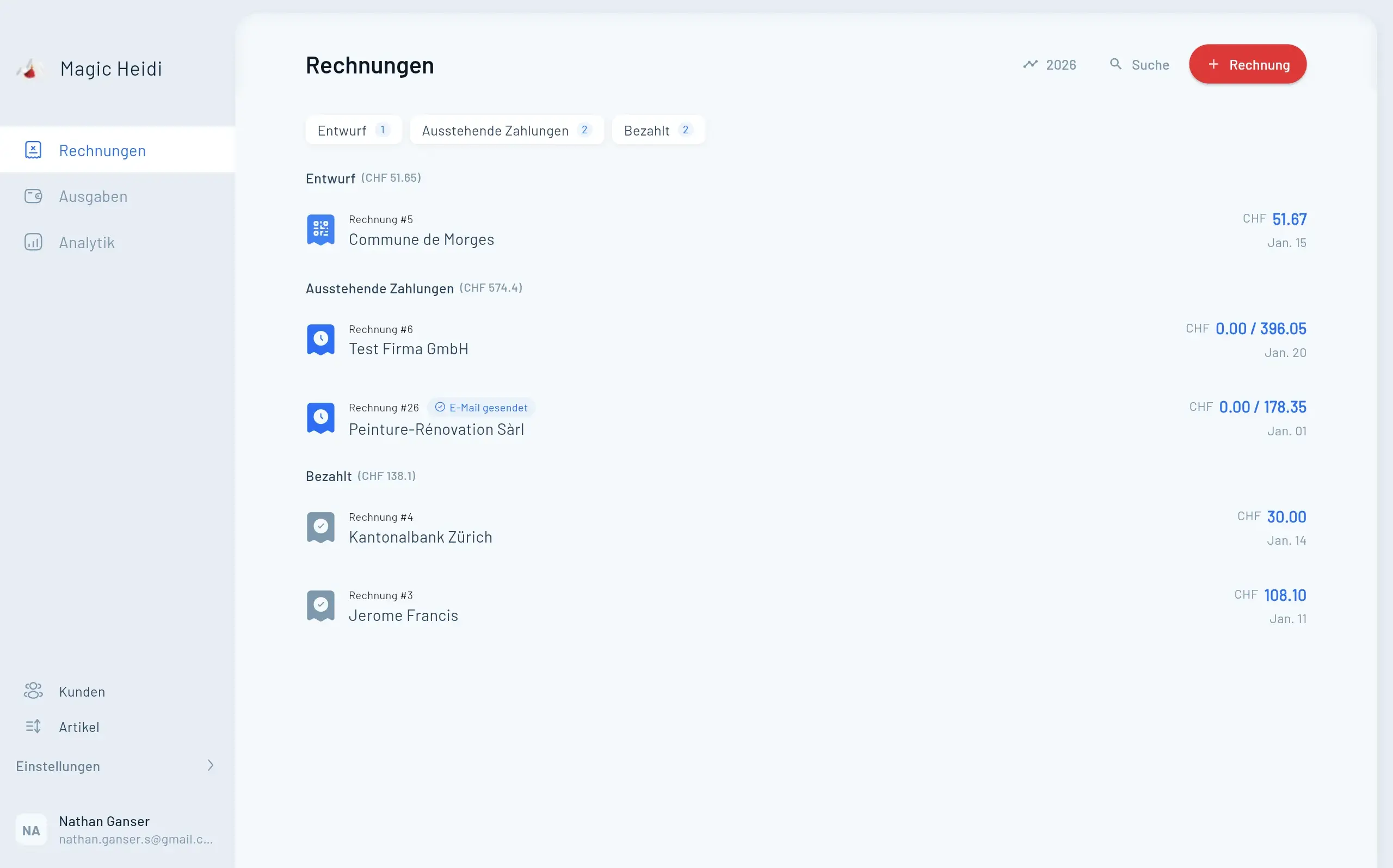
Anyone who issues invoices must first clarify at year-end what has actually been paid. This is exactly where clean bookkeeping separates itself from gut feeling, because open invoices, partial payments and late incoming payments change the view of revenue and receivables. With bank reconciliation in Magic Heidi, this step can be directly combined with a practical reconciliation of invoices and bank payments, instead of manually recording everything afterwards.

What works in practice

Monthly reconciliation beats the year-end marathon almost every time. If you check invoices against bank movements every month, you spot discrepancies early and don't have to guess in December which payment belongs to which invoice. This is especially useful with customers who only pay after a reminder, or when payments arrive across the turn of the month.

Practical rule: Always check invoices from December and January separately, because that's exactly where delays often distort the closing figures.

A clean process also means documenting deliberately written-off receivables in a traceable way. If you stop collecting a receivable, it should remain visible in the system why it was treated as a loss. Magic Heidi helps bring invoices, payments and notes together in one place, so you don't have to search through emails or stacks of paper for explanations later.

For freelancers with few but irregular clients, this is often the biggest time saver. Those who maintain reconciliation continuously not only get a cleaner closing at year-end, but also a realistic picture of liquidity. This makes the year-end closing checklist significantly less stressful, because open items become visible early.

2. VAT return and compliance review

VAT is not a side topic in the Swiss year-end closing, but a checkpoint with direct influence on the final figures. Since the rate change effective January 1, 2024, Switzerland applies the standard rate of 8.1%, the reduced rate of 2.6% and the special rate for accommodation of 3.8%. Those who allocate incorrectly here often only notice late — namely when the VAT audit or the tax documents don't match up cleanly. The historical classification of these rates is directly relevant in practice for Swiss sole proprietorships.

A drawn illustration with a calculator, a stack of documents, a receipt and coins for annual accounting and financial planning.

Separate cleanly before it gets expensive

International invoices require special attention. For cross-border services, it is not enough to simply book the amount — the VAT treatment must be professionally sound. Magic Heidi supports receipt capture in such a way that relevant fields are read from photos and PDFs, which reduces manual effort and makes allocation errors visible.

Especially for Swiss solo self-employed people, it's worth not skipping monthly closings. That way, incorrectly categorized receipts show up earlier, and the annual settlement doesn't turn into a big search operation. Retention also belongs in this step, because invoices and receipts must remain complete and legible.

  • Check invoices continuously: This way you catch VAT errors before they run through the whole year.
  • Capture receipts digitally: This saves time when gathering documents and reduces gaps.
  • File copies systematically: If you have to provide evidence later, you need documents quickly at hand.
  • Assign VAT rates correctly: This is crucial especially with multiple types of services.

The combination of receipt capture, VAT logic and closing preparation is one of the biggest advantages of good accounting software. Magic Heidi bundles exactly these points in a workflow that remains practical for Swiss sole proprietorships. You can find more about electronic VAT filing in the guide to filing VAT online.

3. Capture and categorize business expenses

Expenses are only helpful for the closing if they are captured cleanly. A receipt without a category, a credit card transaction without a receipt, or a private payment in the business account make profit determination unnecessarily inaccurate. Magic Heidi is strong here because receipts can be collected via email, photo or PDF and assigned directly to the appropriate cost types.

Consistently separate private and business expenses

Many problems don't arise with large items, but with the small mixtures in between. A laptop for private and business use, a restaurant receipt with a mixed purpose, or a spontaneous online payment can hardly be untangled cleanly at year-end. Those who separate private and business expenses from the start save themselves follow-up questions from the trustee later.

AI capture is helpful, but it doesn't replace the quick plausibility check. A second look is worthwhile especially with foreign currencies, because automatic recognition brings speed, but the professional classification remains with you. That's not a disadvantage, but exactly the point where a good checklist prevents errors.

If an expense can't be explained in two sentences, it needs to be reviewed again.

In practice, a simple rhythm works best. Don't collect receipts until the folder bursts — feed them in continuously, categorize them and check briefly. This keeps the closing manageable, and you have a clear picture at all times of materials, services, rent, insurance or travel costs. The year-end closing checklist thus turns from a burden at year-end into an ongoing routine process.

4. Review customer and debtor management

Open customer accounts often tell more about your business than the revenue total alone. Anyone who only looks at total revenue at year-end quickly overlooks which invoices have been open for a long time and which receivables may no longer seem collectible. A clean debtor review makes the closing figures more realistic and helps you plan for the next year at the same time.

Don't just balance — evaluate

A high open balance is not automatically a problem, but it needs context. If a customer has already been reminded several times or keeps postponing payments, that should be documented. That's exactly why it makes sense to record contact attempts and payment agreements in customer management.

Magic Heidi supports working with customer accounts, notes and attachments, so you don't have to jump between different filing systems. This is especially practical for freelancers who manage every client themselves and don't have a separate debtor team. Those who keep data cleanly across multiple projects also recognize which customer relationships are economically viable and where prices or payment terms should be adjusted.

For older receivables, a clear decision is worthwhile. What can realistically still be collected continues to be pursued. What is effectively unlikely to come in should be handled traceably so the closing doesn't appear artificially inflated. This is also important for future business planning, because then you don't just see revenue, but real payment quality.

For solo self-employed people, this is often an eye-opener. A good customer account is not just an accounting function, but a control instrument for liquidity and priorities.

5. Inventory management and item valuation

If you store goods, the year-end closing immediately becomes a bit more serious. Inventory is not a static value, but a snapshot that must be physically correct and traceable on the balance sheet. Even small differences between warehouse, sales and accounting can distort profit determination.

The stocktake must match reality

At year-end you should not only count inventory, but also value it. Whether FIFO, LIFO or the average method, what matters above all is that you use a consistent logic and document it. For trading businesses this is crucial, because the value of goods plays directly into the closing figures.

Magic Heidi can serve as a central repository here, even if the actual warehouse doesn't live in the tool. Photos, delivery documents and notes on shrinkage or damage can be brought together, so later queries don't get stuck in scattered folders. This is a big advantage especially for small shops, studios or manufactories, because there is usually no separate inventory management system running alongside.

  • Take the physical count seriously: Only the actual stock counts, not the everyday estimate.
  • Record shrinkage separately: Damaged or lost items don't simply belong silently in the figure.
  • Document the valuation method: Those who can later explain how the calculation was done save discussions.
  • Review slow-moving items: Some positions tie up capital even though they are hardly sold anymore.

A common mistake is simply carrying forward inventory values from the previous year. That seems convenient, but it's risky if the assortment, demand or condition of the items has changed. A good year-end closing checklist forces you to bring inventory and accounting together briefly but cleanly.

6. Review depreciation and fixed assets

Fixed assets are the part of the business that is not consumed immediately but loses value over time. Machines, cameras, software, vehicles or office equipment must therefore be recorded correctly and depreciated over the appropriate useful life. Those who work sloppily here unnecessarily shift profit and tax burden.

The fixed asset register is your safety net

A separate fixed asset register alongside Magic Heidi makes sense because you can record the acquisition date, value and useful life cleanly there. Exactly this data is what you need when someone later asks why an item was depreciated in a particular way. Additions and disposals also belong there so the picture remains complete.

What matters is not only the acquisition, but also the proof of when something entered the business and when it left again.

In practice, the problem often shows up with software or technology that becomes obsolete faster than expected. A laptop may still function, but economically no longer make sense. Those who document value losses and technical obsolescence make the closing more robust and avoid discussions with the trustee.

Magic Heidi helps above all on the documentation side. Receipts, notes and payment proofs can be filed in such a way that the documents don't have to be gathered individually later. If you work with a trustee, exactly this overview is worth its weight in gold, because the depreciation calculation is then carried out on a clean basis.

For solo businesses this is especially pleasant. You don't have to automate everything perfectly, but you should document every asset in such a way that the logic is still traceable next year.

7. Prepare the profit and loss statement and tax calculation

The profit and loss statement shows whether your business carried itself during the year. It also makes clear how high the taxable income turns out. Those who keep the figures clean here go into the tax return more calmly and notice earlier when something goes off track.

Monthly control makes the annual figure credible

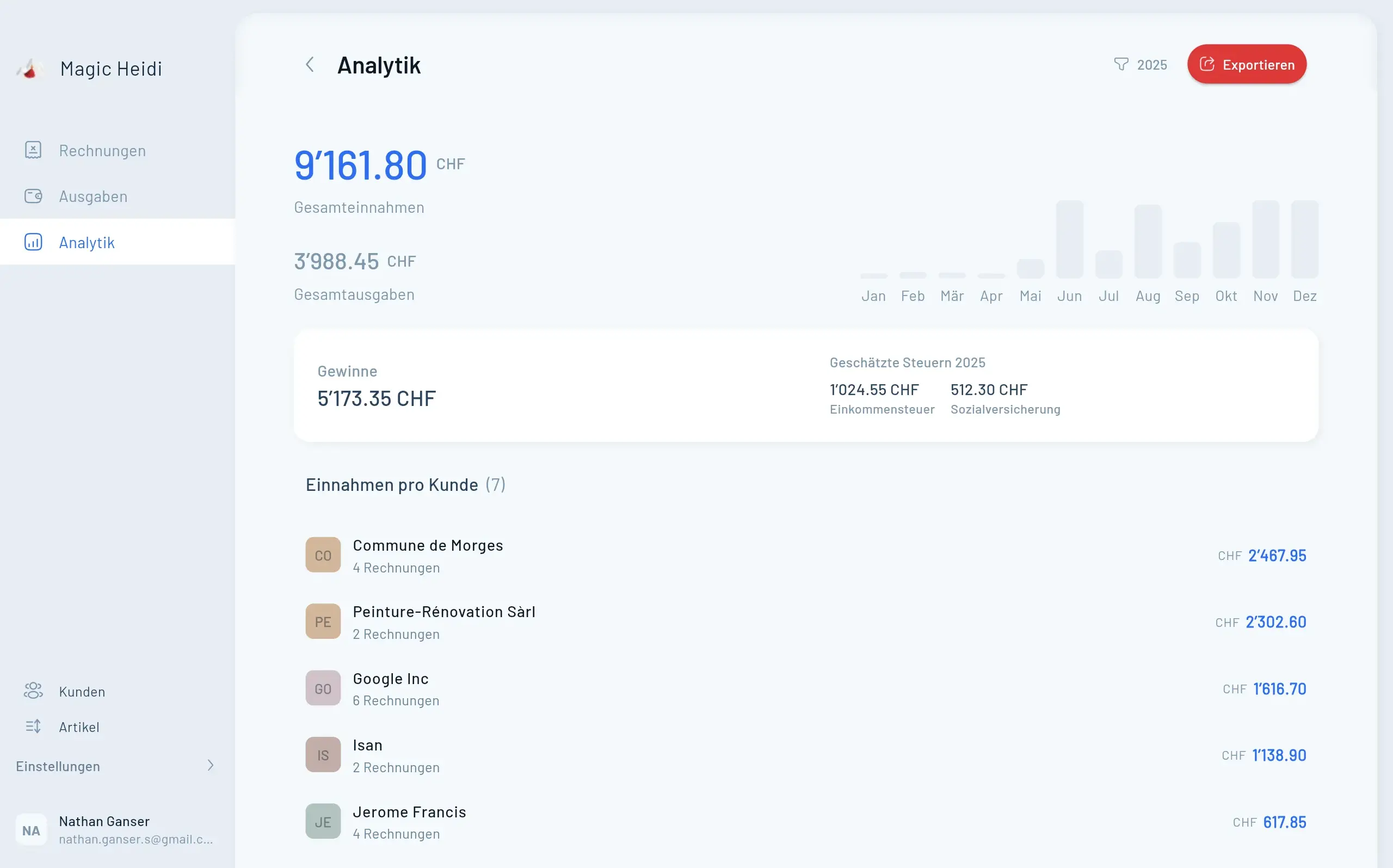
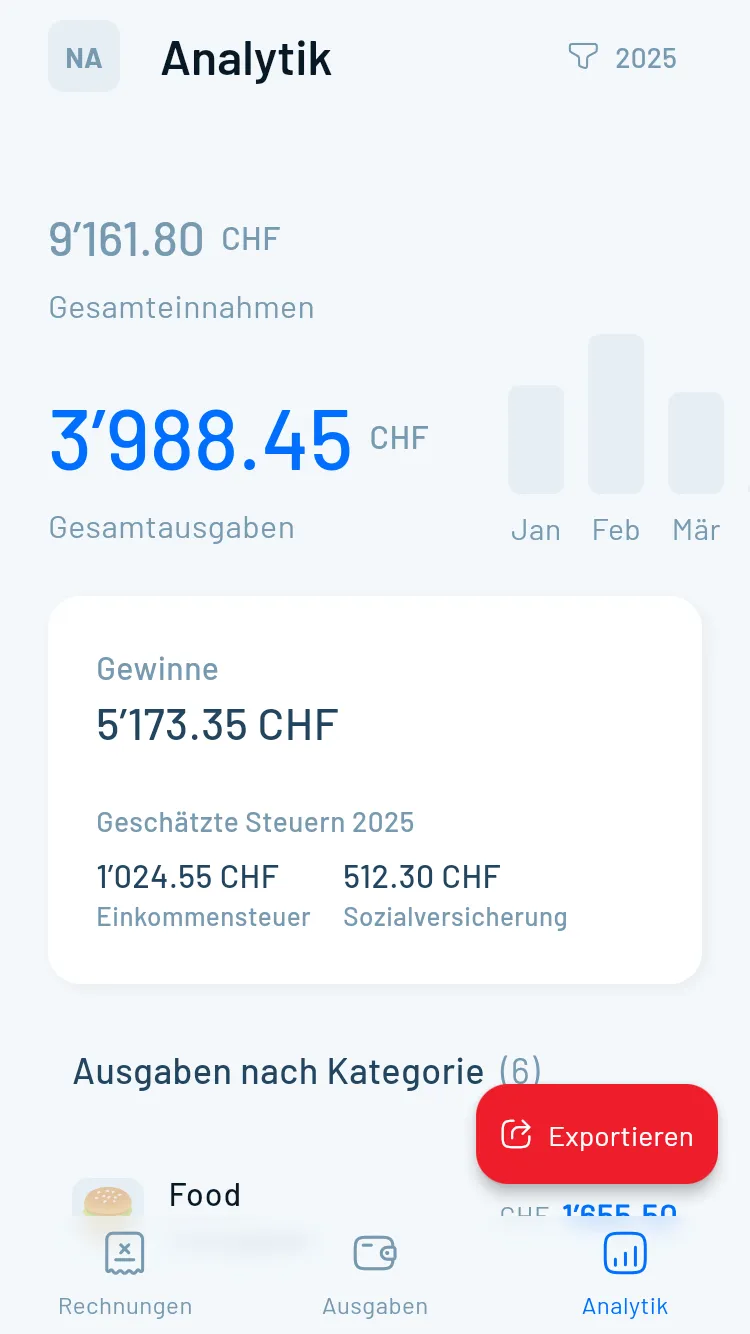
If you only check profits and margins at year-end, outliers often remain undetected for too long. With monthly checks you see faster whether the gross profit margin stays stable or individual months are dragging unnecessarily. The dashboard in Magic Heidi helps here because revenue, expenses, profit and estimated tax burden are visible in one place.

This makes tax planning more tangible. You can assess the expected burden earlier and build reserves in time, instead of reacting only shortly before the tax return. The comparison with previous year's values also shows you whether your business is developing healthily or whether individual positions should be examined more closely.

It also makes sense to export the profit and loss statement several times a year. That way you don't wait until the end for the overall picture, but can check along the way whether categories, income and expenses fit together. Those who work this way make better decisions on prices, investments and liquidity planning.

A year-end closing checklist at this point is more than a control sheet — it helps you read the course of business during the year. That's exactly why the effort is worthwhile continuously and not only in the last week.

8. Validate data, collect evidence and document the closing

The cleanest closing is of little use if the documents cannot be fully verified afterwards. That's why the end includes validating all data, securing the receipts and clearly documenting all corrections. This is exactly where it is decided whether your closing is not only finished, but also auditable.

Completeness matters more than cosmetic order

Magic Heidi is particularly helpful in this step because you can export all data as a backup at year-end. On top of that comes the ability to store receipts legibly as photos or PDFs, which makes providing evidence later significantly easier. If you have made changes manually, these should be in the notes so the origin of the figures remains traceable.

At the end, check not only the bookings, but also the receipts themselves. A clean export only helps if the documents are legible and complete.

For collaboration with trustees or authorities, the document structure is crucial. Account statements, open item lists, trial balances, receipt copies and export files must fit together in such a way that follow-up questions can be answered quickly. Those who keep their own closing list with completion status at the end create peace of mind in case something still needs to be found later.

The retention obligation remains central. Receipts and exports should remain fully available for the required period, so you don't have to frantically search for old PDFs when an inquiry comes in. This final phase turns your year-end closing checklist into a robust archive and not just a snapshot.

8-point comparison: year-end closing checklist

In practice, a year-end closing often becomes tedious exactly where work steps are completed individually and no one sees the common thread. For Swiss self-employed people, that's exactly the point where a good year-end closing checklist must do more than just list tasks. It must show how each step interlocks cleanly, where Magic Heidi reduces manual work and where typical errors arise for Swiss sole proprietorships.

The following overview is therefore not an abstract comparison. It organizes the 8 steps by effort, benefit and typical use, and it directly shows how Magic Heidi supports the process, from AI receipt capture to the trustee export. Anyone working with QR invoices, VAT codes, open debtors or a fixed asset register immediately recognizes where automation saves time and where professional control is still necessary.

🔄 Implementation complexity⚡ Resource requirements / efficiency📊 Expected results💡 Ideal use cases⭐ Key benefits
Verify invoice reconciliation and incoming paymentsMedium, because bank transactions, QR invoices and reconciliation rules must fit together cleanlyFewer open items, clear receivables overview, fewer duplicate bookingsSwiss sole proprietorships with many invoices, partial payments or mixed incoming paymentsMagic Heidi reconciles bank transactions with invoices, reliably recognizes QR invoices and reduces manual searching in the debtor base
VAT return and compliance reviewHigh, because VAT rates, input tax and special cases must be separated cleanly depending on the businessCorrect VAT return, fewer follow-up questions, better preparation for taxesVAT-liable freelancers, service providers with domestic and foreign business, companies with mixed tax codesMagic Heidi assigns receipts to the correct VAT codes, prepares the data for the return and simplifies the export for filing — see also filing VAT online with clear preparation
Capture and categorize business expensesLow to medium, because the AI does much of the preliminary work and only exceptions are checked manuallyFaster receipt capture, better separation of business and private, complete filingSelf-employed people with many expenses, credit card receipts or digital receipts from email and photoMagic Heidi reduces manual entries through AI receipt capture, recognizes typical expense categories and makes receipt filing for the year-end closing significantly calmer
Review customer and debtor managementMedium, because open invoices, reminders and customer accounts must be considered togetherMore realistic cash flow view, fewer forgotten receivables, cleaner customer accountsService providers with recurring customers, subscription models or many open invoicesMagic Heidi shows open items centrally, supports debtor control and helps identify unpaid invoices early, before they disrupt the closing
Inventory management and item valuationMedium to high, because stocktake, valuation method and goods movements must fit togetherConsistent inventory values, better profit determination, traceable inventory correctionsTrading businesses, small warehouses, sole proprietorships with goods inventory or project materialMagic Heidi links purchasing and sales data, keeps inventory development traceable and simplifies valuation for the closing
Review depreciation and fixed assetsMedium, because the fixed asset register, acquisitions and useful life must be maintainedClean depreciation, complete asset overview, better evidence for the trusteeCompanies with equipment, IT, machines or larger acquisitions in the business yearMagic Heidi supports the documentation of acquisitions, keeps fixed assets structured and simplifies later exports for the trustee
Prepare profit and loss statement & tax calculationMedium, because figures from several areas must be brought together and special cases reviewedEarly visibility of profit development, better tax planning, more reliable documents for adviceFreelancers with irregular income, planning for tax returns, preparation for exchanges with the trusteeMagic Heidi bundles evaluations in one place and makes preparation for tax forms and internal planning clearer, instead of gathering data from multiple sources
Validate data, collect evidence and document the closingMedium, because receipts, exports and audit trails must be brought together cleanlyComplete audit trail, clear documentation, better handover to trustee or auditYear-end closing phase, internal control, handover to third parties, the accounting obligations for the CFOMagic Heidi brings receipts, exports and evidence together so that account statements, receipt copies and closing documents remain consistent

Anyone reading the steps this way recognizes the real difference from the usual checklist. It's not just about what needs to be done, but also about how much of it can be prepared digitally in a Swiss sole proprietorship without losing professional control. Especially with VAT, QR invoices and trustee exports, this brings a noticeable advantage because less manual work and fewer media breaks remain.

Practice also clearly shows the limits. Not every step can be fully automated, especially where tax special cases, inventory corrections or depreciation questions occur. That's exactly why Magic Heidi is not a replacement for accounting here, but a tool that speeds up routines and reduces typical sources of error.

Your year-end closing 2026: clean, digital, done

A good year-end closing doesn't happen in the last night before the tax deadline, but through small, consistent work steps throughout the year. That's exactly what makes the difference between hectic gathering and a clean, traceable closing. For Swiss self-employed people this is especially important because accounting, VAT, receipts and tax data are closely connected and errors often only become visible late.

The best routine is simple. Reconcile invoices continuously, capture receipts immediately, separate expenses cleanly, check customer accounts regularly, count inventory honestly, document assets, keep an eye on profit development and validate everything at the end. Those who keep this order reduce not only stress, but also follow-up questions from the trustee.

Magic Heidi fits exactly into this process because the software bundles invoices, receipts, VAT, bank reconciliation, exports and evaluations in one place. For freelancers and sole proprietorships in Switzerland this is practical because less has to be gathered manually and the data basis for the closing stays cleaner. This turns the year-end closing from a special case into a routine that can be repeated every year.


If you want to translate your year-end closing checklist directly into a simple workflow, try Magic Heidi in everyday life. With invoices, receipt capture, VAT and exports in one place, preparation becomes significantly easier. Visit Magic Heidi and set up your next closing so that it already runs along during the year.