Swiss Sole Proprietorship:
The Complete Guide (2026)

Over 52% of Swiss businesses are sole proprietorships. Discover everything you need to know to set up, manage, and grow your Einzelfirma with confidence.

Swiss entrepreneur office

The sole proprietorship (known as Einzelfirma in German or raison individuelle in French) is the most common legal form in Switzerland. Easy to set up, with no minimum capital and favorable taxation, it appeals to freelancers, consultants, tradespeople, and independent professionals looking to get started quickly.

This guide covers:

  • what a sole proprietorship is and its legal characteristics
  • the concrete advantages and disadvantages
  • step-by-step setup process
  • taxation, accounting, and social security contributions
  • the critical thresholds (CHF 100,000 and CHF 500,000)
  • comparison with the GmbH and when to consider transitioning

Already self-employed? Magic Heidi simplifies invoicing, accounting, and VAT for Swiss sole proprietorships.

Who should choose a sole proprietorship?

A sole proprietorship is particularly well suited for:

  • Freelancers and consultants: developers, designers, translators, coaches
  • Tradespeople and service providers: plumbers, electricians, photographers
  • Liberal professions: architects, therapists (subject to specific regulations)
  • Online businesses: e-commerce, digital marketing, content creation
  • Side businesses: supplementary income alongside salaried employment

If you are starting out on your own, testing an idea, or prioritizing simplicity, a sole proprietorship is generally the best starting point.

Advantages

The 8 advantages
of a sole proprietorship

Simple, fast, and affordable β€” the sole proprietorship offers considerable benefits for Swiss freelancers and self-employed professionals.

The disadvantages you need to understand

The sole proprietorship also has important limitations. Before you start, evaluate these risks to make an informed choice.

⚠️

Unlimited personal liability

You are personally liable for all business debts with your entire private assets: savings, real estate, vehicles
πŸ“›

Restricted business name

The business name must include your surname. You cannot use a brand name alone.
🚫

No partners or investors

It is impossible to bring in a partner or raise external funding. Growth is limited to personal financing.
πŸ“‰

No unemployment insurance

Self-employed individuals do not contribute to unemployment insurance. If you lose your business, there is no automatic coverage.
πŸ”„

Difficult to transfer

The business has no independent legal existence. In case of death or retirement, it ceases to exist unless assets are transferred.
πŸ’Έ

Limited tax optimization

No option to pay yourself a salary or dividends to reduce the overall tax burden.
Setup steps

Setting up your sole proprietorship:
step by step

Creating a sole proprietorship in Switzerland is one of the simplest business setup processes. Follow these steps to get started in full compliance.

Business setup documents
Practical guide

The 6 steps to get started

From verifying your business name to opening a bank account, here is the complete process for setting up your sole proprietorship.

Step 1

Choose and verify your business name

Your business name (Firmenname / raison sociale) must include your surname. You can add a first name, a fantasy name, or a description of your activity.

  • Required: include your surname (e.g., 'Smith Consulting')
  • Prohibited: using AG, GmbH, Group, or any misleading terms
  • Check availability on zefix.ch (central index)
  • Name protection applies only within the same municipality
Business name verification
Step 2

Register with AHV as self-employed

This is the most important step. Contact the AHV compensation office in your canton to obtain self-employed status.

  • Mandatory once income exceeds CHF 2,500/year
  • Provide invoices, contracts, and proof of multiple clients
  • Demonstrate economic risk and independence
  • Decision within 2-6 weeks
AHV self-employed registration
Step 3

Commercial register (if applicable)

Registration in the commercial register (Handelsregister) is mandatory above CHF 100,000 annual turnover, but can be done voluntarily before that.

  • Mandatory from CHF 100,000 annual turnover
  • Voluntary below that (boosts credibility)
  • Via EasyGov or the cantonal commercial register office
  • Cost: approximately CHF 120-250
Swiss commercial register
Step 4

VAT registration (if applicable)

VAT liability is mandatory from CHF 100,000 turnover. Voluntary registration is possible below this threshold.

  • Mandatory from CHF 100,000 annual turnover
  • 30-day deadline after reaching the threshold
  • Choose between effective method and flat tax rate method
  • Voluntary registration allows you to reclaim VAT on purchases
VAT management
Step 5

Arrange the necessary insurance

Some types of coverage are mandatory, while others are strongly recommended to protect your business.

  • Mandatory: AHV/IV/EO (social security contributions)
  • Mandatory if you have employees: accident insurance (UVG)
  • Recommended: professional liability insurance
  • Optional: 2nd pillar (occupational pension / BVG)
Protection and insurance
Step 6

Open a business bank account

While not legally required, a separate account makes accounting and tax audits much easier.

  • Recommended: separate personal and business finances
  • Necessary for VAT registration and the commercial register
  • Compare fees across banks (CHF 5-25/month)
  • Digital alternatives: Yuh, neon, Revolut Business
Banking for self-employed

Setup costs: how much does it cost?

The sole proprietorship is the cheapest legal form to set up in Switzerland:

ItemCost
AHV registration (self-employed)Free
Commercial register (if applicable)CHF 120-250
VAT registrationFree
Business bank accountCHF 0-25/month
Accounting softwareCHF 0-30/month
Total startup costCHF 0-500

Compare this with a GmbH (CHF 2,000-5,000 + CHF 20,000 capital) or an AG (CHF 5,000-10,000 + CHF 100,000 capital).

With Magic Heidi: start for free with 3 invoices and 3 expenses, then upgrade to unlimited from CHF 24.99/month.

Magic Heidi accounting dashboard

Practical example: taxation of a self-employed person

Scenario: Clara, a marketing consultant in Lausanne, with CHF 95,000 in annual turnover.

ItemAmount
Annual turnoverCHF 95,000
Deductible business expenses- CHF 15,000
Net business incomeCHF 80,000
AHV/IV/EO contributions (~10%)- CHF 8,000
Pillar 3a contribution- CHF 7,258
Taxable income (before other deductions)~CHF 64,742

Estimated tax burden (Canton of Vaud): approximately CHF 10,000-13,000 in taxes, depending on the municipality and personal situation.

Key advantage: No double taxation. With a GmbH, Clara would first pay corporate tax on profits, then personal tax on her salary and dividends.

Comparison

Sole proprietorship vs. GmbH

Here is a detailed comparison to help you choose the right structure for your situation.

CriterionSole proprietorshipGmbH
Minimum capitalβœ“ CHF 0CHF 20,000
LiabilityUnlimited (personal assets)βœ“ Limited to capital
Setup timeβœ“ 1-4 weeks4-8 weeks
Setup costβœ“ CHF 0-500CHF 2,000-5,000
Accountingβœ“ Simplified (under 500k)Double-entry mandatory
Taxationβœ“ Single (income)Double (corporate + dividends)
Partnersβœ— Not possibleβœ“ Possible
Investorsβœ— Noβœ“ Share capital
Unemployment insuranceβœ— Noβœ— No (director)
Admin burdenβœ“ LowMedium

When should you switch from a sole proprietorship to a GmbH?

Transitioning to a GmbH becomes worthwhile when:

  1. Your turnover exceeds CHF 100,000-150,000 and salary/dividend tax optimization becomes advantageous
  2. You take on significant risks (large contracts, inventory, liability) and want to protect your personal assets
  3. You plan to hire employees and want a clear separation between the business and yourself
  4. You want to bring in a partner or seek investors
  5. Your corporate clients require it for credibility or compliance reasons

How to convert your sole proprietorship into a GmbH

A direct "conversion" is not possible. The process involves:

  1. Creating a new GmbH (articles of incorporation, notary, CHF 20,000 capital)
  2. Transferring the assets and liabilities from the sole proprietorship to the GmbH (contribution in kind or acquisition)
  3. Deregistering the sole proprietorship from the commercial register
  4. Verifying the conditions for tax deferral (tax postponement if book values are maintained)

Estimated timeline: 3-6 months. Tip: carry out the transition at the beginning of a financial year to simplify documentation. See our guide on business structures for more details.

Common mistakes
to avoid

Thousands of self-employed professionals make these mistakes every year. Here is how to avoid them and start on the right foot.

βœ… Best practice
πŸ’‘ Pro tip
βš–οΈ Compliance
πŸ›‘οΈ Protection
⚠️
Underestimating liability

A dispute or unpaid debt can consume your personal assets. Take out professional liability insurance.

πŸ“Š
Not separating finances

Mixing personal and business accounts complicates accounting and tax audits.

⏰
Missing the VAT threshold

You have 30 days to register once you reach CHF 100,000 in turnover. Late registration incurs penalties.

πŸ“
Neglecting documentation

Keep all receipts from day one. Tax audits can cover up to 10 years.

πŸ”„
Waiting too long to transition

Staying as a sole proprietorship too long exposes your assets. Plan the GmbH transition ahead of time.

πŸ’°
Forgetting retirement planning

With no mandatory 2nd pillar, build your retirement through pillar 3a (up to CHF 36,288/year).

Use case

Sole proprietorship and side business

Many people in Switzerland combine salaried employment with a self-employed activity through a sole proprietorship. This is perfectly legal and very common.

Side business freelancing

Dual status: employed and self-employed

You can absolutely keep a salaried job while running a sole proprietorship:

How it works:

  • Your employer handles AHV contributions on your salary (50/50 split)
  • You register separately with AHV for your self-employment income
  • At tax time, both incomes are combined

Example: Marc, an engineer in Zurich (salary CHF 80,000), runs an IT consulting side business in the evenings (CHF 25,000/year from 4 clients).

  • AHV on salary: handled by the employer
  • AHV on self-employment: ~6% on CHF 25,000 = ~CHF 1,500/year
  • Total taxable income: CHF 105,000
  • Professional expenses from consulting (equipment, software, travel) are deductible

Points to watch:

  • Do not directly compete with your employer
  • Check the clauses in your employment contract
  • The side activity should not compromise your salaried performance

Learn more in our guide on registering as self-employed.

Simplified management

How Magic Heidi simplifies life for the self-employed

Set up your sole proprietorship and focus on your work. Magic Heidi handles the accounting paperwork for you.

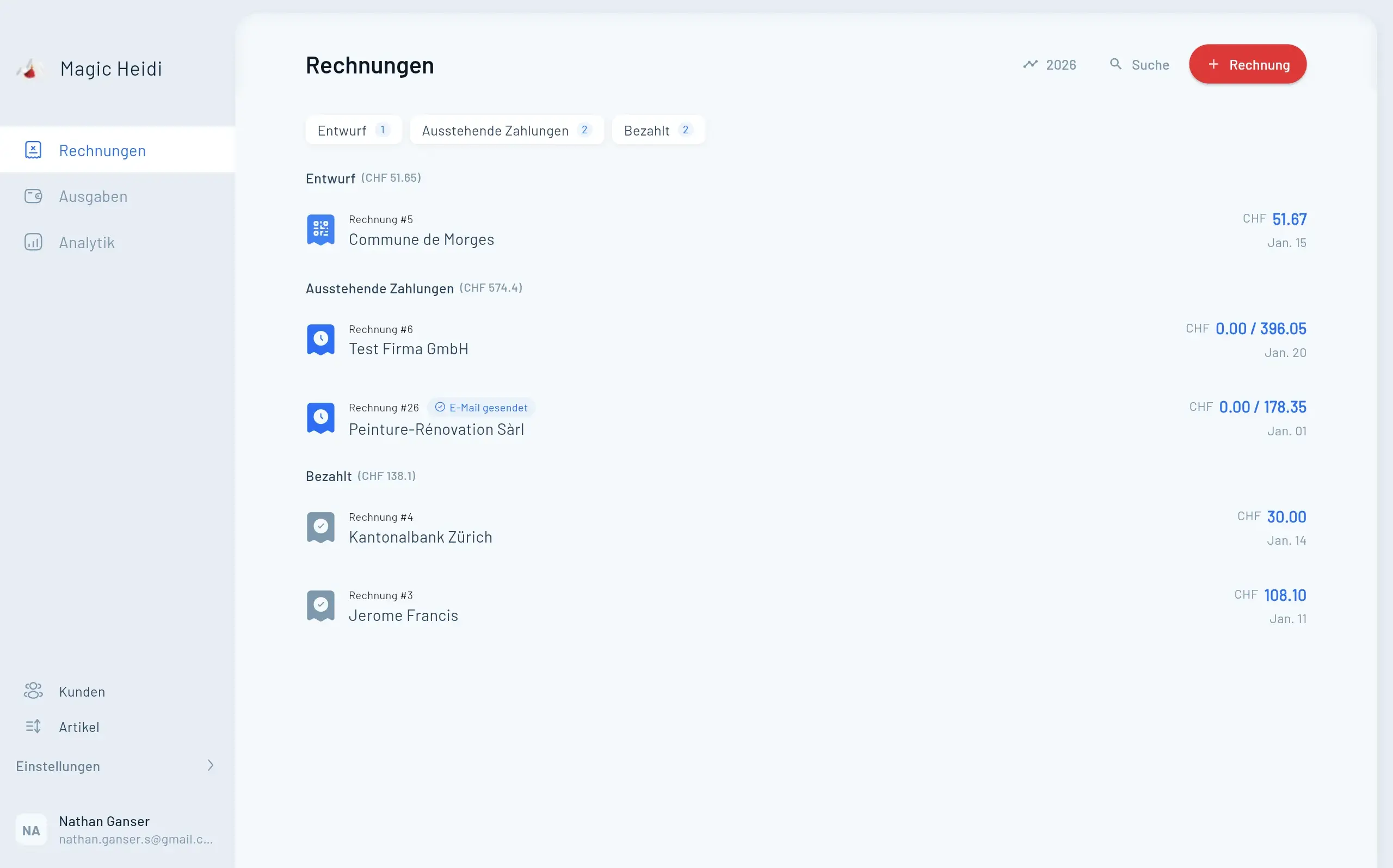
  • 🧾
    Swiss QR invoices

    Create compliant invoices with QR-IBAN in 30 seconds. Automatic sending, tracking, and reminders.

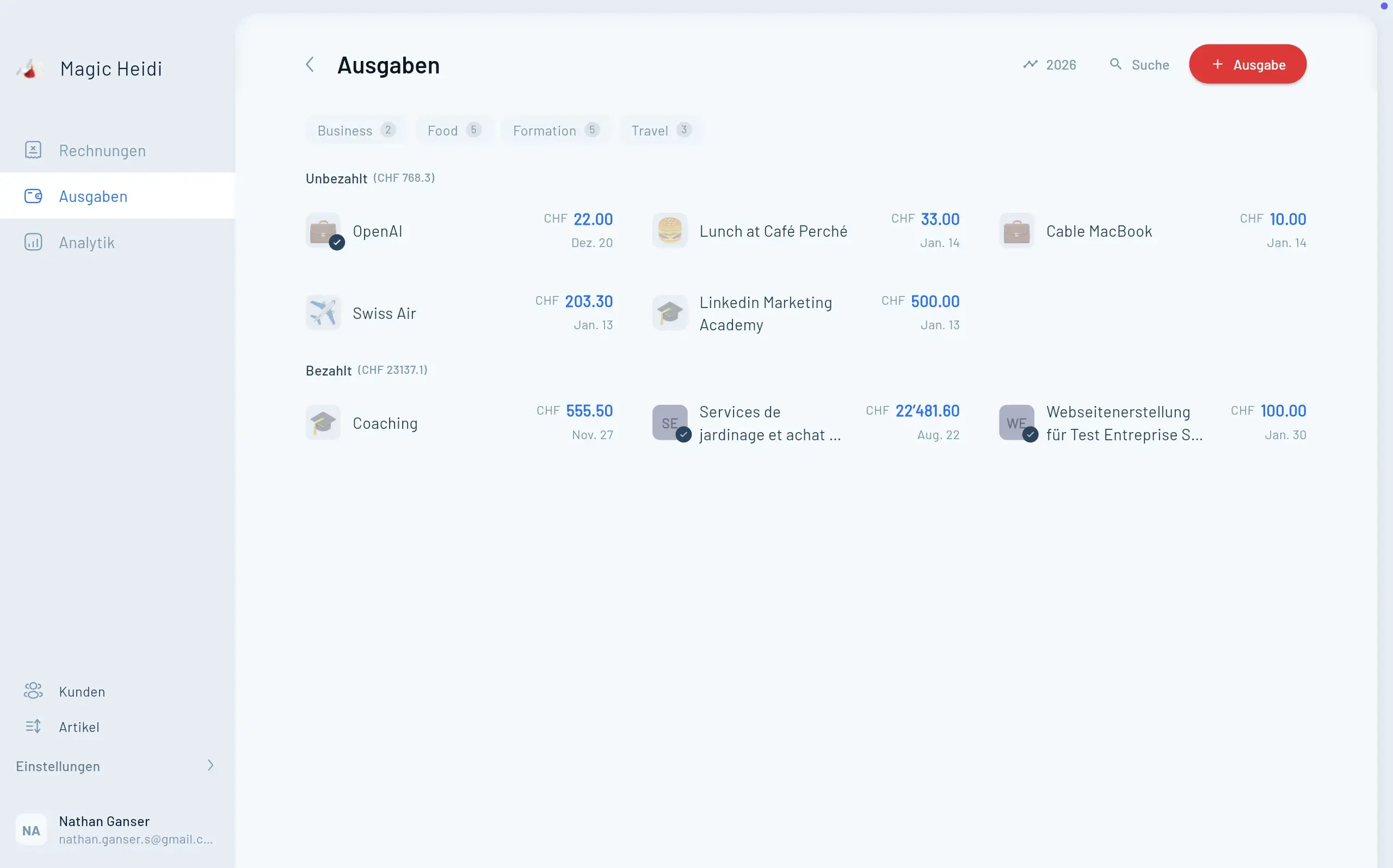
  • πŸ“Έ
    AI-powered expenses

    Photograph your receipts β€” AI extracts the date, amount, VAT, and category automatically.

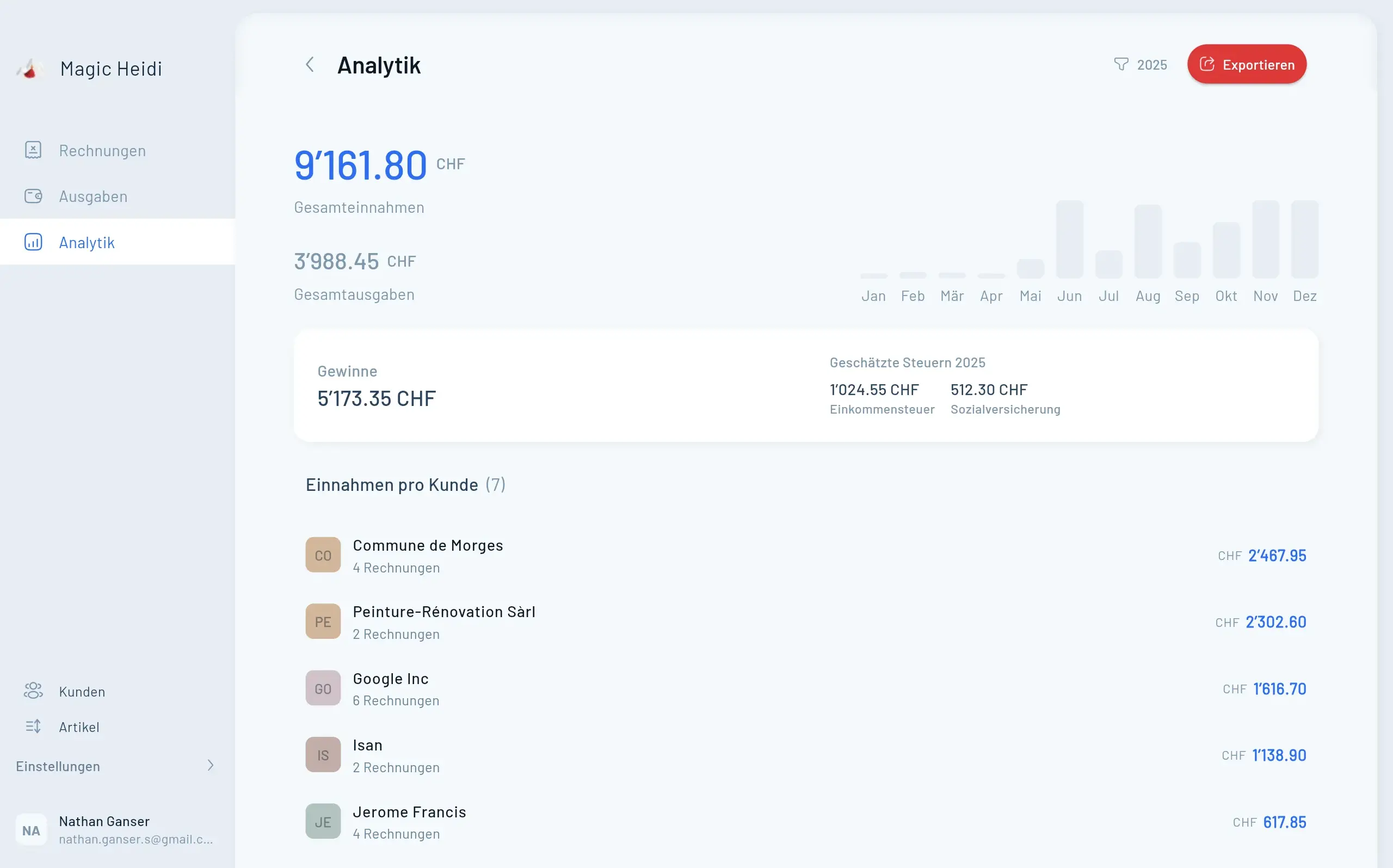
  • πŸ“Š
    Simplified accounting

    Income/expense dashboard tailored to the simplified accounting requirements of sole proprietorships.

  • 🏦
    Bank statement import

    Connect your bank and reconcile your transactions in a few clicks.

Invoices
  • Invoice #3

    Magic Heidi

    CHF 500

    Jan 29

  • Invoice #2

    Webbiger LTD

    CHF 2000

    Jan 24

  • Invoice #1

    John Doe

    CHF 600

    Jan 20

FAQ

Frequently asked questions

Can I hire employees with a sole proprietorship?

Yes, absolutely. Despite the term 'sole' proprietorship, you can employ staff. You will then need to register as an employer with AHV, take out accident insurance (UVG), and manage payroll statements.

Do I need to register in the commercial register?

This is mandatory only if your annual turnover exceeds CHF 100,000. Below that, registration is voluntary but recommended for credibility. More details in our guide on the Swiss commercial register.

Can I use a brand name without my surname?

No, for commercial register registration, the business name must contain your surname. However, you can use a trade name (brand name) alongside it for your marketing and communication.

How can I protect my personal assets with a sole proprietorship?

Unlimited liability cannot be eliminated in a sole proprietorship. You can mitigate the risk with professional liability insurance, prudent debt management, and, if risks increase, transitioning to a GmbH.

Do I need to charge VAT?

Only if your annual turnover reaches or exceeds CHF 100,000. Below that, VAT registration is voluntary. See our guide on Swiss VAT for more details.

Which accounting software should I use?

For sole proprietorships, simple software suited to simplified accounting is sufficient. Magic Heidi is designed specifically for Swiss freelancers: QR invoicing, AI expenses, automatic VAT.

What happens if I exceed CHF 100,000 during the year?

You have 30 days to register for VAT. Registration in the commercial register must also be completed. Plan for these steps in advance if you are approaching the threshold.

Can I convert my sole proprietorship into a GmbH?

Yes, but it is not a direct conversion. You need to create a GmbH, transfer the assets, then deregister the sole proprietorship. The process takes 3-6 months. A tax deferral may avoid taxation of unrealized capital gains.

How much are social security contributions?

Approximately 10% of your net self-employment income (AHV/IV/EO), with a declining scale for incomes below CHF 60,500. The minimum is CHF 530/year. Cantonal family allowances (0.3-3%) are added on top.

Am I eligible for pillar 3a?

Yes. Without a 2nd pillar (BVG), you can contribute up to 20% of your net income, capped at CHF 36,288/year. With a 2nd pillar, the maximum is CHF 7,258/year. These contributions are tax-deductible.

Launch your sole proprietorship with confidence

Thousands of Swiss freelancers trust Magic Heidi to handle invoicing, accounting, and VAT. Start for free and focus on what you do best.

Key takeaways

The sole proprietorship (Einzelfirma / raison individuelle) is the ideal choice for starting a self-employed activity in Switzerland:

βœ… Simple setup: no minimum capital, no notary, quick start βœ… Favorable taxation: single taxation at the personal rate, no double taxation βœ… Lightweight accounting: simplified accounting below CHF 500,000 βœ… Full autonomy: decision-making freedom without governance constraints

⚠️ Points to watch:


Last updated: March 2026. Swiss regulations change regularly. Verify current thresholds and requirements with your cantonal compensation office or at ch.ch.