5 / 5
I created my LLC 3 months ago. Magic Heidi allowed me to start my accounting from day one, without any prior knowledge. QR invoices are ready in 30 seconds.
Julie Renard
Interior Architect, Geneva
55,654 businesses created in 2025. Exact procedures, real costs by canton, timelines, required documents, incorporation services and mistakes to avoid: everything you need to make your project a reality, step by step.

You have decided to take the leap. Congratulations. But between the idea and the officially registered business, there is an administrative process that 90% of guides gloss over.
This guide is not yet another article about "why start a business in Switzerland" — for that, check out our strategic guide to entrepreneurship. Here you will find the concrete how-to: the forms to fill out, the offices to contact, the exact costs by canton, and the realistic timelines for each step.
Whether you want to become a freelancer or create a company with partners, this guide covers the entire incorporation process, from the first step through your first 90 days of operations.
Before filling out a single form, make sure you have these four elements in place. They will determine the success of every subsequent step.
For a sole proprietorship, your personal address is sufficient in most cases. However, check your lease: some property managers prohibit commercial activity at home.
For an LLC (Sàrl) or Corporation (SA), you can use your private residence, rent an office, or use a domiciliation service (CHF 100-500/month) that provides you with an official business address. This is particularly useful if you are a foreigner or if you want to register your company in a tax-advantageous canton.
Tip: if your business does not require premises, start from home to reduce your fixed costs.
Your choice of legal structure determines everything else: procedures, costs, timelines and liability. This table helps you decide quickly.
| Criterion | Sole Proprietorship (RI) | LLC (Sàrl) | Corporation (SA) |
|---|---|---|---|
| Minimum capital | CHF 0 | CHF 20,000 | CHF 100,000 |
| Incorporation cost (excl. capital) | CHF 100-800 | CHF 1,200-3,000 | CHF 2,500-5,000 |
| Realistic incorporation timeline | 1-2 weeks | 3-4 weeks | 4-6 weeks |
| Liability | Unlimited (personal assets) | ✓ Limited to capital | ✓ Limited to capital |
| Notary required | ✗ No | ✓ Yes | ✓ Yes |
| Accounting requirements | Simplified (under CHF 500K revenue) | Double-entry mandatory | Double-entry mandatory |
| Number of founders | 1 person | 1+ partners | 1+ shareholders |
| Ideal for | Freelancers, consultants, small budgets | SMEs, team projects, liability protection needed | Fundraising, large-scale projects |
The following sections detail the complete process for the two most common structures: the sole proprietorship and the LLC.
The fastest and least expensive legal form. Here are the steps in exact order, with real 2026 timelines and costs.
Contact the compensation office in your canton to declare your self-employed activity. This is the very first mandatory step. See our guide to registering as self-employed.
The name of your sole proprietorship must contain your surname. You can add a complement describing your activity. Try our business name generator.
Not legally required for a sole proprietorship, but strongly recommended to separate your personal and business finances.
Mandatory from CHF 100,000 annual revenue, but strongly recommended even below that threshold for credibility and name protection. Learn more in our commercial register guide.
VAT registration is mandatory from CHF 100,000 annual revenue. Below that threshold, registration remains voluntary.
Some insurance is mandatory, others are strongly recommended depending on your activity.
More structured, more protective, more expensive. Here are the key steps and pitfalls to avoid when creating an LLC in Switzerland.
The articles of association are the founding document of your LLC. They define the operating rules of the company.
The minimum share capital of CHF 20,000 must be deposited in a blocked account at a Swiss bank before incorporation.
The deed of incorporation must be authenticated by a notary. All founding partners must be present (or represented by power of attorney).
The notary submits the complete file to the commercial register office in your canton.
Upon receipt of the commercial register extract, present it to your bank to unblock the capital.
Your LLC officially exists, but several additional registrations are required.
Costs vary considerably from one canton to another. Here is a comparison for the 6 most popular cantons among business founders.
| Criterion | Geneva | Vaud | Zurich | Zug | Basel-City | Ticino |
|---|---|---|---|---|---|---|
| Commercial register fees (sole prop.) | CHF 400 | CHF 350 | CHF 240 | CHF 200 | CHF 280 | CHF 300 |
| Commercial register fees (LLC) | CHF 720 | CHF 680 | CHF 600 | CHF 550 | CHF 620 | CHF 650 |
| Notary fees (LLC) | CHF 1,500-3,000 | CHF 1,200-2,500 | CHF 700-1,500 | CHF 490-1,000 | CHF 800-1,500 | CHF 600-1,200 |
| Corporate tax rate | ~14% | ~14% | ~19% | ~12% | ~13% | ~16% |
| Average commercial register timeline | 10-15 days | 10-15 days | 7-10 days | 5-7 days | 7-12 days | 10-15 days |
| Total LLC cost (estimate) | CHF 3,500-5,000 | CHF 3,000-4,500 | CHF 2,000-3,200 | CHF 1,600-2,500 | CHF 2,100-3,000 | CHF 2,000-3,000 |
The choice of canton is not just about taxation. Processing times, notary fees and commercial register costs vary significantly.
Zug offers the best overall value: attractive taxation (around 12%), among the lowest incorporation fees, and fast processing (5-7 days). Zurich is fast but more expensive in taxes. Geneva and Vaud are the most expensive for notary fees.
Important: you can register your business in a different canton from where you reside, provided you have an actual address there (office or domiciliation service). However, beware of "tax tourism": the authorities verify the reality of your economic presence.
• ID card or passport
• Proof of residence in Switzerland
• Detailed description of the business activity
• Client contracts or invoices (proof of multi-client activity)
• Professional qualifications (if regulated profession)
• Business plan (recommended for social insurance)
• AVS registration form from your cantonal compensation office
• Commercial register application form (if applicable)
• Articles of association signed by all founders
• Notarized deed (drafted by the notary)
• Bank certificate of capital deposit
• ID of all partners/shareholders
• Declaration of beneficial owners (Lex Friedrich form)
• Commercial register application form
• Appointment of manager(s) with specimen signature
• Lease or domiciliation certificate for the registered office
Should you do everything yourself, use an online service, or hire a fiduciary? Here is an objective comparison.
| Criterion | DIY (EasyGov) | Online service | Fiduciary / Notary |
|---|---|---|---|
| Service cost | Free (fixed fees only) | CHF 490-1,200 | CHF 1,500-4,000 |
| Total timeline | 3-5 weeks | 2-3 weeks | 2-4 weeks |
| Support | ✗ None | ✓ Step-by-step guidance | ✓ Personalized |
| Risk of errors | High (if beginner) | Low | Very low |
| Tax advice included | ✗ No | ✗ Basic | ✓ Comprehensive |
| Ideal for | Sole proprietorship only | Standard LLC & Corporation | Complex cases, foreigners |
For a sole proprietorship, the DIY route via EasyGov.swiss is more than sufficient. The process is straightforward and the savings are significant.
For a standard LLC, an online service like Fasoon, NewCo or Swisslex offers the best value: everything is guided, the risk of errors is minimal, and you save time. Check out our detailed comparison of the 5 best incorporation services in French-speaking Switzerland to choose the right provider.
For complex cases (foreign partners, multi-canton structure, holding company), hire a fiduciary or specialized lawyer. The additional investment will save you from costly mistakes.
Same rights as Swiss nationals with a B, C or G permit. Self-employment is authorized. Only condition: demonstrate the financial viability of your project (business plan, client contracts). No restrictions on legal structure.
More restrictive. A C permit is preferable. For an LLC or Corporation, at least one manager must reside in Switzerland. Creating a company (rather than a sole proprietorship) can facilitate obtaining a work permit. Consult a lawyer specializing in immigration law.
Self-employment is authorized with a G permit. Domiciliation in Switzerland is mandatory for the registered office. Taxation is complex: at source in Switzerland or in the country of residence depending on bilateral agreements. Check with your canton.
Perfectly legal in Switzerland. Check the non-compete clause in your employment contract. Declare both sources of income. Separate AVS contributions for each activity. No revenue limit on the secondary activity.
Separating personal and business finances is essential for clean accounting and trouble-free tax management.
Not legally required, but strongly recommended. Options:
Mandatory: escrow account for the capital deposit, then conversion to a professional current account.
Documents required for account opening: commercial register extract, articles of association, ID of all signatories, Form A (beneficial owners).
Practical tip: open the bank account as early as possible in the process — it is often the slowest step. Once operational, connect it to your accounting software and enable automatic bank statement import to save hours every month.
Your business is officially created. Now you need to make it work. Here are the priority actions, week by week.
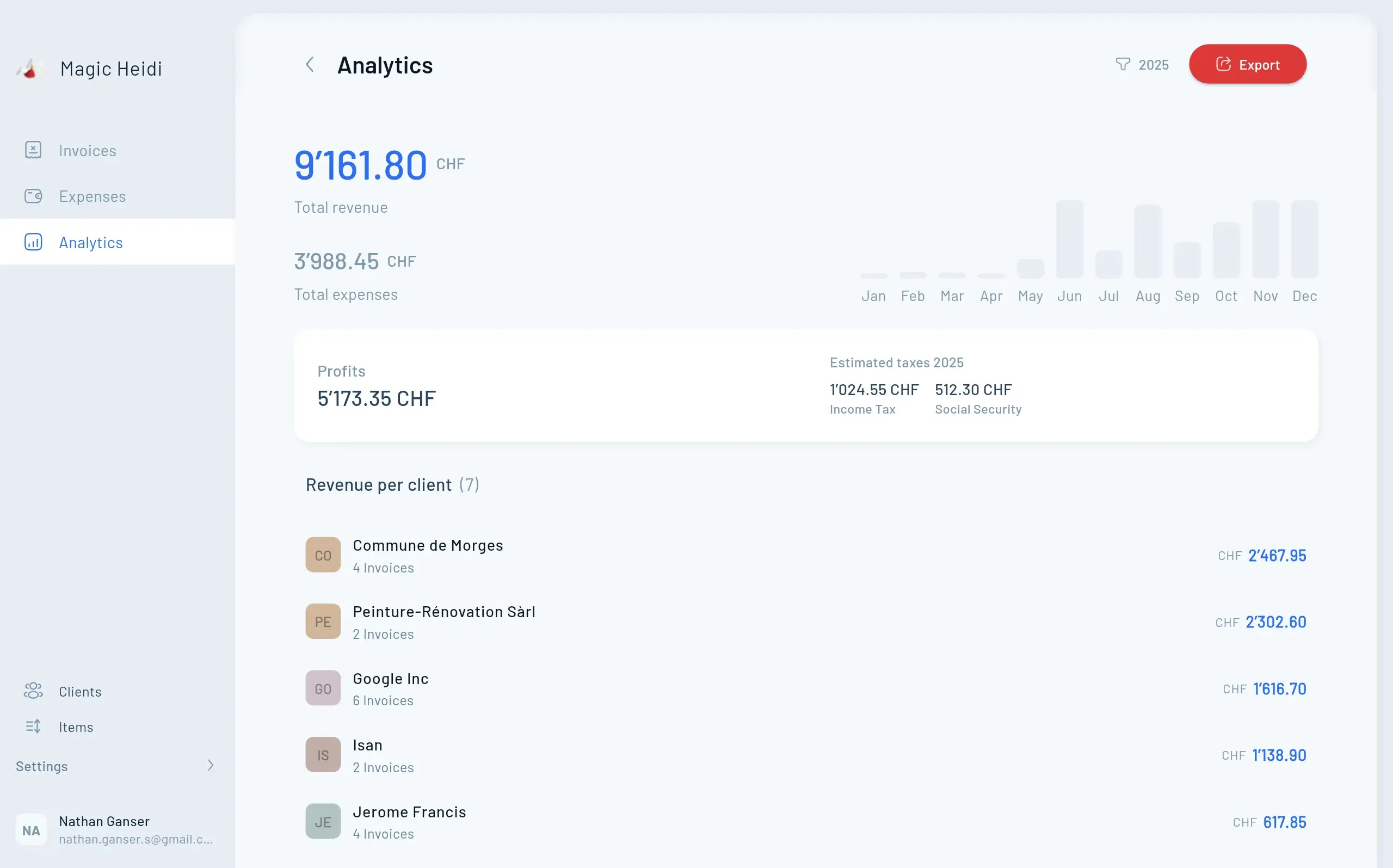
Creating the business is just the beginning. Here are the annual and quarterly obligations you must meet to stay compliant.
Bookkeeping is a legal obligation. The type of accounting required depends on your legal structure and revenue.
If you are subject to VAT, you must file quarterly or semi-annual returns.
Social contributions are due every year, calculated on your net income from the previous year.
Annual tax return is mandatory: on income for sole proprietorships, on profit for LLCs/Corporations.
Avoid these pitfalls that cost hundreds of entrepreneurs in Switzerland thousands of francs every year.
5. Choosing the wrong legal structure. Creating an LLC too early (unnecessary costs) or staying as a sole proprietorship too long (asset risk). Reassess your structure every year. When to switch from sole proprietorship to LLC?
6. Ignoring cantonal differences. The tax difference between cantons can represent thousands of francs per year. A self-employed person in Zug pays ~12% corporate tax, compared to ~19% in Zurich.
7. Not having proper insurance. An accident without loss of earnings insurance can jeopardize your business. Professional liability protects you in case of damage caused to a client.
8. Forgetting transparency obligations. Since 2025, companies must maintain a register of beneficial owners. Non-compliance is sanctioned.
9. Working for a single client. The AVS office can reclassify your activity as disguised employment. Maintain at least 2-3 active clients. Learn more about independence criteria
10. Skipping tax advice in the first year. Structural mistakes (tax choices, VAT method, share allocation) cost far more to fix than to prevent. A fiduciary for the first annual closing is well worth the investment.
For a sole proprietorship: CHF 300-800 (social insurance and commercial register fees). For an LLC: CHF 1,600-5,000 in incorporation fees + CHF 20,000 share capital. For a Corporation: CHF 5,000-15,000 in fees + CHF 100,000 capital. Costs vary significantly by canton.
Sole proprietorship: 1-2 weeks. LLC: 3-4 weeks (up to 5 weeks in the slowest cantons). Corporation: 4-6 weeks. With an express incorporation service, an LLC can be created in 5-7 days if the escrow account is already open.
Yes. EU/EFTA citizens have the same rights with a B, C or G permit. For non-EU nationals, it is more restrictive but possible, particularly through an LLC or Corporation where at least one manager must reside in Switzerland.
No for a sole proprietorship (CHF 0). CHF 20,000 for an LLC (fully paid up at incorporation). CHF 100,000 for a Corporation (of which at least CHF 50,000 paid up at incorporation).
Sole proprietorship to start (simple, inexpensive, fast). LLC once your revenue exceeds CHF 100-150K or you need to protect your personal assets. Check out our detailed sole proprietorship vs LLC comparison.
Yes, combining salaried employment with self-employment is perfectly legal in Switzerland. There is no revenue limit on the secondary activity. Simply check the non-compete clause in your employment contract.
It depends on your priorities. Zug and Schwyz for taxation (12-13%). Zurich and Geneva for the entrepreneurial ecosystem and networking. Vaud for French-speaking Switzerland. Ticino for access to the Italian market. The canton of residence is often the most practical.
Not mandatory, especially for a sole proprietorship. For LLCs/Corporations, modern accounting software handles 80% of daily work. A fiduciary is recommended for the first annual closing and complex cases.
Via the EasyGov.swiss portal (free) or directly at the cantonal office. For LLCs/Corporations, the registration goes through the notary who submits the file. Cost: CHF 120-800 depending on the canton and legal structure. Timeline: 5-15 business days.
Mandatory once your annual revenue reaches CHF 100,000. You must register within 30 days of exceeding the threshold. Voluntary registration is possible below this amount if you want to recover VAT on your business purchases.
Yes for an LLC or Corporation, provided at least one manager/director is domiciled in Switzerland. For a sole proprietorship, you must reside in Switzerland. Domiciliation and nominee management services exist for foreign founders.
Up-to-date accounting (10-year retention), quarterly VAT returns (if subject to VAT), annual AVS contributions, annual tax return, and annual general meeting for LLCs/Corporations. Accounting software automates the majority of these tasks.
Join the thousands of entrepreneurs who simplified their administrative management from the very start of their business.
I created my LLC 3 months ago. Magic Heidi allowed me to start my accounting from day one, without any prior knowledge. QR invoices are ready in 30 seconds.
Interior Architect, Geneva
Als Freelancer war die Gründung meiner Einzelfirma überraschend einfach. Mit Magic Heidi habe ich sofort professionelle Rechnungen erstellt und meine Ausgaben automatisch erfasst.
IT-Berater, Zürich
Going from employee to self-employed was scary. But with the right accounting software, administrative management became almost enjoyable. I highly recommend it.
Marketing Consultant, Lausanne
Compliant invoicing, automated accounting, stress-free VAT. Magic Heidi is the tool built for Swiss entrepreneurs, from day one.
Official sources: EasyGov.swiss, kmu.admin.ch, estv.admin.ch (Federal Tax Administration), zefix.ch (Commercial Register), ahv-iv.ch (Social Insurance). Last updated: March 2026.