The Swiss Chart of Accounts for Freelancers: A Complete Guide
Everything you need to know about structuring your bookkeeping, choosing the right accounts, and preparing a tax-ready income statement as a Swiss sole proprietor.
This guide walks you through the Kontenrahmen KMU — the standard Swiss chart of accounts — and shows you exactly which accounts matter for your freelance business. Whether you use simplified bookkeeping or full double-entry, structuring your finances correctly from day one saves you hours at tax time.
Related guides: Expense deductions guide | Profit & loss accounts | VAT for freelancers | Bookkeeping basics
What Is a Chart of Accounts?
In Swiss accounting, two terms come up constantly: the Kontenrahmen (chart of accounts framework) and the Kontenplan (your personal chart of accounts). They are not the same thing.
The Kontenrahmen KMU is the standardised Swiss reference framework — a master catalogue of all possible accounts a business could use, published by veb.ch (formerly Verband Schweizerischer Buchhaltungs- und Rechnungsexperten). It was first introduced in 1947 by Prof. Karl Käfer and has been updated several times, most recently in 2023 to reflect the share capital reform (Aktienrechtsreform) that took effect on 1 January 2023.
Your Kontenplan is your personal selection from that framework — only the accounts that are relevant to your business. A freelance graphic designer does not need the same accounts as a restaurant. You pick what you need, but you must respect the numbering structure.
In French-speaking Switzerland this framework is called the Plan comptable PME, and in Italian-speaking Switzerland the Piano dei conti PMI. They are structurally identical.
Do You Even Need One?
This depends on your turnover and legal form. Here are the key thresholds every Swiss freelancer must know.
Under CHF 500,000 — Simplified Bookkeeping
You are legally allowed to use simplified bookkeeping (vereinfachte Buchführung). This is often called the 'Milchbüchlein' method — a structured list of income and expenses, plus a record of your assets. No double-entry required. No formal chart of accounts mandated by law.
- No double-entry bookkeeping required
- Structured income/expense list sufficient
- Still need clear categories for your tax return
- Using KMU structure makes tax filing much easier
Over CHF 500,000 — Full Double-Entry
Article 957 of the Swiss Code of Obligations (OR) requires full double-entry bookkeeping (ordentliche Buchhaltung). This means a proper chart of accounts, a balance sheet, and an income statement structured according to legal requirements.
- Double-entry bookkeeping required by law
- Must maintain formal chart of accounts
- Balance sheet and income statement mandatory
- Kontenrahmen KMU is the de facto standard
CHF 100,000 — VAT Registration
Once your annual turnover exceeds CHF 100,000, you must register for VAT within 30 days. This introduces additional tracking requirements (input tax, output tax, VAT settlement accounts) but does not by itself require double-entry bookkeeping.
- Must register within 30 days of exceeding threshold
- Adds VAT-specific accounts to your chart
- Can choose effective or net rate method
- Some freelancers register voluntarily for input tax recovery
Important nuance: Even if you are below CHF 500,000, you still need to declare your business income on your personal tax return. The tax authorities expect to see a clear, categorised income statement. Using the Kontenrahmen KMU structure — even in a simple spreadsheet — makes your tax return dramatically easier to prepare and defend.
There is no legal obligation to use the Kontenrahmen KMU specifically. However, it is the de facto standard in Switzerland. Tax authorities, fiduciaries, and accounting software all expect this structure. Using it from day one saves you pain later.
The 9 Account Classes at a Glance
The Kontenrahmen KMU is built on a hierarchical numbering system: classes (1 digit), main groups (2 digits), groups (3 digits), and individual accounts (4 digits). The structure mirrors the layout of your financial statements.
| Class | Name (DE / FR / EN) | What It Covers |
|---|---|---|
| 1 | Aktiven / Actifs / Assets | Everything you own: bank accounts, receivables, equipment, prepaid expenses |
| 2 | Passiven / Passifs / Liabilities & Equity | What you owe plus your equity: creditors, VAT payable, loans, owner's equity |
| 3 | Betriebsertrag / Produits d'exploitation / Operating Revenue | Income from your main activity: invoiced services, product sales |
| 4 | Aufwand für Material / Charges de matériel / Cost of Goods | Direct costs: materials purchased, subcontractors, outsourced work |
| 5 | Personalaufwand / Charges de personnel / Personnel Expenses | Salaries, social contributions (only relevant if you have employees) |
| 6 | Übriger Betriebsaufwand / Autres charges / Other Operating Expenses | Rent, insurance, office supplies, IT costs, vehicle expenses, depreciation |
| 7 | Nebenerfolge / Produits accessoires / Non-Operating Income | Side income: rental income, gains on asset sales |
| 8 | Ausserordentlicher Erfolg / Résultat exceptionnel / Extraordinary Items | One-off, unusual gains or losses |
| 9 | Abschluss / Clôture / Closing Accounts | Internal accounts for closing the books |
For most freelancers, Classes 1, 2, 3, 6, and the equity portion of Class 2 are where 95% of your activity happens. Class 4 matters if you buy materials or hire subcontractors. Class 5 only matters if you employ staff.
The Freelancer's Practical Chart of Accounts
Below is a ready-to-use chart of accounts tailored for a typical Swiss freelancer (IT consultant, designer, translator, photographer, coach, etc.) operating as a sole proprietorship. Accounts marked with ★ are the ones most freelancers will use regularly.
Class 1 — Assets
| Account | Name | Purpose |
|---|---|---|
| 1000 | Kasse / Caisse / Cash | Physical cash on hand |
| 1020 ★ | Bank / Banque / Bank Account | Your main business bank account |
| 1025 | Bank Fremdwährung / Foreign Currency | If you invoice in EUR, USD, etc. |
| 1100 ★ | Debitoren / Débiteurs / Accounts Receivable | Unpaid client invoices |
| 1109 | Wertberichtigung Debitoren / Bad Debt Provision | Allowance for clients who may not pay |
| 1170 | Vorsteuer Material / Input VAT on Goods | VAT paid on purchases (if VAT-registered) |
| 1171 | Vorsteuer Investitionen / Input VAT on Investments | VAT paid on operating costs and assets |
| 1176 | Verrechnungssteuer / Withholding Tax | Withholding tax on bank interest |
| 1300 ★ | Aktive Rechnungsabgrenzung / Prepaid Expenses | Expenses paid in advance (e.g., annual subscriptions) |
| 1301 | Noch nicht erhaltener Ertrag / Accrued Income | Revenue earned but not yet invoiced |
| 1500 ★ | Maschinen & Geräte / Equipment | Cameras, tools, specialised equipment |
| 1510 ★ | Büroeinrichtung / Office Furniture | Desk, chair, shelving |
| 1520 ★ | Informatik / IT Equipment | Laptop, monitor, printer, peripherals |
| 1530 | Fahrzeuge / Vehicles | Business vehicle (if applicable) |
| 1570 | Software / Intangible Assets | Purchased software licences |
Class 2 — Liabilities & Equity
| Account | Name | Purpose |
|---|---|---|
| 2000 ★ | Kreditoren / Créanciers / Accounts Payable | Unpaid supplier invoices |
| 2200 ★ | Geschuldete MWST / VAT Payable | VAT collected from clients (if VAT-registered) |
| 2201 | Umsatzsteuer / Output VAT | Output VAT detail (if needed) |
| 2300 ★ | Passive Rechnungsabgrenzung / Accrued Expenses | Expenses incurred but not yet billed to you |
| 2301 | Erhaltener Ertrag des Folgejahres / Deferred Revenue | Client prepayments for future work |
| 2800 ★ | Eigenkapital / Capital Propre / Owner's Equity | Your capital in the business |
| 2850 | Privat / Prélèvements privés / Owner's Draws | Personal withdrawals from the business |
| 2891 | Gewinnvortrag / Report de bénéfice / Retained Earnings | Accumulated profit from prior years |
Key point for sole proprietors: Your personal income tax and AHV contributions are not business expenses. They go through the private account (2850), not through the income statement. This is a common mistake.
Class 3 — Revenue
| Account | Name | Purpose |
|---|---|---|
| 3200 ★ | Dienstleistungsertrag / Produits des services / Service Revenue | Income from your freelance services |
| 3400 | Übrige Erlöse / Other Revenue | Miscellaneous business income |
| 3800 | Erlösminderungen / Revenue Reductions | Discounts granted, credit notes |
If you sell both products and services, add account 3000 (Handelsertrag / Product Sales) to separate them.
Class 4 — Cost of Goods & Third-Party Services
| Account | Name | Purpose |
|---|---|---|
| 4000 | Materialaufwand / Charges de matériel / Materials | Raw materials, components for your service |
| 4400 ★ | Aufwand für Drittleistungen / Third-Party Services | Subcontractors, freelancers you hire |
Most pure-service freelancers barely use Class 4. It becomes relevant when you regularly outsource work or buy materials for client projects.
Class 5 — Personnel Expenses
| Account | Name | Purpose |
|---|---|---|
| 5000 | Löhne / Salaires / Salaries | Only if you have employees |
| 5700 | Sozialversicherungsaufwand / Social Contributions | Employer's share of AHV/IV/EO, BVG, etc. |
Remember: As a sole proprietor, you do NOT pay yourself a salary. Your income is the business profit. Your personal AHV/IV/EO contributions are declared in your personal tax return, not as a business expense.
Class 6 — Other Operating Expenses
This is where most freelancer expenses live. Here is the detailed breakdown:
| Account | Name | Purpose & Examples |
|---|---|---|
| 6000 ★ | Raumaufwand / Premises | Office rent, co-working space fees |
| 6030 | Nebenkosten / Ancillary Costs | Electricity, heating, water for office space |
| 6040 | Reinigung / Cleaning | Office cleaning |
| 6050 ★ | Anteil Home-Office / Home Office Share | Proportional share of your apartment rent |
| 6100 ★ | Unterhalt & Reparaturen / Maintenance | Repairs to equipment, furniture |
| 6200 ★ | Fahrzeugaufwand / Vehicle Expenses | Fuel, insurance, repairs, leasing |
| 6260 | Reisespesen / Travel Expenses | Train tickets, flights, hotels |
| 6261 | Verpflegung / Business Trip Meals | Meals during business travel |
| 6300 ★ | Versicherungen / Insurance | Professional liability, business insurance |
| 6310 | Gebühren & Bewilligungen / Fees & Permits | Trade register fees, cantonal permits |
| 6500 ★ | Verwaltungsaufwand / Administration | Postage, stationery, copying, bank fees |
| 6510 ★ | Telefon & Internet / Phone & Internet | Mobile phone, internet subscription |
| 6520 ★ | Informatikaufwand / IT Expenses | Software subscriptions, cloud hosting, domains |
| 6530 ★ | Buchführung & Beratung / Accounting | Fiduciary fees, tax advisor, legal advice |
| 6570 ★ | Weiterbildung / Training | Courses, conferences, professional books |
| 6600 ★ | Werbeaufwand / Advertising | Online ads, brochures, website hosting, SEO |
| 6700 ★ | Übriger Betriebsaufwand / Other Expenses | Catch-all for expenses that don't fit elsewhere |
| 6800 ★ | Abschreibungen / Depreciation | Annual depreciation on equipment, IT, furniture |
| 6900 | Finanzaufwand / Financial Expenses | Bank fees, interest on business loans |
| 6950 | Finanzertrag / Financial Income | Bank interest earned (credit entry) |
Classes 7 & 8 — Side Income & Extraordinary Items
| Account | Name | Purpose |
|---|---|---|
| 7000 | Ertrag Nebenbetrieb / Side Business Income | E.g., rental income from a sublet workspace |
| 7010 | Aufwand Nebenbetrieb / Side Business Expenses | Costs related to side income |
| 8000 | Ausserordentlicher Ertrag / Extraordinary Income | Unexpected one-off gains |
| 8100 | Ausserordentlicher Aufwand / Extraordinary Expenses | Unexpected one-off losses |
Mapping Everyday Expenses to Account Numbers
If you are under CHF 500,000 turnover and using simplified bookkeeping, you do not need formal ledger accounts. But you do need clear expense categories. Here is a practical mapping from everyday freelancer expenses to the account structure:
| Everyday Expense | Account | Category |
|---|---|---|
| Monthly co-working membership | 6000 | Premises / Rent |
| Share of apartment rent (home office) | 6050 | Home Office |
| Electricity & heating (home office share) | 6030 | Home Office Utilities |
| New MacBook Pro | 1520 → 6800 | IT Equipment (then depreciate) |
| Adobe Creative Cloud subscription | 6520 | IT / Software |
| GitHub / hosting / domain name | 6520 | IT / Software |
| Swisscom mobile plan (business share) | 6510 | Phone & Internet |
| Train to Zurich for client meeting | 6260 | Travel |
| Hotel in Geneva for conference | 6260 | Travel |
| Lunch during business trip | 6261 | Travel Meals |
| Subcontractor invoice | 4400 | Third-Party Services |
| Google Ads campaign | 6600 | Advertising |
| Business card printing | 6600 | Advertising |
| Professional liability insurance | 6300 | Insurance |
| Postage & shipping | 6500 | Administration |
| Bank account fees | 6500 or 6900 | Administration / Finance |
| Fiduciary / tax advisor fee | 6530 | Accounting & Consulting |
| Online course (Udemy, Coursera) | 6570 | Training |
| Professional conference ticket | 6570 | Training |
| Reference book for your field | 6570 | Training |
| Office chair, desk | 1510 → 6800 | Office Furniture (then depreciate) |
| Printer paper, ink cartridges | 6500 | Administration |
The Milchbüchlein itself is simply a table (Excel, Google Sheets, or a dedicated app) with columns for date, description, income amount, expense amount, expense category, and a reference to the receipt. At year-end, you total up income, total up expenses by category, and the difference is your net profit — which goes on your tax return.
Depreciation: What You Need to Know
When you buy an asset that will be used over several years (laptop, camera, furniture, vehicle), you cannot deduct the full cost in the year of purchase. Instead, you spread the cost over the asset's useful life through annual depreciation.
The Swiss Federal Tax Administration (ESTV/AFC) publishes maximum depreciation rates in its "Merkblatt A 1995." These are the maximum rates using the declining balance method (applied to the current book value, not the original purchase price). For straight-line depreciation, halve these rates.
| Asset Type | Max Rate (Declining Balance) | Straight-Line Equivalent |
|---|---|---|
| Office furniture & furnishings | 25% | 12.5% |
| Appliances & machines | 30% | 15% |
| Motor vehicles | 40% | 20% |
| Office & computer equipment | 40% | 20% |
| Software, patents, licences | 40% | 20% |
| Tools | 45% | 22.5% |
Practical Example — Declining Balance for a CHF 2,400 Laptop
| Year | Book Value Start | Depreciation (40%) | Book Value End |
|---|---|---|---|
| 1 | 2,400 | 960 | 1,440 |
| 2 | 1,440 | 576 | 864 |
| 3 | 864 | 346 | 518 |
| 4 | 518 | 207 | 311 |
| 5 | 311 | 124 | 187 |
Each year, the depreciation amount goes into account 6800 as an expense on your income statement.
Small asset rule: Many cantons allow assets under CHF 1,000–5,000 (varies by canton) to be fully expensed in the year of purchase rather than capitalised and depreciated. Check your canton's rules — this can simplify your bookkeeping significantly.
Method consistency: Once you choose between declining balance and straight-line for an asset category, stick with that method consistently. The tax authorities may question a switch if it appears motivated solely by tax optimisation.
The Home Office Deduction
You can deduct a proportional share of your housing costs if you use a room (or a clearly defined area) exclusively for your business activity and you do not have a separate office.
How to calculate it: Take the area of your workspace, divide it by the total apartment area, and apply that percentage to your rent and utilities.
Example: Your apartment is 80 m². Your office room is 10 m². The business share is 10 ÷ 80 = 12.5%. If your rent is CHF 2,000/month, your monthly office deduction is CHF 250, or CHF 3,000/year.
The same percentage applies to ancillary costs (electricity, heating, internet). For internet and phone, many freelancers use a 50% business allocation unless they can demonstrate a higher share with records.
What the tax authorities look for: The space must be genuinely used for work, not a guest bedroom with a laptop on the nightstand. If you have a co-working membership or external office, claiming a home office deduction on top of that will raise questions.
What Your Tax Return Needs
At the end of the year, your canton's tax return will include an Annexe B (or equivalent) for self-employment income. While the exact form varies by canton, they all require essentially the same information:
REVENUE
  Service revenue (3200)                          CHF  120,000
  Other revenue (3400)                            CHF    2,000
  ./. Revenue reductions (3800)                   CHF   -1,000
  ─────────────────────────────────────────────────────────────
  NET REVENUE                                     CHF  121,000

EXPENSES
  Third-party services (Class 4)                  CHF   -8,000
  ─────────────────────────────────────────────────────────────
  GROSS PROFIT                                    CHF  113,000

  Premises / rent (6000)                          CHF   -6,000
  Home office share (6050)                        CHF   -3,000
  Maintenance & repairs (6100)                    CHF     -500
  Vehicle expenses (6200)                         CHF   -2,400
  Travel expenses (6260/6261)                     CHF   -1,800
  Insurance (6300)                                CHF   -1,200
  Administration (6500)                           CHF     -800
  Phone & internet (6510)                         CHF   -1,440
  IT / software (6520)                            CHF   -3,600
  Accounting & consulting (6530)                  CHF   -2,000
  Training & education (6570)                     CHF   -1,500
  Advertising (6600)                              CHF   -4,000
  Depreciation (6800)                             CHF   -2,500
  Financial expenses (6900)                       CHF     -200
  ─────────────────────────────────────────────────────────────
  TOTAL OPERATING EXPENSES                        CHF  -30,940

  ─────────────────────────────────────────────────────────────
  NET PROFIT (TAXABLE SELF-EMPLOYMENT INCOME)     CHF   82,060
This net profit figure is what gets added to your personal income on the tax return. From there, you can deduct AHV/IV/EO contributions, Pillar 3a contributions, and other personal deductions.
Documents to Keep Ready
- Complete income/expense listing for the year
- All invoices issued and all expense receipts
- Bank statements for all business accounts
- Depreciation schedule for capitalised assets
- VAT settlement reports (if VAT-registered)
- Record of private usage allocation (home office, vehicle, phone)
- Pillar 3a contribution certificate
Cash vs. Accrual Accounting
This choice affects when you record income and expenses.
Cash basis (Ist-Methode): You record revenue when payment arrives in your account, and expenses when you actually pay them. This is simpler and is the default for most freelancers.
Accrual basis (Soll-Methode): You record revenue when you issue the invoice (regardless of payment) and expenses when you receive the supplier's bill (regardless of when you pay). This gives a more accurate picture, especially with long payment cycles.
Recommendation: If you are just starting out, use cash accounting. It is simpler, requires less bookkeeping, and is perfectly acceptable for simplified bookkeeping. Switch to accrual when your activity involves significant receivables, payables, or prepaid items.
Consistency matters: Whichever method you choose, apply it consistently. Switching between methods mid-year or between years without justification will attract scrutiny from the tax authorities.
VAT Considerations
If your annual turnover exceeds CHF 100,000, you must register for VAT within 30 days. This adds complexity to your chart of accounts.
Additional Accounts You Will Need
- 1170: Input VAT on materials & third-party services (Class 4 expenses)
- 1171: Input VAT on investments & other operating expenses (Class 1/5-8)
- 1175: VAT settlement account
- 2200: VAT payable (output VAT)
Two VAT Methods for Freelancers
The effective method requires you to track actual input VAT on every purchase and offset it against the output VAT you charge clients. More bookkeeping, but better if you have high expenses relative to revenue.
The net rate method (Saldosteuersatzmethode) simplifies everything: you pay a fixed percentage of your gross revenue to the tax authorities and do not claim back any input VAT. The applicable rate depends on your sector (typically 0.6%–6.5% for services). Much simpler and often preferable for freelancers with low material costs.
Strategic note: Some freelancers approaching CHF 100,000 voluntarily register for VAT to reclaim input tax on large equipment purchases. This can make sense if you are planning significant investments.
Record Retention: 10 Years
Swiss law requires you to keep all business records for 10 years. This includes invoices (issued and received), bank statements, contracts, expense receipts, and your annual accounts.
The thermal receipt problem: Receipts printed on thermal paper (most retail receipts) fade within 6–12 months. Scan or photograph them immediately. A faded receipt is as good as no receipt during an audit.
Digital storage is fully accepted as long as documents remain readable, complete, and retrievable. The ESTV emphasises Prüfspur (audit trail) — the ability to trace any entry in your accounts back to the original document.
Complete Milchbüchlein Category List (Copy-Paste Ready)
Here is a ready-to-use list of expense categories for your simplified bookkeeping spreadsheet, aligned with the Kontenrahmen KMU so that upgrading to double-entry later is seamless:
| ID | Category Name | KMU Account | Notes |
|---|---|---|---|
| EXP-01 | Rent / Co-Working | 6000 | Office space costs |
| EXP-02 | Home Office | 6050 | Proportional apartment share |
| EXP-03 | Utilities (Business) | 6030 | Electricity, heating, water |
| EXP-04 | Maintenance & Repairs | 6100 | Equipment repairs |
| EXP-05 | Vehicle — Fuel | 6200 | Fuel for business vehicle |
| EXP-06 | Vehicle — Insurance | 6200 | Vehicle insurance |
| EXP-07 | Vehicle — Maintenance | 6200 | Repairs, service, tyres |
| EXP-08 | Vehicle — Leasing | 6200 | Lease payments |
| EXP-09 | Travel — Transport | 6260 | Train, flights, taxis |
| EXP-10 | Travel — Accommodation | 6260 | Hotels, Airbnb |
| EXP-11 | Travel — Meals | 6261 | Meals on business trips |
| EXP-12 | Insurance — Business | 6300 | Liability, professional insurance |
| EXP-13 | Fees & Permits | 6310 | Government / trade register fees |
| EXP-14 | Administration | 6500 | Postage, supplies, bank fees |
| EXP-15 | Phone & Internet | 6510 | Mobile, landline, ISP |
| EXP-16 | Software & IT Services | 6520 | SaaS, hosting, domains, cloud |
| EXP-17 | Accounting & Legal | 6530 | Fiduciary, tax advisor, lawyer |
| EXP-18 | Training & Education | 6570 | Courses, conferences, books |
| EXP-19 | Advertising & Marketing | 6600 | Ads, SEO, print, branding |
| EXP-20 | Depreciation | 6800 | Annual asset write-downs |
| EXP-21 | Subcontractors | 4400 | Outsourced freelance work |
| EXP-22 | Materials & Supplies | 4000 | Raw materials, components |
| EXP-23 | Financial Expenses | 6900 | Loan interest, bank charges |
| EXP-24 | Other Business Expenses | 6700 | Anything not covered above |
Non-Deductible Expenses: What You Cannot Claim
Not everything is a business expense. The following are explicitly not deductible for Swiss sole proprietors:
- Personal income tax (federal, cantonal, communal) — a personal expense, not a business cost
- AHV/IV/EO contributions — deducted on your personal tax return, not in business accounts
- Fines and penalties — including parking tickets and late payment penalties
- Personal living expenses — groceries, personal clothing, entertainment
- Clearly personal travel — holidays, even if you "also did some networking"
- Excessive expenses — e.g., a CHF 5,000 business dinner for two
- Capital losses on personal investments — neither deductible nor taxable
- Pillar 3a contributions — deducted on your personal return, not in the business income statement
The key principle from Article 27 of the Federal Tax Act (DBG): an expense is deductible if you can establish a clear link between the expense and your professional activity, and the expense is commercially justified.
Frequently Asked Questions
Do I need an accountant or fiduciary?
Not legally. There is no requirement to use a certified accountant for sole proprietorships, regardless of turnover. You only need an auditor if you have 10+ full-time employees. That said, a fiduciary is valuable for your first tax return, setting up your chart of accounts, and year-end closing if your activity becomes complex.
Can I just use Excel?
Yes, absolutely. For simplified bookkeeping, a well-structured spreadsheet is perfectly adequate and legally compliant. Many fiduciaries provide Excel templates. The key is consistency, completeness, and keeping all receipts.
What happens if I don't keep any books?
The tax authorities will estimate your income — and they will generally err on the high side. You will also be unable to prove expenses during an audit, resulting in a higher tax assessment. In extreme cases, there are penalties for inadequate record-keeping.
Should I open a separate business bank account?
Not legally required for sole proprietors, but strongly recommended. Mixing personal and business transactions makes bookkeeping harder and raises questions during tax audits. Most Swiss banks offer business accounts from around CHF 5–10/month.
How do I handle mixed-use expenses (phone, internet, car)?
Apply a reasonable allocation key (percentage split between business and personal use) and document it. Common splits are 50% for phone/internet and 60–70% for a primarily business-used vehicle. The tax authorities accept reasonable estimates but will question unrealistic allocations (e.g., 100% business use for a phone you also use privately).
When should I switch from simplified to double-entry bookkeeping?
Legally, at CHF 500,000 turnover. Practically, consider switching earlier if your activity involves significant assets, debts, multiple revenue streams, or if you hire employees. Double-entry bookkeeping gives you much better visibility into your financial position.
Can I deduct my Pillar 3a contribution as a business expense?
No. Pillar 3a contributions are deducted on your personal tax return, not in the business income statement. For self-employed individuals without a 2nd pillar (BVG), the maximum Pillar 3a deduction is 20% of net self-employment income, up to CHF 36,288 (2025 figure).
What about meals and entertainment?
Business meals with clients are deductible, but keep them reasonable. Switzerland does not have a fixed daily meal allowance for the self-employed (unlike for employees). You claim actual costs, backed by receipts. Lavish meals will be questioned.
What if I make a loss?
Losses from self-employment can be offset against your other income (employment, investment) in the same tax year. Losses can also be carried forward for up to 7 years at the federal level. This is a significant advantage of being self-employed.
Can I deduct costs incurred before officially starting my business?
Yes. Pre-start costs directly related to your future business activity (training, initial equipment, market research) are generally deductible in the first business year. Keep all receipts from day one.
This guide is for informational purposes and reflects the general rules applicable to Swiss sole proprietors as of 2025–2026. Cantonal rules may differ on specific deduction amounts, depreciation methods, and filing requirements. For advice tailored to your situation, consult a qualified Swiss fiduciary or tax advisor.
Legal references: Swiss Code of Obligations Art. 957–958f (bookkeeping obligations), Federal Tax Act (DBG) Art. 27–28 (deductible business expenses), ESTV Merkblatt A/1995 (depreciation rates).
Simplify Your Swiss Bookkeeping
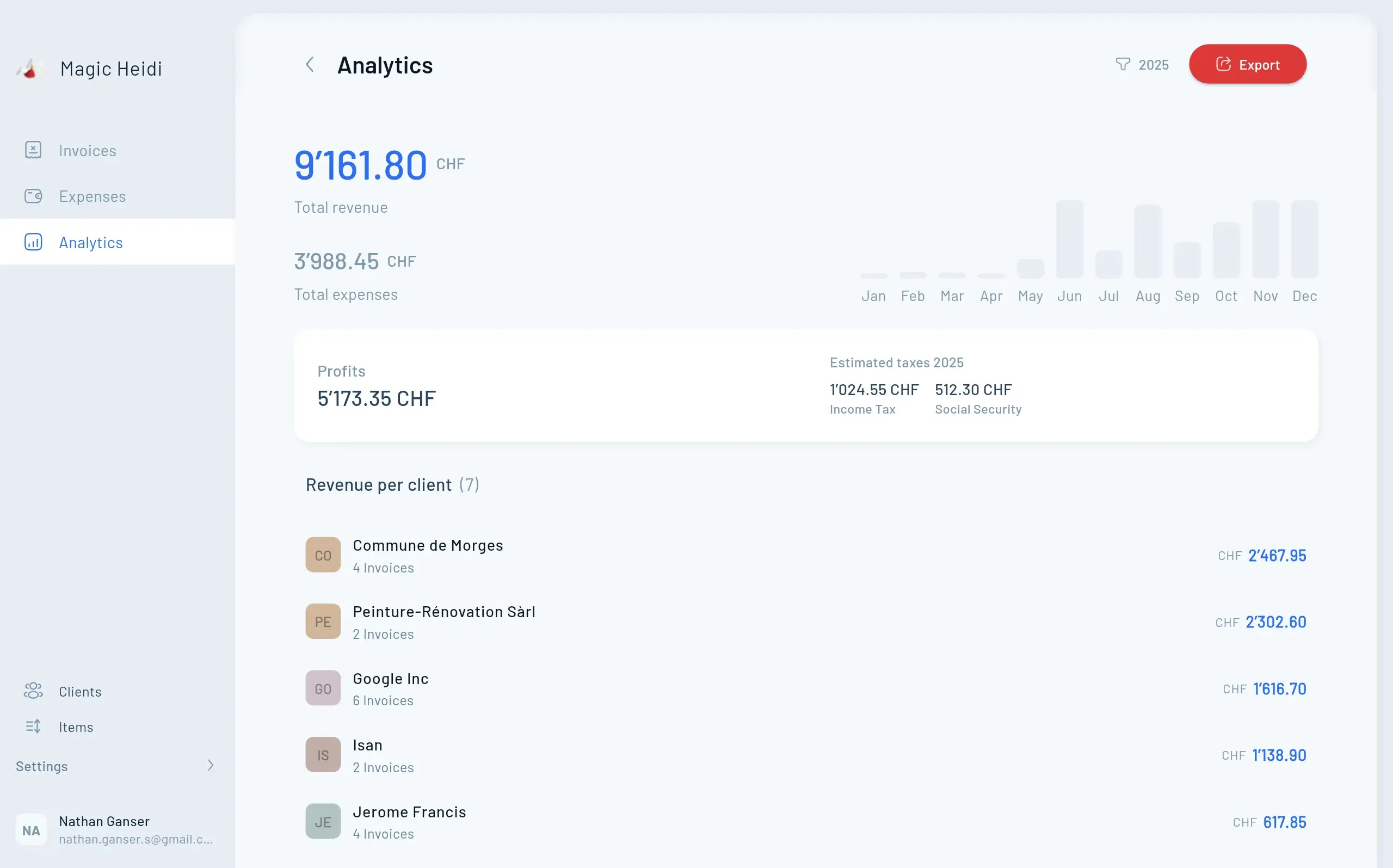
Magic Heidi automatically categorises your expenses using the Kontenrahmen KMU structure. Create invoices, track expenses, and stay tax-ready — all in one app built for Swiss freelancers.