Complete Guide 2026

LLC vs Corporation in Switzerland: Which Structure Is Right for You?

Over 165,000 limited liability companies and 120,000 corporations are registered in Switzerland's commercial registry. These two legal forms dominate the Swiss business landscape — but which one fits your project?

Swiss business office

Choosing between an SA (société anonyme / AG) — the Swiss corporation — and a Sàrl (société à responsabilité limitée / GmbH) — the Swiss LLC — is one of the most consequential decisions for any entrepreneur in Switzerland. Share capital requirements, ownership privacy, governance, taxation, and transferability of shares all come into play.

This guide provides an in-depth comparison of both structures to help you make the right call. Looking for a broader comparison that includes sole proprietorships? Check out our complete guide to Swiss business structures.

LLC vs Corporation: find your answer in 30 seconds

Four criteria will settle the question for most entrepreneurs:

💰

Available capital

Less than CHF 50,000 → the LLC (Sàrl/GmbH) wins by default (minimum capital CHF 20,000). Over CHF 100,000 available → the Corporation (SA/AG) becomes a realistic option.
👥

Number of owners

1 to 5 partners → the LLC is the simplest choice. A large or changing group of shareholders → the Corporation offers far more flexibility.
🔒

Need for privacy

LLC: all shareholders are publicly listed in the commercial register. Corporation: only board members are visible — shareholders remain anonymous.
📈

Fundraising plans

Venture capital, angel investors, or an eventual IPO → the Corporation is the standard. Self-funded or bank-financed → the LLC is perfectly adequate.
The LLC in Detail

Limited Liability Company (Sàrl / GmbH)

The most popular legal form for SMEs and independent professionals in Switzerland. Affordable, protective, and well-suited to small businesses.

Key Characteristics

What Defines the Swiss LLC

Governed by articles 772 to 827 of the Swiss Code of Obligations (CO), the LLC combines liability protection with straightforward management.

  • Minimum capital: CHF 20,000, fully paid up at incorporation
  • Shares (parts sociales): registered, minimum nominal value CHF 100
  • Members: 1 or more, all listed in the commercial register
  • Management: one or more managers (at least one must be resident in Switzerland)
  • Accounting: double-entry bookkeeping required
  • Auditor: mandatory once the company exceeds 10 full-time employees (or upon request of a member holding 10% of capital)
LLC legal protection
Advantages

Why Choose an LLC

The LLC offers an excellent balance of simplicity and protection for small and medium-sized businesses.

  • Low entry cost: CHF 20,000 vs. CHF 100,000 for a Corporation
  • Limited liability: your personal assets are protected
  • Flexible management: members manage the company directly, without a formal board of directors
  • Quick incorporation: 4 to 6 weeks on average
  • Formation costs: CHF 2,000 to 5,000 (notary, commercial register, miscellaneous fees)
  • Control: share transfers require member approval — built-in protection against unwanted third-party entry
LLC formation documents
Disadvantages

Limitations of the LLC

Some characteristics of the LLC can become restrictive depending on your situation.

  • Mandatory transparency: all members and their shareholdings are publicly visible in the commercial register
  • Complex share transfers: requires a notarized deed, member consent, and an update to the commercial register
  • Less attractive to investors: venture capital firms prefer the Corporation due to easier share transfers
  • Double taxation: profits are taxed at the company level, then dividends are taxed again as personal income
  • Residency requirement: at least one manager must be domiciled in Switzerland
LLC taxation
The Corporation in Detail

Swiss Corporation (SA / AG)

The preferred legal form for larger companies, fundraising, and structures that require shareholder anonymity or equity flexibility.

Key Characteristics

What Defines the Swiss Corporation

Governed by articles 620 to 763 of the Code of Obligations, the SA/AG is the most common legal form among large Swiss companies.

  • Minimum share capital: CHF 100,000, of which at least CHF 50,000 (or 20% of total) must be paid up at incorporation
  • Shares: registered or bearer, any nominal value (commonly CHF 0.01 to CHF 1,000)
  • Shareholders: 1 or more, not published in the commercial register
  • Governance: mandatory board of directors (at least one member domiciled in Switzerland)
  • Accounting: double-entry bookkeeping required, including balance sheet, income statement, and notes
  • Auditor: ordinary audit required once 2 of 3 thresholds are met (CHF 20M balance sheet, CHF 40M revenue, 250 employees)
Corporation structure
Advantages

Why Choose a Corporation

The SA/AG provides the ideal framework for ambitious companies and complex ownership structures.

  • Anonymity: shareholders are not published in the commercial register
  • Easy share transfers: shares are transferred by simple endorsement (registered) or delivery (bearer), with no mandatory approval
  • Attractive to investors: the standard structure for venture capital, private equity, and IPOs
  • Partial capital liberation: only CHF 50,000 is required at incorporation; the remainder can be called up later
  • Credibility: the SA/AG form is perceived as more prestigious by international partners and clients
  • Equity flexibility: preferred shares, participation certificates, and stock options are easy to implement
Corporate headquarters
Disadvantages

Limitations of the Corporation

The Corporation imposes heavier requirements in terms of capital and governance.

  • High capital threshold: CHF 100,000 minimum (CHF 50,000 paid up) — a barrier for smaller ventures
  • Formal governance: mandatory board of directors with meeting minutes and annual general meetings
  • Formation costs: CHF 5,000 to 10,000 (notary, articles of association, commercial register, capital)
  • Double taxation: like the LLC, profits are taxed at the corporate level and dividends are taxed again personally
  • Administrative complexity: stricter reporting obligations and a risk of over-administration for small businesses
  • Incorporation timeline: 6 to 12 weeks on average
Corporation costs and taxation
Comparison

SA vs Sàrl: side-by-side comparison

All the key criteria at a glance to help you decide.

CriterionLLC (Sàrl)Corporation (SA)
Minimum capitalCHF 20,000CHF 100,000
Capital to pay up100% (CHF 20,000)Min. CHF 50,000 (or 20%)
Liability Limited to capital Limited to capital
Anonymity Members public in CR Shareholders anonymous
Management bodyManager(s)Board of directors
Ownership transferNotarized deed + member approvalSimple endorsement or delivery
Min. number of founders11
Commercial register Mandatory Mandatory
AuditorOpt-out possible (< 10 employees)Opt-out possible (< 10 employees)
AccountingDouble-entry bookkeepingDouble-entry bookkeeping
Formation costsCHF 2,000 – 5,000CHF 5,000 – 10,000
Incorporation timeline4 to 6 weeks6 to 12 weeks
TaxationCorporate tax + dividend taxCorporate tax + dividend tax

Taxation: Are SA and Sàrl Taxed Differently?

From a tax perspective, the SA and Sàrl are treated almost identically in Switzerland. Both are subject to:

  • Federal corporate income tax: effective rate of 8.5% on net profit
  • Cantonal and municipal profit tax: ranges from 3.5% to 14% depending on the canton
  • Capital tax: a tax on equity (cantonal rates vary)
  • Economic double taxation: profits are taxed at the corporate level, then dividends distributed to shareholders/members are taxed again as personal income

A Concrete Example

LLC in ZurichCorporation in Zurich
Net profitCHF 100,000CHF 100,000
Corporate tax (~19.7%)– CHF 19,700– CHF 19,700
Profit after taxCHF 80,300CHF 80,300
Dividend distributedCHF 80,300CHF 80,300
Dividend tax (~24% on 70%)– CHF 13,490– CHF 13,490
Net to the ownerCHF 66,810CHF 66,810

Important: The total tax burden depends heavily on the canton. Zug, Nidwalden, and Appenzell Innerrhoden offer the lowest rates, while Vaud and Geneva are among the highest. The legal structure (SA or Sàrl) has no impact on the tax rate.

When the Corporation Has a Tax Advantage

The Corporation can be more tax-efficient in specific scenarios:

  • Retained earnings: if you reinvest heavily rather than distributing dividends, the Corporation's partial capital liberation reduces the capital tax burden
  • Succession planning: transferring shares is simpler and can be optimized for tax purposes
  • Holding structures: the Corporation is the standard vehicle for the participation deduction (Beteiligungsabzug)

For more on managing your VAT obligations in Switzerland, see our dedicated guide.

Converting an LLC into a Corporation

Has your LLC outgrown its structure, and you're considering converting it into a Corporation? This is a common and well-regulated process under Swiss law (art. 54 of the Merger Act / LFus).

When to Consider the Conversion

  • You're preparing a fundraising round or bringing in outside investors
  • You want greater privacy around ownership
  • Your company has clearly outgrown the SME thresholds
  • You're planning to sell or transfer the business

Key Steps

  1. Resolution: the members vote on the conversion at a general meeting (qualified majority of ⅔ of votes + absolute majority of capital)
  2. Conversion report: a report explains the reasons, legal consequences, and how membership shares will be converted into stock
  3. Audit: an auditor verifies that the conversion complies with the law
  4. Notarized deed: a notary formalizes the conversion and the new articles of association
  5. Commercial register: the change is published in the SOGC (Swiss Official Gazette of Commerce)

Estimated Costs

ItemAmount
Notary feesCHF 2,000 – 5,000
Auditor feesCHF 1,500 – 3,000
Commercial register filingCHF 500 – 1,000
Capital increase (if required)Variable
Estimated totalCHF 5,000 – 12,000

The conversion does not dissolve the company. The LLC continues to exist in the form of a Corporation, retaining all its rights and obligations. No tax is levied on the conversion itself, provided book values are maintained.

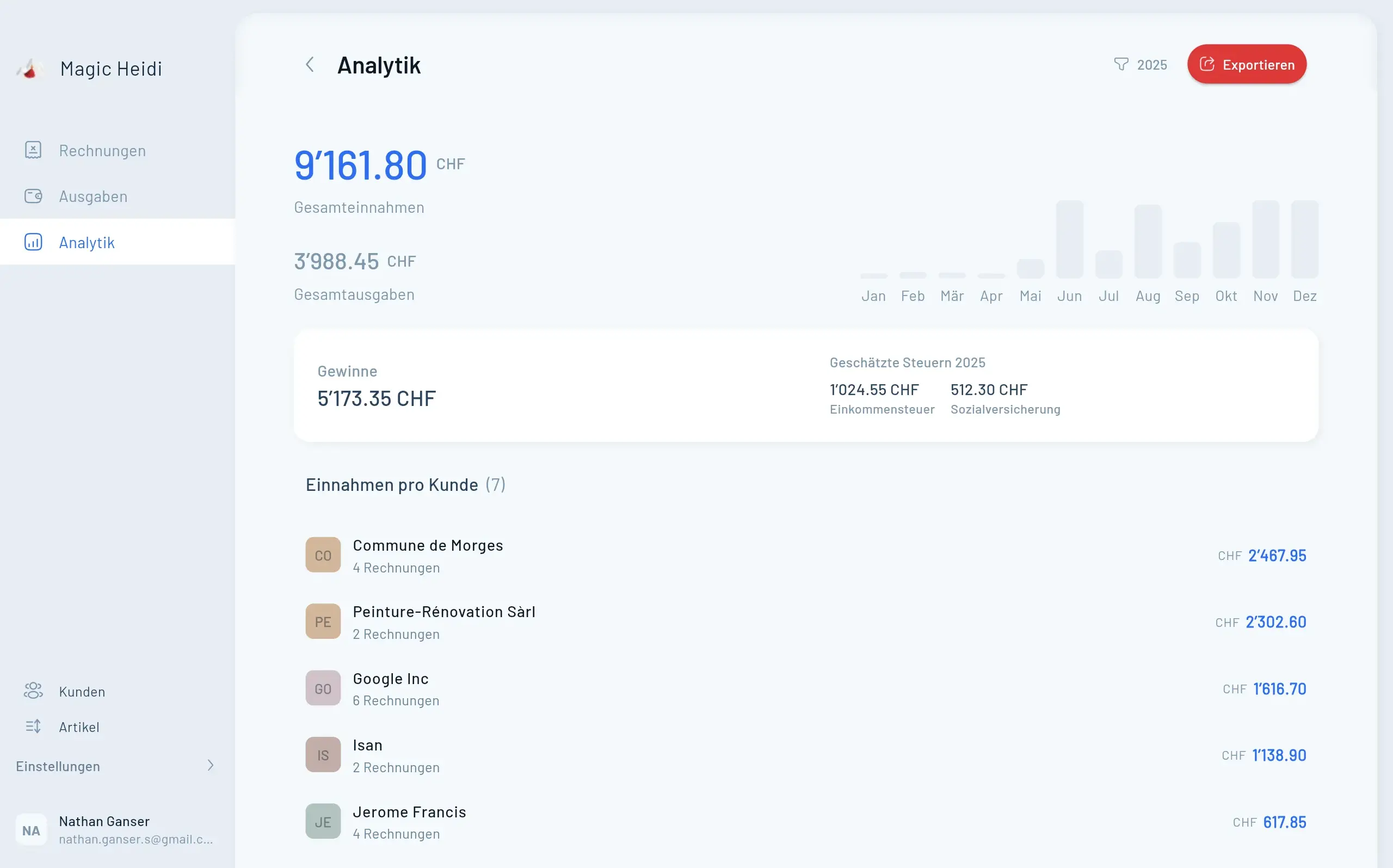
Magic Heidi accounting dashboard
Magic Heidi

The Ideal Tool for Freelancers and Small LLCs

Magic Heidi is built for freelancers and small LLCs (Sàrl/GmbH) with a single director. Invoicing, VAT, and expenses — everything you need, day to day.

  • 🧾
    Compliant QR Invoices

    Create invoices with a Swiss QR code in 30 seconds. Fully compliant with Swiss legal requirements.

  • 📊
    Simplified Accounting

    Track your income and expenses easily, with a clear journal and real-time financial overview.

  • 💰
    Automated VAT Management

    Automatic 8.1% calculation and a VAT return ready to submit. Handles reduced rates and exemptions.

  • 📸
    AI Expense Tracking

    Scan your receipts — AI extracts the amount, VAT, category, and supplier. Learn more.

Invoices
  • Invoice #3

    Magic Heidi

    CHF 500

    Jan 29

  • Invoice #2

    Webbiger LTD

    CHF 2000

    Jan 24

  • Invoice #1

    John Doe

    CHF 600

    Jan 20

FAQ

Frequently Asked Questions: SA vs Sàrl

Can you form an LLC on your own?

Yes. Since the revision of the Code of Obligations, an LLC (Sàrl) can be founded by a single person (individual or legal entity). There is no minimum number of members. The same applies to the Corporation (SA): a single shareholder is sufficient.

What is the total cost of forming a Corporation?

Expect CHF 5,000 to 10,000 in formation costs (notary, commercial register, articles of association), plus at least CHF 50,000 in share capital to pay up. The total startup budget is therefore at least CHF 55,000 to 60,000.

Can you convert an LLC into a Corporation?

Yes, the conversion is governed by the Merger Act (LFus). It requires a qualified majority vote of the members, a conversion report, an auditor review, and a notarized deed. Total cost ranges from CHF 5,000 to 12,000.

Which structure for a non-Swiss resident?

Both forms require at least one representative (manager for the LLC, board member for the Corporation) to be domiciled in Switzerland. If you live abroad, you'll need to appoint a Swiss resident to that role. The Corporation offers more flexibility since its board can include multiple members.

Is an auditor required?

Not necessarily. Small LLCs and Corporations (fewer than 10 full-time employees) can opt out of an audit if all members or shareholders consent. Beyond 10 employees, a limited audit becomes mandatory.

What's the difference between LLC shares and corporate stock?

LLC shares (parts sociales) are registered, listed in the commercial register, and transferring them requires a notarized deed plus member approval. Corporate shares (actions) are freely transferable securities (unless restricted by the articles of association), are not published in the commercial register, and can be transferred by simple endorsement or delivery.

Which structure for raising capital?

The Corporation is clearly preferable. Professional investors (business angels, venture capital funds) almost always require an SA/AG because it allows standardized, easily transferable issuance of shares, participation certificates, and stock options.

SA or Sàrl for real estate?

For holding real estate, the Corporation is generally preferred thanks to shareholder anonymity and ease of transfer (selling shares rather than the property itself). Note: some cantons impose restrictions on foreign-owned real estate companies.

What accounting software for an SA or Sàrl?

Magic Heidi is built for freelancers and small LLCs in Switzerland. QR invoices, VAT management, and AI-powered expense tracking — all in one simple, affordable tool. For Corporations or businesses needing full double-entry bookkeeping, a dedicated solution like Bexio may be a better fit.

Manage Your LLC with Magic Heidi

Invoicing, VAT, and expenses — everything your small business needs, in one Swiss tool.