Receipt Template Switzerland 2026: Free to Create, Download and Fill In Correctly

Free Swiss receipt template as PDF, Word or Excel download. Required fields, the CHF 400 rule, and a step-by-step guide for freelancers in Switzerland.

Nathan Ganser

Founder of Magic Heidi

A receipt in Switzerland needs at least six things: date, amount, description of the service, name of the payer, name of the recipient, and a signature. From CHF 400 upwards, the buyer's address is also required. Below you'll find free templates to download and a generator to create your receipt directly as a PDF.

Received a cash payment and not sure what a receipt should look like? Or sold a used bike and the buyer wants proof? You're in the right place. As Swiss freelancers ourselves, we issued receipts regularly before switching to doing everything digitally through Magic Heidi. This guide has everything you need: free templates, the legal requirements, and a clear walkthrough.

Key takeaways

  • Every receipt needs a date, amount, service description, payer, recipient, and signature
  • From CHF 400, the buyer's full address is mandatory (Art. 26 Para. 3 MWSTG / Swiss VAT Act)
  • VAT-registered businesses must show the VAT amount and UID number separately
  • A receipted invoice replaces a separate receipt in most cases
  • Receipts must be kept for 10 years in Switzerland

Create a Receipt Online: Free PDF Generator

Use this generator to create a Swiss receipt as a PDF in a few clicks. Just enter your details, check the preview, and download.

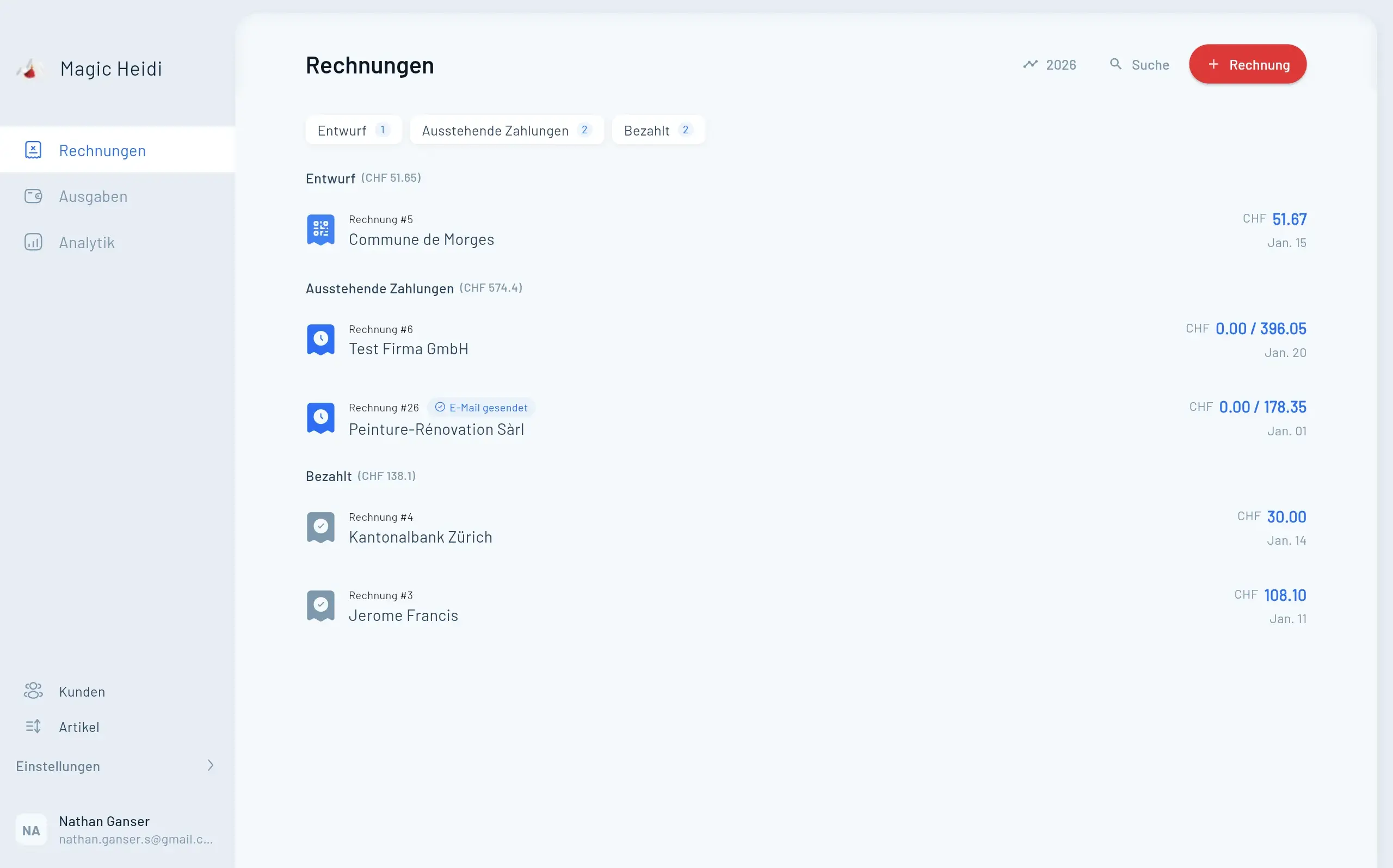
For recurring receipts, automatic VAT calculation, and professional invoices, we recommend trying Magic Heidi for free. No need to start from scratch every time.

Free Receipt Template Switzerland: Word, Excel and PDF

If you'd rather download a template and fill it in manually, we've prepared four options.

What Must Be on a Receipt in Switzerland?

In Switzerland there is no single standalone "receipt obligation" law. The rules come from the Code of Obligations (OR / CO — Art. 88 OR) and the VAT Act (MWSTG — Art. 26 MWSTG).

Required Fields for Every Receipt

Every receipt in Switzerland should include:

  1. Receipt number or sequential number
  2. Date of payment
  3. Name and address of the issuer (the person who received the money)
  4. Name of the payer (the person who paid)
  5. Description of the goods or service
  6. Amount in CHF (or other currency)
  7. Signature of the issuer

That sounds like a lot, but most of these fields take under a minute to fill in.

Additional Requirements from CHF 400

Once the amount reaches CHF 400 or more, Swiss law additionally requires:

  • Full address of the buyer (street, postcode, city)
  • For business transactions: company name and legal form

This rule comes from Art. 26 Para. 3 MWSTG (Swiss VAT Act). The reasoning: above a certain amount, it must be traceable who paid, so that the tax authorities can verify the transaction.

VAT Details for Tax-Registered Businesses

If your business is registered for VAT (turnover above CHF 100,000 per year), your receipts must also include:

  • UID number with the suffix "MWST" (e.g. CHE-123.456.789 MWST)
  • VAT rate (8.1% standard rate or 2.6% reduced rate)
  • VAT amount shown separately
  • Net and gross amounts

Without these details, the other party cannot claim input tax deductions. This matters especially for business transactions.

Tip: If you regularly create VAT-compliant receipts or invoices, invoicing software like Magic Heidi is well worth it. VAT is calculated automatically — you just select the rate.

How to Fill In a Receipt Step by Step

Completed Receipt Example

Here's a concrete example. Imagine you're a graphic designer and a client pays you in cash after a workshop:

RECEIPT No. 2026-003

Date: 4 May 2026

Issued by:
Anna Meier
Bahnhofstrasse 12
8001 Zürich
CHE-111.222.333 MWST

Payer:
Example SME GmbH
Lagerstrasse 5
8004 Zürich

Description                              Amount
-----------------------------------------------
Graphic Design Workshop (4 hrs.)       CHF 480.00

Net amount:                            CHF 443.94
VAT 8.1%:                             CHF  36.06
Total amount:                          CHF 480.00

Payment method: Cash

Payment gratefully received.

_________________________
Signature Anna Meier

Common Mistakes When Writing a Receipt

These are the mistakes we see regularly:

  • No signature. Without a signature, the receipt has no evidentiary value. A stamp alone is not enough.
  • Forgot VAT. If you're VAT-registered and don't show the amount separately, you're handing the client a useless document.
  • Buyer's address missing for amounts from CHF 400. This makes the receipt worthless for input tax deduction purposes.
  • Description too vague. "Service" is not enough. Be specific: "Graphic Design Workshop, 4 hours" or "Used bicycle, Scott Scale 970".

When Do You Need a Receipt?

Not every payment needs a receipt. Here are the most important cases.

Cash Payments and Private Sales

The classic case. When someone pays in cash, there's no bank record as proof. The receipt is then the only confirmation that money changed hands.

Under Art. 88 OR (Swiss Code of Obligations), the debtor can request a receipt for any payment. This means: if your client asks for one, you must issue it.

Deposits and Partial Payments

For larger projects, freelancers often agree on a deposit. For example: Marco is a web developer and requires a 50% deposit for a website project worth CHF 6,000. The client hands over CHF 3,000 in cash. Marco issues a receipt for CHF 3,000 with the note "Deposit for website redesign, Project No. 2026-W12". Both parties are protected.

Private Sales (Second-hand, Furniture, Bikes)

Selling your old road bike for CHF 800 on Ricardo or at a flea market? A receipt protects both sides. The buyer has proof for their insurance (in case the bike gets stolen), and you have evidence that you received the money.

For private sales there is no VAT. So the receipt is simpler: date, item or service, amount, both names, signature.

Rent Receipt

When a tenant pays rent in cash, the landlord should issue a receipt. This comes up mainly with subletting arrangements or informal setups. The receipt serves as proof that rent was paid.

TWINT and Digital Payments

With TWINT, credit card, or bank transfer, there is already a digital payment record (bank statement, TWINT confirmation). A separate receipt is not strictly necessary in these cases. The bank statement counts as proof.

If the client still wants a receipt, you can of course issue one. Just note the payment method: "Payment by TWINT on 04.05.2026".

Receipt vs. Invoice: What's the Difference?

This question comes up often, and the answer is simpler than most people think.

ReceiptInvoice
PurposeConfirms that payment was madeRequests payment
TimingAfter paymentBefore payment
Legal basisArt. 88 OR (CO)Art. 26 MWSTG (VAT Act)
When neededMainly for cash paymentsFor every business transaction
SignatureYes, from the recipientNot strictly required

The key difference: an invoice says "Please pay", a receipt says "Thank you, payment received".

When Is a Receipted Invoice Enough?

In practice, most freelancers don't issue a separate receipt. Instead, they add a note to the invoice:

"Amount of CHF 480.00 received in cash on 04.05.2026." Signature: ___________

This is sufficient in the vast majority of cases. A receipted invoice is legally equivalent to a separate receipt, as long as all required fields are present.

If you create your invoices with Magic Heidi, you can record payment receipt directly in the app. That saves you the manual receipt entirely.

Receipts as a Freelancer or Self-Employed Person in Switzerland

As a freelancer or sole trader in Switzerland, you typically issue invoices, not receipts. The invoice is the standard business document. You only need a separate receipt in a few cases:

  • Cash-paid services without a prior invoice
  • On-the-spot confirmation at a market stall, on-site trades work, or at workshops
  • At the client's request after a cash payment

Lisa is a yoga teacher in Bern who gives private lessons. Some clients pay cash after each session. Rather than creating a full invoice every time, Lisa issues a short receipt: "Private yoga lesson, 60 min., CHF 120, cash received." At the end of the month she consolidates everything into tidy bookkeeping. Since she started using Magic Heidi, she scans expenses with her phone and has everything digital.

Self-Issued Voucher for a Lost Receipt

Lost your receipt? It happens. For small amounts (parking fees, tips, meals) you can create a so-called self-issued voucher (Eigenbeleg). This is a self-receipt containing:

  • Date and amount
  • Description of the expense
  • Reason why the original receipt is missing
  • Your signature

Important: you cannot claim input tax deductions on self-issued vouchers. They simply serve to make the expense traceable in your bookkeeping. Use them sparingly — they're not a routine solution.

Record Retention for Receipts in Switzerland

Business receipts must be kept for at least 10 years under Art. 958f OR (Swiss Code of Obligations). This applies to:

  • All receipts you have issued
  • All receipts and vouchers you have received
  • Digital copies (scans, photos), provided they faithfully reproduce the original content

In practice this means: scan or photograph your paper receipts promptly. Paper fades, gets lost, or becomes illegible. A digital copy in an accounting tool is safer and is accepted by the tax authorities.

FAQ

Frequently Asked Questions About Receipts in Switzerland

How do I create a receipt?

Enter the date, amount, service description, the payer's name and the recipient's name into a template, then sign the document. Use our free generator at the top of this page or download one of the free Word/Excel templates.

Can I write a receipt myself?

Yes. Anyone — including private individuals — can issue a receipt. No special software or form is needed. A sheet of paper with the required fields and a signature is enough.

What must a receipt in Switzerland include?

At minimum: date, amount, description of the goods or service, name of the payer, name of the recipient, and signature. From CHF 400 upwards, the buyer's full address is also required. For VAT-registered businesses: UID number, VAT rate, and VAT amount.

How do I issue a receipt as a private individual?

Exactly like a business receipt, just without the VAT details. Write the date, the item or service, the amount, both names, and sign it. For private sales over CHF 400 (e.g. a used car or furniture) you should also note the buyer's address.

Does a receipt have to be signed?

A signature is not legally required in every single case. In practice, however, it is strongly recommended — without a signature, a receipt has almost no evidentiary weight in a dispute. Always sign.

Is a till receipt (cash register receipt) the same as a receipt?

Not automatically. A till receipt often does not contain all the required fields of a full receipt — for example the signature and the buyer's name are typically missing. For input tax deduction on amounts below CHF 400, a till receipt is usually sufficient as long as the VAT is shown on it.

How long do I need to keep receipts?

Business receipts and vouchers must be kept in Switzerland for at least 10 years (Art. 958f OR / Swiss Code of Obligations). This applies to both paper and digital copies. It's best to scan your receipts immediately upon receipt.

Invoices and Receipts in One Place

For most Swiss freelancers, an invoice is the better document. Magic Heidi creates invoices, manages receipts, and calculates VAT automatically.