Swiss Invoicing FAQ: Everything You Need to Know in 2026
Invoicing in Switzerland comes with specific legal requirements, from mandatory QR-bills to 10-year retention rules. Whether you're a freelancer issuing your first invoice or an SME navigating VAT registration, this guide answers your most pressing questions.
Jump to Your Question
Find answers to the most common Swiss invoicing questions
QR-Bills & Payment Slips
What is a QR-bill and is it mandatory in Switzerland?
Yes, QR-bills have been mandatory since October 1, 2022, completely replacing traditional red and orange payment slips.
A QR-bill is an invoice with an integrated payment section containing a scannable Swiss QR code. This code includes all payment information: IBAN, amount, currency (CHF or EUR), creditor details, and debtor information. Clients simply scan the code with their banking app to pay instantly.
Important 2025 update: Since November 22, 2025, version 2.3 of the Swiss Implementation Guidelines requires structured addresses (separate fields for street, house number, postal code, and city). Ensure your invoicing software generates compliant QR-bills.
What's the difference between a regular IBAN and QR-IBAN?
Both are valid for QR-bills, but they serve different purposes:
QR-IBAN:
- Special IBAN starting with "CH" followed by specific institution codes
- Contains a QR reference number (27 digits)
- Enables automatic payment matching without manual reconciliation
- Ideal for businesses processing many transactions
Regular IBAN:
- Standard Swiss bank account number
- Uses unstructured reference or creditor reference (ISO 11649)
- Requires the 140-character additional information field
- Sufficient for most small businesses and freelancers
You don't need a QR-IBAN to issue valid QR-bills. A regular IBAN works perfectly for most independent professionals.
Can I send QR-invoices to clients outside Switzerland?
Yes, but with limitations.
The QR-bill is designed for domestic Swiss payments and payments from Liechtenstein. International clients typically cannot scan Swiss QR codes with their banking apps.
Best practice for international clients:
- Include the QR-bill payment section (legally required)
- Also provide payment details in clear text format
- Specify IBAN, BIC/SWIFT code, and bank address
- Consider using international payment platforms for recurring clients
Modern invoicing software like Magic Heidi automatically includes both QR code and text-based payment information, ensuring all clients can pay easily.
Do I need to include a QR code on every invoice?
Yes, if your invoice triggers a payment in Switzerland, it must include a valid Swiss QR code.
The only exceptions are:
- Invoices sent exclusively to foreign clients (though including QR-bills doesn't hurt)
- Credit notes or purely informational documents
- Recurring direct debit arrangements where no payment action is required
For all standard B2B and B2C invoicing in Switzerland, the QR-bill is mandatory. Non-compliance can delay payments and create administrative headaches.
Generate Compliant QR-Bills in Seconds
Magic Heidi automatically creates Swiss-compliant QR-bills with structured addresses, correct IBAN formatting, and all mandatory payment information. No manual configuration needed.
VAT & Tax Requirements
Do I need to register for VAT in Switzerland?
You must register for VAT when your annual turnover exceeds CHF 100,000.
This threshold applies to businesses and self-employed individuals providing goods or services in Switzerland. For non-profit associations and foundations, the limit is CHF 150,000.
Key points:
- Turnover includes all revenue before expenses
- You can voluntarily register below the threshold
- Registration is mandatory within 30 days of exceeding the limit
- Foreign companies providing services in Switzerland may have different rules
Once registered, you must charge VAT on invoices, submit quarterly or biannual VAT returns, and maintain compliant records.
What are the current VAT rates in Switzerland?
Switzerland uses three VAT rates as of 2024:
- 8.1% - Standard rate for most goods and services
- 2.6% - Reduced rate for necessities (food, non-alcoholic beverages, books, newspapers, medicines)
- 3.8% - Special rate for hospitality services (hotels, restaurants, catering)
These rates apply to your invoice total. Always display the VAT amount separately on invoices, showing both the net amount and gross amount clearly.
How do I handle VAT if I'm not registered?
If you're below the CHF 100,000 threshold and not voluntarily registered, you simply don't charge VAT.
Your invoices should not show any VAT amount. Include a note stating "VAT exemption - small business" or "Not subject to VAT" to clarify your status.
Important: You cannot deduct input VAT on your business expenses when you're not registered. This means you pay VAT on purchases but can't reclaim it. Many businesses choose voluntary registration to reclaim input VAT, even below the threshold.
What happens if I issue an invoice with the wrong VAT amount?
You must correct it immediately with a credit note or corrected invoice.
Switzerland's Federal Tax Administration is strict about VAT accuracy. If you charge too much VAT, you must refund the difference. If you charge too little, you're still liable to pay the correct amount to tax authorities.
Best practice:
- Issue a credit note for the incorrect invoice
- Generate a new invoice with correct VAT calculation
- Keep both documents in your records
- Notify your client of the correction
Quality invoicing software prevents these errors by automatically calculating VAT based on current rates and your registration status.
Built for Swiss VAT Compliance
Magic Heidi automatically applies the correct VAT rates, handles exempt invoices for non-registered businesses, and tracks your revenue against the CHF 100,000 threshold. Stay compliant without the complexity.
8.1%, 3.8%, and 2.6% rates applied correctly
Monitor your CHF 100K threshold in real-time
Compliant invoices for non-registered businesses
Ready-to-submit quarterly returns
Legal & Compliance
What information must a Swiss invoice contain?
Swiss law requires these mandatory elements on every invoice:
Business information:
- Your full business name or registered company name
- Complete business address
- VAT registration number (if applicable)
Client information:
- Client's full name or company name
- Complete address
Invoice details:
- Unique invoice number (sequential and gap-free)
- Invoice date
- Delivery or service date (if different from invoice date)
- Detailed description of goods or services
- Quantity and unit price
- Net amount, VAT rate, VAT amount, and gross total
- Payment terms and due date
- Payment section with QR-bill (for invoices triggering payment)
Missing mandatory elements can make invoices invalid for tax deduction purposes and create compliance issues.
How long must I keep invoices in Switzerland?
You must retain all invoices for 10 years.
This retention period, defined in Article 958f of the Swiss Code of Obligations, starts from the end of the tax year to which the invoice relates.
What "retention" means:
- Documents must be readable throughout the entire period
- You must prove authenticity and integrity (no modifications)
- Storage can be physical or digital
- You must retrieve documents within reasonable time for audits
Storage tips:
- Use cloud backup for digital invoices
- Maintain consistent file naming conventions
- Regular backups prevent data loss
- Consider professional archiving software with built-in compliance features
Magic Heidi automatically archives all invoices with tamper-proof storage, ensuring you meet the 10-year requirement effortlessly.
Are electronic invoices legally valid in Switzerland?
Yes, electronic invoices (e-invoices) are fully valid and legally equivalent to paper invoices.
Since January 1, 2018, digital signatures are no longer mandatory. However, you must ensure:
- Authenticity: Proof the invoice comes from the claimed sender
- Integrity: Proof the content hasn't been altered
- Readability: Content remains accessible throughout the retention period
Most businesses achieve compliance through reliable internal control systems, secure invoicing software, or document management platforms.
E-invoicing is mandatory for B2G (business-to-government) contracts exceeding CHF 5,000 with Swiss federal entities. For B2B transactions, it's voluntary but increasingly common.
What's the statute of limitations for unpaid invoices?
In Switzerland, the general limitation period is 10 years for unpaid invoices.
However, this can vary based on:
- Type of claim: Some specific services have shorter periods
- Contractual agreements: Parties can agree on different terms
- Acknowledgment: The period resets if the debtor acknowledges the debt
If a client requests an invoice two years after service delivery, this is legal—claims remain valid for up to 10 years. However, disputes about old invoices are best resolved with clear communication or legal advice.
What format should I use for invoice numbering?
Swiss law requires consecutive, gap-free invoice numbering with no duplicates.
Acceptable formats:
- Sequential numbers: 1, 2, 3, 4...
- Year-based: 2026-001, 2026-002, 2026-003...
- Client-based sequences: separate series per client
- Alphanumeric: INV-2026-001, INV-2026-002...
Unacceptable:
- Duplicate numbers
- Gaps in sequence (except for deliberately canceled invoices)
- Random numbers
- Restarting numbering within the same year
Professional invoicing software automatically manages numbering, ensuring compliance without manual tracking.
10-Year Archiving Built In
Magic Heidi stores every invoice with tamper-proof digital archiving, meeting Swiss legal requirements automatically. Access any invoice instantly, even years later.
International Invoicing
How do I invoice clients in the European Union?
When invoicing EU clients from Switzerland, VAT handling depends on what you're selling:
For services (B2B):
- Apply reverse charge mechanism
- Invoice without Swiss VAT
- Client pays VAT in their country
- Include note: "VAT payable by recipient (reverse charge)"
- Specify client's EU VAT number
For goods:
- Complex rules based on delivery method and value
- May need to register for VAT in destination country
- Consider using EU Import One-Stop Shop (IOSS) for e-commerce
For services to consumers (B2C):
- Different rules apply based on service type
- Some services require VAT registration in client's country
EU invoicing rules are complex. Consult a tax advisor for high-volume cross-border transactions.
How do I handle invoices in different currencies?
Switzerland accepts invoices in both Swiss Francs (CHF) and Euro (EUR).
Best practices:
- Choose one primary currency for consistency
- Specify exchange rate and date for converted amounts
- Consider client preferences (Swiss clients prefer CHF)
- Use official exchange rates for accounting
- Keep currency consistent within the same client relationship
QR-bills support both CHF and EUR. If you invoice in EUR, ensure your bank account accepts EUR payments, or clients will face conversion fees.
Can I invoice international clients with QR-bills?
Yes, but they may not be able to scan them.
Include both:
- QR-bill payment section (for Swiss clients and compliance)
- International payment details in text format:
- Full bank name and address
- IBAN number
- BIC/SWIFT code
- Beneficiary name and address
This dual approach ensures Swiss clients can scan-and-pay while international clients have the information needed for traditional bank transfers.
Invoice in CHF or EUR Seamlessly
Magic Heidi supports both Swiss Francs and Euro invoicing with automatic QR-bill generation and clear payment instructions for international clients. One platform, any currency.

Using Invoicing Software
Why should I use invoicing software instead of templates?
Swiss invoicing requirements are complex and changing. Software ensures automatic compliance:
Automatic compliance:
- QR-bill generation with latest standards (including Nov 2025 updates)
- Gap-free invoice numbering
- Current VAT rates applied correctly
- Mandatory fields included
- 10-year archiving with tamper-proof storage
Time savings:
- Generate invoices in under 2 minutes
- Automatic payment tracking
- Bank statement importing and matching
- Recurring invoices for regular clients
- Multi-language support
Professional appearance:
- Consistent branding across all invoices
- Error-free calculations
- Mobile-friendly PDF generation
A freelancer spending 30 minutes per invoice (with templates) versus 2 minutes (with software) saves 28 minutes per invoice. At 50 invoices per year, that's 23 hours—nearly three full workdays.
How does Magic Heidi ensure compliance?
Magic Heidi is built specifically for Swiss market requirements:
✓ Automatic QR-bill generation with current standards (including structured addresses)
✓ Built-in VAT calculator with current rates (8.1%, 3.8%, 2.6%)
✓ 10-year digital archiving with proof of integrity
✓ Sequential invoice numbering without gaps
✓ Multi-language support (German, French, Italian, English)
✓ Bank statement importing for automatic payment matching
✓ AI-powered expense scanning for complete financial overview
✓ Available on all platforms (iPhone, Android, Mac, Windows, Web)
Unlike generic tools, Magic Heidi understands Swiss regulations and updates automatically when requirements change. You focus on your business; the software handles compliance.
What happens when Swiss invoicing rules change?
Requirements evolve regularly—like the November 2025 QR-bill update requiring structured addresses.
When using professional software:
- Updates deploy automatically
- Your invoices remain compliant without action
- You receive notifications about regulatory changes
- Historical invoices stay accessible in their original format
With templates, you must manually research changes, update documents, and hope you haven't missed critical requirements. The risk of non-compliance grows with each regulatory update.
Create Perfect Invoices in 30 Seconds
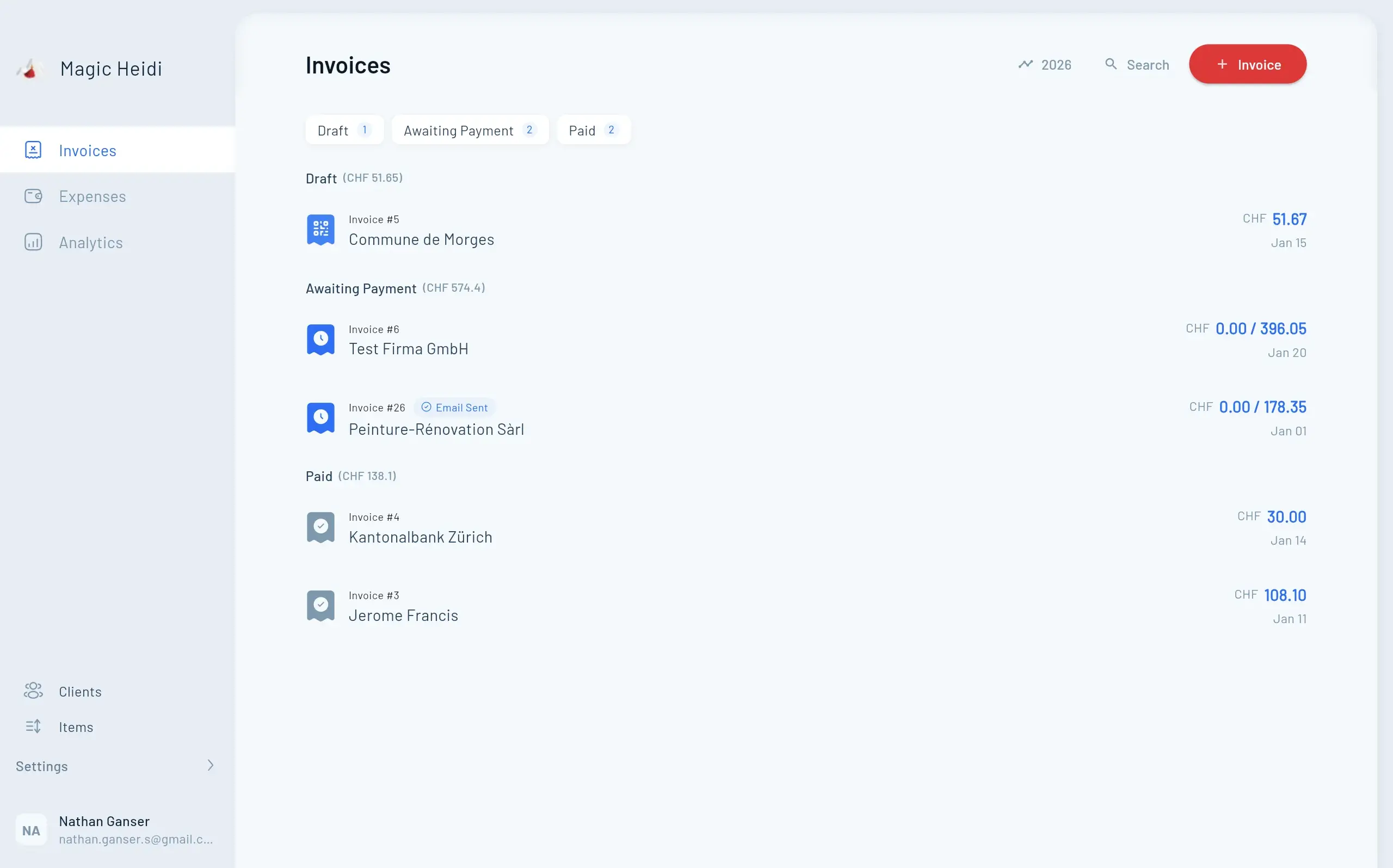
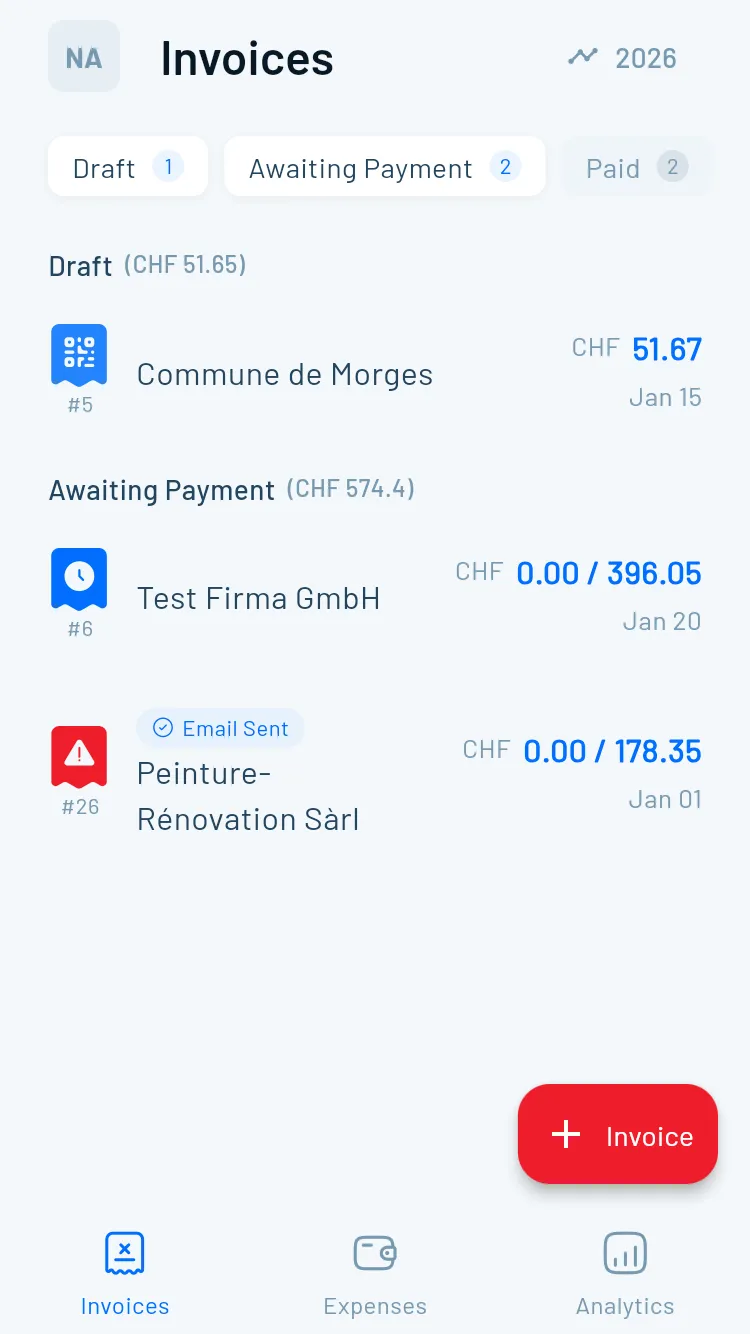
Magic Heidi handles every Swiss invoicing requirement automatically—from QR-bills to VAT calculations to 10-year archiving. Focus on your business, not paperwork.
- 🧾QR-Bill Generation
Compliant payment slips with every invoice
- ⚡30-Second Creation
From blank page to sent invoice in seconds
- ✨Automatic Compliance
All mandatory fields included by default
- 🌍Multi-Language
DE, FR, IT, EN invoices at the click of a button
- Invoice #3
Magic Heidi
CHF 500
Jan 29
- Invoice #2
Webbiger LTD
CHF 2000
Jan 24
- Invoice #1
John Doe
CHF 600
Jan 20
Simple Pricing. No Surprises.
One plan. All features. Cancel anytime.
Free Trial
- 3 invoices
- 3 expenses
- All features unlocked
- No credit card required
Annual
- Unlimited invoices
- Unlimited expenses
- QR-bill generation
- VAT management
- 10-year archiving
- Multi-currency support
- Bank statement import
- AI expense scanning
- Priority support
Monthly
- Unlimited invoices
- Unlimited expenses
- QR-bill generation
- VAT management
- 10-year archiving
- Multi-currency support
- Bank statement import
- AI expense scanning
- Email support
Still Have Questions?
Does Magic Heidi work for both freelancers and companies?
Yes! Magic Heidi is designed for Swiss freelancers, self-employed professionals, and small-to-medium businesses. Whether you're a sole proprietor or a company with multiple employees, the platform adapts to your needs.
Can I try Magic Heidi before committing?
Absolutely. You get 3 free invoices and 3 free expenses with full access to all features. No credit card required. See if Magic Heidi fits your workflow risk-free.
What happens to my data if I cancel?
You can export all your invoices and expenses as PDFs or CSV files at any time. Your data remains accessible for 90 days after cancellation, giving you plenty of time to migrate or archive.
Is my financial data secure?
Yes. Magic Heidi uses bank-level encryption (AES-256), stores data in Swiss data centers, and never shares your information with third parties. Read more on our security page.
Do you offer support in multiple languages?
Yes! Magic Heidi supports German, French, Italian, and English throughout the entire platform—including invoices, customer support, and documentation.
Can I import data from other invoicing tools?
Yes. Magic Heidi can import client data, products, and invoices from common formats (CSV, Excel). Contact support for migration assistance from specific platforms like bexio, Crésus, or Banana.
Ready to Simplify Swiss Invoicing?
Join thousands of Swiss freelancers and businesses who trust Magic Heidi for compliant, fast, and stress-free invoicing.
Last updated: January 2026. Information reflects current Swiss regulations. For specific tax advice, consult a certified Swiss accountant or fiduciary.