Swiss receipt template: when you need one and what to include
If you searched for a Swiss receipt template, you probably do not just want a blank document. You want to know when a receipt is useful, what it has to say, and when a paid invoice is the cleaner proof of payment.
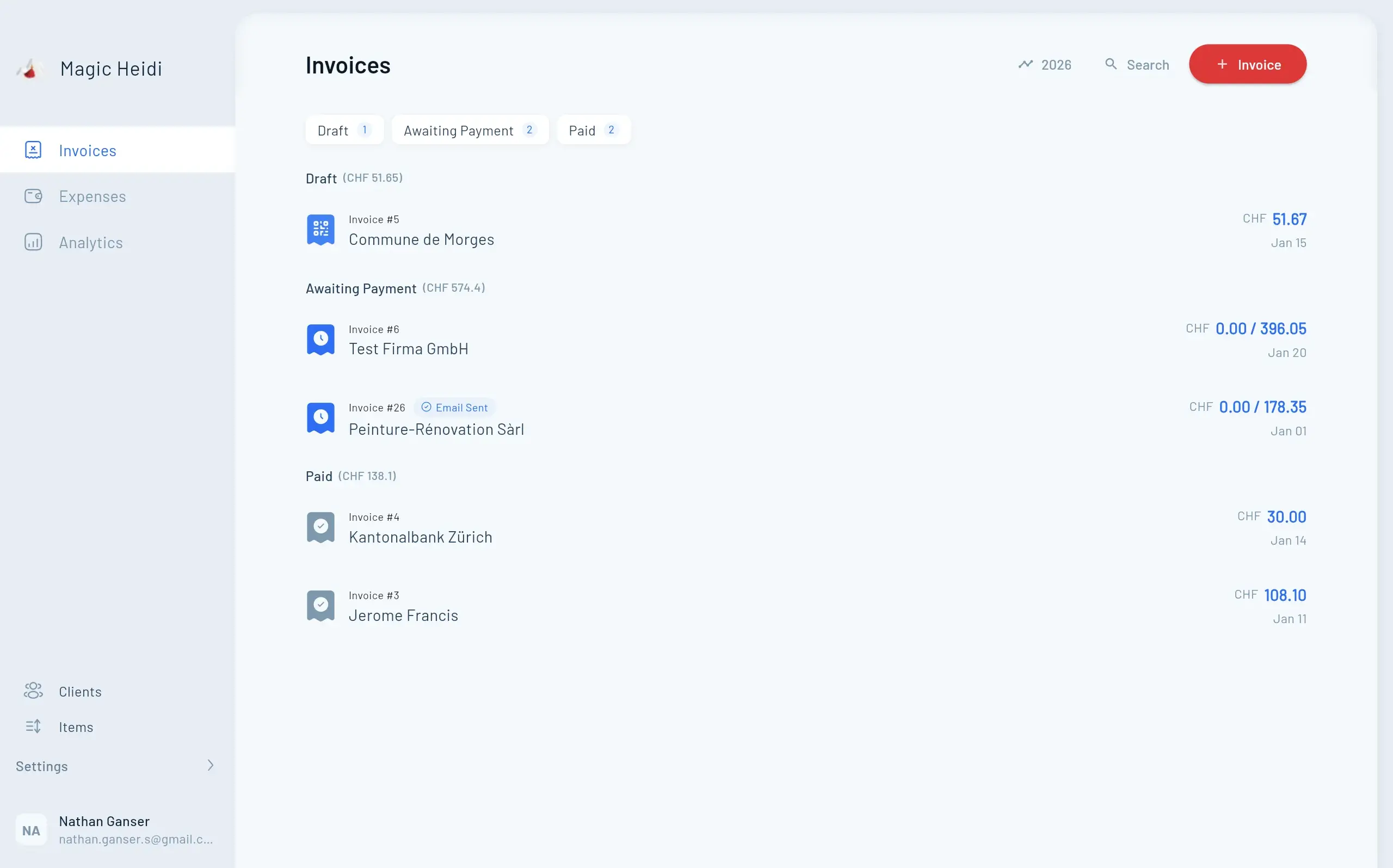
Short answer: A receipt confirms that money has already been received. In Switzerland, it is most useful for cash payments, part-payments, and situations where the customer wants a clear proof of payment.
The key distinction is simple:
- An invoice asks for payment.
- A receipt confirms payment.
- A cash-register slip can work as proof of payment if it contains the right details.
- A bank or TWINT confirmation proves that money moved, but not always clearly enough what it was for.
If you need a document that asks for payment, start with our Swiss invoicing guide. If you need a document that proves the payment was already made, this page is the better fit.
Receipt, invoice, cash-register slip, payment confirmation: what changes in practice?
These documents can look similar, but they do different jobs. That is why so many freelancers use the wrong one.
| Document | Main purpose | Typical content | Proves payment? |
|---|---|---|---|
| Receipt | Confirms that payment was received | Payer, payee, amount, date, purpose, often a signature | Yes |
| Invoice | Requests payment for goods or services | Service description, amount due, payment terms, payment details | Not by itself |
| Cash-register slip | Records a sale at the point of payment | Date, amount, business name, often item details | Usually yes |
| Bank or TWINT proof | Shows that money moved | Amount, date, account or app transaction | Yes, but sometimes without enough context |
When a Swiss receipt is usually the right document
For most solo businesses, the question is not whether receipts exist. The question is when a separate receipt actually helps.
Cash payment
Without a bank trail, a receipt becomes the clearest proof that the money changed hands.
- useful for one-off sales
- useful for in-person services
- important when the customer asks for proof
- helpful for later bookkeeping
Part-payment or deposit
A receipt makes it easier to prove which amount was paid and what still remains open.
- deposit received
- balance payment received
- partial settlement documented
- fewer disputes later
Digital payment with unclear context
TWINT or bank proof can show that money arrived, but a receipt can still help if the payment is hard to match to a service.
- customer wants a simple confirmation
- multiple small payments came in
- no clear invoice reference exists
- you want better records
What should a receipt include in Switzerland?
There is no single mandatory layout for every case, but the practical core stays the same. A useful Swiss receipt should clearly show:
- who paid
- who received the money
- how much was paid
- when it was paid
- what the payment was for
- and, especially for cash, a signature or clear confirmation
For VAT-registered businesses, a minimal receipt may be enough as proof of payment, but it is not always the best document for VAT or bookkeeping purposes. In many service businesses, a paid invoice is cleaner because it already contains the service description, customer details, and tax breakdown.
Swiss law also gives the payer the right to ask for a receipt. That is the practical point behind Article 88 of the Swiss Code of Obligations: if somebody pays, they may request written confirmation that the payment was received.
A simple Swiss receipt template
Use this as a practical starting point for cash payments, small in-person sales, or a signed proof that an invoice has been settled.
Receipt

Place and date: Zurich, 27 April 2026

Received from:
Anna Example

Received by:
Max Example
Example Studio
Bahnhofstrasse 12
8001 Zurich

Amount received:
CHF 350.00

Purpose of payment:
Payment for logo revision project

Payment method:
Cash

Confirmation:
The amount listed above was received in full.

Signature:
________________________
When a paid invoice is the better option
For many freelancers, a separate receipt is not the best everyday workflow. If you already issued a proper invoice, it is often enough to mark that invoice as paid with:
- a clear note such as "Amount received"
- the date of payment
- the amount received
- and, when helpful, a signature or internal confirmation
That is often easier to archive and easier to understand later than keeping a second document next to the invoice.
If you still need to issue the original payment request, use an invoice, not a receipt.
Common questions about Swiss receipts
Is a receipt mandatory in Switzerland?
Not as a separate standard document for every transaction. In practice, though, the payer may request one, and receipts are especially useful for cash payments.
Is a receipt the same as an invoice?
No. An invoice asks for payment. A receipt confirms that payment was already received.
Do I need a separate receipt for TWINT?
Often not. If the payment can be matched clearly to an invoice, the payment record plus the invoice may be enough. A separate receipt still helps when the context is unclear or the customer asks for one.
What is the minimum information a receipt should contain?
The payer, the payee, the amount, the date, and the purpose of the payment. For cash, a signature or explicit confirmation is strongly recommended.
Can a cash-register slip count as a receipt?
Often yes. Whether it is also strong enough for bookkeeping or VAT purposes depends on how complete the information is.
Can I just mark my invoice as paid instead?
Yes. For many freelancers, that is the most practical solution, especially when the invoice already contains all the important commercial and tax details.
Keep invoices, receipts and proof of payment in one clear workflow
Magic Heidi helps Swiss freelancers keep invoices, expenses and payment records organised so that nothing has to be reconstructed months later.