Opening balance sheet Switzerland: when you really need one and how to build it cleanly
People searching for an opening balance sheet in Switzerland usually do not want accounting theory. They want to know whether they actually need one, what has to go into it, and how to avoid starting the year with the wrong opening values.
Short answer: an opening balance sheet shows which assets, liabilities, and which equity a business starts with at the beginning of a financial year or at the start of a new accounting setup. In Switzerland, it matters most once you are in a balance-sheet-based accounting system with double-entry bookkeeping, for example in a GmbH, an AG, or a sole proprietorship that has moved beyond very simple cash tracking.
For most readers, the real clarification is this:
- a small sole proprietorship with simplified bookkeeping does not automatically need the same formal opening balance sheet as a GmbH;
- a GmbH, AG, or business moving into full bookkeeping does need clean opening figures;
- the opening balance sheet is not just a disconnected extra document, but the starting point for the new year’s accounting;
- if the opening values are wrong, the rest of the year becomes harder to explain.
If you search for opening balance sheet switzerland, you usually want a practical answer to one of these questions:
- who really needs to prepare one;
- what needs to be included;
- how it differs from the closing balance sheet;
- how to build it when you are starting a company, changing software, or taking over bookkeeping.
This page provides general practical information. It does not replace tax, legal, or fiduciary advice for your specific case.
What this page helps you sort out
The best DE, FR, IT, and EN sources keep returning to the same starting questions.
Do I really need one?
For a GmbH or AG, usually yes. For a small sole proprietorship, it depends more on the bookkeeping system in use.What goes into it?
The assets, debts, and equity that exist at the start date.How does it connect to the closing balance sheet?
In normal cases, the closing values of one year become the opening values of the next.Where do mistakes happen?
In copied opening balances, forgotten receivables, missing liabilities, or poorly explained capital.What is an opening balance sheet?
It is the opening snapshot of your financial position at the start of a financial year or a new bookkeeping system.
Starting point
The opening balance sheet fixes the values your accounting starts from.
Not a transaction list
It is not a journal or a history of movements, but the base those entries build on.
Balance sheet view
It mainly shows assets, liabilities, and equity at the beginning.
Direct link to the next period
In a well-kept system, the closing balance of one year becomes the opening balance of the next.
What multilingual research makes clear
The wording changes a little from language to language, but the underlying logic is remarkably stable.
- In German, pages about the Eröffnungsbilanz usually stress company formation, the start of the year, and the connection to the Schlussbilanz.
- In French, practical pages around accounting journals and year-end work often frame the bilan d'ouverture as the set of opening values from which the new year’s entries begin.
- In Italian, explanations of bilancio di apertura and saldi di apertura emphasise that opening balances must be complete, plausible, and balanced between assets and liabilities.
- In English, guides on
opening balance sheetoropening balancesusually come back to the same idea: your starting values need to be complete, balanced, and traceable.
That leads to a very practical Swiss takeaway:
An opening balance sheet is not an academic extra. It is the accounting starting point that determines whether the rest of the year will stay readable.
If the base is messy, journals, VAT checks, account balances, and year-end reporting get harder very quickly.
When an opening balance sheet becomes real in Switzerland
The usual situations are not identical, but they all require disciplined opening values.
Starting a GmbH or AG
The opening capital, bank account, and any early liabilities need to be shown properly.
- share capital clearly visible
- opening bank balance consistent
- no hidden mixing of private and business funds
- clear logic from day one
Starting a new financial year
The previous year’s closing balance normally feeds the next year’s opening values.
- continuity of balances
- no unexplained gaps
- clean carry-forward of prior-year values
- profit allocation handled correctly
Moving to new software or a fiduciary setup
This is where differences show up fast if opening balances are rebuilt badly.
- bank and cash checked
- open receivables and payables carried over
- fixed assets identified
- equity figures remain plausible
Opening balance sheet, closing balance sheet, accounting journal: what is the useful difference?
They belong to the same accounting system, but they do not answer the same question.
| Item | Main question | When it matters |
|---|---|---|
| Opening balance sheet | What do we start with? | At the beginning of the financial year or accounting setup |
| Closing balance sheet | Where do we stand at the end? | At the end of the financial year |
| Accounting journal | What entries happened, and in what order? | Throughout the year |
Who really needs an opening balance sheet in Switzerland?
The honest answer is: not everyone in the same level of formality.
The Swiss SME portal makes the core distinction quite clear:
- legal entities such as a GmbH or AG must keep proper accounts and prepare financial statements under the Swiss Code of Obligations;
- sole proprietorships and partnerships with more than CHF 500'000 in revenue from the last financial year also have to keep full accounts;
- below that threshold, simplified bookkeeping based on revenue, expenses, and assets can still be enough.
The practical reading is therefore:
| Situation | How important the opening balance sheet is | What that means in practice |
|---|---|---|
| GmbH / AG | high | part of normal balance-sheet bookkeeping and year changes |
| Sole proprietorship with full bookkeeping | high | opening balances need to match prior-year logic cleanly |
| Small sole proprietorship with simplified bookkeeping | lower | a clear assets overview still helps, but not always with the same formal structure |
| Migration into a new accounting system | high | opening balances need to be carried over correctly to avoid long-term distortions |
This is where many businesses misjudge the topic: they either assume they need a very formal document, or no structure at all. In reality, what matters most is that your starting balances match your actual accounting setup.
If your bigger question is how the whole year-end package fits together, these pages are the best next steps:
What should an opening balance sheet include?
There is no single universal layout for every business, but the logic stays the same: show what the business owns, what it owes, and what sits in equity at the start.
Typical components
In most cases, an opening balance sheet includes:
- assets such as bank, cash, receivables, inventory, or fixed assets;
- liabilities such as supplier debts, loans, or VAT owed;
- equity, including share capital, owner contributions, or a clean opening capital figure.
Very simple example for a newly formed Swiss GmbH
ASSETS                                 LIABILITIES AND EQUITY
Bank                     CHF 20'000    Share capital          CHF 20'000
                         ----------                           ----------
Total assets             CHF 20'000    Total liabilities/equity CHF 20'000
Simple example for an existing business entering a new year
ASSETS                                 LIABILITIES AND EQUITY
Bank                     CHF 14'500    Supplier liabilities    CHF 3'000
Receivables              CHF  4'000    Equity                  CHF 15'500
                         ----------                           ----------
Total assets             CHF 18'500    Total liabilities/equity CHF 18'500
The important thing is not that your table looks exactly like this. The important thing is that the opening values are complete, balanced, and explainable.
That is also the strongest recurring point in Italian and English practical sources: opening balances must balance. If they do not, the rest of the accounting year starts on unstable ground.
The mistakes that make an opening balance sheet wrong from day one
Problems usually do not come from the definition. They come from rough carry-forwards, missing items, or private and business values being mixed together.
Private values mixed in
Private money or personal spending silently ends up inside the business opening balances.
Receivables or liabilities forgotten
The balance sheet seems fine, but it does not reflect the real start-date position.
Capital explained badly
Especially in a GmbH, you need to understand where the share capital is and how it was used.
Balances copied without control
Closing values no longer match the next year’s opening figures.
Fixed assets estimated loosely
Laptops, equipment, or other values are carried over without a clear basis.
Difference hidden instead of explained
An improvised adjustment line avoids the question now, but creates a problem for the whole year.
What the multilingual review highlights
Three ideas come back again and again across languages:
- The opening balance sheet is a base, not a display piece. It exists so your accounting starts from reliable figures, not to satisfy a textbook definition.
- The connection to the previous year matters. Serious guidance keeps stressing that the closing balance of one period normally feeds the opening balance of the next.
- The main risk is operational, not theoretical. Errors usually show up when values are imported from Excel, copied from an older system, or rebuilt during a company start without enough control.
That is why the best recommendation is neither to dramatise nor to trivialise the topic.
Do not make the opening balance sheet bigger than it needs to be, but do not treat it as a minor formality if you run real balance-sheet accounting.
How to build an opening balance sheet cleanly
If your software does not generate it automatically from well-kept prior-year data, this simple process prevents many mistakes.
Fix the right opening date
Decide whether you are dealing with a company formation, the start of a new year, or a migration to a new system.
- clear opening date
- consistent scope
- no later movements mixed in
- context documented
Gather assets and liabilities
Start with bank, cash, receivables, payables, and the major balance-sheet items that really exist.
- bank reconciled
- open receivables identified
- supplier liabilities included
- fixed assets only with a plausible basis
Check both balance and logic
The totals need to balance, but they also need to tell a believable opening story.
- no hidden difference account
- equity or share capital understandable
- no unintended private/business mix
- short fiduciary review if the setup is complex
Frequently asked questions about the opening balance sheet in Switzerland
Is the opening balance sheet the same as the closing balance sheet?
No. The closing balance sheet shows the position at the end of the financial year. The opening balance sheet shows the position at the beginning. In practice, the closing values of one year usually become the opening values of the next.
Does every sole proprietorship in Switzerland need an opening balance sheet?
Not with the same level of formality as a GmbH. Below CHF 500'000 in revenue, simplified bookkeeping can be enough. But once you keep full accounts, the opening values become much more important.
What matters most for a Swiss GmbH?
A clear presentation of share capital, opening liquidity, and any debts or start-up costs. The opening position has to make sense and fit with the later bookkeeping.
Can I carry an opening balance sheet over from Excel?
Yes, but this is exactly where many differences appear. You need to verify bank, receivables, liabilities, fixed assets, and equity instead of simply copying an old sheet.
What should I do if the opening balances do not balance?
It is usually better to find the source of the difference than to create an artificial adjustment line. Common causes are forgotten receivables, missing liabilities, badly treated owner contributions, or an incorrect carry-forward of the prior year result.
When should I get a fiduciary involved?
As soon as the case involves a GmbH, uncertain historical balances, larger fixed assets, mixed private and business transactions, or a system migration with several open accounts.
A clean opening is better than a whole year of corrections
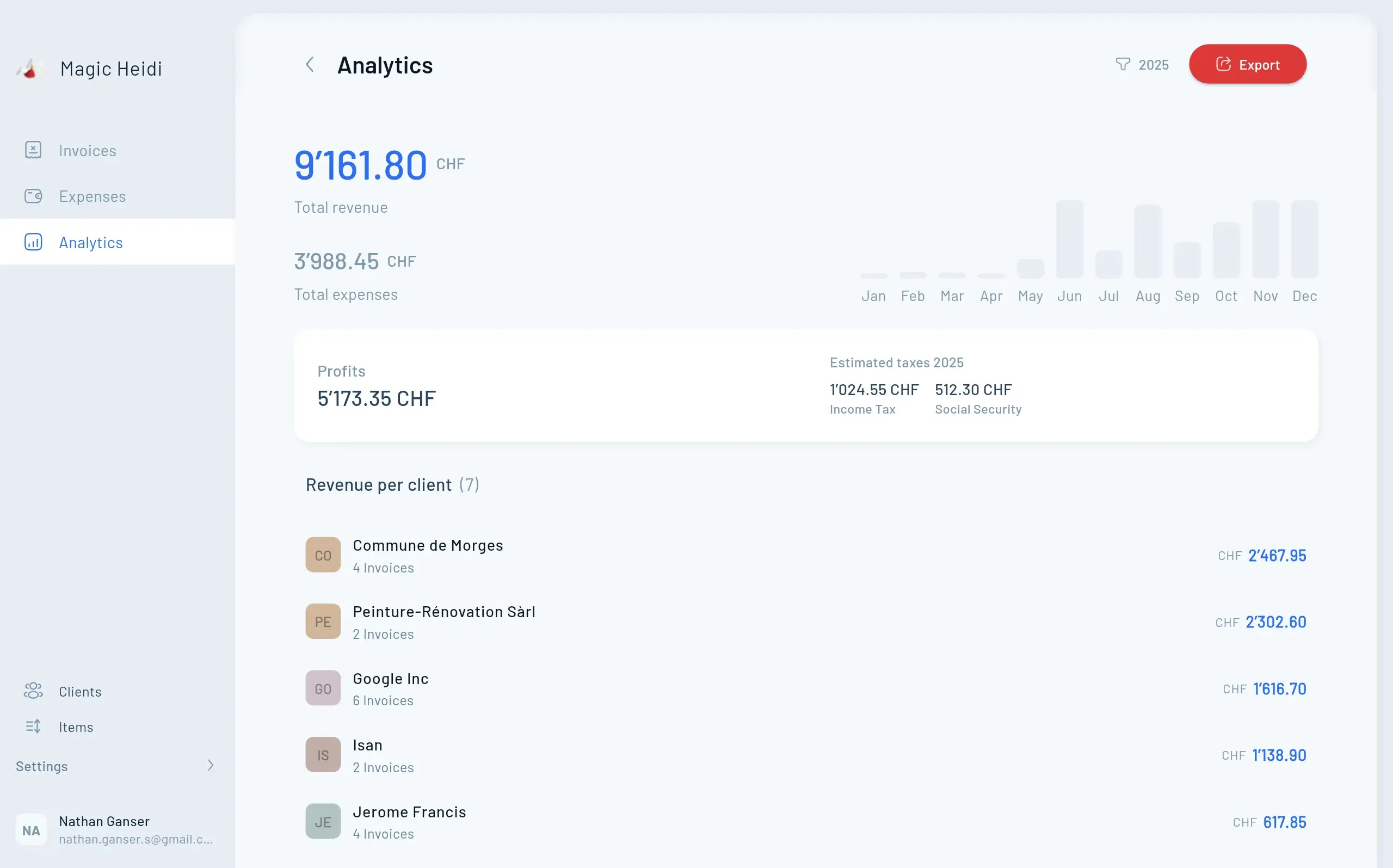
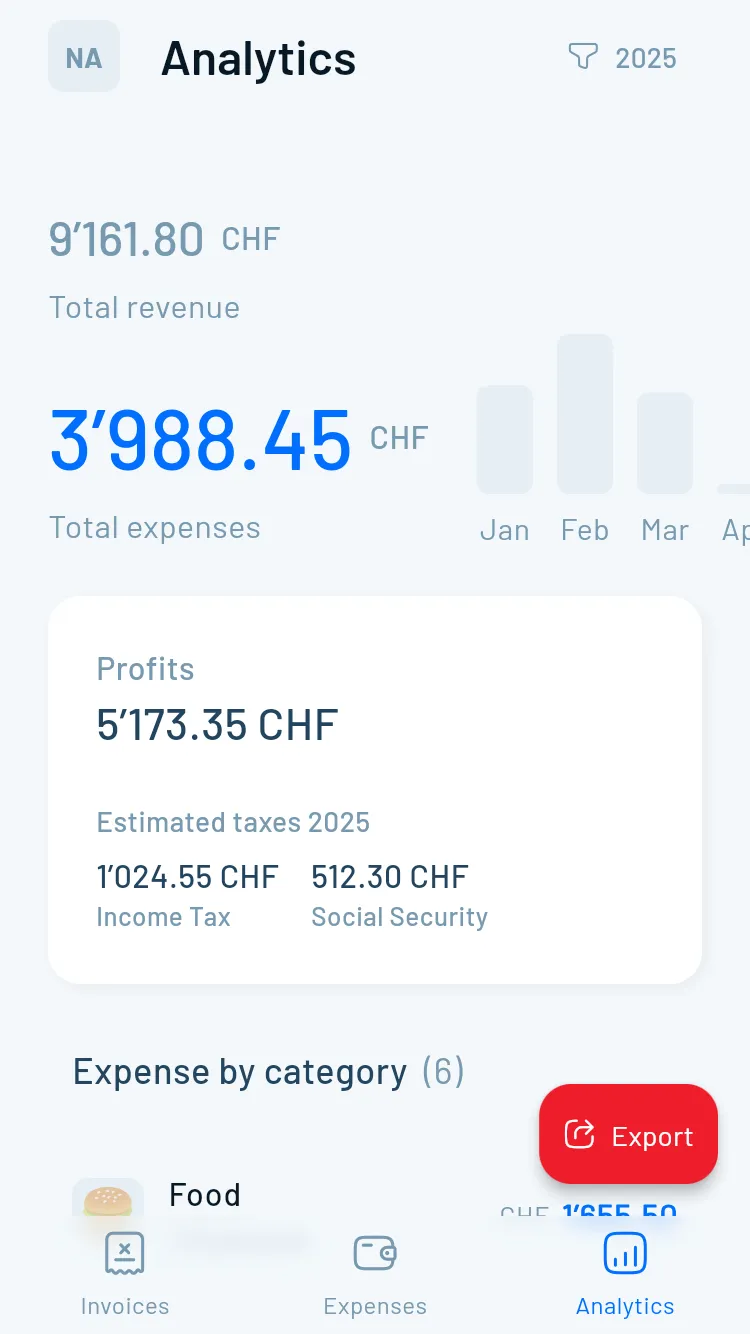
With Magic Heidi, invoices, expenses, and accounting logic stay easier to follow, so your starting values do not turn into a year-long problem.
Read next:
- Swiss GmbH year-end accounting guide
- Balance sheet explained
- Swiss chart of accounts
- Bookkeeping and record keeping
Sources and references:
- Swiss SME Portal EN: Compulsory accounting
- Swiss SME Portal EN: Financial statements
- bexio DE: Die Eröffnungsbilanz einfach erklärt
- Banana IT: Saldi iniziali
- Banana EN: Opening balances
The main thing to remember is simple:
in Switzerland, a good opening balance sheet is not the most sophisticated-looking one, but the one that lets you start with complete, balanced, and still explainable values months later.
Checked in April 2026.