Invoice Number Switzerland: mandatory or simply smart practice?
Most people searching for invoice numbers in Switzerland are not looking for a textbook definition. They want a practical answer: do I really need one, does it have to be strictly sequential, what changes with QR-bills, and what should I do if I make a mistake? This guide focuses on exactly that.
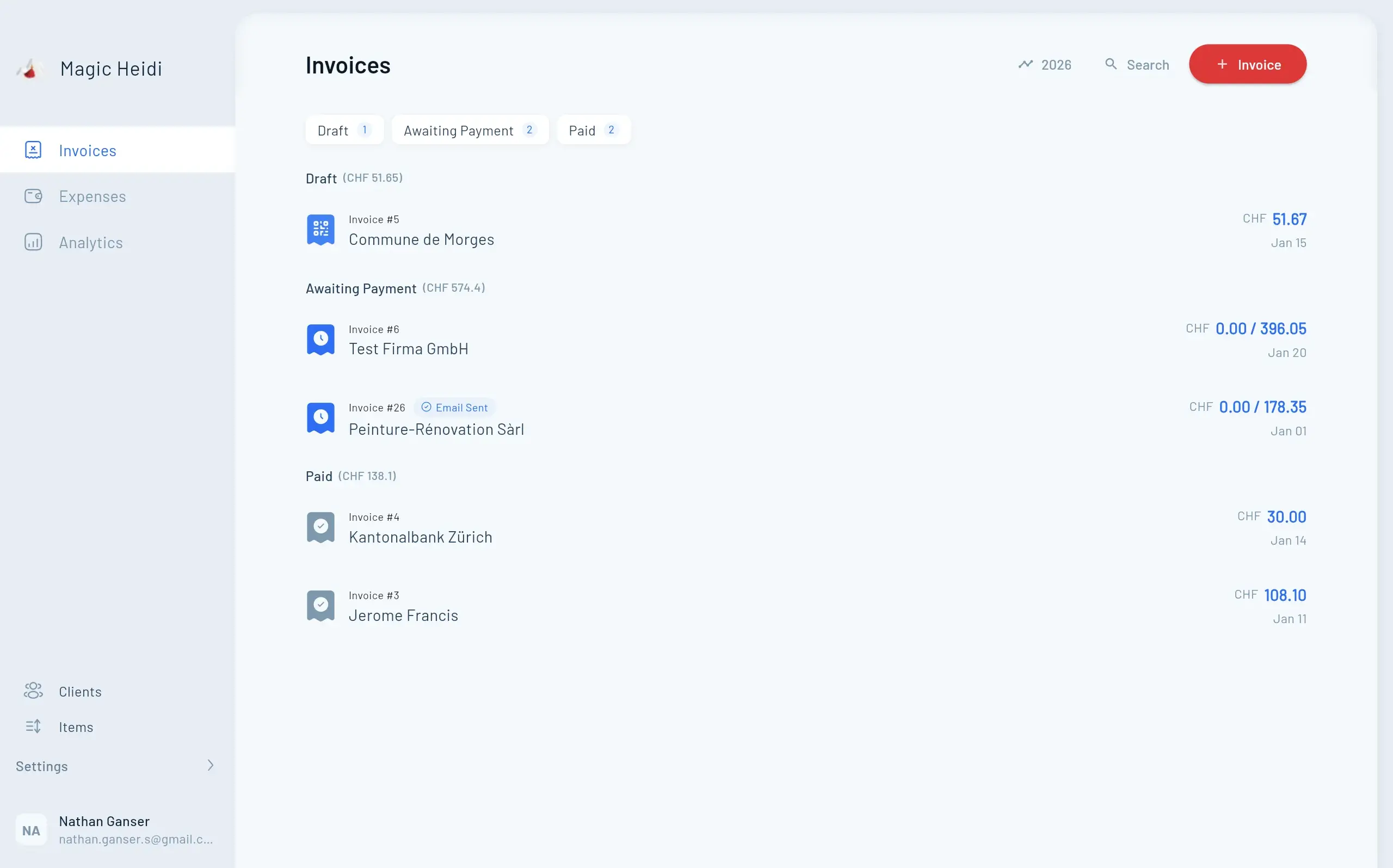
Short answer: In Switzerland, an invoice number is almost always a very good idea, but the official Swiss VAT guidance does not usually list it as one of the explicitly named minimum formal invoice fields. For freelancers, sole proprietors, and small businesses, the most useful rule is therefore practical rather than theoretical:
- if you invoice clients regularly, always use a unique invoice number
- if it is a one-off private or occasional invoice, clear documentation may still be possible without one
The next distinction matters just as much:
- The invoice number identifies the invoice itself.
- The customer number identifies the client.
- The purchase order number identifies the client's order.
- The QR reference or payment reference helps allocate the payment.
Those numbers are often mixed up online, which later creates avoidable confusion in reminders, payment matching, and bookkeeping.
If you first want a broader Swiss invoicing overview, start with the Swiss invoice template. It already links back to this page when your main question is about numbering rather than layout.
What people really want to know about invoice numbers in Switzerland
The real uncertainty is usually not “what is an invoice number?” but “am I doing something wrong without one, and what system will save me trouble later?”
Is it legally mandatory?
Many pages claim that flatly. For Switzerland, the answer is more nuanced.Does it have to be sequential?
A clean sequence is smart, but not every sensible system looks identical.Where should it appear?
It should be visible and clearly labelled as the invoice number.What changes with QR-bills?
That is where the format becomes more technical than many expect.Is an invoice number legally required in Switzerland?
This is where it helps to separate Swiss practice from generic European or German-language advice copied onto Swiss pages.
Official VAT guidance
Swiss official invoicing guidance does not usually name the invoice number as a standalone formal minimum field.
Business reality
Accounting tools, invoicing software, and internal controls almost always rely on unique invoice numbers.
One-off private invoice
A single occasional invoice may still be understandable without a dedicated numbering system.
Regular invoicing
As soon as you send several invoices, reminders, or QR-bills, a clear invoice number becomes close to indispensable.
The useful Swiss answer
The current Swiss SME portal invoicing guidance focuses on fields such as supplier and recipient details, date, service description, pricing, and VAT details. In that official context, the invoice number is not usually highlighted as a separately named minimum requirement.
That is why the blanket statement “a Swiss invoice is invalid without an invoice number” is too strong. At the same time, the opposite conclusion “then I do not need one at all” is poor business practice for almost everyone who invoices clients more than occasionally.
As soon as you:
- invoice repeatedly,
- send reminders,
- issue credit notes,
- reconcile incoming payments,
- or work with QR-bills,
an unambiguous invoice number becomes the cleanest way to stay organised.
The most useful summary is therefore:
- not always presented as a separate formal legal field in official Swiss VAT guidance
- operationally strongly recommended in almost every real business workflow
Invoice number, customer number, purchase order, and reference: what is the difference?
These numbers often get mixed together on Swiss invoices and in QR workflows. The cleaner rule is simple: one number, one job.
| Term | What does it identify? | Does it stay the same? | Example |
|---|---|---|---|
| Invoice number | This exact invoice | Changes with every new invoice | 2026-0012 |
| Customer number | The client in your system | Usually stays the same for that client | C-1047 |
| Purchase order number | The client's internal order or assignment | Often stays the same for that order | PO-77821 |
| QR or payment reference | Automatic payment allocation | Generated per invoice or payment flow | 002000000000123456789012345 |
What a good Swiss invoice number looks like
There is no single perfect format, but strong systems usually follow the same principles.
Unique
Every invoice gets its own number. Never reuse one quietly later.
- no duplicates
- clear link to one invoice
- helps with reminders
- easier client communication
Consistent
Use one logic across the year instead of inventing a new format each month.
- same structure every time
- easy to sort
- works in folders and spreadsheets
- lower error risk
Simple enough for software
In QR and import workflows, clean formats beat creative ones.
- few special characters
- predictable length
- easy to read aloud
- compatible with automation
Traceable
You should be able to tell quickly whether a number makes sense and where it belongs.
- year often helps
- clear order
- document gaps instead of hiding them
- handle corrections separately
Three numbering systems that work in practice
1. Year plus running number
2026-001
2026-002
2026-003
For many Swiss freelancers and small service businesses, this is the strongest default. It is easy to understand, easy to sort, and easy to communicate.
2. Year, month, and running number
2026-04-001
2026-04-002
2026-05-001
Useful if you issue many invoices and want faster filtering by period.
3. Customer-based structure
C1047-2026-001
C1047-2026-002
C2091-2026-001
This can work, but it also increases the risk that invoice numbers and customer numbers get mixed up.
For most small Swiss businesses, year plus running number is still the best balance of clarity and simplicity.
With QR-bills, the invoice number becomes more technical
Once numbering feeds into payment references or automatic allocation, readability is no longer the only concern.
Classic IBAN workflows
Simple letters and numbers without awkward special characters are usually easier for tools to process.
QR-IBAN workflows
These often become even stricter, with highly structured reference logic.
Automatic matching
Messy numbering can make imports and payment allocation harder than necessary.
Less creativity, more stability
In Swiss QR workflows, boring often wins.
What changes when QR-bills enter the picture
Without QR-bills, you usually have a lot of freedom with invoice numbers. With QR-bills and automated payment allocation, format discipline matters more.
Swiss software documentation, especially around QR references, repeatedly shows the same pattern:
- simple formats are easier to process,
- excessive special characters can create friction,
- long or inconsistent numbering makes reconciliation harder,
- and if you expect future automation, a cleaner numbering system pays off early.
That does not mean every invoice number must look purely numeric today. It does mean that if you want fewer problems later, simple and systematic beats clever and decorative.
The most common invoice-number mistakes
These mistakes rarely feel dramatic at the moment, but they create unnecessary cleanup later.
Duplicate numbers
The classic manual-template problem. It quickly creates confusion in reminders and bookkeeping.Renumbering old invoices retroactively
That often creates more confusion than it solves.Making one number do too many jobs
Customer logic, order logic, and invoice logic should not all live inside one identifier.Too many special characters
They look creative but are often the first source of technical friction.Quietly replacing a paid invoice
Once an invoice is paid or booked, credit-note or correction logic is usually cleaner than overwriting history.Common questions about invoice numbers in Switzerland
Is an invoice number legally required in Switzerland?
Official Swiss invoicing guidance does not usually list it as a separately named formal minimum field. In normal business practice, however, using a unique invoice number is still strongly recommended.
Does the invoice number have to be sequential?
A sequential system is very sensible, but the key point is first that each invoice can be identified clearly and uniquely.
Can I restart at 001 every year?
Yes, if the system remains unambiguous, for example 2026-001 and 2027-001.
Can I use the customer number as the invoice number?
It is better not to. One identifies the client, the other identifies the invoice. Mixing them makes payment follow-up and bookkeeping harder.
Where should the invoice number appear?
In a visible place on the invoice, usually in the header area or near the invoice title, clearly labelled as the invoice number.
What matters most in QR workflows?
Keep the numbering simple, structured, and tool-friendly. That usually matters more than making it look clever.
The best invoice number is not the most original one. It is the one that causes the least friction later.
If you want a Swiss invoicing workflow that stays clear across issuing, sending, and payment tracking, start with a clean numbering system from day one.
Sources for this page:
- Swiss SME Portal DE – Invoicing
- Swiss SME Portal FR – Facturation
- Swiss SME Portal IT – Compilazione delle fatture
- bexio EN – Invoice number
- Banana EN – How to define Customer Number and Invoice Number
- Vertec DE – Invoice numbers
Checked in April 2026. This guide reflects common Swiss invoicing practice for freelancers and small businesses and does not replace legal or tax advice for special cases.