Budgeting Apps & Software 2026

The Best Budgeting Apps in Switzerland 2026

The best budgeting app for Switzerland depends on your situation: BudgetCH for your personal budget, BlueBudget for automatic multibanking and Magic Heidi for self-employed people who want to keep business and personal finances cleanly separated. Here's the full comparison with prices, strengths and weaknesses.

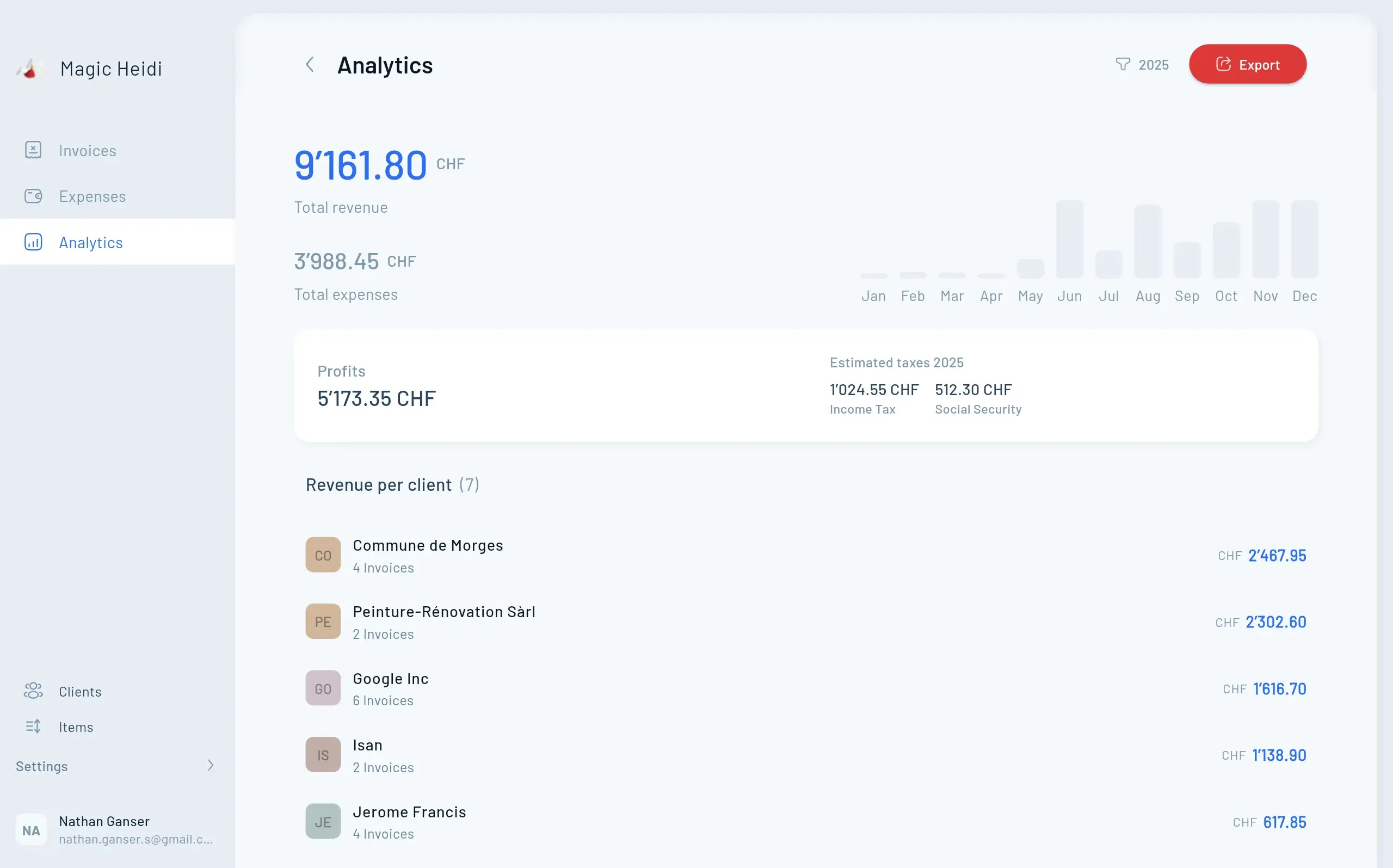
Magic Heidi analytics dashboard

TL;DR

  • Best free budgeting app for Switzerland: BudgetCH from Budgetberatung Schweiz (the Swiss budget advice association) — free, ad-free, built on Swiss household benchmarks.
  • Best budget app with bank sync: BlueBudget, connects 50+ Swiss banks via bLink, the official open banking standard from SIX.
  • For the self-employed: Magic Heidi combines budgeting, invoices, expenses and VAT in one app. Free up to 3 invoices and 3 expenses, Pro from CHF 25/month.
  • Rule of thumb for freelancer budgets: set aside 20 to 25% of every payment immediately for taxes and AHV (Swiss social security), plus keep 3 to 6 months of expenses as an emergency fund.
  • Key distinction: budget apps plan your money, accounting software keeps your books. If you're self-employed, you usually need both.

Quick Comparison: The Best Budget Apps at a Glance

AppPriceBest forCHFSwiss BanksQR-billVAT
Magic HeidiFree, Pro from CHF 25/mo.All-in-one for the self-employed
BudgetCHFreePersonal budgets & families
BlueBudgetFree (still growing)Swiss multibanking✅ (bLink)
BudgetHubFree + paidBudgeting without bank linkingCSV import
YNAB$109/yearZero-based budgeting
MoneyControlCHF 5 (one-off)Simple overviewCSV import
WalletFree + PremiumInternational accountsLimited

Prices last verified: 08.09.2026

Budget App or Budgeting Software: What's the Difference?

Budgeting software, a budget planner and a budget app all do the same thing: record income, categorize expenses, track savings goals. The word "software" is a holdover from the desktop era; today almost every option runs as an app on your phone and as a web app in the browser. What matters isn't the label — it's three questions:

  1. Personal or business? For a household budget, BudgetCH or BlueBudget is plenty. If you're self-employed, you also need invoices, expense receipts and VAT — which points you towards invoicing software with expense tracking.
  2. Automatic or manual? Bank sync (BlueBudget, Wallet) saves time. Manual entry (BudgetCH, BudgetHub) keeps your data private and makes you more aware of every expense.
  3. One-off purchase, subscription or free? Everything's on the table, from CHF 0 (BudgetCH) to CHF 5 one-off (MoneyControl) to an annual subscription (YNAB).
The best budgeting apps in detail

The Top Apps Compared

From all-in-one tools for the self-employed to specialized Swiss budget apps: here's how to find the right fit.

Magic Heidi

Budgeting Software & Business Admin for Swiss Freelancers

Magic Heidi is more than a budget app: invoices, expenses, VAT and tax planning in one tool, built by Swiss freelancers for Swiss freelancers. If you want your business budget under control, you see income, expenses and your estimated tax bill at a glance.

  • Swiss invoices in seconds: QR-bills to the Swiss standard, with automatic VAT calculation
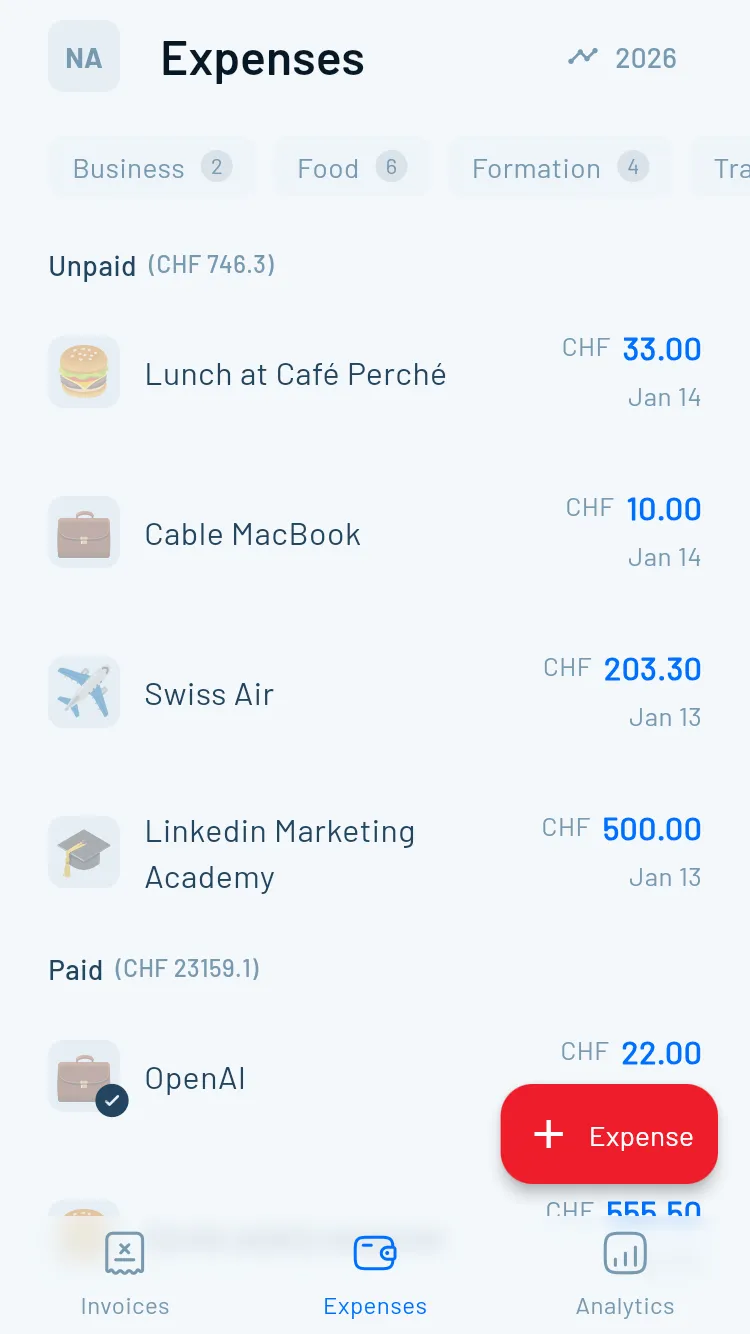
  • AI-powered expense tracking: snap a photo of the receipt, done. The AI picks up the date, amount and category automatically
  • Built-in tax and budget planning: tax estimates, savings planning, export for your accountant
  • Available: iOS, Android, Web, Mac, Windows | Languages: DE, FR, IT, EN, ES, PT | Price: free up to 3 invoices + 3 expenses, Pro CHF 25/month (billed annually) or CHF 39/month
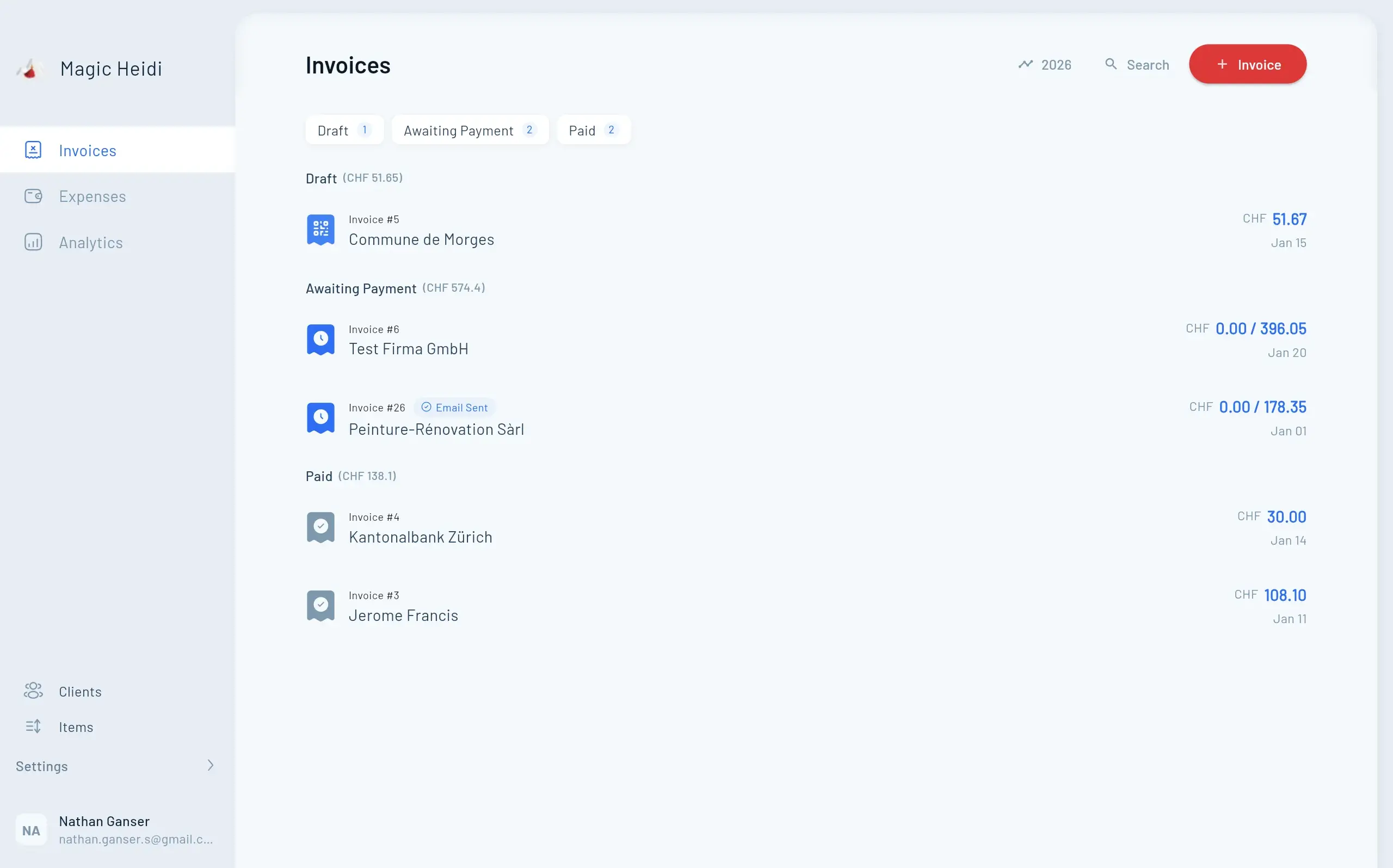
Magic Heidi invoice list
BudgetCH

The Official Swiss Budgeting App

BudgetCH is the non-profit app from Budgetberatung Schweiz (the Swiss budget advice association): trustworthy, ad-free and built around Swiss living costs. As a pure budget planner for Swiss households, it's the standard recommendation.

  • Guided budget planning: templates and benchmarks based on Swiss living costs
  • Spending alerts: notifications when you go over budget
  • Family sharing: share and sync your budget with family members
  • Available: iOS, Android | Languages: DE, FR, IT | Price: free (export CHF 4)
Swiss budget planning
BlueBudget

Swiss Budget App with Real Multibanking

BlueBudget was co-founded by Swiss finance blogger FinanzFabio and connects 50+ Swiss banks via bLink, the official open banking standard from SIX. Transactions are imported automatically and categorized by AI.

  • Automatic bank import: 50+ Swiss banks via bLink, no manual entry needed
  • AI categorization: expenses are sorted automatically, savings goals tracked continuously
  • Shared expenses: joint budgets for couples and households
  • Available: iOS, Android | Languages: DE, FR, IT, EN | Price: free, feature set still growing
Mobile expense tracking
YNAB

You Need A Budget: Zero-Based Budgeting

YNAB is the gold standard for proactive, zero-based budgeting: every franc gets a job before you spend it. It's a powerful method if your income is irregular — but there's no Swiss bank sync.

  • Envelope budgeting: every franc gets a job: rent, taxes, emergency fund
  • Real-time sync: Web, iOS and Android
  • Reports and goal tracking: visual overview of spending and savings goals
  • Available: Web, iOS, Android | Languages: EN | Price: $109/year, 34-day free trial
Budget planning and savings goals

Budgeting Software for the Self-Employed: Separate Business and Personal

If you're self-employed, a personal budgeting app isn't enough. You need two separate money loops: your business budget (income from invoices, business expenses, reserves for taxes and AHV) and your personal budget (the "salary" you pay yourself).

Here's how the separation works in practice:

  1. Open a dedicated business account. All client payments and business expenses run through this account only.
  2. Record business expenses immediately. With AI receipt scanning, you photograph the receipt the moment you buy — instead of hunting for crumpled receipts at year-end.
  3. Pay yourself a fixed "owner's salary". Transfer a fixed amount to your personal account every month. That's the amount you budget privately with BudgetCH, BlueBudget or another app from this comparison.
  4. Automate your reserves. 20 to 25% of every client payment goes straight to a separate reserve account for taxes and social security contributions, before you touch the rest.
  5. Keep an eye on VAT. From CHF 100'000 annual revenue, VAT registration is required (Swiss Federal Tax Administration). Budgeting software with VAT support calculates the amounts automatically.

Your hourly rate decides whether your budget can work at all. Use the hourly rate calculator for the self-employed to check whether your prices actually cover taxes, AHV, holidays and unpaid admin time.

How to Create a Budget in 5 Steps: Free Budget Planner Template and Swiss Benchmarks

Here's how to build a realistic budget in about 30 minutes:

  1. Work out your net income. If your income is irregular: average the last 12 months, and round down when in doubt.
  2. List your fixed costs. Rent, health insurance, other insurance, subscriptions, taxes. Everything that hits every month.
  3. Estimate variable spending. Food, transport, leisure. Three months of bank statements will tell you the truth.
  4. Set savings goals. Emergency fund (3 to 6 months of expenses), pillar 3a, bigger purchases.
  5. Review monthly. 30 minutes at the end of the month is enough: compare actuals to plan and adjust your categories.

Proven rules of thumb for splitting net income in Switzerland:

CategoryBenchmark
Housing (rent + utilities)max. 25–30%
Taxes & reserves (self-employed)20–25%
Health insurance & other insurance10–15%
Food & household10–15%
Transport5–10%
Savings & retirementmin. 10%
Leisure & personalthe rest

The benchmarks in the table come from Budgetberatung Schweiz, which also publishes example budgets for apprentices, families and retirees. For the self-employed, we built our own template on top of them: the budget planner below separates business from personal, calculates reserves for taxes, AHV, VAT and pillar 3a automatically, and includes the benchmarks as a separate sheet with your share per category for comparison.

Download

Free Swiss Budget Template (Excel & PDF)

Budget planner template for the self-employed: monthly budget with business and personal columns, a 12-month yearly overview and reserves for taxes, AHV, VAT and pillar 3a. The Excel version calculates automatically; the PDF is for printing. Free, no sign-up.

Decision guide

Which Budgeting App Is Right for You?

The best app depends on your situation. Here's our guide:

Your situationRecommended appWhy
Self-employed with invoicing & VATMagic HeidiAll-in-one: invoicing, expenses, taxes, Swiss-made
Personal budget with automatic bank importBlueBudget50+ Swiss banks via bLink, AI categorization
Free budgeting app for the householdBudgetCHFree, ad-free, Swiss benchmarks
Learning zero-based budgetingYNABBest method for proactive budgeting with irregular income
Budgeting without bank linking, web appBudgetHubSwiss categories, CSV import, your data stays with your bank
Beginner, simple, no subscriptionMoneyControlAll the basics, CHF 5 one-off, zero complexity

Key Features for Swiss Users

What to look for when choosing a budgeting app for Switzerland.

Swiss landscape
FAQ

Frequently Asked Questions

What is the best budgeting app for Switzerland?

For personal budgets: BudgetCH (free, from Budgetberatung Schweiz) or BlueBudget (automatic bank import). As a pure budget planner with Swiss benchmarks, BudgetCH is the first choice. For self-employed people who send invoices: Magic Heidi, because budgeting, invoices, expenses and VAT come together in one app. For the zero-based method: YNAB.

Is there a good free budgeting app?

Yes, several. BudgetCH is completely free and available in German, French and Italian. BlueBudget is currently free to use, and BudgetHub has a free plan. Magic Heidi is free forever for up to 3 invoices and 3 expenses, no credit card required.

Is there a free budget template for Switzerland?

Yes. On this page you can download a free budget planner template for Switzerland as Excel and PDF, no sign-up required. It's built for the self-employed: business and personal kept separate, reserves for taxes, AHV, VAT and pillar 3a calculated automatically, and the Budgetberatung Schweiz benchmarks included as a separate sheet. For families, apprentices or retirees, Budgetberatung Schweiz publishes its own budget templates.

Do I need special budgeting software as a self-employed person?

Yes, as soon as you send invoices. Normal budget apps only cover the spending side. As a self-employed person you also need QR-bills, expense receipts for your tax return and, from CHF 100'000 revenue, VAT returns. Magic Heidi combines all of that in one app; you run your personal budget separately alongside it.

Can I connect Swiss banks automatically?

Partially. BlueBudget connects 50+ Swiss banks via bLink, the official open banking standard from SIX. Most other apps rely on CSV import from e-banking, which works reliably but adds a manual step. YNAB offers no automatic bank connection in Switzerland.

Free vs. paid budget apps: which is worth it?

For personal budgeting, a free app like BudgetCH is usually enough. A subscription pays off when the app measurably saves you time or money: YNAB costs $109/year and demands discipline, but rewards it with full control. For the self-employed, Magic Heidi Pro (CHF 25/month billed annually) quickly pays for itself through the admin time saved on invoices and receipts.

How much should I save as a self-employed person?

As a rule of thumb: 20 to 25% of every payment for taxes and social security contributions, plus an emergency fund of 3 to 6 months of expenses. For pillar 3a, self-employed people without a pension fund can pay in 20% of net income (2026: max. CHF 36'288); with a pension fund, CHF 7'258. Both are tax-deductible.

Automatic sync or manual entry?

Auto-sync (BlueBudget, Wallet) is convenient and complete, but requires linking your bank. Manual entry or CSV import (BudgetCH, BudgetHub, MoneyControl) keeps your data private and makes spending more deliberate. A proven setup: business account automatic, personal account manual.

What is zero-based budgeting?

With zero-based budgeting (the YNAB method), you give every franc a job before you spend it: CHF 5'000 of income means CHF 5'000 of assignments for rent, food, taxes and savings. For self-employed people with irregular income it's especially valuable, because you always know exactly how much money is truly available after all commitments.

Ready to Get Your Finances Under Control?

Try Magic Heidi for free: invoices, expenses and tax planning in one app. 3 invoices + 3 expenses free, no credit card. Swiss-made, for the Swiss self-employed.

Conclusion: The Right Budgeting Software for Your Situation

A budgeting app isn't a luxury — it's your tool for financial control. Especially in Switzerland, with high fixed costs, tax bills that arrive after the fact and (for the self-employed) irregular income, your budget is what decides between stress and clarity.

One important distinction: this page is about budget planning and expense tracking, not bookkeeping. If you're looking for receipts, VAT returns and year-end accounts, head to accounting software for Switzerland.

Our recommendations at a glance:

  • Best budgeting software for the self-employed: Magic Heidi, because budgeting, invoicing, expenses and taxes belong together
  • Best free option for personal budgets: BudgetCH — simple, secure, Swiss-specific
  • Best Swiss app with bank sync: BlueBudget, 50+ banks via bLink
  • Best method for proactive budgeting: YNAB, zero-based budgeting for disciplined savers
  • Best value for money: MoneyControl, CHF 5 one-off, no subscription

Start today: build your budget with BudgetCH or BlueBudget (free), or create your first 3 invoices and 3 expenses free with Magic Heidi, no credit card required.