Invoicing Without MWST Switzerland
Not every business in Switzerland has to charge VAT. Below the threshold of CHF 100,000 in annual revenue, you can issue invoices without MWST (Swiss VAT) — but that doesn't mean they're informal. QR-bill, service description, and clear references to the MWST exemption remain mandatory. This guide shows when an invoice without MWST is permissible, what it must contain, and when voluntary registration is still worth it.
Why an invoice without MWST is not automatically a simple invoice
CHF 100,000 revenue threshold for MWST liability, voluntary registration below it with input tax deduction benefit, reverse charge procedure for international clients, and seven mandatory elements under Art. 26 MWSTV — get this wrong and you risk retroactive claims from the ESTV (Swiss tax authority), rejected input tax deductions from your clients, and invoices that aren't legally sound.
CHF 100,000 revenue threshold
Below CHF 100,000 in annual revenue, no MWST obligation — but from the first franc above that, registration becomes mandatoryVoluntary registration is often worth it
{ "Even below the threshold": "input tax deduction on materials, software, vehicles — frequently higher than the MWST owed" }Reverse charge for foreign clients
{ "Services to foreign B2B clients": "MWST shift, recipient self-assesses — but a correct note on the invoice is mandatory" }7 mandatory elements even without MWST
QR-bill, service description, date — most formal requirements also apply to non-MWST-liable businessesKey Takeaways — Invoicing Without MWST Switzerland
- CHF 100,000 revenue threshold: Below this annual limit, you are not MWST-liable. Above it, registration with the ESTV becomes mandatory.
- Voluntary registration: Even below the threshold, you can register voluntarily — and in many cases it pays off because of the input tax deduction.
- An invoice without MWST is not informal: QR-bill, seven mandatory elements under Art. 26 MWSTV, and a clear reference to the MWST exemption remain required.
- Reverse charge for foreign clients: Services to foreign businesses (B2B) can be invoiced without Swiss MWST — with the correct notation.
- No input tax deduction without an MWST number: If you're not registered, you can't claim input tax — that's the key disadvantage.
- AHV/IV/EO is separate: The compensation fund (Swiss social insurance) has no revenue threshold — you register from the first franc.
Not every business in Switzerland has to charge VAT. Below the threshold of CHF 100,000 in annual revenue, you can issue an invoice without MWST — but that doesn't mean it's informal. QR-bill, service description, and a clear reference to the MWST exemption remain mandatory. This guide shows when an invoice without MWST is permissible, what it must contain, and when voluntary registration is still worth it economically despite the VAT obligation.
The situation is a classic: you start as a side-business freelancer or small business, take on your first assignments, issue invoices — and wonder whether the MWST obligation applies to you. The answer is: probably no, as long as your revenue stays below CHF 100,000 per year. But there are pitfalls: what happens when you reach the threshold during the year? What if you have clients in the EU? And what if you buy expensive materials and can't recover the input tax because you're not registered?
The CHF 100,000 threshold — when does MWST become mandatory?
An invoice without MWST in Switzerland is permissible as long as your annual revenue doesn't reach the threshold of CHF 100,000. This limit is set out in Art. 10 para. 2 let. a of the Mehrwertsteuergesetz (MWSTG, Swiss VAT Act). The rule is clear:
- Below CHF 100,000 per year: No MWST obligation. You can issue invoices without MWST and don't need an MWST number.
- From CHF 100,000 per year: MWST obligation. You must register with the ESTV, submit your MWST returns, and include an MWST number on your invoices.
- The threshold applies per tax period (calendar year) and is calculated based on worldwide revenue from taxable services.
Important: the CHF 100,000 is not a trivial limit you can simply exceed and then ignore. As soon as it becomes foreseeable that you'll reach the limit in the current year — for example, because you've landed a major contract — you must register with the ESTV within 30 days. The deadline starts on the day you know (or reasonably should have known) that the threshold will be exceeded.
Practical example: Anna is a freelance graphic designer in Bern. In 2025, she generated revenue of CHF 72,000 — clearly below the threshold. In March 2026, she signs a framework agreement with an agency that alone brings in an additional CHF 60,000 for 2026. Together with her other clients, she's projected to generate CHF 115,000 in 2026. Anna must register with the ESTV within 30 days of signing the contract — not at the end of the year when the CHF 100,000 is actually reached.
What counts as revenue for the threshold?
For the invoice without MWST in Switzerland, what counts as revenue is crucial. The ESTV calculates the threshold based on taxable deliveries and services domestically and abroad. The following do not count:
- Capital income such as dividends or interest
- Contributions from AHV/IV/EO (Swiss social insurance) that you receive as an employee
- Services you provide as an employee for another business (so-called dependent secondary employment)
- Income from real estate sales (unless you're a commercial real estate dealer)
What does count: all income from self-employment, whether you generate it as an Einzelfirma (Swiss sole proprietorship), GmbH, or AG. Non-taxable services (e.g., foreign revenue not subject to Swiss MWST) also count toward the threshold, because the MWSTG is based on worldwide revenue.
Mini-Story: Thomas, a web designer in Zurich, was convinced he wouldn't reach the threshold. He only counted his Swiss clients — CHF 85,000 per year. What he forgot: his clients in Germany and Austria brought in another CHF 25,000. Total revenue: CHF 110,000. The ESTV became aware through an input tax audit at the German client and demanded MWST for the last two years — plus interest. Thomas should have registered voluntarily and claimed the input tax deduction. That would have saved him several thousand francs in software, hardware, and vehicle costs.
Voluntary MWST registration — is it worth it below the threshold?
The short answer: often yes. The longer answer depends on how much input tax you can claim.
Voluntary registration below the CHF 100,000 threshold is regulated in Art. 11 MWSTG. It allows you to register with the ESTV even if you're not required to. Once you're registered:
- You show MWST on your invoices (8.1% or 2.6% depending on the type of service).
- You can claim input tax on all business expenses — software, hardware, materials, vehicles, travel costs, office rent.
- You must submit an MWST return (quarterly or annually, depending on revenue).
The question of whether it's worth it is a simple calculation:
| Situation | MWST to pay | Input tax recovered | Net result |
|---|---|---|---|
| Revenue CHF 60,000, no material costs | CHF 0 (not registered) | CHF 0 | CHF 0 |
| Revenue CHF 60,000, CHF 8,000 input tax | CHF ~4,860 (8.1% on 60,000) | CHF 8,000 | +CHF 3,140 |
| Revenue CHF 40,000, CHF 2,000 input tax | CHF ~3,240 (8.1% on 40,000) | CHF 2,000 | −CHF 1,240 |
The rule of thumb: the more material-intensive your business, the more likely voluntary registration pays off. A freelancer who only sells their time and has few expenses benefits less. A tradesperson who buys a lot of materials benefits significantly.
Important: Voluntary registration is a one-time decision. You can't switch it on and off every month. The ESTV expects you to remain registered for at least 12 months before you can deregister. Upon deregistration, the ESTV checks whether there's a balance in your favor or against you.
Input tax deduction — what can you recover?
If you issue an invoice without MWST in Switzerland, you're forgoing the input tax deduction. This affects typical self-employed people as follows:
- Software & subscriptions: Adobe Creative Cloud, Microsoft 365, project management tools — all with 8.1% MWST that you recover when registered.
- Hardware: Laptop, monitor, printer — also 8.1% MWST.
- Vehicle: Purchase, leasing, fuel, service, insurance — proportionate to business use.
- Office rent: 8.1% MWST on the monthly rent.
- Travel costs: Train, flight, hotel — if business-related.
- Materials: Flyers, printing, packaging, tools.
A solo freelancer with CHF 70,000 in revenue and CHF 12,000 in business expenses pays no MWST without registration, but forgoes ~CHF 972 in input tax per year. Against the MWST of ~CHF 5,670 (8.1% on 70,000), that results in a net burden of ~CHF 4,698 — so voluntary registration costs them money. Different for a photographer who generates CHF 70,000 in revenue but invests CHF 25,000 in equipment, props, and printing: there, the input tax of ~CHF 2,025 exceeds the MWST burden, and they get money back.
What does an invoice without MWST look like?
An invoice without MWST in Switzerland differs from an MWST-liable invoice in one key respect: no MWST line, no MWST number. But that doesn't mean it's informal. A good invoice template helps you cover all mandatory elements. The following elements remain required even without MWST liability:
Mandatory elements without an MWST number
- Full name and address of the invoicing party (your business).
- Full name and address of the invoice recipient (your client).
- Invoice date — the date of issue.
- Unique invoice number — sequential, without gaps.
- Type and scope of the service — specific, not just "service."
- Total amount in CHF — without MWST breakdown.
- Reference to MWST exemption — optional but recommended.
The reference to the exemption is not legally required, but strongly recommended so the client doesn't look for an MWST number and query the invoice. Typical phrasing:
- "VAT not shown: Business is not MWST-liable (revenue below CHF 100,000 pursuant to Art. 10 MWSTG)."
- "Pursuant to Art. 10 para. 2 MWSTG, there is no MWST obligation. The amount is a net amount without VAT breakdown."
- "No MWST pursuant to Art. 10 MWSTG — revenue below CHF 100,000."
QR-bill remains mandatory — even without MWST
The QR-Rechnung (Swiss QR-bill) has been mandatory for all invoices issued in Switzerland since October 1, 2022 — regardless of whether you're MWST-liable or not. The old red and orange payment slips (ESR/BESE) were abolished. This means:
- Every invoice without MWST in Switzerland needs a QR payment section with a Swiss QR code.
- You need a QR-IBAN (with the QR-IID 30000–31999) or a regular IBAN with a QR reference.
- The QR code contains the payee, IBAN, reference, amount, and currency.
- The receipt section is part of the QR payment section and is detached by the customer.
This also applies to small businesses that have never charged MWST. The QR-bill is a payment standardization, not a tax requirement.
Mini-Story: Claudio, a translator in Lugano, has never charged MWST — his revenue is CHF 45,000. In 2024, he continued sending invoices with a simple IBAN line, no QR code. His main client, a large insurance company, sent the invoices back with the note: "Please use a QR-bill, otherwise payment takes 2 weeks longer." Claudio had wanted to get the CHF 4,500 invoice for a translation series done extra fast — and didn't receive his money until three weeks later.
Reverse charge — invoices without MWST for foreign clients
The invoice without MWST in Switzerland has a second important variant: reverse charge (shift of tax liability). If you provide services to foreign B2B clients, you can invoice without Swiss MWST under certain conditions — even though you're MWST-liable.
When does reverse charge apply?
Reverse charge applies when:
- The recipient is a business abroad (B2B, not private individuals).
- The service is not covered by the exemption under Art. 21 MWSTG (i.e., it's taxable).
- The recipient is located in a country that recognizes the Swiss MWST declaration (EU, EEA, etc.).
The reverse charge mechanism means: you issue the invoice without MWST, and the recipient self-assesses the tax in their country. The invoice must include a correct notation:
- "Reverse charge pursuant to Art. 74 MWSTG — tax liability shifts to the service recipient."
- "VAT is handled under the reverse charge procedure; tax liability shifts to the recipient (Art. 74 MWSTG)."
- In English: "Reverse charge — VAT shifted to recipient under Swiss VAT Act Art. 74."
Practical example: A Zurich-based IT consultant advises a company in Munich. She is MWST-liable in Switzerland but invoices the service without Swiss MWST with a reverse charge notation. The German company self-assesses the tax in Germany (intra-community acquisition / reverse charge under EU law).
When does reverse charge NOT apply?
Reverse charge does not apply to:
- Private clients (B2C) abroad: Here, you generally must charge Swiss MWST if the service is subject to Swiss MWST (exception: certain digital services that fall under the mini-one-stop-shop rule).
- Services performed at the recipient's place of business — here the destination country principle applies, not reverse charge.
Reverse charge vs. exemption — don't confuse them
Reverse charge is not a MWST exemption within the meaning of Art. 21 MWSTG (which applies to medicine, education, or culture). With an exemption, the service is tax-free and there's no tax liability. With reverse charge, the service is taxable, but the tax liability is shifted — the recipient must self-assess.
An invoice without MWST in Switzerland via reverse charge must therefore look different from an invoice that is MWST-exempt. Typical phrasing:
- Reverse charge: "Reverse charge — tax liability shifts to the recipient pursuant to Art. 74 MWSTG."
- Exemption: "Exempt from MWST pursuant to Art. 21 para. 2 no. XX MWSTG."
MWST exemption vs. invoice without MWST — two different things
Not every invoice without MWST in Switzerland is based on the same reason. There are three completely different scenarios that lead to an invoice without MWST:
1. Not MWST-liable (Art. 10 MWSTG)
You're not MWST-liable because your revenue is below CHF 100,000. You can't show MWST and can't claim input tax. The invoice contains no MWST amount, no MWST number, and ideally a reference to the exemption under Art. 10 MWSTG.
2. MWST exemption (Art. 21 MWSTG)
You're MWST-liable, but the specific service falls under a tax exemption under Art. 21 MWSTG. This covers:
- Medical services from doctors, dentists, physiotherapists
- Educational services at recognized schools
- Cultural services (theater, concerts, museums)
- Health insurance and social insurance
- Certain financial services
- Sale of real estate (unless commercial real estate trading)
You have an MWST number but don't show MWST on the specific invoice. Instead, you note: "Exempt from MWST pursuant to Art. 21 para. 2 no. XX MWSTG."
3. Reverse charge (Art. 74 MWSTG)
You're MWST-liable but invoice a foreign B2B client without MWST. Tax liability shifts. See above.
| Scenario | MWST number on invoice? | MWST amount? | Reference? |
|---|---|---|---|
| Not MWST-liable (Art. 10) | No | No | Recommended: "not MWST-liable under Art. 10 MWSTG" |
| MWST-exempt (Art. 21) | Yes | No | Mandatory: "Exempt from MWST pursuant to Art. 21 para. 2 no. XX MWSTG" |
| Reverse charge (Art. 74) | Yes | No | Mandatory: "Reverse charge — tax liability shifted to recipient" |
Confusing these three scenarios leads to errors: e.g., showing MWST when the service is exempt (→ overpaying taxes), or not adding a reverse charge notation when the client is abroad (→ ESTV demands MWST retroactively).
Copy-ready template — invoice without MWST Switzerland
Here is a copy-ready template for an invoice without MWST in Switzerland (not MWST-liable under Art. 10 MWSTG). You can use it in your word processor or invoicing tool:
─────────────────────────────────────────────────────────────
[Your Company Name]
[Street No.]
[ZIP City]
[Phone] | [Email] | [Website]

INVOICE No. 2026-017
─────────────────────────────────────────────────────────────

Invoice date: July 15, 2026
Customer number: K-0042

Billed to:
[Client Name / Company]
[Street No.]
[ZIP City]

─────────────────────────────────────────────────────────────
Item                      Date          Qty     Rate   Amount
─────────────────────────────────────────────────────────────
Web design concept        07/10/2026    8 h     140    1,120
HTML/CSS implementation   07/12/2026   12 h     140    1,680
Responsive testing        07/14/2026    3 h     140      420
─────────────────────────────────────────────────────────────

                                    Total: CHF 3,220

─────────────────────────────────────────────────────────────
VAT not shown:
Business is not MWST-liable
(revenue below CHF 100,000 under Art. 10 MWSTG).
─────────────────────────────────────────────────────────────

Payment terms:
- Payable within 30 days
- Payment via QR-bill (QR code below)

Bank details:
[QR-IBAN: CHxx 3000 xxxx xxxx xxxx x]
[QR reference: 27-digit number]

─────────────────────────────────────────────────────────────
[QR payment section with Swiss QR code]
─────────────────────────────────────────────────────────────

Thank you for your business!

[Your Company Name]
[Your Name]
─────────────────────────────────────────────────────────────
This template contains all mandatory elements for an invoice without MWST in Switzerland:
- Name and address of the invoicing party and recipient
- Invoice date and sequential invoice number
- Type and scope of the service (detailed line items)
- Total amount in CHF
- Reference to MWST exemption under Art. 10 MWSTG
- QR payment section with QR-IBAN and QR reference
Adaptation for reverse charge: If you're MWST-liable and invoicing a foreign B2B client, replace the MWST note with: "Reverse charge — tax liability transferred to the service recipient pursuant to Art. 74 MWSTG." and add your MWST number.
Swiss compliance
without MWST overhead
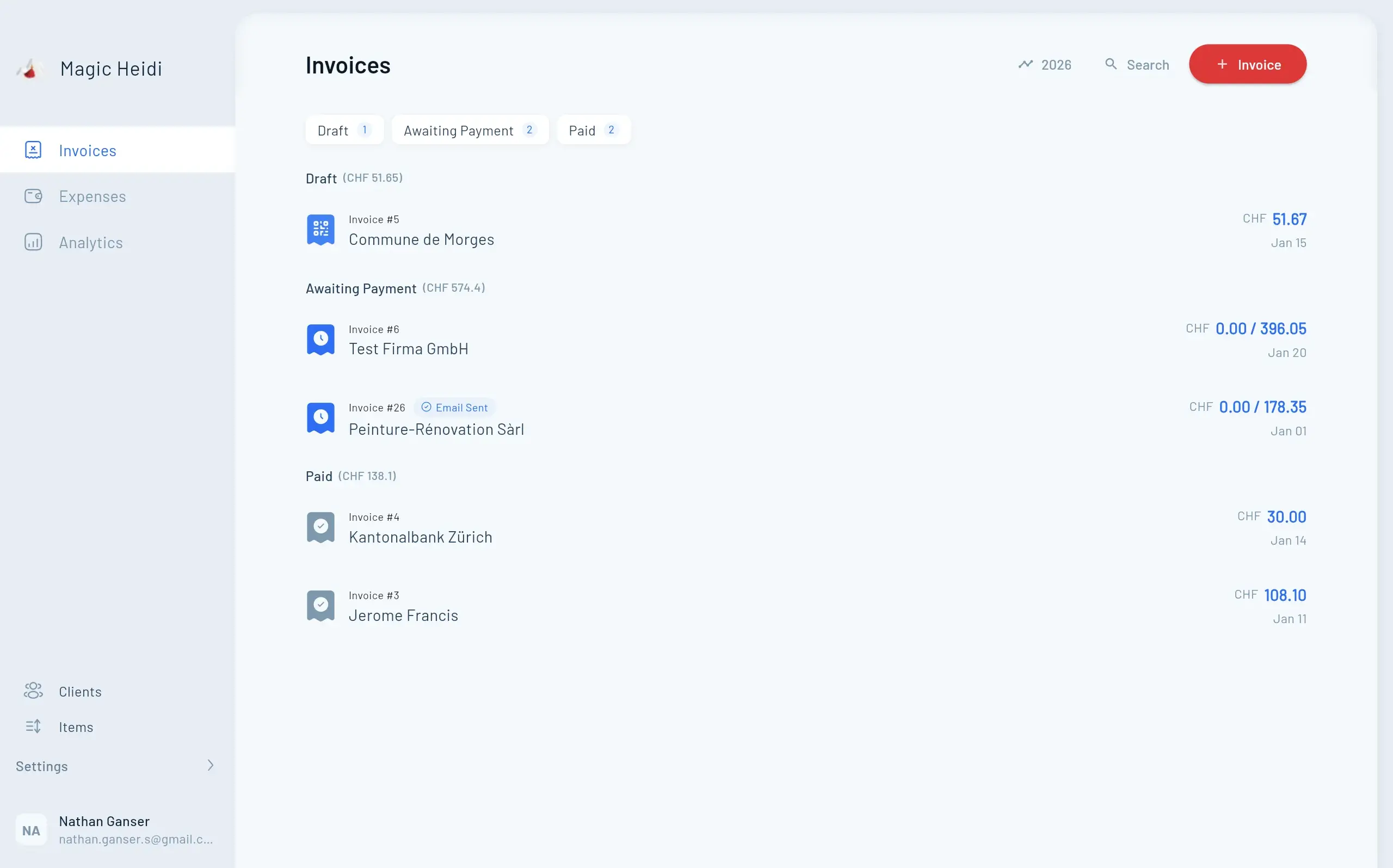
Magic Heidi handles Swiss specifics automatically — QR-bill even without an MWST number, optional MWST display when you register, switch between MWST-liable and non-liable with one click.
Swiss QR code is generated automatically — even if you don't have an MWST number and don't show MWST
Voluntarily registered? Enable the MWST field — and disable it again if you change your mind
Record expenses with MWST — as soon as you register, the input tax deduction is ready
Foreign B2B clients? One click adds the correct reverse charge reference under Art. 74 MWSTG
How Magic Heidi simplifies invoicing without MWST
The invoice without MWST in Switzerland is a standard situation for solo freelancers and small businesses. But most Swiss invoicing tools are designed for MWST-liable companies — with complex MWST chart of accounts, tax code logic, and return forms that you as a small business owner don't need.
bexio — massive overkill for solo freelancers
bexio costs from CHF 52/month and is designed for small businesses with inventory, payroll, MWST chart of accounts, and an online shop. Solo freelancers just starting out who aren't yet MWST-liable need little of that. The MWST features bexio offers are aimed at larger companies — not someone who issues three invoices a month.
Billify — generic invoicing tool
Billify is solid but built as a generic invoicing tool. It covers the basics, but Swiss specifics — QR-bill without MWST, reverse charge notation, switching between non-liable and voluntarily registered — aren't deeply integrated.
Magic Heidi — CHF 25–39/month, QR-bill even without MWST
Magic Heidi is the Swiss tool for solo freelancers and micro-businesses:
- CHF 25–39/month — half of bexio, without features you don't need.
- QR-bill native: Swiss QR code is automatically generated from your QR-IBAN and QR reference — even if you don't show MWST.
- Toggle MWST on and off: Not MWST-liable? Disable the MWST field. Registering voluntarily? Enable the MWST field with one click — 8.1% or 2.6% preset, MWST number stored.
- Reverse charge notation: Foreign B2B clients? One click adds the correct reverse charge reference under Art. 74 MWSTG.
- Input tax tracking: Record expenses with MWST — as soon as you register, the input tax deduction is ready.
- Mobile-first: Invoice in 30 seconds from your phone. You're standing in a co-working space, open the app, select the client, enter the amount, send by email. The QR payment section is included.
Mini-Story: Yves, a solo consultant in Lausanne, started his self-employment in 2025. He wasn't MWST-liable — revenue CHF 55,000. He created his first invoices with Word and assembled the QR-bill from an online generator. It was cumbersome: copy-paste the IBAN, generate the QR code, insert it into the Word document, hope the reference was correct. With Magic Heidi, he disabled the MWST field (no MWST shown), selected the client, entered the hours, and tapped "Send." QR code, QR-IBAN, and the note "not MWST-liable under Art. 10 MWSTG" were automatically included. Yves' cash flow improved: instead of 18 days of waiting, payments arrived in 8 days.
Pricing and details are on the pricing page. There's no minimum term, no setup joke, no add-ons that only kick in at CHF 100/month.
FAQ: Invoicing Without MWST in Switzerland
When can I issue invoices without MWST in Switzerland?
You can issue an invoice without MWST in Switzerland as long as your annual worldwide revenue from taxable services is below CHF 100,000 (Art. 10 para. 2 let. a MWSTG). Below this threshold, you're not MWST-liable and don't show MWST on your invoices. As soon as you reach or foreseeably will reach the threshold in the current year, you must register with the ESTV within 30 days and show MWST from then on.
Do I have to include a note on the invoice that I'm not MWST-liable?
There's no legally mandatory note, but it's strongly recommended so the client doesn't look for an MWST number and query the invoice. Typical phrasing: "VAT not shown: Business is not MWST-liable (revenue below CHF 100,000 pursuant to Art. 10 MWSTG)." For MWST-exempt services under Art. 21 MWSTG, the note is mandatory (e.g., "Exempt from MWST pursuant to Art. 21 para. 2 no. XX MWSTG").
What is reverse charge and when does it apply?
Reverse charge (shift of tax liability) applies when you, as a Swiss MWST-liable business, provide a service to a foreign B2B client. You issue the invoice without Swiss MWST, and the recipient self-assesses the tax in their country. The invoice must include a correct notation: "Reverse charge — tax liability transferred to the service recipient pursuant to Art. 74 MWSTG." Reverse charge does not apply to private clients (B2C) abroad.
Do I need a QR-bill even if I'm not MWST-liable?
Yes. The QR-bill has been mandatory for all invoices issued in Switzerland since October 1, 2022 — regardless of MWST liability. The old red and orange payment slips (ESR/BESE) were abolished. Every invoice, including an invoice without MWST in Switzerland, needs a QR payment section with a Swiss QR code, QR-IBAN (or IBAN with QR reference), and receipt section. This is a payment standardization, not a tax requirement.
Is voluntary MWST registration worth it below CHF 100,000?
Often yes, but it depends on your expenses. If you work in a material-intensive way (lots of hardware, software, materials, vehicles) and high input tax amounts accrue, voluntary registration can be economically advantageous despite the MWST you have to pay. A pure service provider with few expenses is better off without registration, since the MWST burden exceeds the input tax. The decision is binding for at least 12 months.
What happens if I exceed the CHF 100,000 threshold without registering?
As soon as you know (or reasonably should have known) that you'll exceed the threshold in the current year, you must register with the ESTV within 30 days. If you miss the deadline, the ESTV can demand MWST retroactively — plus interest and possible penalties. The ESTV often learns about unregistered suppliers through input tax audits at your clients. Retroactive claims can go back up to 5 years.
Conclusion
An invoice without MWST in Switzerland is permissible as long as your worldwide annual revenue is below CHF 100,000. That's the clear threshold in Art. 10 para. 2 MWSTG — below it, you're not MWST-liable, can't show MWST, and can't claim input tax. But the invoice isn't informal: QR-bill, seven mandatory elements under Art. 26 MWSTV, and a recommended reference to the MWST exemption remain required.
Voluntary registration below the threshold pays off for material-intensive businesses — where the input tax on software, hardware, vehicles, and materials exceeds the MWST burden. For pure service providers with few expenses, registration is usually a disadvantage. The decision is binding for at least 12 months, so calculate carefully.
Reverse charge is a third scenario that leads to an invoice without Swiss MWST — not to be confused with non-liability and exemption under Art. 21 MWSTG. Anyone with foreign B2B clients must include the correct notation under Art. 74 MWSTG on the invoice.
Those who want to outsource invoicing without investing in an SME tool like bexio will find Magic Heidi the lean, mobile-first alternative for CHF 25–39/month — with QR-bill native (even without MWST), optional MWST field, reverse charge notation, and input tax tracking for the moment you do register.
Start invoicing with Magic Heidi →
Sources: ESTV for MWST regulations · MWSTG Art. 10, 11, 21, 74, 77 · QR-bill Swiss Implementation Guidelines for QR payment section requirements.
Create your first invoice in 30 seconds
No credit card required. QR-bill, optional MWST, and reverse charge notation included — from your phone, even if you're not MWST-liable.